
Guiyang City
Guiyang CityGuiyang City, abbreviated as "Zhu," also known as "Forest City" or "Zhucheng," is a prefecture-level city, provincial capital, and Type I large city under Guizhou Province, located in central Guizhou. It borders Zunyi and Bijie
Guiyang City
Guiyang City, abbreviated as "Zhu," also known as "Forest City" or "Zhucheng," is a prefecture-level city, provincial capital, and Type I large city under Guizhou Province, located in central Guizhou. It borders Zunyi and Bijie to the north and west, Qiannan to the east and south, and Anshun to the southwest. Total area: 8,043 square kilometers. As of January 2024: 6 districts, 3 counties, 1 county-level city. As of end 2025: 6,668,900 permanent residents. Subtropical humid climate, average elevation 1,100 m, four distinct seasons with moderate temperatures and abundant precipitation. Human activity dates back 30,000 years. The area belonged to ancient Yelang during the Spring and Autumn to early Han period. Guiyang was designated a prefecture in 1569 and became a city in 1941. It is the first National Forest City and "China's Summer Resort Capital." In 2025, the gross regional product was 603.815 billion yuan, up 5.1%.
Name Evolution
During the Yuan (1271–1368) and Ming (1368–1644) dynasties, Guiyang was called "Guizhou." In 1465, "Guiyang" first appeared in records, officially adopted in 1569 when Chengfan Prefecture moved into the city. The name derives from being on the sunny (yang) side of Gui Mountain.
History
Pre-Qin Period
During the Spring and Autumn period, the area belonged to the Zangke Kingdom. During the Warring States period to 25 BC, it was under the Yelang Kingdom.
Qin-Han to Northern and Southern Dynasties
After Qin's unification, it was under Qin's commanderies. In 111 BC, Emperor Wu established Zangke Commandery. The area roughly belonged to Qielan County. During the Wei-Jin and Southern-Northern Dynasties, local powerful families (Long, Fu, Dong, Yin, Xie) controlled the area.
Sui-Tang to Song-Yuan Period
During the Tang (618–907) and Song (960–1279), the area was under various tributary states. In 974, Pugui paid tribute to Song Taizu, who responded "your Guizhou is far..." establishing the name "Guizhou." During the Yuan (1271–1368), it was renamed "Shunyuan" (Submitting to Yuan).
Ming-Qing Period
In 1413, the Ming Dynasty established the Guizhou Provincial Administration Commission, formally creating Guizhou Province. In 1569, Guiyang Prefecture was established. In 1586, Xingui County was established under Guiyang Prefecture. During the Qing (1644–1912), Guizhu County was established in 1687. By the late Qing, Guiyang Prefecture governed 4 counties and 3 departments.
Republic of China Period
In 1914, Guiyang Prefecture was abolished and Guiyang County was established. In 1941, Guiyang County was abolished and Guiyang City was established, with Guizhu County moved to Huaxi.
After the Founding of the People's Republic of China
On November 23, 1949, the Guiyang City People's Government was established. In 1957, Guizhu County was abolished and incorporated into Guiyang. In 1996, Xiuwen, Xifeng, and Kaiyang counties were transferred to Guiyang, and Qingzhen became a county-level city under Guiyang's administration. In 2000, Xiaohe District was established. In 2012, Xiaohe was merged back into Huaxi District, and Guanshanhu District was established from parts of Wudang and Qingzhen.
Natural Geography
Location
Central Guizhou, central Miaoling Range, between 106°07'–107°17' east longitude and 26°11'–26°55' north latitude. Total area: 8,043 square kilometers.
Climate
Subtropical humid climate with four distinct seasons. Annual average: 15.3°C. Extreme maximum: 39.5°C; extreme minimum: -1°C. July average: 24°C; January average: 4.9°C. Annual precipitation: ~1,190 mm (44.8% in summer, 27.6% spring, 21.9% autumn, 5.7% winter). Flood season (May–September): 836.2 mm (69.9%). Annual sunshine: 1,354 hours. Average wind speed: ~2 m/s.
Geology
Exposed strata include Sinian through Quaternary systems, with Permian and Triassic most widespread. Structurally at the transition between the Qianzhong Uplift and Qiannan Depression, belonging to the Sichuan-Guizhou meridional structural belt. Complex fold and fault systems with NE, NW, and NS structural trends.
Topography
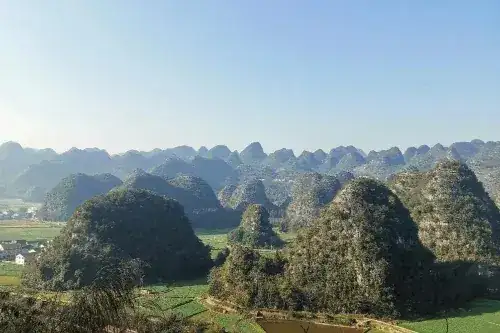
Central Guizhou hilly basin area on the second step of China's topography (Yunnan-Guizhou Plateau). Average elevation: 1,100 m. Highest: 1,659 m (Shuitian-Miaowo). Lowest: 880 m (Nanming River outlet). Relative elevation difference: 100–200 m. Mountains: 52% of area; hills: 35%; basins: 11.3%. Karst covers 85.03% of the area (above provincial 61.92% and all Chinese provincial capitals). Located on the Yangtze-Pearl River divide, with Miaoling as the watershed.
Hydrology
All rivers are rain-fed mountain streams. Western rivers flow west into Maotiao River (Wujiang/Yangtze system, 82% of area); southern rivers flow south into Hongshui River (Pearl River system, 18%). Nanming River: 150+ km, the city's largest river. Mengjiang: 219 km total. Maotiao River: 190+ km. Major reservoirs: Hongfeng Lake, Baihua Lake, Aha Lake, Huaxi Reservoir, Guanshan Lake.
Soil
8 soil types: yellow soil (largest), yellow-brown soil, limestone soil, purple soil, alluvial soil, swamp soil, skeletal soil, and paddy soil. Yellow soil: widespread, acidic (pH 4.5–5.5), suitable for Chinese fir, oil tea, and tea. Limestone soil: second largest, neutral to alkaline (pH 6.5–8.5).
Natural Disasters
Main hazards: drought, floods, hail, freezing, snow, earthquake, landslides, debris flows, forest fires, and biological disasters. 2008 January: historic freezing disaster (35,000 stranded, extensive agricultural damage). 2010: centennial drought (900,000+ affected, 499,400 with drinking water difficulties). 2023 June 18: 150+ mm daily rainfall, urban flooding.
Natural Resources
Water Resources
Mainly surface water. Total reservoir capacity: 248.71 million m³. Total water supply: 1.046 billion m³. Per capita water resources: 1,371 m³ (only 11% of world average, below the 1,760 m³/year international water scarcity warning line). Moderately water-scarce city.
Land Resources
Total: 8,043.45 km². Cultivated: 1,867.20 km². Built-up: 553 km². Per capita cultivated: 0.059 hectares (65.56% of China's average, 18.44% of world average). Cultivated land is only 33.46% of total area.
Mineral Resources
52 proven mineral types: coal, iron, silicon, barite, marble, refractory clay, bauxite, phosphorus, sulfur, mercury. Bauxite: 4.3 billion tons (1/5 of China's reserves), concentrated in Xiuwen and Qingzhen, with the Maotang super-large deposit at 1.5 billion tons. Phosphorus: 4.64 billion tons (one of China's three major phosphorus bases, 70%+ of national high-quality reserves). Coal: 900 million tons. Iron: 23.96 million tons. Pyrite: 28.78 million tons. Mercury: 2,683 tons.
Biological Diversity
Plants
2,908 vascular plant species (237 families, 979 genera): 260 ferns (44 families, 87 genera), 63 gymnosperms (8 families, 28 genera), 2,585 angiosperms (185 families, 864 genera). 6 national Class I protected species (Yunnan-Guizhou quillwort, yew, southern yew, Bretschneidera, dove tree, glabrous dove tree). 11 Class II species. 18 Guiyang-endemic species. 2,201 ancient and notable trees.
Vegetation
3 vegetation type groups, 23 formations: coniferous forest (3), broadleaf forest (12), shrubland (8). 3 categories by soil: acidic soil vegetation, calcareous soil vegetation, aquatic and swamp vegetation. 4 Guiyang-endemic forest types. Forest coverage: 55% (up from 45.5% in 2015). Forest area: 834,000 mu. Standing timber: 29 million m³. 27 nature reserves (11 forest parks, 9 scenic areas, 4 national wetland parks, 1 nature reserve, 2 geoparks) covering 1,251 km² (15.5% of total).
Animals
478 vertebrate species (35 orders, 108 families): 105 mammals (8 orders, 22 families), 259 birds (18 orders, 58 families), 30 reptiles, 16 amphibians, 68 fish. 6 Chinese-endemic mammals, 5 Chinese-endemic birds. 1 Guiyang-endemic fish. 8 Guiyang-endemic land snails. 260+ Guiyang-endemic insects. 2 national Class I protected (forest musk deer, black stork), 39 Class II protected.
Administrative Divisions
As of January 2026: 6 districts (Yunyan, Nanming, Huaxi, Wudang, Baiyun, Guanshanhu), 3 counties (Xiuwen, Xifeng, Kaiyang), and 1 county-level city (Qingzhen), plus 4 national-level development zones. The City People's Government is at No. 7 Lincheng East Road, Guanshanhu District.
Politics
Population
Population Size
According to the Seventh Census (November 1, 2020): 5,987,018 (urban 4,794,071, 80.07%; rural 1,192,947, 19.93%). Males: 3,061,169 (51.13%); females: 2,925,849 (48.87%). As of end 2025: 6,668,900 (up 66,400). Urban: 5,428,400 (81.4%). Birth rate: 6.85 per mille; death rate: 6.96 per mille; natural growth rate: -0.12 per mille.
Ethnic Groups
55 ethnic groups. Minorities: 1,283,300 (21.43%). 11 resident minorities: Miao, Buyei, Tujia, Yi, Dong, Gelao, Bai, Hui, Manchu, Zhuang, Shui. Concentrated in 18 ethnic townships and 279 ethnic villages.
Language
Guiyang dialect: Northern Chinese, Southwestern Mandarin, Sichuan-Guizhou sub-dialect. Very close to dialects in Chongqing and Chengdu. Pure old Guiyang dialect speakers are now a minority; most young people speak the new Guiyang dialect.
Religious Beliefs
Five traditional religions all present: Buddhism, Taoism, Islam (introduced in Yuan Dynasty), Catholicism, and Christianity (late Qing/early Republic). 18 religious organizations (6 municipal, 12 county-level). 83 registered religious venues (51 Buddhist, 7 Taoist, 7 Catholic, 16 Christian, 2 Islamic). Hongfu Temple, Qianming Temple, North Catholic Church, Xianren Cave Taoist Temple, and Qingzhen Mosque are notable sites.
Economy
Overview
Key industries: electronic information manufacturing, advanced equipment, new energy vehicles, phosphorus chemical, aluminum processing, health pharmaceuticals, eco-food, and software services ("1+7+1"). Agriculture focuses on vegetables, fruits, tea, medicine, and dairy, with 10 specialty industry blocks. In 2025, the gross regional product was 603.815 billion yuan, up 5.1%. By industry: primary 21.928 billion (3.6%), secondary 178.314 billion (29.5%), tertiary 403.572 billion (66.8%). Per capita GDP: 90,995 yuan. Fixed-asset investment down 1.9% (infrastructure up 6.7%, high-tech up 4.9%, private up 6.6%). Total fiscal revenue: 102.769 billion, up 4.7%. General public budget revenue: 49.076 billion, up 4.0%.
Primary Industry
29 provincial agricultural parks. 8 specialty industries: vegetables, fruits, tea, medicine, livestock, poultry, eggs, dairy. Vegetable area: 1.7 million mu. Grain area: 1.3502 million mu. Grain output: 447,600 tons, up 2.4%. Meat: 180,500 tons, up 5.8%. Eggs: 27,600 tons, up 12.7%. Milk: 25,800 tons, up 28.4%. Aquaculture: 4,917 tons, up 14.1%.
Secondary Industry
Industrial added value: 129.624 billion yuan, up 8.6%. Above-scale industrial added value up 8.8% (mining up 6.4%; manufacturing up 10.0%; electricity/heat/gas/water up 3.2%). Top 5 industries by share: tobacco (27.8%, up 2.7%), electricity (9.7%, up 4.4%), non-metallic mining (9.0%, up 5.6%), chemicals (8.9%, up 25.4%), electronics (7.4%, up 48.8%). "5+10" industrial parks: 82.2% of above-scale value, up 9.6%. Construction added value: 49.296 billion, down 2.7%.
Economic Functional Zones
Guiyang Economic and Technological Development Zone: Established 1993, national-level since 2000. 99.8 km². Multiple national honors. 2022: above-scale industrial output 60.5 billion yuan. Nanming Smart Manufacturing Industrial Park: 761 mu, 5 phases. Phases 1-3 operational (451 mu, 467,000 m², 47 factory buildings).
Social Affairs
Science and Technology
Ranked 29th among 288 cities for innovation capacity. 1,028 high-tech enterprises (55.4% of provincial total). 1,064 technology-based SMEs (45% of provincial). 63 new provincial innovation platforms including 2 provincial labs, 9 key labs, 10 technology innovation centers. Technology contract turnover: 23.212 billion yuan (up 19%), 3.84% of GDP.
Education
2,064 schools (836 private). 1,215 kindergartens, 482 primary, 210 junior high, 86 high schools, 56 vocational, 10 special education, 38 universities. University enrollment: 153,100 new, 489,000 total. Primary: 537,600. Junior high: 242,600.
Culture
4 art troupes, 12 cultural centers, 148 cultural stations, 13 public libraries (4.2607 million volumes). Radio and TV coverage: 100%.
Healthcare
4,348 health institutions: 217 hospitals, 4,074 grassroots, 32 professional public health, 25 other. 48,615 beds (29,173 public hospitals, 14,027 private). 77,333 health workers (30,180 physicians, 35,707 nurses). Doctor-nurse ratio: 1:1.18.
News Media
Guiyang Network (founded 1999), Guiyang Daily, Guiyang Media Governance Platform. Integrated media center with "News + Government + Service" model. Governance platform: 130+ first-level departments, 600+ second-level, 47,868 issues received, 46,267 resolved in 4 years, 600+ million views.
Sports
Hosted: China Boxing Open, WSB World Boxing Finals, China-South Korea Football, Bailing Cup World Go Open, Chinese Super League, Guiyang International Marathon, ITF Women's Tennis. Guizhou Hengfeng Football Club. 21,354 sports venues (22.6243 million m²). 17 ecological sports parks. 44 medals (26 gold, 13 silver, 5 bronze) in 2025.
Environmental Protection
Air quality comprehensive index: 2.45. Excellent days: 99.5%. SO2: 7 micrograms/m³, NO2: 15, PM10: 34, PM2.5: 20, O3: 114, CO: 0.7 mg/m³.
Social Security
Employee pension: 2,884,900, up 1.0% (504,900 retired). Urban-rural pension: 873,700, up 2.2%. Medical insurance: 4,622,500, up 1.1%. Work injury: 1,645,700, down 6.8%. Maternity: 1,286,200, up 1.6%. Unemployment: 1,051,300, down 1.5%. 91 elderly care institutions (10,811 beds, 5,945 residents). 434 community elderly facilities (2,562 beds). 1 child welfare institution (450 beds, 233 children). 826,100 minimum living person-times. 15,871 disability living allowance. 9,739 special hardship recipients. 121,200 elderly allowance recipients.
Transportation
Overview
Southwest China's key hub connecting Pearl River Delta and Yangtze Delta. 4 conventional railways form a cross. Multiple HSR lines. Total urban roads: 5,852 km (71.33 million m²). Metro: 93 stations, 6 transfer stations, 146.47 km, 286.6473 million annual ridership (up 12.4%). 19,610 taxis with GPS. 3,257 standard buses, 5,399.6 km route network, 298.48 million annual passengers.
Highways
12 expressways built (600+ km total) + 3 under construction. National expressways: G6002 ring, G75 Lanzhou-Haikou, G69 Yinchuan-Baise, G60 Shanghai-Ruili, G76 Xiamen-Chengdu. 4 national highways (365 km), 15 provincial highways (1,355 km), 18,525 km rural roads.
Railways
4 conventional railways (Chuanqian, Xiangqian, Qiangui, Guikun) + 4 HSR (Shanghai-Kunming, Guiyang-Guangzhou, Chengdu-Guiyang, Guiyang-Nanning under construction) + 3 express railways + 6 conventional lines. Main stations: Guiyang North (special-class, Southwest China's largest comprehensive rail hub), Guiyang East (HSR origin station), Guiyang Station (special-class, 1959).
Aviation
Guiyang Longdongbao International Airport: 4E-level, Guizhou's aviation hub. 2023: 19.4706 million passengers, 91,300 tons cargo, 144,000 flights. 198 domestic + 6 international routes, 107 domestic + 7 international cities. 2025: 22.7317 million passengers (up 1.9%), 119,300 tons cargo (up 11.9%), 217 routes, 126 cities (19 international).
Water Transport
34 convenience docks, 5 general ports (Kaiyang, Xifeng, Qingzhen, Xiuwen, urban). 2019: 2.99 million passengers, 14,000 tons freight. Yangtze River (Wujiang) downstream route opened.
Public Transportation
Metro Line 1 (2018): connecting Guanshanhu, Yunyan, Nanming, Economic Zone, and Guiyang North/East stations. Line 2 (2021): Baiyun, Guanshanhu, Yunyan, Nanming, and Longdongbao Airport. Line 3 (2023): Huaxi, Nanming, Yunyan, Wudang. All urban districts covered. Line S1 (2024): 4 lines total, 149.13 km. 19,610 taxis. 3,257 standard buses, 238 routes, 831 km network.
Culture
Overview
700+ years of city history with 4 major migration waves. Yangming (Wang Yangming) culture, Red culture, and ethnic minority culture. Old city formed "9 gates, 4 pavilions, 13 passes" pattern. 2 national, 14 provincial, 31 municipal protected heritage sites within the inner ring.
Food
Guiyang is a city of food: specialty noodles and rice noodles for breakfast and lunch. Famous: Changwang noodles, silk dolls (sihuawa), tofu balls, rice cake porridge.
Customs
April 8th (Miao, multi-ethnic), Buyei Dixi opera (January 15), March 3rd (Buyei "ground silkworm festival"), June 6th (Buyei, at Huaxi riverside), Jiading Miao cave burial (120+ coffins in a natural cave, Guiyang municipal protected site), Gaopo Miao "Tiao Dong" festival, Duzhai Buyei funeral "cattle chopping" ceremony, Shilong Miao "grabbing drumstick" dance (every 13 years), "Four-Seal Miao" clothing, Xiuwen Miao clothing, Pianpo Buyei clothing. Traditional crafts: Miao embroidery and cross-stitch (Miao most colorful, Buyei elegant, Shui understated, Dong bright), maple dye (Han Dynasty origin, "Pangdian"), Wudang handmade paper (72 processes, identical to Cai Lun's papermaking), Gaopo Miao silver crafting (hundreds of years, complex processes).
Arts
Wenchang Pavilion (Qingyan, Qing Dynasty), Jiaxiu Tower (1598, national protected site, on a natural rock in the river), Xifeng Miao ancient songs, flower stick dance, Xiaoyao Miao flower drum dance, Huaxi Lusheng flower drum dance, flower lantern opera (Guiyang's main local opera, evolved from flower lantern dance), Huaxi Dixi opera (ancient Nuo-derived), Xifeng Yang opera (Qianlong era, "living fossil of drama").
Cultural Heritage Sites
Dade School former site (revolutionary heritage site), Xifeng Concentration Camp (national protected, national patriotic education base, KMT's highest-grade prison, "university" level in their classification system).
Regional Symbol
City flower: Crape myrtle (July–October, "hundred-day red") and Orchid (Guizhou is a major orchid producer with 600+ species, 40% of China's orchids). City tree: Camphor tree (widely planted for landscaping) and Bamboo (prolific in Guiyang's climate, deeply embedded in local culture).
Scenic Spots
Overview
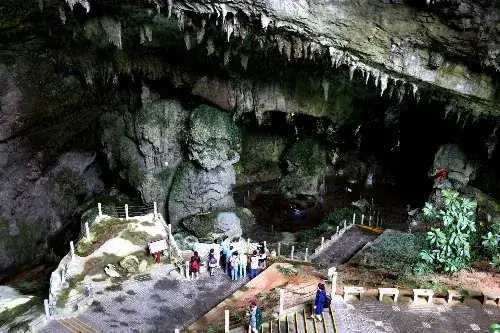
Rich karst landscapes: peak forests, gorges, caves. 1 5A (Qingyan Ancient Town), 24 4A, 17 3A, 1 2A scenic areas. 1 national key rural tourism town, 5 national key villages, 37 provincial key villages, 7 A-level, 29 B-level village scenic spots, 32 five-star and 116 four-star agritainment establishments.
Important Scenic Spots
Hongfeng Lake: 28 km west, 200 km², national 4A scenic area integrating plateau lake, karst landscape, and ethnic culture. Named for red maple leaves in autumn.
Aha Lake National Wetland Park: Guiyang's first national wetland park, 1,024.71 hectares. "Wetland at the doorstep" for urban wildlife.
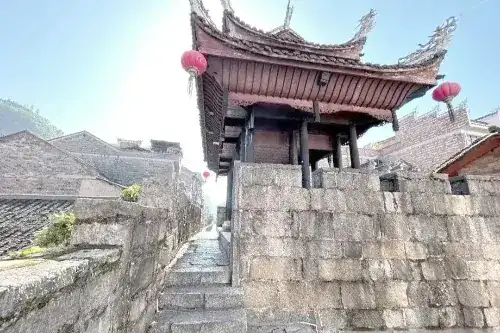
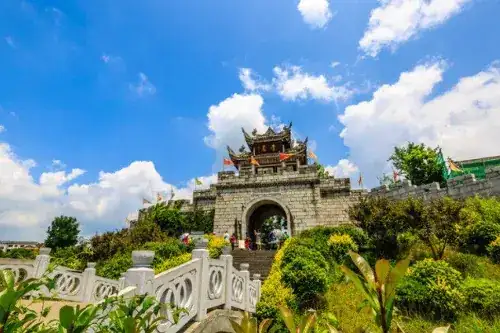
Qingyan Ancient Town: One of Guizhou's four major ancient towns, 29 km south. Ming-Qing military stronghold, 0.3 km² walled city with stone streets and houses. 9 temples, 8 shrines, 5 pavilions. 5 religions coexist. National 5A scenic area (2010).
Wenchang Pavilion: Built 1596, three-story nine-cornered design (unique in China), provincial protected site, restored 2003.
Jiaxiu Tower: Built 1598, national protected site (2006), 3A scenic area. Built on a natural rock in the Nanming River.
Qianlingshan Park: 332 hectares, 88% forest coverage, 10+ million annual visitors. National 4A. Guiyang's "back garden."
Famous People
External Exchange
Sister Cities
Cooperation Exchange
May 26, 2025: Guiyang Culture and Tourism Bureau signed tourism cooperation memoranda with Italian, Turkish, and German travel agencies.
Honorary Titles
First National Forest City. National Circular Economy Pilot City. "China's Summer Resort Capital" (China Meteorological Society). National Hygienic City. National Double Support Model City. National Smart City Pilot.
Travel information can change. Check current opening hours, reservations and entry requirements before you travel.
Traveller discussion
Start the conversation with a helpful tip or a question.