
Garzê Tibetan Autonomous Prefecture
Garzê Tibetan Autonomous PrefectureGarzê Tibetan Autonomous Prefecture, commonly known as the Khampa region or Kham, is an autonomous prefecture in western Sichuan Province, China. It borders Ya'an and the Aba Tibetan and Qiang Autonomous P
Garzê Tibetan Autonomous Prefecture
Garzê Tibetan Autonomous Prefecture, commonly known as the Khampa region or Kham, is an autonomous prefecture in western Sichuan Province, China. It borders Ya'an and the Aba Tibetan and Qiang Autonomous Prefecture to the east, Liangshan Yi Autonomous Prefecture and Yunnan's Diqing Tibetan Autonomous Prefecture to the south, the Jinsha River and Qamdo of the Tibet Autonomous Region to the west, and Qinghai's Yushu and Golog Tibetan Autonomous Prefectures to the north, covering 149,700 square kilometers. As of March 2026, it administers one county-level city and 17 counties. As of the end of 2025, the permanent resident population was 1.119 million. The prefecture sits on the southeastern edge of the Qinghai-Tibet Plateau, features a continental alpine monsoon climate, and lies at the headwaters of the Yangtze and Yellow Rivers, earning it the name "Water Tower of China." The local Han Chinese speak Southwestern Mandarin, while Tibetans primarily speak the Kham dialect. Garzê is the core area of Khampa culture, home to the legendary King Gesar, the "Kangding Love Song," and the Batang Xianzi dance. In 2025, the prefecture's GDP reached 61.311 billion yuan (approximately US$8.52 billion), up 5.5%.
Name Origin
The name "Garzê" derives from Tibetan, meaning "pure white and beautiful." In 1662, the Fifth Dalai Lama dispatched disciples to build 13 Gelugpa monasteries; the first—Garzê Monastery—was built on a foundation of white stone, giving the place its name.
Historical Evolution
Pre-Qin Period
As early as the Neolithic Age, early humans inhabited the Jinsha River, Yalong River, and Dadu River basins, using stone tools for hunting and gathering. During the Spring and Autumn and Warring States periods, northern Qiang tribes migrated and merged with local populations.
Qin-Han through Northern and Southern Dynasties
After Emperor Wu of Han pacified the Southwest, tribal interactions with interior China increased. In 111 BCE, Shenli Commandery was established. By 71 CE, the White Wolf kingdom and over a hundred tribes pledged allegiance.
Sui-Tang through Song-Yuan Periods
Tubo influence expanded east of the Jinsha River during the Sui Dynasty. During the Tang Dynasty, loose-rein prefectures were established. By the late Tang, the Tubo dynasty collapsed, and the region transitioned from slavery to feudal serfdom. The Song Dynasty saw continued Han-Tibetan exchange through the Tea-Horse Trade. In 1253, Mongol armies passed through, and local tribes submitted.
Ming-Qing Period
During the Ming and Qing dynasties, the region came under increasingly centralized administration, with the Qing court establishing the Chuanbian commissioner system to strengthen governance over the Khampa region.
Republic of China Period
During the Republic of China era, the region was administered under Xikang Province, seeing the early spread of modern education and infrastructure.
Post-PRC Founding
In 1950, the Xikang Province Tibetan Autonomous Region was established. In 1955, it was incorporated into Sichuan Province and renamed Garzê Tibetan Autonomous Prefecture.
Administrative Divisions
As of March 2026, the prefecture administers one county-level city (Kangding) and 17 counties, including Luding, Batang, Daocheng, Dege, and Baiyu.
Geography
Location
Located in western Sichuan on the southeastern edge of the Qinghai-Tibet Plateau, covering 149,700 square kilometers.
Geology
Complex geological structures shaped by tectonic activity from the Qinghai-Tibet Plateau's uplift, with active fault zones and diverse rock formations.
Topography
The terrain slopes from northwest to southeast, featuring alpine gorges, plateaus, and mountain ranges. Mount Gongga, at 7,556 meters, is Sichuan's highest peak.
Climate
Continental alpine monsoon climate with annual precipitation ranging from 330.6 mm (Derong County) to 902.6 mm (Jiulong County), and 1,900-2,600 annual sunshine hours.
Hydrology
Lies at the headwaters of the Yangtze and Yellow Rivers. Three major rivers—the Jinsha River, Yalong River, and Dadu River—flow north to south, totaling 1,739.3 km with a drainage area of 150,000 square kilometers. There are 144 lakes and 18 important wetlands.
Soil
Alpine soils of the Qinghai-Tibet Plateau, classified into 16 soil types and 29 subtypes, with alpine meadow soil covering 47.7% of the total area.
Natural Disasters
The prefecture is a high-risk area for mountain floods and geological hazards. In June 2023, a debris flow in Luding County caused direct economic losses of 10.14 million yuan (approximately US$1.41 million).
Natural Resources
Water Resources
Total water resources reached 139.783 billion cubic meters, with hydropower reserves exceeding 50 million kW and developable capacity of 41.3 million kW, ranking second in Sichuan. The Lianghekou Hydropower Station on the Yalong River, with a 295-meter dam, is China's highest million-kilowatt-class station.
Land Resources
Wetlands cover 6,076 square kilometers, forests 74,259 square kilometers, and grasslands 55,142 square kilometers.
Mineral Resources
Seventy-four mineral types have been discovered with 1,581 solid mineral sites. The prefecture is an important metallogenic area for lithium, beryllium, niobium, tantalum, platinum, silver, and gold.
Renewable Resources
Solar energy reserves exceed 100 million kW (67% of Sichuan's total), and wind energy reserves are approximately 10 million kW. The Batang Chaluo geothermal field is one of China's three major geothermal fields.
Biological Resources
One of 34 global biodiversity hotspots, home to 652 wild animal species including giant pandas, golden snub-nosed monkeys, and snow leopards (34 under Class I national protection), and 5,223 higher plant species (103 under national key protection). Forest coverage reaches 35.14% and grassland vegetation coverage 85.13%, both ranking first in Sichuan. Notable reserves include the Chaqingsongdo White-lipped Deer and Yading National Nature Reserves.
Population
Population Size
As of the end of 2025, the permanent resident population was 1.119 million, with an urbanization rate of 35.65% and natural growth rate of 6.6 per thousand.
Ethnic Composition
Home to 41 ethnic groups, with Tibetans comprising 78.97% of the total population.
Religious Beliefs
Three main religions: Tibetan Buddhism, Catholicism, and Islam. Tibetan Buddhism arrived in the 7th century with five major sects. As of 2023, 262 monasteries are designated as cultural heritage protection units, including Garzê Monastery and Baiyu's Katok Monastery.
Politics
Economy
Overview
In 2025, GDP reached 61.311 billion yuan (approximately US$8.52 billion), up 5.5%. The primary, secondary, and tertiary industries contributed 9.235 billion yuan (approximately US$1.28 billion), 18.561 billion yuan (approximately US$2.58 billion), and 33.515 billion yuan (approximately US$4.66 billion) respectively. Per capita GDP reached 54,987 yuan (approximately US$7,637). General public budget revenue was 7.186 billion yuan (approximately US$998 million), up 18.7%.
Primary Industry
Agriculture and animal husbandry dominate, producing highland barley, potatoes, and medicinal herbs. The prefecture is Sichuan's largest highland barley base (over 70% of provincial output) and a major matsutake producer (3,200 tons annually, 45.7% of China's total). Yak husbandry is the most distinctive livestock industry. In 2025, total agricultural output reached 14.961 billion yuan.
Secondary Industry
Clean energy leads, with hydropower generating 47.158 billion kWh annually (89.7% transmitted externally) as part of the "West-to-East Power Transmission" program. In 2025, total industrial value added reached 17.115 billion yuan (approximately US$2.38 billion), up 11.9%.
Tertiary Industry
Cultural tourism is the pillar, featuring events like the Danba Jiarong Festival and Daocheng Yading Snow Mountain Culture Week. In 2025, retail sales reached 15.313 billion yuan (approximately US$2.13 billion). Financial deposits totaled 100.23 billion yuan (approximately US$13.92 billion).
Economic Functional Zones
The Baiyu County Highland Seedling and Tibetan-Chinese Medicinal Herbs Modern Forestry Park, established in 2022, covers 3,300 mu with investments exceeding 10 million yuan.
Social Affairs
Science and Technology
In 2025, the prefecture secured 29 national and provincial science projects. High-tech enterprises reached 14 (up 40%), with 55 technology-based SMEs registered.
Education
664 schools with 229,437 students and 15,910 full-time teachers. Sichuan Minzu College, established in 1985, is the only public undergraduate institution in the Khampa region.
Culture
23 performing arts troupes, 19 public libraries, 19 cultural centers, and 10 museums. Broadcasting coverage reaches 98.86% and television 98.81%.
Healthcare
2,450 medical institutions with 4,487 beds. The Garzê People's Hospital, affiliated with West China Hospital, is the only Grade III Class A comprehensive hospital.
Sports
In 2025, the prefecture won 9 gold, 3 silver, and 17 bronze medals in provincial competitions.
Social Security
In 2025, basic pension insurance covered 115,500 urban workers and 529,800 rural residents. Medical insurance covered 859,400 residents. Minimum living assistance covered 153,500 people, with disbursements of 629 million yuan (approximately US$87.4 million).
Transportation
Overview
Three airports, two expressways, and numerous highway trunk lines. In 2025, passenger volume reached 8.66 million and freight 5.52 million tons.
Highways
Total highway mileage reached 33,565 km, including 95 km of expressways. The Yakang Expressway, opened in 2018, features an 82% bridge-tunnel ratio and reduces Chengdu-to-Kangding travel to about 3 hours.
Railways
No railway in operation yet, but the Sichuan-Tibet Railway is under construction with a 396-km Garzê section through six counties.
Aviation
Three airports—Kangding, Daocheng Yading, and Garzê Gesar—all above 4,000 meters elevation, making the prefecture the only one in China with three such high-altitude airports.
Public Transportation
As of October 2022, 25 county-level passenger stations, 302 township stations, and 2,736 village stops, with 1,755 commercial vehicles operating 299 routes.
Culture and History
Overview
Garzê is the core of Khampa culture, birthplace of King Gesar legends, the "Kangding Love Song," and a main route of the Tea Horse Road. It ranks first in Sichuan for both intangible cultural heritage projects (640) and key cultural heritage units (1,103).
Local Languages
Chinese (Southwestern Mandarin) and Tibetan (primarily the Kham dialect) are most widely spoken. The Dege dialect is regarded as the standard Kham dialect.
Festivals and Customs
Key festivals include the Buddha Unfolding Festival at Paoma Mountain, Tibetan New Year (Losar), and the Yangle Festival in Batang. Traditional customs include the Jiarong Tibetan coming-of-age ceremony and distinctive Khampa clothing.
Literature and Arts
Renowned as the "Ocean of Song and Dance." The "Kangding Love Song" is internationally famous. Batang Xianzi, Zhaba Mani Dance, and Tibetan opera are major cultural treasures, along with black pottery and yak wool weaving crafts.
Regional Symbols
The prefectural flower is the Gongga crabapple ("Osei" in Tibetan, meaning "radiance"), and the prefectural bird is the golden eagle.
Cultural Heritage Sites
As of 2025, there are 18 national-level, 83 provincial-level, and 1,224 prefectural/county-level key cultural heritage sites. Notable sites include Luding Bridge (1705-1706), Baili Monastery (1662), and Baiyu Katok Monastery (1159).
Intangible Cultural Heritage
Ranks first in Sichuan with 4 world-level, 25 national-level, 140 provincial-level, and 471 prefectural-level items. The Epic of King Gesar, inscribed in 2006, is a masterpiece of traditional folk literature.
Scenic Areas
Overview
Concentrates 50% of Sichuan's undeveloped world-class tourism resources, with 94 A-level scenic areas including 2 AAAAA-level and 25 AAAA-level sites.
Key Attractions
Hailuogou Glacier Forest Park (AAAAA): In Luding County, featuring snow peaks, glaciers, icefalls, forests, and hot springs.
Daocheng Yading Scenic Area (AAAAA): Known as the "Last Shangri-La," featuring three sacred mountains—Xianeri, Yangmaiyong, and Xianuoduoji.
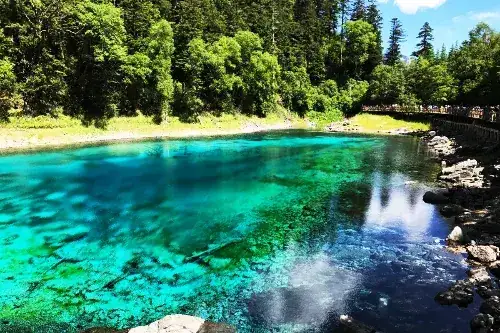
Kangding Love Song (Mugecuo) Scenic Area (AAAA): Part of the Mount Gongga National Scenic Area, featuring alpine lakes and hot springs.
Bamei Inkstone Park (AAAA): China's only alpine stone forest landscape.
Muya Holy Land Scenic Area: The prefecture's first tourism area combining folk customs with natural scenery.
King Gesar City: A cultural tourism landmark in Garzê County.
Local Cuisine
Food
Tibetan cuisine dominates, featuring highland barley (tsampa), butter tea, yak beef, and dairy products. Specialties include yogurt with dasyiphora fruit, matsutake stewed chicken, and "Unity Buns."
Special Products
Notable products include Jiulong yak, Yajiang matsutake, Derong tree peppers, Luding cherries, Danba fragrant pig legs, Xiangcheng Tibetan chicken, Daofu green onions, and Batang walnuts.
External Exchange
Notable Figures
Important Honors
Travel information can change. Check current opening hours, reservations and entry requirements before you travel.


Traveller discussion
Start the conversation with a helpful tip or a question.