
Bazhong City
Bazhong CityBazhong City, a prefecture-level city in Sichuan Province (also known as Bacheng), is located in the northeastern Sichuan Basin at the southern foot of Micang Mountain in the Daba Mountain range. It borders Dazhou to the east, N
Bazhong City
Bazhong City, a prefecture-level city in Sichuan Province (also known as Bacheng), is located in the northeastern Sichuan Basin at the southern foot of Micang Mountain in the Daba Mountain range. It borders Dazhou to the east, Nanchong to the south, Guangyuan to the west, and Hanzhong (Shaanxi Province) to the north, covering 12,300 square kilometers. As of April 2026, it administers 2 municipal districts and 3 counties. As of end-2025, the permanent population was 2.578 million. The local dialect belongs to the Chengdu-Chongqing cluster of Southwestern Mandarin. In 1913, Bazhou was renamed Bazhong County. In 1993, the State Council approved establishing Bazhong Prefecture, separating four counties from Daxian Prefecture. Bazhong has a subtropical monsoon humid climate with four distinct seasons, and its terrain slopes from north to south. Leading industries include energy and chemicals, advanced materials, food and beverages, electronic information, and pharmaceuticals, forming a "5+2+3" industrial system. In May 2025, Bazhong was awarded the National Civilized City title. In 2025, the city achieved a regional GDP of 91.664 billion yuan (approximately $12.64 billion), up 6.0% year-on-year.
Name Origin
According to the Annotated Bazhong County Gazetteer, Bazhong was originally named Bazhou, derived from the ancient Ba Kingdom. In 1913, it was renamed "Bazhong" because it lies between Badong and Baxi.
Historical Evolution
Qin and Han to Northern and Southern Dynasties
Bazhong's administrative establishment began during the Eastern Han Dynasty (91 AD) with Hanchang County. In 514 AD (Northern Wei), Bazhou was formally established, reaching its peak under Western Wei and Northern Zhou with 10 commanderies and 15 counties.
Sui and Tang to Song and Yuan
During the Sui Dynasty, Bazhou governed 9 counties, later renamed Qinghua Commandery (14 counties). Under the Tang Dynasty, it belonged to Shannan Circuit. In 1286, Sichuan Province was formally established, with Bazhou under Guangyuan Route.
Ming and Qing
In 1376 (Ming Dynasty), Bazhou became Ba County under Baoning Prefecture, later re-established as Bazhou. During the Ming-Qing transition, Zhang Xianzhong's Great Xi regime briefly controlled the area (1644). From early Qing to 1912, Bazhou remained under Baoning Prefecture.
Republic of China Era
In 1913, Bazhou was renamed Bazhong County. In 1935, it became part of Sichuan's 15th Administrative Inspection District (present-day Dazhou).
Post-1949
After 1949, Bazhong was placed under the Daxian Special District. In 1993, the State Council approved establishing Bazhong Prefecture. In 2000, Bazhong City (prefecture-level) was established, administering Bazhou District, Tongjiang, Nanjiang, and Pingchang counties. In 2013, Enyang District was established.
Administrative Divisions
As of April 2026, Bazhong administers 2 municipal districts and 3 counties: 17 subdistricts, 116 towns, and 6 townships (139 township-level units), plus 2 provincial-level economic development zones and 1 cultural-tourism integration demonstration zone.
Natural Geography
Location
Bazhong lies at the Sichuan-Shaanxi provincial boundary, between 106°20'-107°49'E and 31°15'-32°45'N. It is 331 km from Chengdu, 320 km from Chongqing, and 439 km from Xi'an.
Climate
Subtropical humid monsoon climate with four distinct seasons. Average annual temperature: 16.9-17.4°C. Winter averages 6.1-6.8°C, spring 17.0-17.7°C, summer 25.4-26.2°C, autumn 16.1-17.6°C.
Geology
The geological structure spans four secondary tectonic units: the Micang Mountain dome, Daba Mountain arc, North Sichuan platform depression, and East Sichuan Neocathaysian system. Folding is the dominant feature, with over 30 synclinal and anticlinal fold belts.
Topography
Typical basin-marginal mountainous terrain sloping from north (high) to south (low). The north features dissected middle mountains (1,500-2,000 m), the center has low mountains (800-1,000 m), and the south consists of hills (350-600 m) and flatlands (268-400 m). The highest point is Guangwu Mountain at 2,507 m; the lowest is Huangmeixi at 268.3 m. Mountains account for 90% of the area.
Hydrology
Over 1,100 rivers, with 7 major rivers exceeding 1,000-square-kilometer basins, including the Ba River, Nanjiang River, Enyang River, and Tongjiang River. Total river length: 4,342 km. As of 2024, 825 reservoirs had been built with 768 million cubic meters of storage capacity.
Soil
Six soil types, 10 subtypes, 22 genera, and 61 species. Paddy soil covers 13,180 hectares (56.32% of cultivated land), purple soil 78,968 hectares (33.74%), and yellow soil 14,914 hectares (6.37%).
Natural Resources
Water Resources
Average annual rainfall: 1,189 mm. Total water resources: 7.168 billion cubic meters. Per capita availability: 1,611 cubic meters. The Ba River basin is in the Daba Mountain storm zone with pronounced flood characteristics.
Land Resources
As of 2022: 258,700 hectares of cultivated land (165,800 ha paddy, 92,900 ha dry), 778,600 hectares of forest, 69,600 hectares of construction land, and 30,300 hectares of water areas.
Biological Resources
308 tree and shrub species, 421 grass and vine species, and 1,386 medicinal herb species. Northern wildlife surveys recorded 670 species, including 176 bird and 67 mammal species.
Mineral Resources
Over 50 mineral types discovered. Key reserves: graphite ore (4.72 million tons proven), magnetite (76.51 million tons), coal (37.93 million tons), and natural gas (80 billion cubic meters proven, 1,400 billion projected). Major resources include magnetite, crystalline graphite, nepheline-aluminum ore, and natural gas/shale gas.
Population
Population Size
End-2025 permanent population: 2.578 million (urbanization rate 50.43%). Registered population: 3.5131 million. Births: 16,900 (6.17‰); deaths: 22,400 (8.19‰); natural growth rate: -2.03‰.
Ethnic Groups
Predominantly Han Chinese. As of 2024, 44 ethnic groups with approximately 35,000 minorities—a typical scattered multi-ethnic area.
Language
The Bazhong dialect belongs to the Chengdu-Chongqing cluster of Southwestern Mandarin, with influences from historical migrations. Some areas with Qing Dynasty Hakka immigrants still speak Hakka.
Religion
Buddhism, Christianity, Catholicism, Taoism, and Islam are all present. By 2000: 56,807 believers (37,500 Buddhist, 18,200 Christian, 1,100 Catholic) and 21 religious venues.
Politics
The municipal government exercises administrative authority over Bazhong's districts and counties.
Economy
Overview
2025 GDP: 91.664 billion yuan (approximately $12.64 billion), up 6.0%. Primary industry: 19.836 billion yuan (up 3.7%); secondary: 17.522 billion yuan (up 5.4%); tertiary: 54.306 billion yuan (up 7.1%). Industrial structure: 21.6:19.1:59.3. Per capita GDP: 35,316 yuan (approximately $4,871), up 7.2%. Private economy: 55.448 billion yuan (approximately $7.65 billion), 60.5% of GDP. 2024 local public budget revenue: 6.541 billion yuan (approximately $902 million), up 16.7%.
Primary Industry
2025 grain output: 1.992 million tons (up 0.4%) from 5.149 million mu. Slaughtered hogs: 3.2991 million (up 1.6%); cattle: 184,100; sheep: 584,700. Aquaculture output: 85,700 tons (up 5.1%).
Secondary Industry
2025 industrial added value: 9.469 billion yuan (up 10.8%), with 441 above-scale enterprises. Above-scale industrial revenue: 18.38 billion yuan (up 11.0%), profit: 589 million yuan. Construction added value: 8.088 billion yuan (up 0.5%) with 274 qualified enterprises.
Tertiary Industry
2025 wholesale and retail added value: 6.358 billion yuan (up 7.8%); finance: 5.051 billion yuan (up 7.4%); real estate: 5.733 billion yuan (up 0.2%); information technology: 1.227 billion yuan (up 10.8%). Total retail sales: 54.303 billion yuan (approximately $7.49 billion, up 6.6%). Foreign direct investment: $10.05 million (up 43.6%). Financial deposits: 238.378 billion yuan (up 7.9%); loans: 163.966 billion yuan (up 9.7%). Insurance premiums: 6.239 billion yuan (up 4.0%).
Social Affairs
Education
655 schools, 405,200 students, 35,100 teachers. Includes 272 kindergartens, 175 primary schools (166,000 students), 152 junior high schools (97,400 students), 40 senior high schools (63,500 students), 9 vocational schools, and 1 higher vocational college. Junior high advancement rate: 96.5%; high school: 89.5%.
Science and Technology
2025 technology contracts: 1.66 billion yuan; 802 patent grants (43 inventions). 166 national high-tech enterprises, 519 technology-based SMEs, 1,238 R&D personnel.
Culture
6 public libraries (1.2732 million volumes), 191 cultural centers, 377 bookstores, 20 theaters, 18 museums, and 7 cultural heritage protection agencies.
Healthcare
2,907 medical institutions including 72 hospitals, 145 township health centers, and 6 disease control centers, with 19,824 beds and 22,316 health workers (6,468 licensed physicians). Total clinical visits: 21.468 million.
Sports
14,300 sports venues, 4 stadiums. 364 events hosted; 46 provincial medals won (11 gold, 13 silver, 22 bronze).
Social Security
33,536 new urban jobs created; 1.0749 million rural workers transferred (32.325 billion yuan labor income). Per capita disposable income: 30,523 yuan (approximately $4,211, up 5.6%); urban: 44,037 yuan; rural: 19,527 yuan. Pension and medical insurance participants totaled over 4.9 million combined.
Environmental Protection
2025 afforestation: 2,608 hectares. Forest area: 777,300 hectares (63.2% coverage). 7 nature reserves (137,100 hectares) and 5 forest parks. Air quality good or above on 344 days (95.6%).
Transportation
Overview
27,570 km of highways (473 km expressways), 175 km of railways, and 1 airport. Highway freight: 38.14 million tons; railway passengers: 4.53 million; aviation passengers: 563,800. 672,300 motor vehicles.
Highways
National highways G244, G245, G542, G347, and G85 pass through, with all districts and counties connected by expressways. The first expressway (Guangyuan-Bazhong) opened in May 2010.
Railways
Guangyuan-Bazhong Railway (freight 2011, passenger 2012), Bazhong-Dazhou Railway (2016), and Bazhong-Nanchong High-Speed Railway (June 2024). CR200J Fuxing EMU service began October 2019.
Aviation
Bazhong Enyang Airport (4C-level) opened February 3, 2019, with a 13,000-square-meter terminal, 2,600-meter runway, and 14 domestic routes.
Public Transit
Urban bus service launched April 2006 with 4 routes. As of 2025: 1,418 taxis, 431 buses, and 73 tourism vehicles.
Culture and History
Overview
Bazhong's cultural heritage includes the Nankan Grottoes cliff carvings, the Micang Ancient Trail, and intangible cultural assets. As the second-largest Soviet area in Chinese history, it has numerous revolutionary sites, earning the title "Open-Air Museum of the Chinese Revolution." As of 2025: 7 national-level and 96 provincial-level key cultural heritage sites; 2 national-level and 24 provincial-level intangible cultural heritage items.
Festivals and Customs
The 16th-day Lunar New Year mountain climbing festival is a traditional folk activity listed in Sichuan's intangible cultural heritage. The Ba People's Culture and Art Festival has been held since 2002, and the Guangwu Mountain Red Leaf Festival annually since October 2002.
Literature and Arts
Bazhong is the center of the Sichuan-Shaanxi Revolutionary Base Area, where revolutionary leaders Xu Xiangqian and Li Xiannian once fought. Traditional arts encompass painting, sculpture, embroidery, music, dance, drama (Sichuan Opera, Bazhong shadow puppetry), and acrobatics. Folk crafts include carving, papercutting, weaving, sugar painting, and clay sculpture.
City Symbol
The city logo features red (revolutionary heritage) and green (ecological identity), incorporating the Chinese character "Ba" in cursive calligraphy to form "Bazhong," symbolizing the people's loyalty and dedication.
Cultural Relics and Intangible Heritage
As of 2024: 18 museums, 7 cultural heritage agencies, 7 national-level and 96 provincial-level key cultural heritage sites. Intangible cultural heritage includes 16 major categories and 169 sub-items, with 2 national-level listings (Ba Mountain Porter Songs and Fanshan Jiaozi).
Scenic Attractions
Overview
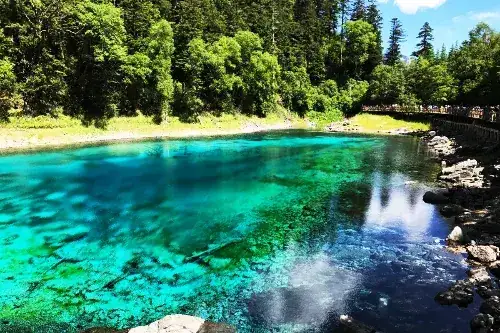
Home to the Guangwu Mountain-Nuoshui River World Geopark, Guangwu Mountain 5A attraction, four national forest parks, and Enyang Ancient Town and Baiyi Ancient Town as 4A attractions. As of 2025: 1 5A, 21 4A, and 8 3A scenic areas, plus 4 provincial-level tourist resorts.
Key Attractions
Guangwu Mountain (5A): At the heart of the Micang Mountain range on China's north-south climate boundary, featuring spectacular karst landscapes. Designated a national scenic area (2004), World Geopark (2018), and 5A attraction (2020).
Micang Mountain (4A): In northern Nanjiang County with 97.3% forest coverage, famous for autumn red leaves—"Asia's longest red carpet" and "Home of Chinese Red Leaves."
Enyang Ancient Town: Dating to 525 AD (over 1,490 years), a former waterway dock known as "Little Shanghai," with 17 ancient streets and 589 traditional buildings. Listed among China's Famous Historical and Cultural Towns.
Maoyu Ancient Town: A red revolutionary town where the Red Fourth Front Army held its historic 1934 conference, establishing the Red Army spirit motto: "Be wise and firm, overcome difficulties with innovation, unite and strive, never rest until victory."
Nuoshui Cave World (4A): In northern Tongjiang County, featuring 128 underground karst caves with spectacular formations at constant 18°C year-round.
Kongshan National Forest Park: Covering 11,511 hectares at up to 2,117 m elevation, featuring primeval forests and karst landscapes.
Local Specialties
Special Products
Known for Tongjiang silver ear (medicinal fungus), Nanjiang yellow goat, and various local agricultural specialties.
Cuisine
Local delicacies include Zaolin Fish, Nanjiang Yellow Goat nourishing soup, Jiangkou Qingyong bean-curd fish, Enyang caramel sesame cakes, Tongjiang silver ear lotus seed soup, and Bazhong jade jelly noodles, recognized as Tianfu Tourism Foods.
External Relations
Bazhong maintains economic and cultural exchanges with cities across China, leveraging its position at the Sichuan-Shaanxi border.
Notable Figures
Bazhong has produced many notable historical and contemporary figures, particularly in revolutionary history.
Major Honors
Awarded the National Civilized City title (May 2025) and National Social Governance Innovation Demonstration City. Also designated as a national old revolutionary base area development zone.
Travel information can change. Check current opening hours, reservations and entry requirements before you travel.

Traveller discussion
Start the conversation with a helpful tip or a question.