
Leshan City
Leshan CityLeshan City, formerly known as Jiazhou and Jiading Prefecture, is a prefecture-level city in Sichuan Province, located in central Sichuan in the southwestern part of the Sichuan Basin. It borders Meishan City to the north, Zigong
Leshan City
Leshan City, formerly known as Jiazhou and Jiading Prefecture, is a prefecture-level city in Sichuan Province, located in central Sichuan in the southwestern part of the Sichuan Basin. It borders Meishan City to the north, Zigong and Yibin cities to the east, Liangshan Prefecture to the south, and Ya'an City to the west. The terrain is higher in the southwest and lower in the northeast, with a northern subtropical climate. The total area is 12,720.03 square kilometers. As of February 2026, Leshan administers 4 districts, 6 counties, and 1 county-level city. As of the end of 2025, the permanent resident population was 3.412 million. In 1734 (the 12th year of the Yongzheng reign of the Qing Dynasty), Leshan County was established at the seat of Jiading Prefecture. Leshan is an important industrial city in Sichuan, a regional center city in the southern part of the Chengdu Economic Zone, an important hub city, and a key transportation node and port city in the Chengdu-Chongqing Urban Agglomeration. The Chengdu-Kunming Railway, Chengdu-Mianyang-Leshan Intercity Railway, and Chengdu-Guiyang High-Speed Railway run through the city. At Leshan, three rivers converge — the Dadu River and Qingyi River flow into the Min River at the foot of the Leshan Giant Buddha. Leshan is a National Historic and Cultural City, renowned as the "Land of Fragrant Crabapple," and is one of the first batch of cities opened to the outside world, a National Greening Model City, a China Excellent Tourism City, a National Garden City, a National Health City, and the only city in China cooperating with the UN Urban Management Center. Leshan has three world-class heritage sites — the Mount Emei and Leshan Giant Buddha (World Natural and Cultural Heritage) and the Dongfeng Weir (World Irrigation Engineering Heritage). It has also been designated a National Intellectual Property Pilot City, selected for the National Double Support Model City list, and included in the planning scope of the Ba-Shu Cultural Tourism Corridor. In 2025, Leshan's regional GDP reached 250.154 billion yuan (approximately $34.7 billion), a year-on-year increase of 3.1% at constant prices.
History
Leshan was once the capital of the Kaiming tribe of the ancient Shu Kingdom. In 309 BC, King Wu of Qin sent troops southward, establishing Nan'an County in what is now the central urban district of Leshan, at the confluence of the Qingyi River and Min River, under the administration of Shu Commandery. In 256 BC, Li Bing organized the people of Leshan to carve through Wuyou Lidui and open the Mahao River, enabling the development of water transportation along the Min and Dadu rivers.
During the Western Han Dynasty, Nan'an native Deng Tong minted coins, leading to the saying "Deng's coins spread across the world." Emperor Wu of Han conquered the Southwest Yi peoples and established Qianwei Commandery. During the Three Kingdoms period, Zhuge Liang, chancellor of Shu, manufactured iron weapons and tools at the Tieshan (Iron Mountain) in Qianwei, bringing Leshan's metallurgy to an advanced level.
In 561 AD (Northern Zhou Dynasty), Pingqiang County and Pingqiang Commandery were established on the site of the former Nan'an County. In 579 AD, the commandery was converted into Jiazhou, named after the Han-era Hanjia County, meaning "the land is beautiful." During the Sui Dynasty, Emei County was established at the foot of Mount Emei in 589 AD, and Qingyi was renamed Longyou County in 593 AD, after the legend of a dragon guiding the Sui army on the Min River. By this time, Leshan had become an important shipbuilding base.
During the Tang Dynasty (618 AD), the area was renamed Jiazhou under the Jiannan Circuit. Tea cultivation was highly developed, and the world-famous Leshan Giant Buddha was carved during the mid-Tang period. In 1196 (Song Dynasty), Jiazhou was elevated to Jiading Prefecture. During the Yuan Dynasty (1276), it became Jiading Prefecture Route. In the Ming Dynasty (1376), it was downgraded to Jiading Zhou. In 1734, the Qing Dynasty re-elevated it to Jiading Prefecture and established Leshan County at its seat, named after "Zhile Mountain" five li to the southwest — the name "Leshan" has been used ever since.
After the founding of the People's Republic of China, Leshan Special District was established. Through numerous administrative reorganizations, the current prefecture-level Leshan City was formed in 1985. In 1997, six counties including Meishan were separated to form Meishan Prefecture.
Administrative Divisions
As of February 2026, Leshan City administers 4 districts (Shizhong, Wutongqiao, Shawan, and Jinkouhe), 6 counties (Qianwei, Jingyan, Jiajiang, Muchuan, Ebian Yi Autonomous County, and Mabian Yi Autonomous County), and 1 county-level city (Emeishan City). There are 132 townships and towns, 264 community committees, and 1,107 village committees. The municipal government is located at 98 Binhe Road, Haitang Subdistrict, Shizhong District.
Geography
Location and Extent
Leshan is located in central Sichuan Province, in the southwestern part of the Sichuan Basin, between 102°50′–104°30′E longitude and 28°25′–30°20′N latitude. It extends 214.4 km north-south and 164.0 km east-west, with a total area of 12,720.03 square kilometers, accounting for 2.64% of Sichuan's total area.
Topography
Leshan sits at the transition zone from the Sichuan Basin to the southwestern mountains, with higher terrain in the southwest and lower in the northeast. The highest point is the main peak of Ma'an Mountain in Ebian Yi Autonomous County at 4,288 meters, while the lowest is the Min River outlet at Machangba in Qianwei County at 307 meters, a relative elevation difference of 3,981 meters. Mountainous areas cover 8,530 square kilometers (66.5%), hills 2,694 square kilometers (21%), and river valley plains 1,603 square kilometers (12.5%).
Climate
Leshan has a northern subtropical climate with distinct seasons, abundant rainfall, and a long frost-free period exceeding 300 days. Average annual temperatures range from 16.5°C to 18.0°C. Average annual precipitation exceeds 1,000 mm in most areas, reaching over 1,500 mm in Emeishan City. Summer and autumn rainfall accounts for about 80% of the annual total.
Natural Resources
Water Resources
Leshan has numerous rivers, including the Min River, Dadu River, and Qingyi River, with total water resources of 85.5 billion cubic meters. The theoretical hydropower potential is approximately 8 million kilowatts, with an economically developable capacity of about 7.5 million kilowatts. Total installed power generation capacity reaches 6.957 million kilowatts, including 5.272 million kilowatts of hydropower.
Plant Resources
Leshan has over 3,000 plant species, with Mount Emei being the most representative area, hosting 141 families, 585 genera, and 1,452 species of seed plants. The city has 39 rare and endangered protected plant species, accounting for 52.7% of Sichuan's total.
Animal Resources
Leshan's wildlife includes 599 species of vertebrates across 37 orders and 112 families. Nine species are under national first-class protection, including the giant panda, takin, snow leopard, and clouded leopard, while 29 species are under national second-class protection, including the macaque, red panda, and otter.
Mineral Resources
Leshan has 34 proven mineral resources, with notable non-metallic minerals. Proven rock salt resources total 10.5 billion tons, with annual extraction of 2.53 million tons, making it one of China's main brine salt production areas. The Mabian phosphate mine ranks fourth among China's eight major phosphate mines, with proven resources of 803 million tons. Proven coal resources amount to 285 million tons, with an additional 320 million tons newly surveyed in the Qianwei-Jingyan area.
Population
As of the seventh national census (November 1, 2020), Leshan's permanent resident population was 3,160,168. As of the end of 2025, the registered population was 3.412 million, a decrease of 28,000 from the previous year. In 2025, there were 13,908 births and 28,388 deaths. Leshan has 41 ethnic groups, with Han, Yi, Hui, and Miao being the long-established peoples.
Politics
Current Leadership
The municipal leadership comprises the Party Secretary, Mayor, and other senior officials governing Leshan City.
Sister Cities
Leshan, through its iconic Mount Emei, has established sister-city and cultural exchange relationships with international partners, including a symbolic stone exchange with Mount Rigi in Switzerland.
Economy
Overview
In 2025, Leshan's regional GDP reached 250.154 billion yuan (approximately $34.7 billion), up 3.1% at constant prices. The primary, secondary, and tertiary sectors contributed 26.828 billion yuan ($3.7 billion, +4.0%), 96.664 billion yuan ($13.4 billion, -1.5%), and 126.662 billion yuan ($17.6 billion, +7.3%) respectively. The industrial structure shifted from 10.4:44.1:45.5 in the previous year to 10.7:38.7:50.6.
Total fiscal revenue was 28.202 billion yuan ($3.9 billion, +3.2%), of which local general public budget revenue was 17.216 billion yuan ($2.4 billion, +5.6%). Per capita disposable income was 35,999 yuan (approximately $5,000, +4.6%) for all residents, 49,195 yuan ($6,833) for urban residents, and 22,801 yuan ($3,167) for rural residents. Fixed asset investment grew 5.3%, with private investment increasing 13.4%.
The private economy generated 151.893 billion yuan ($21.1 billion, +3.0%), accounting for 60.7% of GDP. By the end of 2025, there were 246,500 private economic entities, representing 97.2% of all market entities.
Primary Industry
In 2025, the primary industry's value-added was 26.828 billion yuan ($3.7 billion, +4.0%). Total grain output reached 1.2739 million tons (+0.7%), oilseed output 104,900 tons (+4.7%), tea 65,000 tons (+6.0%), and fruit 309,000 tons (+5.6%). Total meat output was 281,900 tons (+4.3%), with pork accounting for 75.3%. Aquatic product output was 154,400 tons (+5.4%).
Secondary Industry
Industrial value-added was 80.315 billion yuan ($11.2 billion, -2.1%), accounting for 32.1% of GDP. There were 797 above-scale industrial enterprises. Light industry grew 8.8% while heavy industry declined 11.7%. By sector, computer and communications equipment manufacturing grew 38.1%, while crystalline silicon photovoltaic output fell 65.6%. Above-scale enterprises produced 113,600 tons of polysilicon (-66.4%) and 78,900 tons of monocrystalline silicon (-48.7%). Industrial revenue was 141.53 billion yuan ($19.7 billion, -10.7%), with total profits of 10.26 billion yuan ($1.4 billion, +211.9%). Construction industry value-added was 16.463 billion yuan ($2.3 billion, +1.7%).
Tertiary Industry
In 2025, wholesale and retail value-added was 28.043 billion yuan (+9.4%), transportation and postal services 10.830 billion yuan (+6.4%), accommodation and catering 6.065 billion yuan (+7.6%), finance 11.407 billion yuan (+8.8%), and real estate 9.630 billion yuan (+0.8%). Total retail sales of consumer goods reached 100.410 billion yuan ($13.9 billion, +6.5%).
The Mount Emei scenic area received 6.7467 million visitors, and the Leshan Giant Buddha scenic area received 8.1066 million visitors. The city had 40 national A-level tourist attractions, 12 star-rated hotels, and 94 travel agency headquarters.
Household savings deposits reached 358.156 billion yuan ($49.7 billion, +9.8%). Mobile phone users totaled 4.3114 million, fixed-line phone users 672,800, and wired broadband users 1.5974 million.
Social Services
Science and Technology
By the end of 2025, Leshan had 13 provincial and 61 municipal engineering technology research centers, 153 high-tech enterprises, and 450 national technology-based SMEs. Patent grants totaled 1,526, including 268 inventions.
Education
In 2025, Leshan Normal University, Chengdu University of Technology Engineering and Technical College, and Leshan Vocational and Technical College had a combined enrollment of 52,594 students with 2,894 full-time teachers. The city had 193 primary schools (179,490 students), 118 junior high schools (91,866 students), 30 senior high schools (47,416 students), 486 kindergartens (62,906 children), and 16 secondary vocational schools (31,313 students). The nine-year compulsory education completion rate was 100%.
Culture
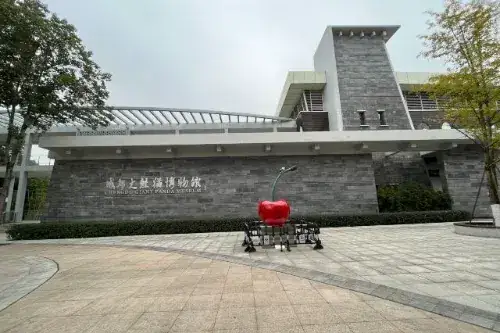
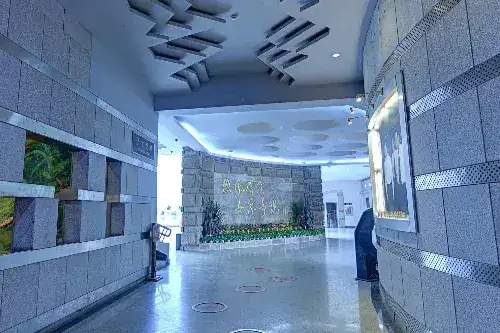
Leshan had 12 mass cultural centers, 12 public libraries, 15 museums, and 200 comprehensive cultural stations. The city had 321 cultural heritage protection units at all levels, including 12 national-level units. A total of 12,322 movable cultural relics were cataloged.
Healthcare
Leshan had 3,061 health institutions, including 87 hospitals and 122 township health centers, with 32,175 health workers and 23,951 hospital beds. The maternal mortality rate was 6.84 per 100,000, and infant mortality was 3.90 per thousand.
Sports
At the 15th National Games in 2025, 12 Leshan-born athletes helped the Sichuan team win 8 gold, 2 silver, and 3 bronze medals. Leshan's women's field hockey players contributed to China's Asian Cup championship after a 16-year hiatus. The city hosted its 9th Sports Games with 28 events and 12,000 athletes, and organized 37 sporting events throughout the year.
Social Security
By the end of 2025, 1.2344 million people participated in enterprise employee basic pension insurance, 1.1792 million in urban-rural resident pension insurance, 648,400 in urban employee basic medical insurance, and 2.3968 million in urban-rural resident medical insurance. There were 15,800 urban residents and 98,000 rural residents receiving minimum living allowances. The city had 12 social welfare homes with 3,782 beds.
Transportation
Overview
Leshan's "Hundred Billion Transportation Project" includes two aviation projects (Min River navigation-power development and Leshan Airport), five railways, ten expressways, and one comprehensive hub (Leshan Port). In 2025, total freight transport was 150 million tons (+11.5%), with freight turnover of 16.297 billion ton-kilometers. Passenger transport totaled 180 million trips. The city had 17,311.49 km of roads and 1,124.20 km of navigable waterways.
Railways
The Chengdu-Kunming Railway, Chengdu-Mianyang-Leshan Intercity Railway, and Chengdu-Guiyang High-Speed Railway run through Leshan. The intercity railway reduces travel time from Chengdu to Leshan to 40 minutes. The Chengdu-Guiyang High-Speed Railway, opened in late 2019, can reach the Yangtze River Delta, Pearl River Delta, and Beijing-Tianjin-Hebei economic zones within 8 hours.
Trams
Leshan's modern tram project plans three lines totaling approximately 76 km: Line 1 (urban loop), Line 2 (high-speed rail station to airport), and Line 3 (Leshan Giant Buddha scenic area to Mount Emei scenic area).
Aviation
Leshan is 100 km from Chengdu Shuangliu Airport. Leshan Airport, which began construction in 2017 in Wutongqiao District, has a total investment of 6.836 billion yuan (approximately $950 million) and covers 6,823 mu. It features a 4C-class runway (upgradable to 4D) and a 28,000-square-meter terminal. Projected annual passenger throughput is 1.8 million by 2030 and 3.8 million by 2050.
Highways
Leshan has 7 expressways totaling 235 km, including the Chengdu-Leshan, Leshan-Ya'an, and Leshan-Yibin expressways. The city also has 15 national and provincial highways totaling 1,298 km, and 9,844 km of rural roads. By the end of 2025, the city had 565,896 civilian vehicles, including 52,552 new energy vehicles.
Waterways
Leshan Port offers daily tourist boats to the Leshan Giant Buddha and passenger services to Chongqing and Shanghai. Chengdu Port, located in Wutongqiao District 10 km from Leshan and 120 km from Chengdu, has a designed annual freight throughput of 50 million tons and 3 million TEU containers. The Min River navigation-power comprehensive development project consists of four cascade hubs (Laomukong, Dongfengyan, Qianwei, and Longxikou), enabling 1,000-ton vessels to sail year-round from Shanghai to Chengdu Port, extending the Yangtze River navigation channel 162 km upstream.
History and Culture
Origin of the Name
After Qin unified China, Nan'an County was established in the area. In 579 AD, Jiazhou was named, meaning "the land is beautiful." The Song Dynasty renamed it Jiading Prefecture, the Yuan made it Jiading Prefecture Route, and the Ming downgraded it to Jiading Zhou. In 1734, the Qing Dynasty re-elevated it to Jiading Prefecture and established Leshan County at its seat, named after "Zhile Mountain" five li to the southwest — the name "Leshan" has been used to this day.
Folk Customs
The Wutongqiao Dragon Boat Festival has a history of over 300 years and is China's only dragon boat festival themed on well salt culture. It originated during the Shunzhi reign of the Qing Dynasty and flourished during the Qianlong reign when the salt industry reached its peak. In 1988, Wutongqiao was designated "Hometown of Dragon Boats" by Sichuan Province, and in 2007, its dragon boat racing was included in the first batch of Sichuan's intangible cultural heritage.
Scenic Spots
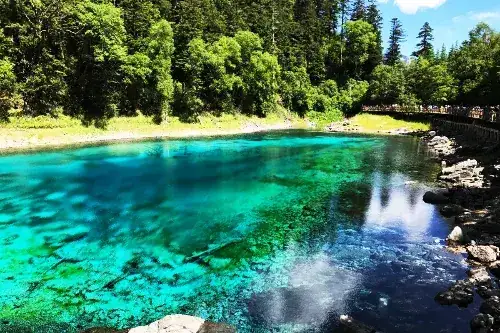
Leshan is one of China's first batch of key scenic tourism cities open to the outside world, known for the saying "The finest landscapes in the world are in Shu, and the finest in Shu are in Jiazhou." The city has 41 national A-level tourist attractions, including two 5A-level and fourteen 4A-level sites.
Leshan has three World Heritage sites: the Leshan Giant Buddha, Mount Emei, and Dongfeng Weir. The density of world-class and national-level tourism resources reaches 25 per 10,000 square kilometers, 3.6 times the Sichuan provincial average. The Leshan Sleeping Buddha, discovered in the 1980s, together with the Leshan Giant Buddha, forms the spectacle of "the heart is Buddha."
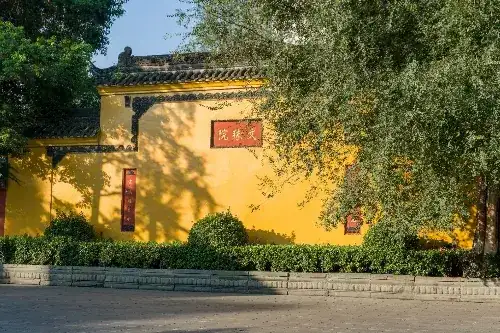
The city has 10 national key cultural heritage protection units, including the Leshan Giant Buddha, Mahao Cliff Tombs, Mount Emei Ancient Architecture Complex, Feilai Temple, Qianwei Confucian Temple, and Thousand Buddha Cliff Grottoes. It also has undeveloped natural areas like the Mucheng Alsophila Valley, a living fossil kingdom of ancient tree ferns.
Local Specialties
Local Products
Leshan has numerous products with China Geographic Indication protection, reflecting the region's rich agricultural and artisanal traditions.
Local Cuisine
Leshan cuisine is an important branch of Sichuan culinary culture, featuring distinctive local flavors and ingredients.
Notable Figures
Leshan has produced many notable historical and contemporary figures who have contributed to Chinese culture, science, and society.
Honors and Titles
Leshan has received numerous national honors, including National Historic and Cultural City, China Excellent Tourism City, National Garden City, National Health City, and National Greening Model City.
Travel information can change. Check current opening hours, reservations and entry requirements before you travel.
Traveller discussion
Start the conversation with a helpful tip or a question.