
Mianyang City
Mianyang CityMianyang City, abbreviated as "Mian" and also known as Mianzhou or Fucheng, is a prefecture-level city in Sichuan Province and a provincial sub-center. It is a Type II large city, a third-tier city, and China's only Science and
Mianyang City
Mianyang City, abbreviated as "Mian" and also known as Mianzhou or Fucheng, is a prefecture-level city in Sichuan Province and a provincial sub-center. It is a Type II large city, a third-tier city, and China's only Science and Technology City, as well as the top Chinese city for wild giant pandas. Located in the northwestern Sichuan Basin along the middle and upper reaches of the Fujiang River, it borders Guangyuan and Nanchong to the east, Suining to the south, Deyang to the west, and the Aba Tibetan and Qiang Autonomous Prefecture and Gansu's Longnan City to the northwest. The total area is 20,200 square kilometers. As of March 2025, Mianyang administers 3 districts, 5 counties, 1 county-level city, and the provincial Science and Technology City Office. As of end-2024, the permanent population was 4.922 million with an urbanization rate of 56.93%. With over 2,200 years of urban history, Mianyang was named for its location south of Mianshan Mountain. It has a northern subtropical mountainous humid monsoon climate and hosts a national-level Qiang cultural ecological protection zone. Known as the "Land of Wealth and Happiness" and the "Silicon Valley of Western China," it is an important national defense and scientific research base, Sichuan's second-largest economy, and a regional center of the Chengdu-Chongqing Urban Agglomeration, housing 18 national-level research institutes. In 2025, Mianyang achieved a regional GDP of 460.066 billion CNY (approximately $63.3 billion USD), up 6.5%.
Historical Evolution
Mianyang is one of the earliest areas of human activity in China, with the Bianduishan site yielding Neolithic stone tools and pottery dating back 4,500 years. Fuxian County was established in 201 BCE, and Guanghan Commandery in 197 BCE. Over centuries, administrative divisions changed through various dynasties. The area was named Mianzhou in 585 CE. In 1727, Mianzhou became a directly governed prefecture. In 1913, Mianyang County was established. After 1949, the Mianyang Special District was created, and in 1985, Mianyang was elevated to a prefecture-level city.
Administrative Divisions
Division History
Administrative boundaries changed significantly from 1950 to 2020 through county mergers, additions, and transfers. Key milestones include absorbing eight counties from the dissolved Guangyuan Special District (1953), incorporating seven from the dissolved Suining Special District (1958), dividing the city center into Youxian and Fucheng districts (1992), establishing the Beichuan Qiang Autonomous County (2003), converting Anxian to Anzhou District (2016), and establishing the 396-square-kilometer Science and Technology City New Area (2020).
Current Divisions
As of October 2022, Mianyang administers 3 districts (Fucheng, Youxian, Anzhou), 5 counties (Santai, Yanting, Zitong, Pingwu, Beichuan Qiang Autonomous County), and 1 county-level city (Jiangyou), plus the provincial Science and Technology City Office. The municipal government is at No. 98 Mianxing East Road.
Natural Geography
Location and Boundaries
Mianyang lies between 103 degrees 45 minutes to 105 degrees 43 minutes east longitude and 30 degrees 42 minutes to 33 degrees 2 minutes north latitude, extending approximately 187 km east-west and 256 km north-south, with a total area of 20,200 square kilometers (4.2% of Sichuan's territory).
Geology and Stratigraphy
Mianyang's strata span two major geological regions at the junction of three tectonic units: the Yangtze Paraplatform, Songpan-Garze Trough Fold System, and Qinling Trough Fold System. Key features include the Motianling fold belt, the Longmenshan structural belt with the Beichuan-Yingxiu deep fault zone (over 400 km), and rotational structures. The Middle-Upper Cambrian, Upper Cretaceous, and Tertiary systems are generally absent; total sedimentary thickness exceeds 33,637 meters.
Topography and Landforms
Terrain descends from northwest to southeast, from mountains to hills. The highest point is Xuebaoding Peak (5,400 m) in the Minshan Range; the lowest is 307.2 m in Santai County's Qijiang River valley — a 5,092.8-meter elevation difference across roughly 300 km. Landforms are classified into 12 categories and two major types: erosion-depositional and structural-denudational.
Climate Characteristics
Mianyang spans northern and central subtropical humid monsoon climate zones. Average annual temperature is 14.7–17.3°C, with extremes from -7.3°C to 39.5°C. The climate is mild with four distinct seasons. Rainfall is abundant but unevenly distributed, concentrated in mid-summer and early autumn.
Hydrology
Over 3,000 rivers and streams belong to the Jialingjiang River system. The Fujiang River, the Jialingjiang's largest right-bank tributary, covers 97.2% of the city's drainage area. Major tributaries include the Pingtong, Tongkou, Anchang, and Kaijiang rivers. Floods occur frequently along the Anchang River and upper Fujiang River.
Soil Types
Three major soil categories: alluvial soil, yellow soil, and purple soil (including paddy soil), subdivided into 6 subcategories, 6 soil groups, and 25 soil types.
Natural Disasters
Earthquakes threaten over 86% of the city's area, with the Longmenshan and Songpan-Maowen seismic belts crossing the region. Landslides and rock collapses are common in steep northwestern mountains, particularly Pingwu and Beichuan. The 1976 Songpan-Pingwu earthquake caused massive rock collapses, blocking rivers to form small lakes. Debris flows, triggered by heavy rain and earthquakes, also affect the northwest.
Natural Resources
Water Resources
Annual precipitation totals 19.845 billion cubic meters; surface water resources reach 11.893 billion cubic meters. The city has over 93,000 water conservancy projects, including 810+ small reservoirs. Water quality is good, with 91% of evaluated river sections meeting Class II standards.
Land Resources
As of 2019: arable land totals 352,300 hectares (5.2842 million mu), forest land 1.2678 million hectares (19.0175 million mu, concentrated in Pingwu and Beichuan at 61.37%), and construction land 134,900 hectares.
Mineral Resources
56 mineral types are found across 400+ locations, including iron, manganese, gold, silver, phosphate, limestone, bentonite, and natural gas. Pingwu's manganese and Santai/Yanting's bentonite rank first in Sichuan Province. Natural gas is widely distributed.
Plant Resources
Mianyang has 3,972 higher plant species across 260 families, including 12 national Class I and 38 Class II protected species. The Xylaria mianyangensis fungus, discovered during 2010–2021, was named after Mianyang as a new species.
Animal Resources
The city has 791 vertebrate and 1,257 invertebrate species, including 18 national Class I and 60 Class II protected species. As an upper Yangtze River ecological barrier, Mianyang is a major wild giant panda habitat. Pingwu County hosts 418 wild giant pandas — 22.4% of the global total — the most of any Chinese county.
Politics
Mianyang operates under the standard Chinese prefecture-level city governance framework, with the CPC Municipal Committee and Municipal People's Government as primary bodies.
Population
As of end-2024, Mianyang had 1.9695 million registered households with 5.2294 million registered population. The permanent population was 4.922 million (2.8021 million urban, 2.1199 million rural), with a 56.93% urbanization rate. The natural growth rate was -3.57‰.
Economy
Overview
In 2025, Mianyang's GDP reached 460.066 billion CNY (approximately $63.3 billion USD), up 6.5%. In 2024, GDP was 434.403 billion CNY (approximately $59.8 billion USD), up 7.0%, with the three-industry structure at 8.0:41.7:50.3. The private economy comprised 61.1% of output. The Science and Technology City achieved GDP of 312.496 billion CNY (approximately $43.0 billion USD), up 7.4%. Local fiscal revenue was 21.667 billion CNY (approximately $2.98 billion USD, up 7.5%); expenditures totaled 59.30 billion CNY (approximately $8.16 billion USD). The CPI rose 0.3%.
Primary Industry
In 2024, agriculture, forestry, animal husbandry, and fisheries output was 66.405 billion CNY (approximately $9.13 billion USD), up 2.7%. Grain production reached 2.3871 million tons (up 1.2%). Forest coverage was 56.13%. Livestock slaughter included 3.5893 million pigs (down 6.9%) and 65.3867 million poultry (down 7.9%).
Secondary Industry
In 2024, industrial value-added reached 145.039 billion CNY (approximately $19.96 billion USD), up 6.8%. Above-scale industrial value-added grew 9.8%; high-tech manufacturing grew 11.2%, accounting for 37.6%. Key growth sectors: electrical machinery (up 21.4%), automobiles (up 18.8%), and electronics (up 12.5%). Industrial enterprises generated 422.848 billion CNY (approximately $58.1 billion USD) in revenue. Construction value-added was 36.583 billion CNY, up 7.4%.
Tertiary Industry
In 2024, the tertiary industry grew 8.1%. Retail sales of consumer goods reached 193.789 billion CNY (approximately $26.6 billion USD), up 6.3%. Import/export volume was 31.018 billion CNY (approximately $4.36 billion USD), up 8.6%. Real estate investment was 24.016 billion CNY (approximately $3.30 billion USD), down 31.4%. Financial deposits totaled 778.112 billion CNY (approximately $107 billion USD, up 10.7%); loans were 503.445 billion CNY (approximately $69.3 billion USD, up 14.1%). Insurance premiums reached 16.033 billion CNY (approximately $2.21 billion USD), up 2.1%.
Transportation
Transportation
Mianyang has 25,331.94 km of highways (including 723.86 km of expressways) and 80 civil aviation routes. Major expressways include Chengdu-Mianyang, Mianyang-Suining, and Mianyang-Guangyuan. Rail connections include the Baoji-Chengdu Railway, Xi'an-Chengdu High-Speed Railway, and Chengdu-Mianyang-Leshan Intercity Railway, serving Mianyang Station (Sichuan's second-largest), Jiangyou Station, and Qinglian Station. Mianyang Nanjiao Airport, a 4D-class facility opened in 2001, is Sichuan's third-largest airport, with a new 20,000-square-meter T2 terminal under construction.
Transport Volume
In 2024, highway passenger turnover was 1.689 billion person-km (up 13.1%); highway freight turnover was 86.84 billion ton-km (up 1.9%); civil aviation passengers totaled 3.0201 million (down 2.7%); aviation cargo was 19,864 tons (up 1.6%).
Social Affairs
Science and Technology
Mianyang has over 930 high-tech enterprises, 3,200+ technology-based SMEs, 35 provincial engineering centers, 1 national high-tech zone, and 5 national business incubators. In 2024, 1,885 technology contracts were registered, valued at 20.04 billion CNY (approximately $2.76 billion USD).
Education
Mianyang has 1,160 primary and secondary schools with 701,300 students and 48,200 full-time teachers. It also has 328 primary schools (280,100 students, 100% enrollment rate), 168 secondary schools (266,800 students), and 15 higher education institutions (180,200 students, 8,867 full-time teachers).
Culture
The city has 10 public libraries, 303 cultural centers, 18 museums, and 4 theaters, with 100% radio and TV coverage.
Sports
Mianyang has 15 sports venues and hosted 697 events in 2024 with 718,100 participants. Athletes won 255 medals (72 gold, 81 silver) in provincial and above competitions.
Health
The city has 4,347 medical institutions (including 118 graded hospitals), 55,500 health workers, and 45,200 beds. Maternal mortality was 4.55 per 100,000; infant mortality 1.50 per thousand.
Social Security
In 2024, 55,000 new urban jobs were created. Pension insurance covered 1.667 million enterprise employees and 2.0797 million urban-rural residents. Urban minimum living standard was 824 CNY/month (29,000 beneficiaries); rural standard was 623 CNY/month (103,100 beneficiaries).
Environmental Protection
All 24 surface water monitoring sections met Class I-III standards (100% excellent rate). Air quality compliance was 89.3% (324 of 363 monitored days). Energy consumption per unit GDP decreased 6.4%.
Production Safety
In 2024, 18 production safety accidents occurred (down 25.0%) with 19 fatalities (down 24.0%). Fatalities per 100 million CNY GDP were 0.004.
History and Culture
Overview
Mianyang is the birthplace of Li Bai, the great Tang Dynasty romantic poet known as the "Poet Immortal," and Ouyang Xiu, one of the "Eight Great Prose Masters of the Tang and Song." It is also the hometown of Leizu, the legendary mother of silk, and the birthplace of Yu the Great, founder of the Xia Dynasty.
Name Origin
Named "Mianzhou" in 585 CE after the Mian River; "Mianyang" was adopted in 1913, following the ancient convention that "south of a mountain" is called "yang," as the city lies south of Mianshan Mountain.
Cuisine
Specialties include Pingwu candied jujubes, Beichuan tea and cured meat, walnuts, fungi, Jiangyou Zhongba soy sauce, and Zitong crispy cakes. Mianyang is also a major producer of traditional Chinese medicinal herbs including aconite, ophiopogon, gastrodia, and salvia.
Customs
Dragon boat racing is traditional during the Dragon Boat Festival on the Fujiang River. The Qijiang Ancient Town in Santai County, former capital of the Qijiang Kingdom, hosts the annual City God Temple Fair on the 27th–28th of the fifth lunar month — a Sichuan intangible cultural heritage event featuring folk performances, Sichuan opera, and rain-praying ceremonies.
Other Culture
Mianyang's cultural heritage encompasses folk arts, crafts, and regional festivals.
Dialects
The Mianyang dialect belongs to the Northern Chinese group but incorporates ancient pronunciations and Huguang dialect features. It lacks retroflex consonants (zh, ch, sh become z, c, s), certain vowels, and has reversed rising/falling tones compared to Mandarin. Erhua endings are minimal.
Scenic Spots
Overview
As of March 2025, Mianyang has 42 A-level tourist attractions (1 at 5A, 18 at 4A, 22 at 3A, 1 at 2A). In 2022, Mianyang (excluding Pingwu and Beichuan) was included in the Ba-Shu Cultural Tourism Corridor plan.
Important Scenic Spots
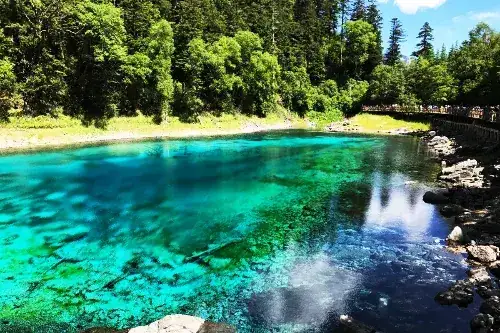
Notable attractions include Li Bai's Hometown in Jiangyou, Beichuan Qiang City, Jiuhuang Mountain, King Yue Tower, and other cultural and natural landmarks.
External Relations
Domestic
Mianyang maintains sister-city relationships and participates in regional cooperation within Sichuan Province and the Chengdu-Chongqing economic circle.
International
Mianyang leverages its status as China's only Science and Technology City to foster global partnerships in research, technology, and economic development.
Notable Figures
Historical figures include Li Bai (701–762), the Tang Dynasty romantic poet born in Jiangyou; Ouyang Xiu (1007–1072), Northern Song statesman and literary master; Wen Tong (1018–1079), renowned Northern Song painter; and Sha Ting (1904–1992), prominent modern writer. Contemporary figures include Liang Guanglie (1940–2024), former Defense Minister and General; Li Shiming (born 1948), General and former Chengdu Military Region commander; academicians Wei Fengsi (space physics) and Deng Xiaogang (aerodynamics); and Li Ziqi (born 1990), renowned food video creator.
Important Honors
Mianyang holds numerous national honors including National Civilized City, National Health City, National Forest City, China Excellent Tourist City, National Intellectual Property Demonstration City, National Smart City Pilot, and National Gigabit City. It ranked 59th among China's top 100 prefecture-level cities (2019) and was named a National Double Support Model City in 2025.
Travel information can change. Check current opening hours, reservations and entry requirements before you travel.
Traveller discussion
Start the conversation with a helpful tip or a question.