
Chengdu City
Chengdu CityChengdu City, abbreviated as "Rong" and alternatively known as Rongcheng or Jincheng, is the capital of Sichuan Province, a sub-provincial city, megacity, and core city of the Chengdu Metropolitan Area. Located in Southwest Chin
Chengdu City
Chengdu City, abbreviated as "Rong" and alternatively known as Rongcheng or Jincheng, is the capital of Sichuan Province, a sub-provincial city, megacity, and core city of the Chengdu Metropolitan Area. Located in Southwest China at the western edge of the Sichuan Basin and eastern edge of the Qinghai-Tibet Plateau, it sits at the heart of the Chengdu Plain with a subtropical monsoon climate. The total area is 14,335 square kilometers. As of end-2025, Chengdu administers 12 districts, 3 counties, and 5 county-level cities with a permanent population of 21.535 million. A first-batch National Famous Historical and Cultural City, Chengdu has over 4,500 years of civilization and 2,300 years of urban history. It is the birthplace of ancient Shu civilization, home to China's first local official school (Wenweng Stone Chamber) and the world's earliest paper money (Jiaozi). Cultural treasures include the Jinsha Site, Wuhou Shrine, and Du Fu Thatched Cottage. It has two World Natural and Cultural Heritage sites: Mount Qingcheng–Dujiangyan Irrigation System and the Giant Panda Habitat. It is the only megacity worldwide with over ten million people that can view 5,000-meter snow-capped mountains from the city. Chengdu is a key central city in western China, an international transportation hub, and headquarters of the PLA Western Theater Command. In 2025, its regional GDP reached 2,476.36 billion yuan (approximately US$341.6 billion), up 5.8%.
Etymology
The name "Chengdu" predates the Kaiming dynasty's settlement. "Cheng" likely originates from ancient Ba-Shu script, meaning a stacked cage structure (a stilt-house with dwelling above and granary below). "Du" generally means royal capital in Chinese, but in ancient Shu and Tibetan it denotes the confluence of two rivers. The earliest "Chengdu" was at the river confluence at the Sichuan-Qinghai-Gansu border, where the Cheng clan resided before migrating eastward to the Chengdu Plain. Thus "Chengdu" means a stilt-house settlement at the confluence of two rivers — originally signifying "the final capital" rather than "an established capital."
Historical Evolution
Ancient Period
As early as 4,500 to 3,700 years ago, settlement centers known as the "Baodun Culture" emerged on the Chengdu Plain with rammed-earth walls and ritual venues. Relics from the Jinsha Site indicate that by the late Shang Dynasty to early Western Zhou Dynasty, Chengdu had become the capital of the ancient Shu Kingdom.
Pre-Qin Period
Originally inhabited by the Baipu people, the area was conquered by the State of Qin in 316 BC, which established Shu Commandery. In 256 BC, Li Bing, governor of Shu Commandery, constructed the famous Dujiangyan Irrigation System and created China's earliest water gauge. By the late Qin and early Han Dynasty, Chengdu replaced the Guanzhong region as the "Land of Abundance."
Han and Three Kingdoms Period
During the Han Dynasty, Chengdu's economy flourished, becoming the nation's second-largest commercial city after Chang'an and the starting point of the "Southern Silk Road." During the Three Kingdoms period, Chengdu served as the capital of the Shu Han Kingdom under Liu Bei (221 AD), lasting forty-three years. The city's prized Shu brocade earned it the alternative names "Brocade Official City" and "Brocade City."
Wei, Jin, Southern and Northern Dynasties
In 306 AD, Li Xiong established the state of "Da Cheng" in Chengdu, later renamed "Han" (known as "Cheng Han"), which was conquered by the Eastern Jin in 347 AD.
Sui and Tang Dynasties
During the Tang Dynasty, Emperor Xuanzong took refuge in Shu in 757 AD and elevated Chengdu to a prefecture and Southern Capital. The Tang-era region centered on Chengdu was the nation's wealthiest, giving rise to the saying "Yangzhou first, Yizhou second."
Five Dynasties and Ten Kingdoms Period
After the Tang fell in 907 AD, the Former and Later Shu regimes were established in Chengdu. Meng Chang of Later Shu ordered hibiscus planted along city walls, earning the nickname "Rongcheng" (Hibiscus City).
Song, Yuan, Ming, and Qing Dynasties
The world's first paper money, "Jiaozi," was born in Chengdu during the Northern Song Dynasty. The Mongols captured Chengdu in 1257; the Yuan established the Chengdu Route in 1286; the Ming made it Sichuan's capital in 1371. In 1644, Zhang Xianzhong proclaimed the "Da Xi" state. During the Qing Dynasty, the "Huguang Migration to Sichuan" repopulated the city. In 1911, the Railway Protection Movement in Chengdu triggered the Xinhai Revolution.
Republic of China Period
In 1912, the Chengdu Military Government was established. In 1928, the City of Chengdu was formally founded.
After the Founding of New China
On December 27, 1949, the PLA entered Chengdu. In 1952, Sichuan Province was reestablished with the government in Chengdu. In 1989, Chengdu became one of 14 cities with separately planned economic status. In 1993, the State Council designated it the Southwest's science, commerce, financial, and transportation hub.
Administrative Divisions
Division Evolution
After 1949, Chengdu's administrative area expanded from 29.9 to 14,335 square kilometers through multiple adjustments. Key changes included merging Wenjiang Prefecture's 12 counties in 1983, reorganizing urban districts into Jinjiang, Qingyang, Jinniu, Wuhou, and Chenghua in 1990, converting Shuangliu and Pi to districts (2016-2017), and establishing Chengdu Eastern New Area in 2020.
Division Details
As of the end of 2024, Chengdu administers 12 municipal districts, 5 county-level cities, and 3 counties, comprising 161 sub-districts and 100 towns. The municipal government is located at No. 2 Jinyue West Road, Wuhou District.
Geography and Environment
Location
Chengdu is located in central Sichuan Province, bordering Deyang, Ziyang, Meishan, Ya'an, and the Aba Tibetan and Qiang Autonomous Prefecture. Coordinates range from 102°54′ to 104°53′ E and 30°05′ to 31°26′ N. Total area is 14,335 square kilometers.
Topography
The terrain slopes from northwest to southeast. Western areas feature mountains (1,000-3,000 m), peaking at 5,364 meters in Dayi County. The eastern basin plain, formed by alluvial deposits, averages 750 meters. This elevation difference creates a unique one-third plains, one-third hills, one-third mountains landscape.
Climate
Chengdu has a subtropical monsoon climate with mild summers, short winters, a long frost-free period, abundant nighttime rain, high humidity, and limited sunshine. Annual average temperature ranges 15.7-18.0°C; annual precipitation 734.8-1,142.3 millimeters. July-August are hottest; January is coldest.
Natural Resources
Water Resources
Annual water resources total 30.472 billion cubic meters. Twelve major rivers including the Minjiang and Tuojiang create a network density of 1.22 km/km². The Dujiangyan Irrigation System and numerous reservoirs ensure effective irrigation. Theoretical hydropower potential is 1.615 million kilowatts.
Land Resources
Plains cover 40.1% (4,971.4 km²), hills 27.6%, and mountains 32.3% of the total area. The usable area ratio reaches 94.2%, with a reclamation index of 38.22% — far above the national average.
Biological Resources
Chengdu supports over 3,000 species across 764 genera. Protected animals include the giant panda, red panda, golden snub-nosed monkey, and takin. Over 860 varieties of medicinal herbs grow here. In July 2024, two new bird species were discovered during a breeding bird survey.
Mineral Resources
Over 60 mineral types are verified across 400+ mining sites, including metals (iron, titanium, vanadium, gold, rare earths) and non-metals (glauberite, coal, natural gas). Glauberite reserves rank first nationally at 98.62 billion tons.
Population
At end-2025, the permanent population reached 21.535 million with an urbanization rate of 81.46%. Chengdu is multi-ethnic with 55 minority groups totaling 129,300 people; the largest are Tibetan, Hui, Yi, and Qiang.
Politics
Chengdu serves as the seat of the Sichuan Provincial Committee of the Chinese Communist Party and the Sichuan Provincial People's Government. It is also the headquarters of the Western Theater Command of the People's Liberation Army.
Economy
Overview
In 2025, Chengdu achieved a regional GDP of 2,476.36 billion yuan (approximately US$341.6 billion), a year-on-year increase of 5.8%. By industry: primary industry added value was 54.11 billion yuan (approximately US$7.5 billion), up 3.3%; secondary industry 690.39 billion yuan (approximately US$95.2 billion), up 5.4%; tertiary industry 1,731.86 billion yuan (approximately US$238.9 billion), up 6.1%. In 2024, the regional GDP was 2,351.13 billion yuan (approximately US$324.3 billion), up 5.7%, with a per capita GDP of 109,669 yuan (approximately US$15,127). The three-industry structure was 2.3:28.7:69.0.
Primary Industry
In 2024, grain output was 2.346 million tons (up 1.1%) from 5.801 million mu. Hog slaughter reached 4.001 million head (down 8.1%); meat output was 418,000 tons.
Secondary Industry
Industrial added value was 497.05 billion yuan (approximately US$68.6 billion), up 5.9%. High-tech manufacturing grew 5.7%. Construction added value was 187.86 billion yuan (approximately US$25.9 billion), up 5.4%.
Tertiary Industry
Key 2024 figures: wholesale/retail 215.81 billion yuan (up 3.5%); finance 231.13 billion yuan (up 4.1%); IT services 196.47 billion yuan (up 8.2%). Retail sales reached 1,083.53 billion yuan (approximately US$149.5 billion, up 3.3%). Imports/exports totaled 839.0 billion yuan (approximately US$115.7 billion, up 12.1%). General public budget revenue was 194.95 billion yuan (approximately US$26.9 billion). Bank deposits and loans exceeded 6.2 and 6.6 trillion yuan respectively.
Social Affairs
Education
Chengdu has 66 higher education institutions with 1.307 million students (including 25,000 doctoral), 654 middle schools with 810,000 students, 650 primary schools with 1.314 million students, and 2,729 kindergartens.
Science and Technology
Chengdu has 146 national-level innovation platforms. Patent grants totaled 69,557. Technology contract transactions reached 193.13 billion yuan (approximately US$26.6 billion). High-tech industry revenue was 1,560.53 billion yuan (approximately US$215.2 billion), with over 14,000 high-tech enterprises.
Culture
Chengdu had 201 museums, 22 cultural centers, and 23 public libraries. In December 2021, Chengdu was selected at the 79th World Science Fiction Convention in Washington, D.C. as the host for the 81st World Science Fiction Convention in 2023.
Healthcare
Chengdu has 13,983 medical institutions including 807 hospitals and 55 Grade-A tertiary hospitals, with 179,000 beds and 239,000 health professionals. Annual visits totaled 200.8 million.
Sports
Chengdu hosted the 31st Summer World University Games from July 28 to August 8, 2023. From August 7 to 17, 2025, Chengdu hosted the 2025 Chengdu World Games — the first time the World Games were held in mainland China. In 2024, the city held 37 national-level sporting events and built 52 sports parks meeting provincial standards or above.
Infrastructure
The built-up area covers 1,344.2 km². Urban sewage treatment rate is 95.9%; waste harmless treatment rate is 100%. Expressway mileage reaches 1,303 km. Rail transit spans 672.9 km (including 614.9 km of subway), with 2.2 billion annual trips.
Social Security
In 2024, 14.494 million people participated in urban employee basic pension insurance, and 2.988 million in urban and rural resident pension insurance. A total of 23,000 urban residents and 77,000 rural residents received minimum living allowances, with 850 million yuan (approximately US$117.2 million) insocial security funds invested.
Transportation
Overview
Chengdu is a key "Belt and Road" node. The "Air Silk Road" connects five continents; "Land Silk Road" rail links 100+ overseas cities. In 2024, freight turnover was 56.27 billion ton-km; passenger turnover 166.09 billion person-km. Airports handled 87.34 million passengers and 1.03 million tons cargo.
Highways
Chengdu's main urban area has 13 passenger transport centers. Expressway operating mileage reached 1,303 kilometers in 2024.
Railways
Five railway trunk lines and four high-speed railways converge in Chengdu. The "1 ring, 12 radial" network exceeds 1,000 km, creating a high-speed rail circle: 1 hour to Chongqing, 3 hours to Xi'an/Guiyang, 7 hours to Beijing/Guangzhou.
Aviation
Since 2019, Chengdu offers 144-hour visa-free transit for 53 countries. Shuangliu International Airport is a base for Air China, Sichuan Airlines, and others. Tianfu International Airport (4F-class) opened in June 2021. Huaizhou Airport serves general aviation.
Public Transport
Bus fare is 2 yuan with a "Tianfu Tong" card offering 50% discount and free 2-hour transfers. The Chengdu Metro opened in 2010 (8th in mainland China). By December 2025, 18 lines exceed 750 km total. Annual ridership was 2.2 billion trips.
History and Culture
Dialect
The Chengdu dialect is a representative branch of Southwestern Mandarin, characterized by its distinctive tones and vocabulary.
Religion
Chengdu is home to diverse religious communities including Buddhism, Taoism, Islam, Catholicism, and Protestantism, with numerous temples, monasteries, mosques, and churches throughout the city.
Place Name
According to the Taiping Huanyu Ji, the name "Chengdu" borrows from the history of the Western Zhou capital establishment: "In the first year the king arrived, it became a settlement; in the second year, a town; in the third year, a capital." The Shu pronunciation of "Chengdu" thus signifies the "final capital of Shu."
Cultural Heritage
As of January 2022, Chengdu has 639 cultural heritage sites at all levels, including 41 national-level key cultural heritage sites, 109 provincial-level sites, and 186 municipal-level sites.
City Symbols
City Tree: Ginkgo. On May 26, 1983, the Standing Committee of the 9th Chengdu Municipal People's Congress officially designated the ginkgo tree as the city tree. City Flower: Hibiscus. On the same date, hibiscus was designated as the city flower.
Scenic Spots
Overview
Chengdu boasts rich natural landscapes, situated at the intersection of the Sichuan and national tourism circuits. The mountain scenery features characteristics of height, danger, uniqueness, elegance, and tranquility, including Mount Qingcheng, Jiufeng Mountain, Xiling Snow Mountain, and Yulei Mountain. As of December 2025, Chengdu has 103 national A-level scenic areas, including 3 at 5A level, 49 at 4A level, 39 at 3A level, 11 at 2A level, and 1 at 1A level.
Major Attractions
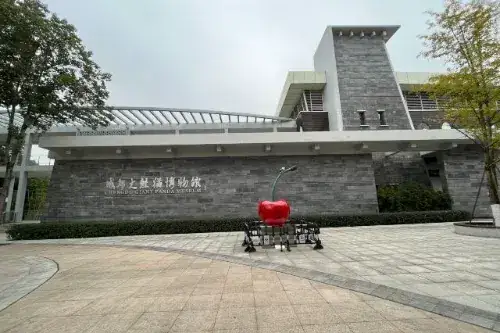
Key attractions include the Wuhou Shrine, Du Fu Thatched Cottage, Jinsha Site Museum, Kuanzhai Alley, Chunxi Road, the Giant Panda Breeding Research Base, Mount Qingcheng, the Dujiangyan Irrigation System, and Xiling Snow Mountain.
Local Specialties
Cuisine
Chengdu cuisine, a major branch of Sichuan cuisine, is renowned for its bold flavors, particularly the use of chili and Sichuan peppercorn. Signature dishes include Mapo Tofu, Kung Pao Chicken, and Hot Pot. Chengdu was designated a UNESCO City of Gastronomy in 2010.
Handicrafts
Chengdu is famous for traditional handicrafts including Shu embroidery, Shu brocade, lacquerware, and bamboo weaving, all with histories spanning centuries.
Foreign Relations
Consular Institutions
Since the United States established a consulate general in Chengdu in 1985, 18 foreign consular institutions have been approved in Sichuan as of August 2025, ranking third nationally and first in central and western China. Visa application centers for countries including the United Kingdom and Canada also operate in Chengdu.
Sister Cities
Chengdu maintains sister city relationships with numerous cities worldwide, fostering cooperation in trade, culture, education, and technology.
Cooperation and Exchange
Chengdu actively participates in international cooperation through the Belt and Road Initiative, hosting international events and maintaining economic and cultural exchange programs with partners across five continents.
Notable Figures
Chengdu has produced many notable historical figures throughout its long history, including poets, scholars, military leaders, and cultural icons who have contributed significantly to Chinese civilization.
Honorary Titles
Chengdu has received numerous honorary designations, including National Civilized City, National Model City for Rule of Law, National Double Support Model City, and UNESCO City of Gastronomy. It was selected for the first batch of national new industrialization demonstration cities in March 2026.
Travel information can change. Check current opening hours, reservations and entry requirements before you travel.

Traveller discussion
Start the conversation with a helpful tip or a question.