
Hechi City
Hechi CityHechi City, abbreviated as "He," is a prefecture-level city under the Guangxi Zhuang Autonomous Region. Located in northern Guangxi at the southern foot of the Yunnan-Guizhou Plateau, the city features diverse terrain with elevati
Hechi City
Hechi City, abbreviated as "He," is a prefecture-level city under the Guangxi Zhuang Autonomous Region. Located in northern Guangxi at the southern foot of the Yunnan-Guizhou Plateau, the city features diverse terrain with elevations higher in the northwest and lower in the southeast. It has a subtropical monsoon climate with abundant heat, ample sunlight, and plentiful rainfall. The city spans 228 km east to west and 260 km north to south, covering a total area of 33,500 square kilometers. As of May 2024, Hechi administers 2 districts and 9 counties, with a permanent population of 3.3135 million. On August 1, 1965, the Hechi Prefecture Commissioner's Office was established from 10 counties carved out of the Liuzhou, Baise, and Nanning prefectures. Hechi is a renowned revolutionary old area—the birthplace of the Guangxi peasant movement, the staging ground for the Baise Uprising, and the heartland of the Youjiang Revolutionary Base. It is where elder-generation proletarian revolutionaries such as Deng Xiaoping and Zhang Yunyi once fought, the hometown of the Red Seventh Army and martyr Wei Baqun, and the place that produced seven founding generals of the Republic, including Admiral Wei Guoqing. Hechi is China's new silk capital, with its sericulture scale ranking first among prefecture-level cities nationwide for 16 consecutive years. The city boasts three world-class ecological resources: the Panyang River Basin Longevity Tourism Belt, the Fengshan World Geological Park, and the Huanjiang Karst World Natural Heritage Site. Within the Bama International Tourism Zone, Tian'e County has a forest coverage rate exceeding 86%. Hechi is a national-level Bronze Drum Culture Ecological Protection Zone. In 2025, Hechi's regional GDP reached 145.362 billion yuan (approximately $20.2 billion), up 5.0% year-on-year.
History
In pre-Qin times, the Hechi area belonged to the Baiyue territory. In 214 BCE, the Qin dynasty unified the Lingnan region, placing Hechi under Guilin Commandery. During the Han dynasty, most of Hechi belonged to Yulin Commandery, while present-day Tian'e, Nandan, and Huanjiang fell under Zangke Commandery. In 111 BCE, Dingzhou County was established within Yulin Commandery, encompassing parts of present-day Yizhou, Jinchengjiang, Donglan, Fengshan, Du'an, and Dahua. During the Three Kingdoms period, Hechi belonged to the Wu state's Yulin Commandery. In the Sui dynasty, parts were under Yulin and parts under Shi'an Commandery.
During the Tang dynasty, Yizhou and Huanzhou were established in eastern Hechi. In 1265, Qingyuan Prefecture was established, governing several counties and indigenous prefectures. During the Yuan dynasty, Qingyuan was reorganized multiple times—first as a Pacification Commission, then a General Administration, and finally as the Qingyuan-Nandan Military and Civilian Pacification Commission in 1297.
In 1370, the Ming dynasty renamed it Qingyuan Prefecture. The Qing dynasty retained this structure. During the Republic of China era, seven counties belonged to the Qingyuan Administrative Inspectorate, Bama and Fengshan to the Baise Inspectorate, and Du'an and Dahua to the Wuming Inspectorate.
In January 1950, the Qingyuan Special District was established and renamed Yishan Special District in February. After several reorganizations, on August 1, 1965, the State Council approved the establishment of the Hechi Prefecture Commissioner's Office from 10 counties of the Liuzhou, Baise, and Nanning prefectures, headquartered in Jinchengjiang Town. In March 1971, it became Hechi Prefecture. On June 18, 2002, the State Council approved the establishment of prefecture-level Hechi City.
Administrative Divisions
Division Evolution
In 1965, the Hechi Special District was established from 10 counties carved out of the Liuzhou, Baise, and Nanning special districts, with the commissioner's office in Jinchengjiang Town, Hechi County. Over subsequent decades, several counties were reorganized: Luocheng became the Luocheng Mulam Autonomous County (1983), Hechi became county-level Hechi City (1983), Huanjiang became the Huanjiang Maonan Autonomous County (1986), and the Dahua Yao Autonomous County was established (1987). Yishan became county-level Yizhou City (1993). In 2002, Hechi Prefecture was abolished and prefecture-level Hechi City established, with county-level Hechi City becoming Jinchengjiang District. In 2016, county-level Yizhou City became Yizhou District, and the municipal government relocated to Yizhou District.
Division Details
As of May 2024, Hechi City administers 2 districts (Yizhou and Jinchengjiang) and 9 counties (Luocheng, Huanjiang, Nandan, Tian'e, Donglan, Bama, Fengshan, Du'an, and Dahua). The municipal government is seated at No. 6 Zhongshan Avenue, Qingyuan Town, Yizhou District.
Geographical Environment
Location and Boundaries
Hechi is located on the northwestern border of Guangxi, at the southern foot of the Yunnan-Guizhou Plateau. It connects Liuzhou to the east, Nanning to the south, Baise to the west, and the Qiannan Buyei and Miao Autonomous Prefecture of Guizhou Province to the north. It lies between 106 degrees 34 minutes and 109 degrees 09 minutes E, and 23 degrees 41 minutes and 25 degrees 37 minutes N, covering 33,500 square kilometers.
Topography
Hechi is mountainous with extensive karst formations covering 21,800 square kilometers—65.74% of the city's total area and 24.34% of Guangxi's total karst area, making it the largest karst-exposed city in Guangxi. Per capita arable land in karst mountain areas is less than 0.3 mu. Rocky desertification affects 723,000 hectares, or 21.6% of the city's total land area, representing 35% of Guangxi's total desertified area.
Climate
Hechi has a subtropical monsoon climate with long hot summers and short mild winters. Annual sunshine ranges from 1,447 to 1,600 hours, and average annual temperature from 16.9 to 21.5 degrees Celsius, with a roughly 6-degree difference between north and south. Annual rainfall is 1,200 to 1,600 mm, with some areas exceeding 2,500 mm.
Hydrology
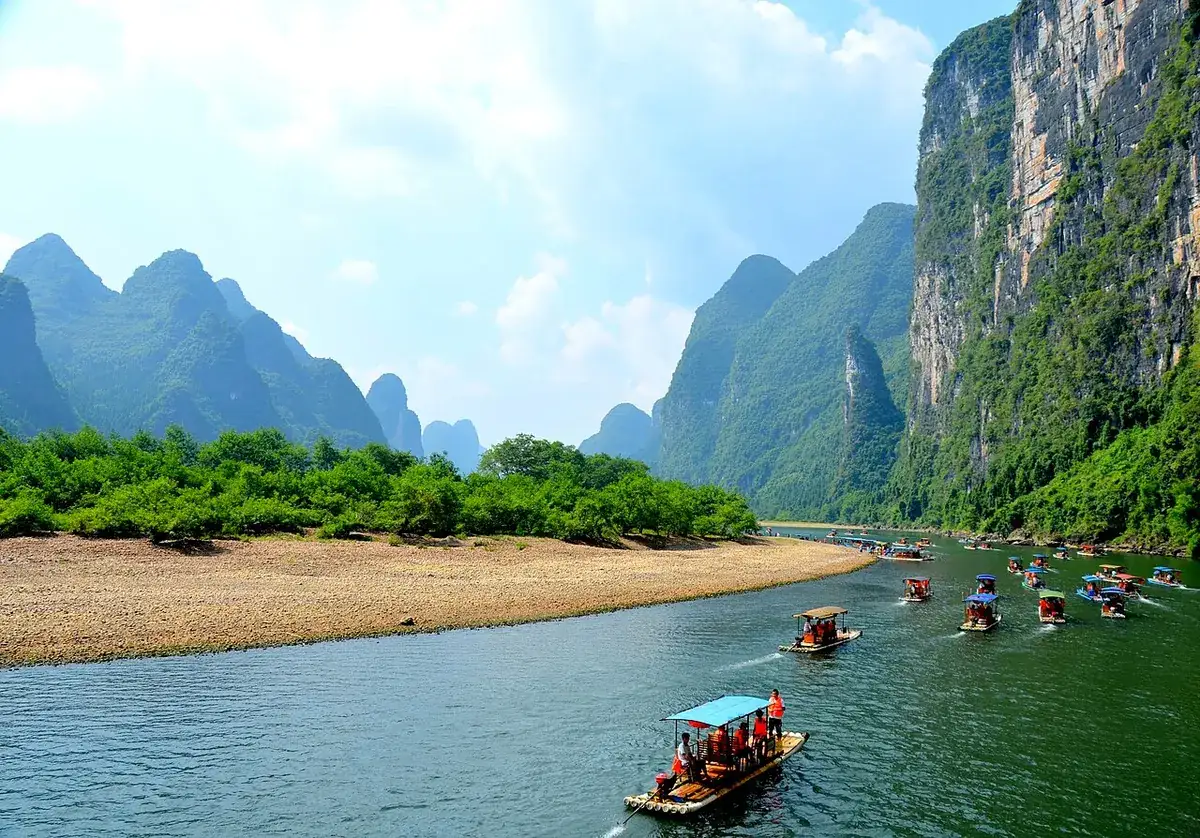
The city's main rivers are the Hongshui River, the Longjiang, and their tributaries, all part of the Pearl River system. Beyond immense hydropower potential, certain river segments—such as the Tian'e "Little Three Gorges" on the Hongshui River, the Banlan Gorge in Dahua, and the Liujia Gorge on the Longjiang—offer significant tourism value.
Natural Resources
Water Resources
Hechi has 635 rivers, including 172 with catchment areas exceeding 50 square kilometers. The multi-year average water resource is 25.1 billion cubic meters. The city has 201 reservoirs. Known nationally as the "Hometown of Hydropower," Hechi has a hydropower potential of 12 million kW with a developable capacity of 9.8 million kW—58% of Guangxi's total. Four of the ten cascade stations on the Hongshui River are within Hechi, including the Longtan Station (4.9 million kW), Guangxi's largest. As of end-2019, 145 hydropower stations had been built with a total installed capacity of 8.1848 million kW, ranking second nationally among prefecture-level cities in both installed capacity and annual power generation.
Mineral Resources
Forty-six mineral types have been discovered across 186 sites. Major non-ferrous metal reserves as of 2019 include: tin 538,000 tonnes, lead 871,500 tonnes, zinc 7.546 million tonnes, antimony 292,400 tonnes, copper 380,600 tonnes, and nickel 151,200 tonnes.
Biological Resources
Hechi has 466 plant families, 1,769 genera, and 3,958 species, including 48 nationally protected rare tree species. Animal resources total 495 species, with 5 under Class I and 36 under Class II national protection.
Forestry Resources
Hechi's forest area covers 2.3793 million hectares, with a coverage rate of 71.02%. The city has 5 forestry nature reserves (72,900 hectares), 3 national wetland parks (1,974.88 hectares), and 6 forest parks (11,000 hectares). Total wetland area is 47,700 hectares, including river wetlands, lake wetlands, marsh wetlands, and constructed wetlands.
Population
Population Size
As of November 1, 2020, the permanent population was 3,417,945. As of end-2023, it was 3.3536 million, down 56,000 (1.64%) year-on-year. The birth rate was 8.10 per mille, death rate 8.66 per mille, and natural growth rate minus 0.56 per mille. The urban population was 1.6044 million, with an urbanization rate of 47.84%, up 1.22 percentage points.
Ethnic Composition
Hechi is home to 8 ethnic groups with long-standing residence: Zhuang, Han, Yao, Miao, Mulam, Maonan, Dong, and Sui.
Politics
Economy
Overview
In 2025, Hechi's GDP reached 145.362 billion yuan (approximately $20.2 billion), up 5.0% at constant prices. The primary industry added value of 27.529 billion yuan (approximately $3.8 billion, +4.0%), secondary industry 43.321 billion yuan (approximately $6.0 billion, +6.1%), and tertiary industry 74.511 billion yuan (approximately $10.4 billion, +4.7%). In 2024, the GDP was 140.415 billion yuan (approximately $19.5 billion, +5.3%). Per capita disposable income was 23,881 yuan (approximately $3,320, +6.1%); urban residents earned 37,405 yuan (approximately $5,200) and rural residents 15,240 yuan (approximately $2,120). General public budget expenditure was 41.271 billion yuan (approximately $5.7 billion, +1.7%), with 82.8% allocated to livelihood areas. Fixed asset investment declined 23.5%.
Primary Industry
In 2024, agricultural, forestry, animal husbandry, and fishery output value grew 5.3%. Vegetable output was 2.3432 million tonnes (+4.4%), fruit 1.016 million tonnes (+6.2%), timber harvest 4.7396 million cubic meters (+35.1%), and meat 252,100 tonnes (+0.7%). Silkworm cocoon output was 218,500 tonnes (+6.7%). Year-end hog inventory was 1.4279 million head (+6.3%), with 2.0716 million slaughtered (+3.8%).
Secondary Industry
In 2024, above-scale industrial value-added grew 17.1%. State-controlled enterprises grew 31.6%, joint-stock enterprises 17.3%, and foreign-invested enterprises 74.1%. By sector: mining +3.9%, manufacturing +13.4%, and utilities +36.0%. Notable output increases included refined sugar (+41.9%), silk (+9.2%), artificial board (+108.1%), and ten non-ferrous metals (+18.8%).
Tertiary Industry
In 2024, the service sector value-added grew 3.0%. Wholesale and retail grew 4.8%, transport and postal services 2.2%, accommodation and catering 2.9%, financial services 4.2%, and real estate 1.5%. Total retail sales of consumer goods grew 2.6%. Year-end deposits reached 183.612 billion yuan (approximately $25.5 billion, +6.6%) and loans 162.027 billion yuan (approximately $22.5 billion, +8.8%). Insurance premium income in 2023 was 3.301 billion yuan (approximately $459 million, +2.5%).
Social Affairs
Science and Technology
In 2024, the city had 3 research institutes with 114 staff. A total of 16 R&D projects were funded with 5.07 million yuan (approximately $705,000). The city registered 119 scientific achievements and granted 823 patents, including 58 invention patents, ending with 577 invention patents on file.
Education
The city has 2 higher education institutions with 32,238 students, 17 vocational schools with 25,328 students, 196 secondary schools with 283,411 students, 569 primary schools with 342,901 students, 990 kindergartens with 113,335 children, and 9 special education schools with 3,713 students.
Culture
The city has 11 public libraries (1.44 million volumes), 12 cultural centers, 139 grassroots cultural stations, and 13 museums. A total of 340 exhibitions and 2,352 performances were organized during the year.
Healthcare
The city has 2,586 medical institutions, including 55 hospitals, 147 township health centers, and 1,665 village clinics. There are 29,813 health professionals, including 7,282 licensed physicians and 13,881 registered nurses, with 25,976 beds.
Sports
In 2024, Hechi athletes won 22 gold, 22 silver, and 35 bronze medals at the Guangxi Youth Championships. They represented Guangxi at the 12th National Traditional Ethnic Minority Games, winning 7 first prizes, 11 second prizes, and 5 third prizes. A Hechi-born athlete won the mixed 4x50m freestyle relay at the Paris Paralympics, setting a new world record.
Social Security
In 2024, per capita disposable income reached 23,881 yuan (approximately $3,320, +6.1%); urban residents earned 37,405 yuan (approximately $5,200) and rural residents 15,240 yuan (approximately $2,120), with the urban-to-rural ratio narrowing to 2.45:1. Per capita consumption expenditure was 15,576 yuan (approximately $2,160, +8.5%). A total of 2.1067 million people participated in basic pension insurance and 3.8975 million in basic medical insurance. The city had 56,600 urban and 338,400 rural residents receiving minimum living allowances. Social welfare institutions provided 7,483 beds.
Transportation
Highways
As of end-2024, the city maintained 24,288.92 km of roads, including 1,122.81 km of expressways (+136.67 km). Passenger transport totaled 15.034 million people, and freight transport 86.5307 million tonnes (+5.3%).
Railways
The Guiyang-Nanning High-Speed Railway runs through Hechi, with Hechi West Station at Dongjiang Town. The Guizhou-Guangxi Railway also passes through. Four major stations serve the city: Jinchengjiang, Luocheng, Yizhou, and Nandan. On August 31, 2023, the Guiyang-Nanning High-Speed Railway opened, ending Hechi's history without high-speed rail.
Water Transport
Hechi has 7 navigable rivers—Hongshui, Buliu, Panyang, Diaojiang, Longjiang, Dahuanjiang, and Xiaohuanjiang—with a total navigable length of 1,104 km. The Hongshui River Class IV waterway is a national high-grade channel spanning 416.2 km. Hechi manages the longest inland waterway mileage among Guangxi's prefecture-level cities.
Aviation
Hechi Jinchengjiang Airport, located 37 km northwest of the city center at Jiantang Mountain, is a 4C-standard regional airport with a 2,200 m x 45 m runway and a 4,200-square-meter terminal. At an elevation of 675 m, it accommodates CRJ200, ERJ145, B737-700, and A320 aircraft. It officially began operations on August 28, 2014.
Historical Culture
Origin of the Name
Hechi derived its name from Hechi County (now Jinchengjiang District), which was named after the former county seat, Hechi Town. The town's karst landscape features the Lanjiang River (now Daluo River) flowing along its southern edge into Shoushui Cave. In autumn and winter, the river dries up forming deep pools; in spring and summer, it floods. Hence the folk saying: "Heavy rain makes a river, light rain makes a pool"—"Hechi" (literally "river-pool") derives from this.
Intangible Cultural Heritage
As of 2021, Hechi has 13 national-level and 83 provincial-level intangible cultural heritage items.
Cultural Relics
According to the National Cultural Heritage Administration, Hechi has 4 nationally protected key cultural relic sites.
Scenic Spots
As of 2023, the city has 73 A-level tourist attractions, including 38 4A-level and 30 3A-level scenic areas. Three world-class ecological resources include the Panyang River Basin Longevity Tourism Belt, Fengshan World Geological Park, and Huanjiang Karst World Natural Heritage Site. On June 23, 2014, at the 38th World Heritage Conference in Doha, Qatar, Huanjiang's application for the "South China Karst" World Natural Heritage was successful.
Notable Figures
Wei Baqun (1894-1932): Born in Dongli Village, Donglan County, of Zhuang ethnicity. A pioneer of the Guangxi peasant movement and a key figure in the Baise Uprising, the Red Seventh Army, and the Youjiang Revolutionary Base.
Wei Guoqing (1913-1989): Born in Donglan, Guangxi. Conferred the rank of Admiral in 1955. Served as Vice Chairman of the National Ethnic Affairs Commission, Chairman of the Guangxi Zhuang Autonomous Region, First Secretary of the CPC Guangxi Committee, Director of the PLA General Political Department, and Vice Chairman of the NPC Standing Committee.
Wei Tao: Born in Luocheng, Guangxi, of Mulam ethnicity. Currently serves as Chairman of the Guangxi Zhuang Autonomous Region. Previously served as Mayor of Yulin and Party Secretary of the Guangxi Beibu Gulf International Port Group. In 2021, he was appointed Vice Governor of Shanxi Province and later elected to the Shanxi Provincial Standing Committee. In July 2025, he was appointed Deputy Secretary of the CPC Guangxi Committee.
Jiang Maosheng (1911-1985): Born in Fengshan, Guangxi. Conferred Major General in 1955. Participated in the Baise Uprising, the Long March, and the Korean War, serving as Deputy Commander of the Guangxi Military District.
Wei Zuzhen (1912-1982): Born in Donglan, Guangxi. A founding Major General who joined the peasant self-defense force at 16 and the Red Army at 17, participating in the Baise Uprising and the Long March.
Qin Shimian: Born in Donglan County, of Zhuang ethnicity. Participated in the Baise Uprising in 1929. Served as Deputy Commander of the Guangxi Military District. Conferred Major General in 1955.
Qin Guohan (1912-?): Born in Dahua County. Participated in the Baise Uprising in 1929. Served as Commander of the Baise Military Subdistrict and Deputy Commander of the Guangdong Provincial Military District. Conferred Major General in 1955.
Feng Jing (1021-1094): Born in Yizhou (now Yizhou District, Hechi). Served four Song dynasty emperors, rising to Vice Grand Councilor. He was the first person from Guangxi to achieve first place in all three levels of the imperial examination.
Dong Xi (pen name): Born in Tian'e County. Graduated from Hechi Normal College in 1985. His novella "Life Without Language" won the inaugural Lu Xun Literature Prize, and his novel "Resonance" won the 11th Mao Dun Literature Prize in 2023.
Honorary Titles
In December 2018, Hechi was included in the list of China's characteristic agricultural product advantage zones. In January 2019, it was named a national "Safe Agricultural Machinery" demonstration city. In February 2022, it was designated a Guangxi food safety demonstration city. In January 2024, it was named a national demonstration city for ethnic unity and progress (11th batch).
Travel information can change. Check current opening hours, reservations and entry requirements before you travel.
Traveller discussion
Start the conversation with a helpful tip or a question.