
Baise City
Baise CityBaise City is a prefecture-level city under the jurisdiction of Guangxi Zhuang Autonomous Region, located in western Guangxi on the upper reaches of the Youjiang River. It borders Wenshan Prefecture of Yunnan Province to the west,
Baise City
Baise City is a prefecture-level city under the jurisdiction of Guangxi Zhuang Autonomous Region, located in western Guangxi on the upper reaches of the Youjiang River. It borders Wenshan Prefecture of Yunnan Province to the west, Qianxi'nan Prefecture of Guizhou Province to the north, the regional capital Nanning City to the east, and Vietnam to the south. The terrain is high in the north and south with a low center, sloping from northwest to southeast, featuring a subtropical monsoon climate. The total area is 36,300 square kilometers. As of March 2025, Baise administers 2 districts, 8 counties, and oversees 2 county-level cities. As of the end of 2024, the resident population was 3.4647 million. Baise is a national key development and opening-up pilot zone and an important node city in the Pearl River-Xijiang River Economic Belt. In 2025, the city's GDP reached 210.134 billion yuan (approximately $29.2 billion), growing 4.8% year-on-year at constant prices.
History
The name "Baise" evolved from "Bose Village," a Zhuang language term meaning a place where mountains and rivers converge in complex terrain. According to legend, at the confluence of the Ejiang and Chengbi rivers, there was a bottomless deep pool where village women often washed clothes, giving the place its name.
During the Warring States period, the Lingnan region was known as the land of Baiyue (Hundred Yue), and Baise was part of it. In 214 BCE, after unifying Lingnan, Qin Shi Huang established three commanderies - Guilin, Nanhai, and Xiang - and Baise belonged to Xiang Commandery. During the late Qin and early Han dynasties, Baise was under the Nanyue Kingdom. After Emperor Wu of Han conquered Nanyue, Baise came under Yulin Commandery's Zengshi County.
During the Qing dynasty, in the third year of the Kangxi reign (1664), Tianzhou was placed under Si'en Prefecture. In the seventh year of the Yongzheng reign (1729), a sub-prefecture system was established in Baise, marking the origin of the name "Baise Sub-prefecture," with the city founded the following year. In the first year of the Guangxu reign (1875), the tusi (native chieftain) system was replaced with regular administration, and Baise was elevated to a directly governed sub-prefecture. In the first year of the Republic of China (1912), Baise Sub-prefecture was renamed Baise Prefecture, and the following year it was reorganized as Baise County. On December 5, 1949, Baise County was liberated. In October 1983, with State Council approval, Baise County became Baise City (county-level). On June 2, 2002, the State Council approved the establishment of prefecture-level Baise City.
Administrative Divisions
Divisional History
In June 2002, Youjiang District was established using the administrative area of the former county-level Baise City. The city originally comprised 12 jurisdictions including Tianyang, Tiandong, Pingguo, Debao, Jingxi, Napo, Lingyun, Leye, Xilin, Tianlin, Longlin Gelao Autonomous County, and Youjiang District. In 2005, Baise consolidated and abolished 50 townships. In 2015, Jingxi County was abolished and replaced with county-level Jingxi City. In 2019, Tianyang County was abolished and replaced with Baise's Tianyang District. In December 2019, Pingguo County was abolished and replaced with county-level Pingguo City.
Division Details
As of March 2025, Baise City administers 2 districts, 8 counties, and oversees 2 county-level cities. The municipal government is headquartered at No. 13 Xiangyang Road, Youjiang District.
Geographical Environment
Location and Boundaries
Baise is located in western Guangxi, bordering Guizhou Province to the north, Yunnan Province to the west, and Vietnam to the south, with Nanning and Chongzuo to the east and Hechi to the northeast. It lies between 22 degrees 51 minutes and 25 degrees 7 minutes north latitude and 104 degrees 28 minutes and 107 degrees 54 minutes east longitude, covering 36,201 square kilometers (approximately 15% of Guangxi's total area), about 260 kilometers from the regional capital Nanning.
Landforms
The terrain extends 320 kilometers east-west and 230 kilometers north-south, with higher elevations in the north and south and lower terrain in the center, sloping from northwest to southeast. Mountainous areas constitute approximately 95.4% of the total area (limestone mountains 30%, earthen mountains 65.4%), while hills and plains account for only 4.6%, making it a typical small basin city.
Climate
Baise has a subtropical monsoon climate with abundant sunlight and rainfall, hot summers and short winters. The annual average temperature ranges from 19.0 to 22.1 degrees Celsius, with extremes from -2.0 to 42.5 degrees Celsius. Annual average sunshine reaches 1,906.6 hours, and annual rainfall averages 1,114.9 mm, with a frost-free period of 357 days.
Hydrology
The Youjiang River flows across the city, and over 40 small and medium rivers with catchment areas exceeding 50 square kilometers are distributed throughout. Most streams flow from northeast and northwest toward the southeast, ultimately joining the Youjiang River, part of the Pearl River system's Xijiang tributary. Major tributaries include the Puting, Baikang, Zhexian, and Yangxu rivers, as well as the Leli and Chengbi rivers.
Natural Resources
Plant Resources
Baise's subtropical climate supports rich plant biodiversity, with 236 families, 955 genera, and 2,775 species. The city boasts over 2,700 tree species, including valuable varieties such as burretiodendron, rosewood, and parashorea. Economic forest species include Chinese fir, pine, oak, bamboo, tung oil tree, oil-tea camellia, star anise, and tea. Fruit trees include mango, citrus, longan, lychee, and chestnut. Medicinal plants number over 110 species, including notoginseng, honeysuckle, and ganoderma.
Animal Resources
Over 100 species of wild animals inhabit Baise. Nationally protected rare species include the slow loris, black leaf monkey, clouded leopard, and Chinese pangolin, distributed across Jingxi, Xilin, Tianlin, Lingyun, and Napo counties.
Mineral Resources
Baise has discovered 57 mineral types, with 31 having proven reserves and 22 currently being exploited. Bauxite reserves exceed 10 billion tons (approximately 30% of China's total), with gold potential reaching 400 tons, coal 600 million tons, and manganese 50 million tons. The potential value of mineral resources is estimated at approximately 300 billion yuan (about $41.7 billion). Bauxite accounts for 99% of Guangxi's reserves, gallium 99%, and gold 60%.
Population
According to the seventh national census (November 1, 2020), Baise's resident population was 3,571,505, an increase of 104,747 (3.02%) over the 2010 census. As of the end of 2024, the registered population was 4.2149 million, and the resident population was 3.4647 million, with the urbanization rate reaching 47.22%. The city is home to over 50 ethnic groups, with the Zhuang people being the indigenous inhabitants.
Politics
The municipal government of Baise operates under the People's Congress system, led by the mayor and the Municipal Committee of the Chinese Communist Party. Key political functions include administering the city's districts, counties, and county-level cities, as well as coordinating regional development policies and cross-border cooperation with ASEAN nations.
Economy
Overview
In 2025, Baise's GDP reached 210.134 billion yuan (approximately $29.2 billion), up 4.8% at constant prices. By sector: primary industry 33.526 billion yuan (approximately $4.65 billion, up 4.4%), secondary industry 90.547 billion yuan (approximately $12.6 billion, up 2.4%), and tertiary industry 86.060 billion yuan (approximately $11.9 billion, up 7.2%).
In 2024, GDP was 200.473 billion yuan (approximately $27.8 billion, up 4.7%). The three industries contributed 16.8%, 44.0%, and 39.2% respectively. Per capita GDP was 57,494 yuan (approximately $7,960), up 6.1%. General public budget revenue was 15.563 billion yuan (approximately $2.16 billion), and expenditure was 48.487 billion yuan (approximately $6.73 billion).
Primary Industry
In 2024, grain planting covered 259.61 thousand hectares, producing 1.1347 million tons (up 0.7%). Mango output reached 1.2146 million tons (up 6.8%), making Baise China's largest mango-producing region. Pork, beef, and mutton production totaled 289,000 tons (up 0.6%), with 2.1656 million hogs slaughtered (up 3.8%). Aquatic products reached 103,600 tons (up 3.1%).
Secondary Industry
In 2024, total industrial value-added grew 8.3%, with above-scale industrial value-added up 8.8%. Manufacturing grew 10.4%, while mining declined 11.7%. Above-scale industrial profits surged 3.1 times to 22.501 billion yuan. The construction industry value-added declined 5.7%.
Tertiary Industry
In 2024, total retail sales of consumer goods reached 48.841 billion yuan (approximately $6.78 billion). Urban retail grew 2.6% and rural retail 4.1%. Total import and export value reached 43.999 billion yuan (approximately $6.11 billion, up 34.5%), with exports of 39.051 billion yuan and imports of 4.948 billion yuan. Trade with ASEAN countries totaled 37.441 billion yuan (up 21.6%). Year-end financial institution deposits reached 231.291 billion yuan (approximately $32.0 billion) and loans 234.871 billion yuan (approximately $32.5 billion).
Social Affairs
Science and Technology
In 2024, the city funded 220 science and technology projects totaling 16.8897 million yuan. It received 7 Guangxi Science and Technology Awards. There were 109 national high-tech enterprises and 91 technology-based small and medium enterprises. Technology contract transactions reached 3.901 billion yuan (up 83.9%). Patent grants totaled 976, including 121 invention patents.
Education
In 2024, secondary vocational education enrolled 6,319 students with 18,846 currently enrolled. Regular senior high schools enrolled 34,215 students (99,720 enrolled). Regular junior high schools enrolled 55,146 (168,027 enrolled). Primary schools enrolled 53,445 (329,530 enrolled). The nine-year compulsory education retention rate was 99.2%, and the gross high school enrollment rate was 95.9%. Major institutions include Baise University, Youjiang Medical University for Nationalities, and Baise Vocational College.
Culture
As of the end of 2024, the city had 14 performing arts troupes, 13 public libraries (1.5229 million visits), and 13 cultural centers. Nine projects were listed as national intangible cultural heritage, and 164 as regional-level heritage. The city had 12 radio and television stations, with radio coverage at 99.1% and television coverage at 99.6%.
Healthcare
As of the end of 2024, Baise had 2,684 medical and health institutions, including 72 hospitals and 177 township health centers. Health professionals numbered 33,304, including 9,905 licensed physicians and 15,550 registered nurses. Medical institutions had 31,309 beds. Annual outpatient visits totaled 14.5458 million, with 1.0682 million discharges.
Sports
As of the end of 2024, the city had 17,500 sports venues covering 10.0699 million square meters, averaging 2.82 square meters per capita.
Social Security
As of the end of 2024, social security card holders reached 4.0861 million. Urban employee pension insurance covered 508,700 people, urban-rural resident pension insurance 2.3651 million, and basic medical insurance 3.9069 million. Unemployment insurance covered 288,600, and work injury insurance 337,700. Minimum living allowances benefited 36,700 urban residents and 297,500 rural residents. The city operated 82 senior care institutions with 6,872 beds.
Transportation
Baise's highway mileage ranks among the top in Guangxi, with the Yunnan-Guangxi high-speed railway fully operational. The Baise-Nanning waterway was upgraded from Class VI to Class III, with the 1,000-ton Youjiang navigation channel largely completed. The city operates 6 civil aviation routes connecting Beijing, Shanghai, Guangzhou, and Shenzhen. Longbang and Pingmeng are national Class I ports, with Longbang being the largest Sino-Vietnamese border trade zone.
As of the end of 2024, total highway mileage reached 28,227 kilometers (including 1,245.3 km of expressways), railway operating mileage 804 km (including 355 km of high-speed rail). In 2024, highway passenger transport served 24.1274 million trips, freight transport 125.6555 million tons, and railway passenger dispatch 6.9245 million. Baise Airport handled 136,500 passengers and 118.1 tons of cargo.
Historical Culture
Baise has a rich cultural heritage shaped by its multi-ethnic character and revolutionary history. The city is home to significant intangible cultural heritage, including the Buluotuo epic, northern Zhuang opera, Zhuang folk songs, Zhuang brocade weaving, Zhuang Liaoge singing, Yao bronze drum dance, and Zhuang lion dance, all listed as national intangible cultural heritage. The Baise Uprising of December 11, 1929, led by Deng Xiaoping and others, established Baise as a key revolutionary base area in southwestern China.
Scenic Spots
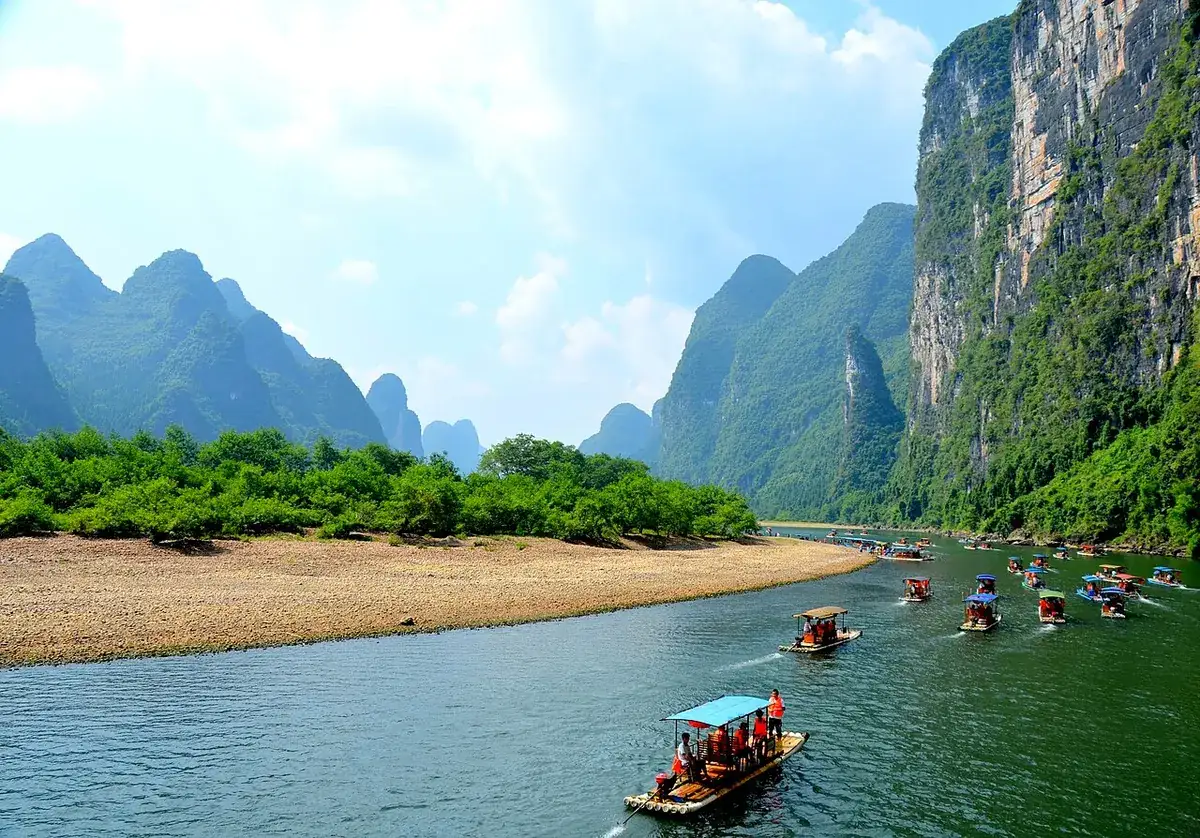
Baise features diverse tourism resources, including the Baise Uprising Memorial Park for revolutionary heritage, tiankeng (giant sinkholes), canyons, and primeval forests for ecological tourism. Major attractions include the Baise Uprising Memorial Hall, the Former Headquarters of the Seventh Red Army, the Youjiang Ethnic Museum, Chengbi Lake, the Dawangling Primeval Forest, the Leye Dashiwei Tiankeng Cluster, the Jingxi Tongling Grand Canyon, the Gulongshan Canyon rafting area, the Tianyang Ganzhuangshan Buluotuo Cultural Tourism Area, and the Lingyun Tea Mountain Pyramids.
Local Specialties
Baise is renowned as the "Hometown of Mangoes in China," with mangoes being the signature agricultural product. Other notable specialties include star anise, tung oil, tea, and various traditional foods reflecting the diverse ethnic cultures of the region.
Famous Figures
Huang Wenxiu (April 18, 1989 - June 17, 2019) was born in Babie Township, Tianyang District, Baise. She was posthumously awarded the title of "National Model for Poverty Alleviation" and received the July 1 Medal. She died in a flash flood while returning from a poverty alleviation mission in the village where she served as first secretary.
Honorary Titles
Baise has received numerous national honors, including National Greening Model Unit (2019), National Double Support Model City (2020, 2025), National Voluntary Blood Donation Advanced City (2020), National Gigabit City (2021), National Health City (2022), and National Model City for Rural Revitalization (2022).
Travel information can change. Check current opening hours, reservations and entry requirements before you travel.


Traveller discussion
Start the conversation with a helpful tip or a question.