
Guilin City
Guilin CityGuilin City, abbreviated as "Gui" and historically known as Guizhou, Jingjiang, and Shi'an, is a prefecture-level city under the Guangxi Zhuang Autonomous Region and a sub-provincial center. Located in southern China at the south
Guilin City
Guilin City, abbreviated as "Gui" and historically known as Guizhou, Jingjiang, and Shi'an, is a prefecture-level city under the Guangxi Zhuang Autonomous Region and a sub-provincial center. Located in southern China at the southern end of the Xiang-Gui Corridor, it sits in the southwestern Nanling mountain system and the north-central Guilin-Yangshuo karst basin. It has a subtropical monsoon climate with a total area of 27,800 square kilometers. As of September 2025, Guilin administers 6 districts, 10 counties, and manages 1 county-level city. As of end-2025, the resident population was 4.9086 million. Guilin is designated by the State Council as an international tourism city, a national tourism innovation pilot zone, and an international tourism transportation hub. It is the only Chinese city recommended for the UN Habitat Scroll of Honour Award, a National Civilized City, and the permanent host of the UN Tourism/PATA Tourism Trends and Outlook Conference. It is also home to the PLA Guilin Joint Logistics Support Center. Guilin has a 2,133-year urban history. The Zengpiyan site showcases prehistoric civilization from 12,000 to 7,000 years ago. After Qin Shi Huang ordered the Lingqu Canal, Guilin became a key Lingnan town and a link in the ancient Maritime Silk Road. After 1938, Guilin became a southern military and political center, known as the famed "Cultural Capital" during the War of Resistance. The city was formally established in 1940. Guilin is an important higher education hub with 16 institutions including Guangxi Normal University, Guilin University of Electronic Technology, Guilin University of Technology, Guilin Medical University, and the Army Special Operations Academy. In 2023, the State Council approved the Guilin World-Class Tourism City Development Plan. In 2025, Guilin's GDP reached 257.953 billion yuan (approximately US$35.83 billion).
Historical Evolution
During the Xia, Shang, and Zhou dynasties, the area was inhabited by the Baiyue people. In 214 BCE, the Qin Dynasty conquered Baiyue and established Guilin Commandery, Nanhai Commandery, and Xiang Commandery in Lingnan. After Qin Shi Huang ordered the Lingqu Canal to connect the Xiang and Li rivers, Guilin became a strategic town linking the southern seas to the northern central plains. In 219 BCE, a Qin army of 500,000 marched south, constructing the Lingqu Canal at Xing'an, comparable in significance to the Great Wall.
In 111 BCE, Shi'an County was established in present-day Guilin under Lingling Commandery of Jingzhou. During the Three Kingdoms, it first belonged to Shu, then to Wu. In 265 CE, Shi'an Commandery was established with its seat at present-day Guilin. During the Southern Dynasties, it was renamed Guizhou.
During the Sui and Tang, it belonged to the Lingnan Guizhou Chief Military Office. In 621 CE, General Li Jing built a city south of Duxiu Peak, and in 634 CE it was renamed Lingui County. From 900 CE, it came under the Jingjiang Military Commission. During the Five Dynasties and Ten Kingdoms, it belonged successively to Chu and Southern Han.
During the Song dynasty, it belonged to Guangnan West Circuit. In 997 CE, Guizhou became the circuit capital. In 1133 CE, it was elevated to Jingjiang Prefecture. During the Yuan dynasty, Yuan forces captured it in 1276 CE and in 1278 CE elevated it to Jingjiang Route, seat of the Guangxi Liangjiang Circuit—hence the alternative name "Jingjiang."
During the Ming dynasty, Zhu Shouqian was enfeoffed as the Prince of Jingjiang with his fief at Guilin. In 1372 CE, the government renamed Jingjiang Prefecture as Guilin Prefecture. The Jingjiang Prince's City, with walls of large bluestone, remains the only completely preserved ancient princely city site in China, lasting 14 generations over 270 years. During the Qing dynasty, the Guangxi Examination Hall was built within the former Prince's City, achieving distinction in Guangxi's educational history.
During the Republic of China period, Guilin served as the Guangxi provincial capital for an extended time. In 1936, the provincial government returned to Guilin under the New Guangxi Clique led by Li Zongren and Bai Chongxi. During the War of Resistance from 1938, Guilin became a major rear-area stronghold second only to Chongqing, serving as the military, political, economic, and cultural center of southern China—the famed "Cultural City." Guilin was liberated on November 22, 1949. In 1998, Guilin City and Guilin Prefecture merged to form the new Guilin City.
Administrative Divisions
Division History
Key changes include: In 1990, Gongcheng County became Gongcheng Yao Autonomous County. In 1996, the suburban district was renamed Yanshan District. In 2013, Lingui County was abolished and Lingui District established, with the government seat relocated. In 2018, Lipu County became county-level Lipu City, administered by Guilin.
Division Details
As of September 2025, Guilin administers 6 districts (Xiufeng, Diecai, Xiangshan, Qixing, Yanshan, Lingui), 10 counties (Yangshuo, Lingchuan, Quanzhou, Xing'an, Yongfu, Guanyang, Longsheng Gezu Autonomous County, Ziyuan, Pingle, Gongcheng Yao Autonomous County), and 1 county-level city (Lipu). The municipal government is at No. 69 Xicheng Middle Road, Lingui District.
Geographical Environment
Location and Territory
Guilin is located in the southwestern Nanling mountain system at the southern end of the Xiang-Gui Corridor, in northeastern Guangxi, between 109 degrees 36 minutes to 111 degrees 29 minutes east longitude and 24 degrees 15 minutes to 26 degrees 23 minutes north latitude. It borders Hunan Province to the north, Hezhou to the southeast, Wuzhou and Laibin to the south, and Liuzhou to the west. The total area is 27,800 square kilometers, 11.74% of Guangxi's total.
Topography and Landforms
The terrain is higher in the west, north, and southeast, and lower in the center. The main peak, Mao'er Mountain in the Yuecheng Ridge, reaches 2,141.5 meters—the highest in southern China. Pingle County descends to 97 meters. The central area features classic karst landforms with striking peaks and beautiful waters, presenting karst peak forests, isolated peak plains, and river terraces.
Climate
Guilin has a subtropical monsoon climate. The annual average temperature is approximately 19.1 degrees Celsius. July and August are the hottest months (averaging around 28 degrees), while January and February are the coldest (around 9 degrees). Annual average rainfall is 1,887.6 millimeters with 166 rainy days. The annual average relative humidity is 76%.
Hydrology
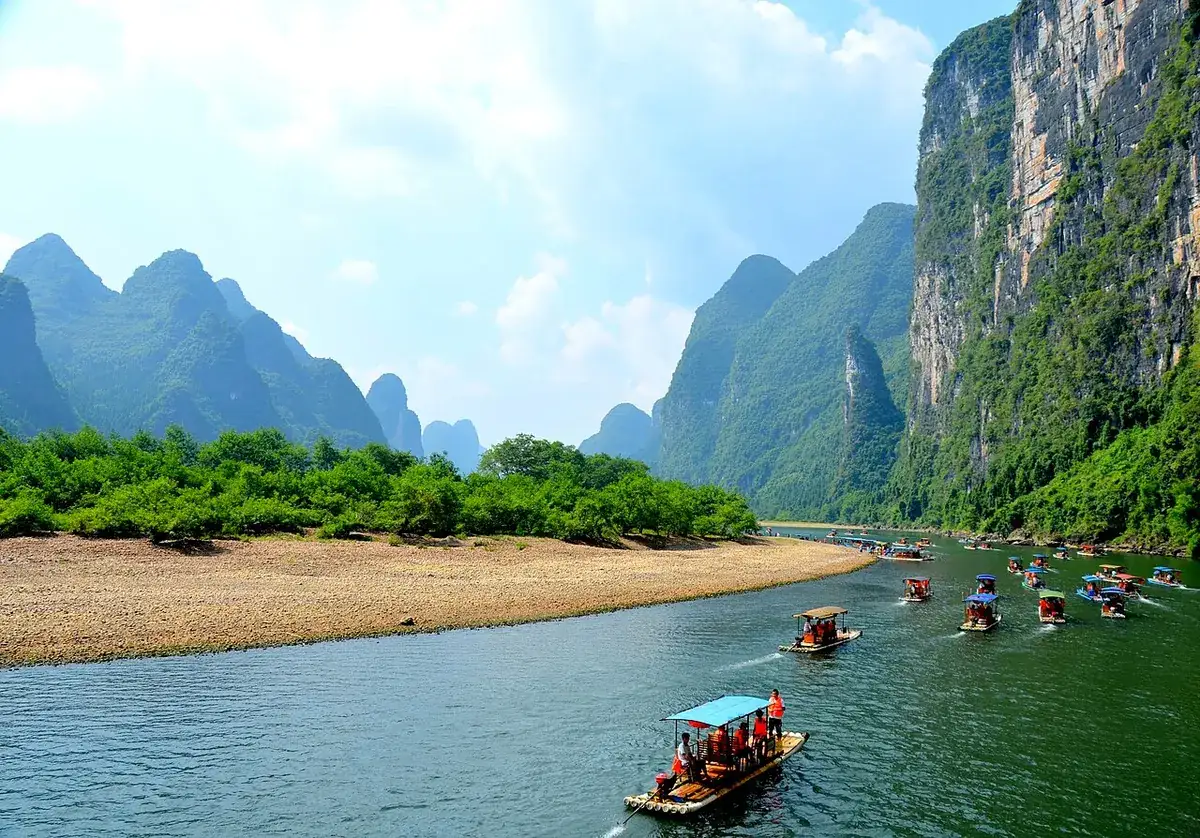
Guilin is in the Guijiang River basin, a tributary of the Xijiang River, with a catchment area of 19,288 square kilometers. The Lijiang River, the upper reach of the Guijiang, has a basin area of 12,565 square kilometers within Guilin, with a main stream length of 295.27 kilometers and average runoff of 12.895 billion cubic meters. Major tributaries include the Taohua River, Xiaodongjiang River, Nanxi River, Liangfeng River, and Ningyuan River.
Natural Resources
Plant Resources
The city has 249 families and 1,103 genera of vascular plants, with over 2,000 known higher plant species. Silver fir (Cathaya) and tree fern (Alsophila) are national first-class protected plants. Forest byproducts include pine resin, shiitake mushrooms, wood ear fungus, and monk fruit (luohanguo).
Animal Resources
Guilin has approximately 545 species of terrestrial vertebrate wildlife, including 36 amphibians, 58 reptiles, 375 birds, and 76 mammals. There are 69 species under national key protection, including 7 first-class protected species: yellow-bellied tragopan, white-necked long-tailed pheasant, golden eagle, python, leopard, clouded leopard, and forest musk deer.
Mineral Resources
Guilin has identified 48 usable mineral resources, of which 40 have proven reserves. Seventeen minerals rank among the top in the region. Talc quality ranks among the world's best, with proven reserves among the nation's top. Lead-zinc, niobium-tantalum, granite, limestone, marble, and barite also have favorable prospects.
Population
According to the Seventh National Census (November 2020), the resident population was 4,931,137, up 3.86% from 2010. As of end-2025, the resident population was 4.9086 million, with an urbanization rate of 56.11%. The birth rate was 5.34 per thousand, death rate 8.84 per thousand, and natural growth rate negative 3.5 per thousand. Guilin is a multi-ethnic city with Han, Zhuang, Miao, Yao, Dong, Hui, Jing, Yi, Shui, Manchu, and other groups.
Politics
Current Leadership
The city's political leadership comprises the Municipal Party Committee Secretary, Mayor, and Chairman of the People's Congress, leading the municipal government apparatus.
External Exchange
Guilin maintains sister-city relationships and international cooperation programs worldwide, leveraging its status as an international tourism city and permanent host of the UN Tourism/PATA conference.
Economy
Overview
In 2025, Guilin achieved a GDP of 257.953 billion yuan (approximately US$35.83 billion), up 3.5%. Primary industry value-added was 61.329 billion yuan (approximately US$8.51 billion), up 3.6%; secondary industry 51.337 billion yuan (approximately US$7.13 billion), up 2.5%; and tertiary industry 145.287 billion yuan (approximately US$20.18 billion), up 3.8%. The three sectors accounted for 23.8%, 19.9%, and 56.3% of GDP respectively. Per capita GDP was 52,392 yuan (approximately US$7,277), up 3.9%. Fixed asset investment fell 11.2%. General public budget expenditure was 53.759 billion yuan (approximately US$7.47 billion), with nearly 80% allocated to livelihood areas. Per capita disposable income was 36,010 yuan (approximately US$5,001), up 4.3%. Urban residents' income was 47,202 yuan (approximately US$6,556) and rural residents' 24,158 yuan (approximately US$3,355).
Primary Industry
In 2025, total agriculture, forestry, animal husbandry, and fishery output was 103.045 billion yuan (approximately US$14.31 billion), up 3.6%. Grain output was 1.8044 million tons. Vegetable output was 6.6338 million tons. Fruit output was 11.3379 million tons, with citrus at 7.7663 million tons. Meat output was 633,200 tons. Chinese medicinal herbs covered 942,300 mu (approximately 62,820 hectares), with output of 554,700 tons, up 15.5%.
Secondary Industry
In 2025, designated-size industrial value-added grew 7.0%. High-tech industry grew 5.7%. Mining grew 25.4%, manufacturing 8.6%. Railway, shipbuilding, and aerospace manufacturing grew 50.3%, computer and electronic equipment manufacturing 20.1%, and automobile manufacturing 18.6%. Construction value-added fell 11.0%.
Tertiary Industry
In 2025, the tertiary industry value-added grew 3.8%. Wholesale and retail grew 3.9%, transportation and postal services 5.8%, accommodation and catering 4.7%, finance 3.7%, and real estate 1.7%. Total retail sales grew 3.3%. Foreign trade reached 12.507 billion yuan (approximately US$1.74 billion), up 9.8%. Postal and telecom volume reached 7.294 billion yuan (approximately US$1.01 billion). By end-2025, 15,700 5G base stations served 6.604 million mobile users.
Guilin received 175 million domestic tourists (up 11.9%), generating 217.547 billion yuan (approximately US$30.21 billion) in tourism revenue (up 12.8%), plus 1.6227 million overnight inbound tourists with US$655 million in international tourism revenue. Financial institution deposits reached 594.182 billion yuan (approximately US$82.53 billion); loans 452.954 billion yuan (approximately US$62.91 billion). Insurance premium income was 8.239 billion yuan (approximately US$1.14 billion).
Social Affairs
Science and Technology
In 2025, 806 scientific achievements were registered (up 65.5%). Patent grants totaled 3,416, including 1,326 invention patents. Technology contract transaction value was 4.625 billion yuan (approximately US$642 million), up 16.8%.
Education
Guilin's educational tradition dates to the Tang dynasty. As of end-2025, there are 13 regular higher education institutions with 342,600 students including 25,200 graduate students, 228 secondary schools with 32,850 students, 537 primary schools with 398,200 students, and 1,035 kindergartens. The nine-year compulsory education retention rate is 100.21%.
Culture
As of end-2025, Guilin has 14 public libraries with 5.7043 million volumes, 18 cultural centers, 7 theaters, 28 museums, and 9 performing arts groups. It holds 129 intangible cultural heritage projects at or above provincial level. Radio coverage is 99.7% and TV coverage 99.8%. The Guangxi Guilin Library is a national first-class library, and the Guilin Museum a national first-class museum.
Healthcare
Guilin has 5,021 health institutions, including 101 hospitals (8 Class A tertiary). There are 34,100 beds and 46,900 health professionals, including 17,300 physicians and 21,800 nurses. The Xiangya Second Hospital of Central South University Guilin Hospital serves as a national regional medical center.
Sports
In 2023, Guilin had 16,580 sports venues with 3.25 square meters per capita. Athletes won 36 international medals (25 gold) and 85 national medals (36 gold).
Social Security
In 2025, 57,700 new urban jobs were created. The minimum wage was 2,200 yuan per month (approximately US$306). Basic pension insurance covered 2.3016 million people, basic medical insurance 3.9754 million, unemployment insurance 613,100, and work injury insurance 744,900. The city has 100 welfare institutions with 13,300 beds, including 85 elderly care facilities.
Transportation
Overview
Guilin sits at the junction of the Pan-Pearl River Delta, Southwest China, and ASEAN economic circles. Since the Qin dynasty's Lingqu Canal linked the Pearl and Yangtze systems, Guilin has been a vital gateway. A comprehensive multimodal network integrates aviation, railway, highway, and waterway. As of end-2025, the city had 1.0054 million civilian vehicles (up 4.3%), including 123,800 new energy vehicles (up 35.3%).
Highways
Guilin has 5 national highways totaling 1,126 kilometers. The Guilin-Liuzhou Expressway connects south to Liuzhou, Nanning, and Beihai, and north to Hunan. The Guilin-Wuzhou Expressway shortens the route to the Pearl River Delta and Hong Kong-Macau. Multiple expressways opened since 2013. In 2024, the Guilin Outer Ring Expressway began construction. In 2025, highway passenger turnover grew 22.5%.
Railways
With the Xiang-Gui Railway expansion (2013) and Gui-Guang High-Speed Railway (2014), Guilin entered the high-speed rail era. Guilin North Station serves as a major hub. Direct trains reach Nanning, Changsha, Wuhan, Shanghai, Guiyang, Guangzhou, and Beijing. The two lines intersect in Guilin, forming a two-to-three-hour economic circle with four provincial capitals, integrating into the China-ASEAN Free Trade Area.
Aviation
Guilin Liangjiang International Airport in Lingui District covers 4.53 square kilometers with a 4E rating and 3,200-meter runway. The T2 terminal (100,000 square meters) was completed in 2018, bringing annual capacity to 12 million passengers. The airport served 75 cities with 96 routes, including international routes to Jakarta, Singapore, Kuala Lumpur, Incheon, Bangkok, Hong Kong, and Taipei. It is designated as a regional hub airport. In 2025, passenger volume grew 9.6%.
Sky Rail
Guilin Sky Rail Line 1 broke ground on August 28, 2017. A tourism test line was planned from the city center to Liangjiang Airport via the Lingui New District.
Waterways
Main navigable rivers include the Lijiang, Guijiang, Xiangjiang, Luoqingjiang, Zijiang, Xunjiang, and Baishouhe, totaling 541 kilometers with 175 navigable. The Lijiang and Guijiang flow via Wuzhou into the Pearl River to the open sea. In 2025, waterway passenger turnover grew 10.2%.
History and Culture
Overview
The fusion of multi-ethnic regional culture is an important characteristic of Guilin's urban culture, encompassing farming, pastoral traditions, festivals, attire, cuisine, architecture, language, and religious beliefs.
Origin of the Name
The name "Guilin" first appeared in the "Classic of Mountains and Seas" (Shan Hai Jing) from the Warring States period. Guilin Commandery was named for the abundant cassia (gui) trees in the area.
Cultural Heritage
Within the urban area are 552 cultural relic sites, with 117 protected (5 national, 23 autonomous-region, 89 municipal/county). Notable sites include the Zengpiyan cave site, the Xing'an Lingqu Canal (one of China's three great ancient water projects alongside the Grand Canal and Dujiangyan), the Ming Jingjiang Prince's Mansion and royal tomb complex (the largest and best-preserved in China), the Gongcheng Confucian Temple (one of China's four great Confucian temples), the Guihai Stele Forest, and the Quanzhou Xiangshan Temple.
Cradle of Wisdom
Guilin is a "Ten-Thousand-Year Cradle of Human Wisdom"—the only city worldwide with three ten-thousand-year-old pottery sites (Zengpiyan, Dayan, Miaoyan). The "proto-pottery" at Zengpiyan fills a gap in world pottery origins. In 2017, the Chinese Academy of Sciences officially named Guilin a "Ten-Thousand-Year Cradle of Wisdom." A total of 169 prehistoric sites have been discovered, making Guilin one of China's cities with the richest prehistoric cultural sites.
Cultural Characteristics
Guilin's culture is closer to the Yangtze River basin culture. The local dialect belongs to the Gui-Liu branch of Southwestern Mandarin. Traditional architecture was nearly entirely destroyed by wartime conflicts and Japanese bombing.
Folk Customs
Guilin is a multi-ethnic city where 28 ethnic minorities account for approximately 8.5 per thousand of the population. They maintain distinctive customs: the Zhuang Sanyuesan Song Festival, the Yao Panwang Festival and Danu Festival, the Miao Lusheng Festival, and the Dong Huapao Festival. Each group preserves its own attire, food, festivals, and language.
Local Specialties
The "Four Treasures of the Lijiang River" are: Lijiang longevity fish, Lijiang spring shrimp, Lijiang chrysanthemum crab, and Lijiang rock snail. The "Three Treasures of Guilin" are chili sauce, fermented bean curd, and Sanhua rice wine. Adding watermelon frost creates the "Four Treasures of Guilin."
Scenic Attractions
Overview
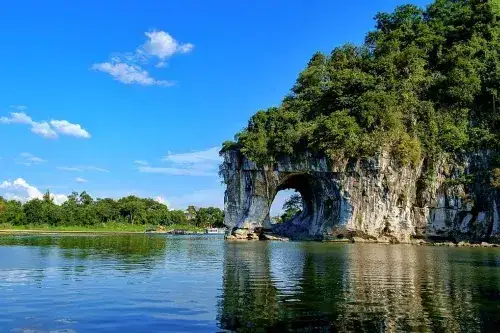
Guilin is a national key tourism city designated as a priority for inbound tourism. In November 2012, the Guilin International Tourism Destination Development Plan was elevated to national strategy. As a 2,000-year cultural city, its heritage includes prehistoric culture (Zengpiyan), ancient city planning (Song and Ming dynasties), water conservancy technology (Lingqu Canal), landscape culture (mountains and cliff carvings), Ming princely culture, and modern revolutionary heritage. As of December 2017, Guilin had 60 A-level scenic areas, including 4 at 5A level: the Lijiang River Scenic Area, Guilin Merryland, Duxiu Peak-Prince's City, and the Two Rivers and Four Lakes-Elephant Hill.
Famous Attractions
Key attractions include the Lijiang River, Elephant Trunk Hill, Reed Flute Cave, Duxiu Peak, Seven Star Park, Diecai Hill, Fubo Hill, and the Jingjiang Prince's City, among numerous other scenic and cultural sites.
Famous People
Historical figures include Zhao Guanwen, Cao Ye, Jiang Mian, Lu Diaoyang, Shi Tao, Chen Hongmou, Tang Jingsong, Wang Pengyun, and Kuang Zhouyi. Modern figures include Liang Shuming, Ma Junwu, Li Zongren, Bai Chongxi, and Huang Xuchu. Contemporary figures include Bai Xianyong, Yu Junjian, Wen Qing, Ouyang Xiadan, Qiao Zhenyu, and Zhang Li.
Media Coverage
In April 2023, the "Rural Revitalization" national public welfare tour featuring 100 artists opened in central Guilin, celebrating the Guangxi Sanyuesan Festival, hosted by CCTV presenter Xi Kai.
Honorary Titles
Guilin has received numerous honors including National Civilized City, National Garden City, National Sanitary City, and China's Top Tourism City. It is the only Chinese city recommended for the UN Habitat Scroll of Honour Award and serves as permanent host of the UN Tourism/PATA Tourism Trends and Outlook Conference.
Travel information can change. Check current opening hours, reservations and entry requirements before you travel.
Traveller discussion
Start the conversation with a helpful tip or a question.