
Liuzhou City
Liuzhou CityLiuzhou City, abbreviated as "Liu" and also known as Dragon City (Longcheng), is a prefecture-level city in Guangxi Zhuang Autonomous Region, designated by the State Council as a provincial sub-center and important central city
Liuzhou City
Liuzhou City, abbreviated as "Liu" and also known as Dragon City (Longcheng), is a prefecture-level city in Guangxi Zhuang Autonomous Region, designated by the State Council as a provincial sub-center and important central city in central Guangxi. Located in northern Guangxi with a subtropical monsoon climate, it covers 18,596 square kilometers. As of end-2025, the permanent population was 4.1258 million across 10 counties and districts. Liuzhou dialect is a subdialect of the Gui-Liu branch of Southwestern Mandarin. Historically part of the Baiyue territory, Liuzhou came under Guilin Commandery after Qin Shi Huang unified Lingnan. In 111 BCE, Tanzhong County was established, marking the city's administrative beginning. Liuzhou was formally established as a city in 1949 and came under direct autonomous region jurisdiction in 1961. A National Famous Historical and Cultural City with over 2,100 years of history, it features prehistoric sites like Bailiandong and Liujiang Man, and a vibrant multi-ethnic culture known for "Zhuang songs, Yao dances, Miao festivals, and Dong architecture." As the largest industrial city in Guangxi, it has formed an industrial system led by automobiles, machinery, and steel. Six railway lines, eight expressways, and six national highways converge here, with Bailian Airport serving major cities. The city has earned National Garden City, National Forest City, and UN Habitat Best Practices awards. In 2025, GDP reached 309.691 billion yuan (approximately USD 43.0 billion), up 6.2%.
Name Evolution
Liuzhou was historically known as Tanzhong, Maping, Kunzhou, Southern Kunzhou, and Longcheng. The name "Liuzhou" dates to 634 CE during the Tang dynasty, derived from the Liu River. According to the Tang-era Yuanhe Junxian Zhi, "In the eighth year of Zhenguan it was changed to Liuzhou, named after the Liu River." The city was first established in 111 BCE as Tanzhong County, named for its midpoint position on the ancient Tan River. The name stabilized as "Liuzhou" from the Qianyuan era and has been used ever since.
Historical Evolution
Qin, Han to Northern and Southern Dynasties
The territory belonged to the Baiyue lands. Under the Qin, it was part of Guilin Commandery. In 111 BCE, Tanzhong County was established near present-day Yufeng District under Yulin Commandery. During the Three Kingdoms (222-280 CE), Chang'an County was set up in present-day Luzhai County. In 274 CE, Guilin Commandery was carved from Yulin. Under the Western Jin, Tanzhong served as the Guilin Commandery seat. During the Southern Dynasties, the Qi and Liang established Qixi, Longzhou, and Lianghua in the region.
Sui and Tang Dynasties
During the Sui Kaihuang era (581-600 CE), Longzhou and Lianghua Commandery were abolished. In 591 CE, Tanzhong was renamed Guilin County, and Maping County was carved from it. Under the Tang, Rongzhou was reestablished and Kunzhou was set up at Maping in 621 CE. In 634 CE, Southern Kunzhou was renamed Liuzhou. In 742 CE, it was renamed Longcheng Commandery (origin of the "Dragon City" alias), reverting to Liuzhou in 758 CE.
Song and Yuan Dynasties
In 1006 CE, Longcheng County became Liucheng County. In 1105 CE, Huaiyuan County was established in present-day Sanjiang Dong Autonomous County. Under the Yuan in 1279 CE, Liuzhou became Liuzhou Route, with the seat moved back to Maping in 1308 CE.
Ming and Qing Dynasties
In 1368 CE, Liuzhou Route became Liuzhou Prefecture. By the end of the Ming, it administered ten counties plus Xiangzhou and Binzhou. Under the Qing, it belonged to the Youjiang Circuit. In 1725 CE, Binzhou and four counties were carved out. By the Qing's end, the prefecture administered seven counties and Xiangzhou.
Republic of China Period
In 1912, Maping was merged into Liuzhou Prefecture. In 1913, the prefecture was abolished and Maping reestablished with the Liujiang Circuit. In 1930, a militia system created the Liuzhou Militia District. In 1931, Maping became Liuzhou County, renamed Liujiang County in 1937. By 1949, the Second Administrative Inspection District administered Liujiang, Liucheng, and other counties.
After the Founding of the People's Republic
On December 19, 1949, the Liuzhou Municipal People's Government was established as a county-level city. It became a province-level city in March 1950, was placed under the Guangxi Zhuang Autonomous Region in 1957, and came under direct autonomous region jurisdiction on November 25, 1961.
Administrative Divisions
Division History
Liuzhou City was formed in 1949 from three towns of Liujiang County. In 1952, Luzhai County was created by merging three former counties. In 1953, Rong County became Rongan County and Sanjiang Dong Autonomous Region was established. In 1966, Damiaoshan Miao Autonomous County became Rongshui Miao Autonomous County. In 1971, Liuzhou Special District became Liuzhou Prefecture. In 1983, Liujiang and Liucheng counties joined municipal jurisdiction. In 2002, Liuzhou Prefecture was abolished and Luzhai, Rongan, Rongshui Miao, and Sanjiang Dong autonomous counties were placed under Liuzhou. In 2016, Liujiang County became a district.
Division Details
As of end-2025, Liuzhou administers five municipal districts, three counties, and two autonomous counties, comprising 53 towns, 33 townships, 32 subdistricts, 228 urban communities, 72 township communities, and 935 villages. The municipal government is at No. 66 Wenchang Road, Chengzhong District. Three functional zones include Liudong New District, Yanghe Industrial New Zone, and Northern Ecological New Zone.
Natural Resources
Land Resources
Liuzhou has 1.8596 million hectares of total land, including 346,600 hectares of cultivated land, 1.1055 million hectares of forest, 114,800 hectares of grassland, and 70,300 hectares of urban and mining land.
Water Resources
With abundant rainfall, Liuzhou has a developed water system covering 369.58 square kilometers, primarily in the Liujiang, Longjiang, Luoqingjiang, and Xunjiang rivers plus reservoirs. Multi-year average precipitation is 1,745 mm, with total water resources of 18.21 billion cubic meters. Exploitable groundwater resources average 1.803 billion cubic meters annually.
Mineral Resources
Located in the central-western Nanling metallogenic belt, Liuzhou has 47 discovered mineral types with 30 listed in reserves, including coal, iron, manganese, copper, lead, zinc, tin, antimony, gold, and silver. There are 51 mining sites. Key advantageous minerals include dolomite, flux limestone, cement limestone, barite, and kaolin, distributed across the urban area, Liucheng, Luzhai, Rongshui, and Liujiang.
Biodiversity
Plants
Liuzhou has over 5,000 wild plant species, including more than 10 Class I nationally protected species such as Yuanbaoshan fir and southern yew, and over 200 Class II protected species. Over 3,000 medicinal plant species have been recorded, primarily in the Yuanbaoshan and Jiuwandashan National Nature Reserves.
Animals
Liuzhou has over 590 wildlife species, including 62 mammals, 212 birds, 71 reptiles, 33 amphibians, and 113 fish. Nine Class I protected animals include the giant softshell turtle, pangolin, and sika deer. Forty-four Class II protected animals include the python, macaque, black bear, and giant salamander. There are 110 migratory bird species.
Nature Reserves
Liuzhou has five nature reserves totaling 43,428.92 hectares, including two national-level reserves. The Jiuwandashan National Nature Reserve spans 23,151.50 hectares across Rongshui in Liuzhou and Luocheng and Huanjiang in Hechi. The Yuanbaoshan National Nature Reserve covers 4,220.7 hectares in Rongshui with 98.5 percent forest coverage. The Lagou Reserve in Luzhai covers 11,500 hectares. The Sijianshan Giant Salamander Reserve covers 10,384 hectares in Rongshui. The Sansuo County-Level Reserve covers 5,600 hectares in Rongan.
Geography
Location and Territory
Liuzhou is in northern Guangxi between 23 degrees 54 minutes and 26 degrees 03 minutes north latitude, and 108 degrees 35 minutes and 110 degrees 10 minutes east longitude. It borders Guilin to the east, Hechi to the west, Laibin to the south, and Hunan and Guizhou provinces to the north, with a total area of 18,598 square kilometers.
Geology
The area is dominated by Paleozoic strata, primarily carbonate rocks (limestone and dolomite). Liuzhou sits on the fault-fold belt of the central Guangxi depression, with a structural history spanning from the Late Paleozoic quasi-platform through Late Mesozoic and Cenozoic continental margin activity.
Topography
The urban area is relatively flat at 85-105 meters elevation, surrounded by mountains on three sides with typical karst landforms. The Liu River creates river terrace and karst features in a natural basin.
Climate
Liuzhou has a subtropical monsoon climate with long summers and short winters. Average annual temperatures range from 18.1 degrees Celsius in the north to 20.7 degrees Celsius in the south. January averages 7.2-10.4 degrees Celsius and July 27.2-28.9 degrees Celsius. Annual precipitation ranges 1,345-1,940 mm, concentrated from April to September, with Rongshui exceeding 2,000 mm.
Hydrology
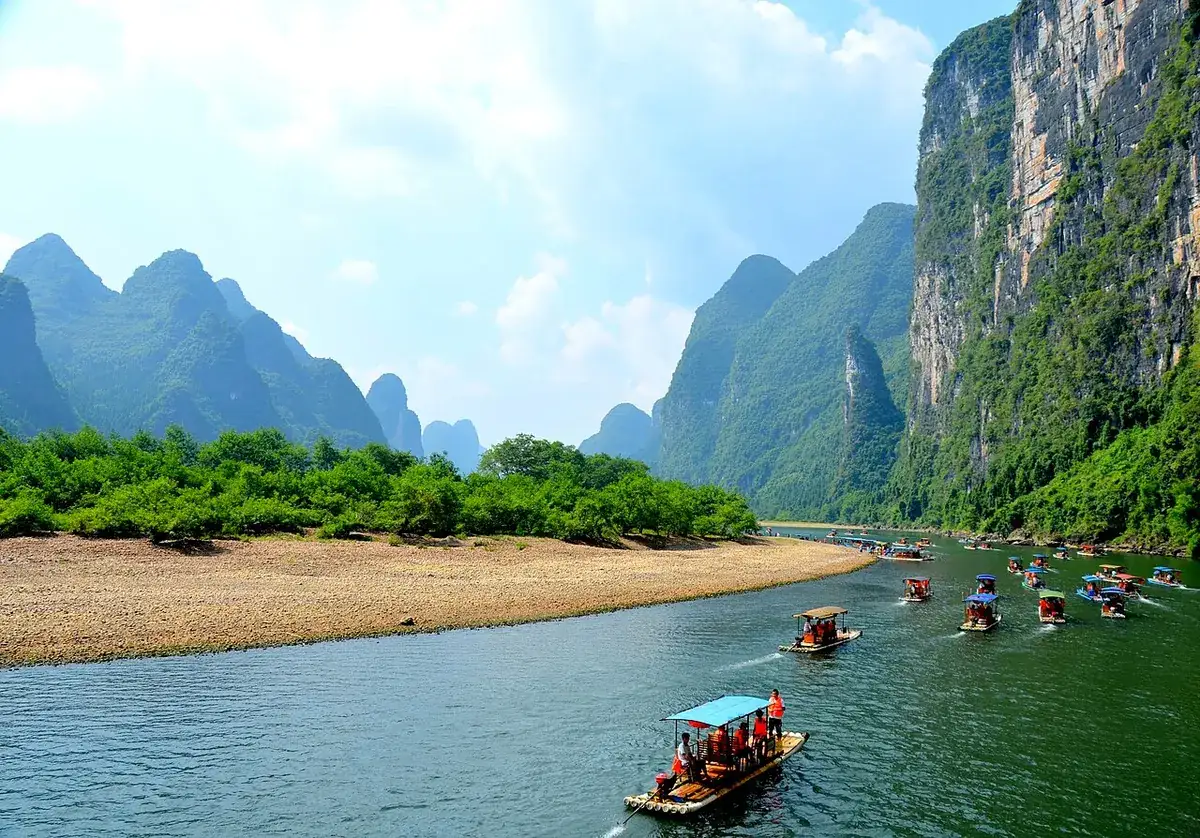
Liuzhou belongs to the Pearl River-Xijiang basin. The Liu River is the largest, originating in Dushan County, Guizhou, running 272 kilometers with a catchment area of 58,398 square kilometers. It enters the urban area at Lutang and winds through the city forming a bottle-shaped peninsula.
Water Conservancy
As of end-2025, Liuzhou has 312 reservoirs (one large, 12 medium, 299 small). Year-end storage was 265.70 million cubic meters. Total water supply from storage projects was 428.33 million cubic meters.
Soil
Liuzhou's soils include five classes, 12 subclasses, 54 genera, and 158 species. Red earth is most widespread, characterized by red color, acidity, and iron-aluminum richness. Rice paddy and alluvial soils are also present.
Natural Disasters
Main hazards include flooding, drought, and hail. The city sits at the intersection of northeast-southwest and east-west fault zones, with 70 percent of its underground area being karst. From 1510 to 1992, 63 earthquakes were recorded without significant damage. On May 18, 2026, two magnitude 5.2 earthquakes struck Liunan District at 8-kilometer depth, causing two deaths, four injuries, and 15 collapsed houses, the highest-magnitude quake in 331 years due to shallow karst amplifying seismic waves.
Population
Population Size
As of end-2025, the permanent population was 4.1258 million (down 20,200), with 2.9706 million urban (72.00 percent urbanization rate, up 0.58 points). The registered population was 3.9900 million. Births totaled 25,200 (6.32 per thousand) and deaths 51,200 (12.83 per thousand), with a natural growth rate of negative 6.49 per thousand.
Ethnic Composition
Liuzhou has eight indigenous groups: Han, Zhuang, Dong, Miao, Yao, Hui, Mulao, and Sui. The Zhuang are mainly in Liujiang, Liucheng, and Luzhai. The Miao are concentrated in Rongshui (43.79 percent) and the Dong in Sanjiang (57.83 percent). The Yao are distributed across Rongshui, Sanjiang, Rongan, and Luzhai.
Dialects
Southwestern Mandarin Liuzhou dialect is the primary daily language, with other dialects including Pinghua, Hakka, Cantonese, Southern Min, and Huguang. The Liuzhou dialect is widely used across Liuzhou, Laibin, Hechi, and Baise, closely related to Guilin dialect.
Religion
In 2023, Liuzhou had five major religions (Buddhism, Daoism, Islam, Catholicism, and Protestant Christianity) with 12 religious organizations and 96 activity sites. Religious clergy numbered 112, with approximately 55,000 believers and 347 registered folk belief sites.
Politics
The municipal government follows standard Chinese governance under the Communist Party of China, with the Municipal Party Committee, People's Congress, and People's Government administering city affairs.
Economy
Overview
In 2024, GDP was 295.067 billion yuan (approximately USD 41.0 billion, up 1.5 percent). Primary industry was 30.876 billion yuan (approximately USD 4.3 billion, up 3.7 percent), secondary industry 117.866 billion yuan (approximately USD 16.4 billion, up 1.6 percent), and tertiary industry 146.325 billion yuan (approximately USD 20.3 billion, up 1.1 percent). In 2025, GDP reached 309.691 billion yuan (approximately USD 43.0 billion, up 6.2 percent), with primary industry at 30.804 billion yuan (approximately USD 4.3 billion, up 4.2 percent), secondary industry at 125.110 billion yuan (approximately USD 17.4 billion, up 7.7 percent), and tertiary industry at 153.778 billion yuan (approximately USD 21.4 billion, up 5.0 percent). Fixed asset investment grew 4.6 percent, with high-tech investment up 35.9 percent. General public budget expenditure was 47.939 billion yuan (approximately USD 6.7 billion), with livelihood spending at 80.9 percent. Per capita disposable income was 39,412 yuan (approximately USD 5,475), with urban income at 47,689 yuan (approximately USD 6,623) and rural at 22,427 yuan (approximately USD 3,115).
Primary Industry
In 2025, grain output was 749,400 tons. Pig slaughter reached 2.0946 million head (up 12.6 percent) and poultry 38.0724 million (down 6.1 percent). Pork output was 167,649 tons (up 13.6 percent), with beef, mutton, and poultry also reported.
Secondary Industry
In 2025, designated-scale industrial value-added grew 10.3 percent. Manufacturing grew 11.6 percent while mining fell 10.4 percent. Equipment manufacturing grew 17.8 percent and high-tech manufacturing 31.1 percent. Key growth sectors included electrical machinery (up 34.6 percent), metal products (up 22.4 percent), and automobile manufacturing (up 14.8 percent). Lithium-ion battery output grew 56.6 percent. Construction value-added was 8.025 billion yuan (approximately USD 1.1 billion, down 3.4 percent).
Tertiary Industry
In 2025, tertiary industry value-added grew 5.0 percent. Transportation and warehousing grew 7.3 percent, wholesale and retail 5.6 percent, and accommodation and catering 5.1 percent. Internet and software services revenue grew 101.4 percent. Total goods import and export was 44.223 billion yuan (approximately USD 6.1 billion, up 17.9 percent), with electric vehicle exports up 264.5 percent. Deposit balances reached 541.331 billion yuan (approximately USD 75.2 billion) and loan balances 618.700 billion yuan (approximately USD 85.9 billion). Domestic tourists numbered 101.6083 million, with total tourism consumption of 112.493 billion yuan (approximately USD 15.6 billion).
Transportation
In 2025, Liuzhou handled 182.72 million tons of highway freight (up 5.4 percent) and 5.4 million tons of waterway freight (down 35.1 percent). Air passengers totaled 622,700. Motor vehicle ownership reached 1.5875 million vehicles.
Highways
Liuzhou is one of China's 45 highway hub cities, with six passenger bus terminals including Liuzhou Main, South, Lianhua, Baisha, Hedong, and Liujiang stations.
Railways
An important Southwest China railway hub, Liuzhou is served by conventional lines including Xianggui (Hunan-Guangxi), Qiangui (Guizhou-Guangxi), and Jiaoliu (Jiaozuo-Liuzhou), plus high-speed lines including Hengliu, Liunan Intercity, and Guiguang. Six urban stations and five county-level passenger stations serve the city.
Shipping
Liuzhou Port is a local inland river port for commodity exports, transit, and tourism. The Liujiang River supports 500-ton vessel navigation year-round to Wuzhou, Guangzhou, Hong Kong, and Macau. Opened in 1990 as a national Class I inland river port.
Aviation
Liuzhou Bailian Airport, 12 kilometers from downtown, is a 4D-standard civil airport and one of Guangxi's six major airports. Its 2,540-meter runway serves most aircraft types, with annual capacity of 1.2 million passengers.
Public Transportation
As of 2021, the bus system operated 102 routes with 1,391 vehicles and 211 million annual riders. The BRT system has 10 express lines. Guangxi's first water bus system has 9 routes. Taxi fares start at 6.00 yuan (approximately USD 0.83) daytime and 8.00 yuan (approximately USD 1.11) nighttime. The city launched Guangxi's first public bicycle rental system with 320 stations and 7,500 bicycles. A planned 7-line light rail system totaling 226.8 kilometers with 129 stations is under construction, with Lines 1 and 2 begun in 2016 using Bombardier monorail trains.
Social Services
Education
In 2025, Liuzhou had 9 vocational secondary schools with 27,300 students. Regular high schools enrolled 91,300 total, junior high 177,600, and primary schools 337,600. Special education served 1,140 students and preschool 110,900.
Science and Technology
In 2025, Liuzhou received 34 Guangxi Science and Technology Awards and authorized 3,450 patents. Technology contracts totaled 9.296 billion yuan (approximately USD 1.3 billion). In July 2025, the city was approved to build a national-level intellectual property protection center.
Culture
As of end-2025, Liuzhou had 2 art troupes, 11 public libraries with 3.526 million volumes, 10 cultural centers, 1 mass art center, and 23 museums. TV coverage reached 99.88 percent and radio 99.38 percent.
Healthcare
As of end-2025, Liuzhou had 2,542 health institutions including 92 hospitals, 93 township health centers, and 897 village clinics. Health workers totaled 45,000 including 16,300 physicians and 20,900 nurses, with 33,400 beds.
Sports
As of end-2025, Liuzhou had 34 public sports venues and 21 gymnasiums. Athletes won 44 gold, 24 silver, and 16 bronze medals in world competitions, breaking Asian records three times, plus 255 gold medals nationally.
Social Security
In 2025, Liuzhou added 47,500 urban jobs. Basic pension insurance participants reached 2.7064 million, unemployment insurance 674,800, and basic medical insurance 3.7108 million. Urban minimum living standard was 770 yuan per month (approximately USD 107) and rural 6,000 yuan per year (approximately USD 833). The city had 302 community service centers and welfare institutions with 5,158 beds.
History and Culture
Regional Symbols
In December 2018, the city designated small-leaf banyan as the city tree and orchid tree (Bauhinia) as the city flower.
Folk Customs
Liuzhou is a convergence point for Han and indigenous Lingnan peoples, with 18 ethnic groups. The "four wonders" of Zhuang songs, Yao dances, Miao festivals, and Dong architecture showcase vibrant ethnic culture. The Sanyuesan festival features antiphonal singing known as the "song fair."
Costumes
Zhuang traditional dress is categorized by gender, age, role, and occasion, with women renowned for weaving, brocade, and wax-resist dyeing. Dong embroidery features vivid birds and animals on collars and headscarves, with colorful Dong brocade. The Miao "Hundred Bird Coat" is a ceremonial garment decorated with feathers and pearls, combining weaving, dyeing, papercutting, embroidery, and metal forging.
Architecture
Zhuang stilt houses have living quarters above and livestock below. Dong villages center on the Drum Tower with singing plazas and shrines, featuring four stilt house types by terrain. Miao mountainside stilt houses have three levels: grain storage, living quarters, and livestock below.
Snacks
Liuzhou cuisine is bold and spicy. The signature dish is snail rice noodles (luosifen). Other specialties include snail and duck feet stew, sour bamboo shoot stir-fried snails, Liuzhou sour pickles, filtered rice noodles, Sanjiang Dong oil tea, Sanjiang rice dumplings, Liucheng rice crackers, Rongan kumquat, and Rongshui vinegar blood duck.
Intangible Cultural Heritage
As of September 2023, Liuzhou had 6 national-level, 104 autonomous-region-level, and 206 municipal-level intangible cultural heritage items with 367 total inheritors. Notable items include Dong wooden architecture techniques, the Dong Grand Song, and snail rice noodle making. Sanjiang County preserves 178 drum towers and 113 wind-and-rain bridges, with the 77.76-meter Chengyang Bridge being most representative.
Cultural Relics and Sites
Liuzhou has 7 national-level protected units spanning prehistoric to modern sites. The Bailiandong Site (37,000-7,000 years ago) is key for South China prehistoric sequences. The Liyuzui Site (20,000-5,000 years ago) yielded 6 complete skeletons. The Ming-era Eastern Gate Tower (1379) stands 17 meters tall. The Ho Chi Minh Former Residence (1943-1944) is a national-level site. The Chengyang Yongji Bridge (1912-1924) in Sanjiang spans 77.76 meters with 5 pavilions and was designated a national key protected unit in 1982.
Scenic Spots
In 2021, Liuzhou had 66 national A-level attractions, 10 industrial tourism sites, 37 star-rated rural tourism areas, 91 star-rated agritainment establishments, 1 national key rural tourism town, and 6 national key rural tourism villages.
Local Specialties
The signature specialty is snail rice noodles (luosifen), the city's culinary emblem and nationally recognized brand. Other products include Liucheng honey oranges, Rongan kumquats, Sanjiang tea oil, and Rongshui bamboo shoots.
Famous Figures
Liuzhou has produced numerous notable historical figures across dynasties, contributing to politics, military, culture, and sports.
Honorary Titles
Liuzhou has been awarded National Garden City, National Forest City, National Historical and Cultural City, and the UN Habitat Best Practices Award. The "Bauhinia Flower City" has become its urban identity.
Sister Cities
Liuzhou maintains friendly city relationships with several international cities, promoting cultural exchange and economic cooperation.
Travel information can change. Check current opening hours, reservations and entry requirements before you travel.

Traveller discussion
Start the conversation with a helpful tip or a question.