
Nanning City
Nanning CityNanning City, abbreviated as "Yong" and formerly known as Yongzhou, is nicknamed the "Green City." It is a prefecture-level city and the capital of the Guangxi Zhuang Autonomous Region, classified as a Type I large city. Located
Nanning City
Nanning City, abbreviated as "Yong" and formerly known as Yongzhou, is nicknamed the "Green City." It is a prefecture-level city and the capital of the Guangxi Zhuang Autonomous Region, classified as a Type I large city. Located in the central-southern part of Guangxi, it faces Southeast Asia and backs onto the great southwest region, bordering the Guangdong-Hong Kong-Macao area to the east and the Beibu Gulf to the south. The terrain forms a basin centered on the vast Yong River valley, opening to the east and surrounded by mountains on three sides. Nanning has a subtropical monsoon climate with abundant rainfall and a total area of 22,100 square kilometers. As of August 2023, Nanning administers 7 districts, 4 counties, and 1 county-level city. At the end of 2025, the resident population exceeded 9 million, reaching 9.0166 million. Nanning is an important central city in South China designated by the State Council, a national comprehensive transportation hub, and a gateway to ASEAN. It sits at a key node of the Belt and Road Initiative and serves as the convergence point of the South China Economic Circle, the Southwest Economic Circle, and the China-ASEAN Economic Circle. Approximately 200 kilometers from the China-Vietnam border, it is the closest provincial capital to ASEAN countries. Nanning has earned the UN Habitat Scroll of Honour Award, National Civilized City, National Ecological Garden City, National Hygienic City, National Forest City, and China Excellent Tourism City titles. It is the permanent host of the China-ASEAN Expo and a land-port national logistics hub for the New International Land-Sea Trade Corridor. In 2025, Nanning's GDP reached 621.246 billion yuan (approximately $86.3 billion), growing 4.7% year-on-year. In April 2026, the Guangxi government officially designated Nanning as a regional-level Famous Historical and Cultural City.
History
Nanning belonged to the ancient land of Baiyue. In 214 BCE, after Qin Shi Huang unified the Lingnan region, he established the Nanhai, Guilin, and Xiang commanderies, with present-day Nanning falling under Guilin and Xiang commanderies. During the Han Dynasty, the area was part of the Nanyue Kingdom. In 111 BCE, Emperor Wu of Han established Lingfang, Anguang, and Zengshi counties under Yulin Commandery. In 318 CE, during the Eastern Jin Dynasty, the Jinxing Commandery was established, marking the first administrative structure in the Nanning area. The name "Jinxing" became Nanning's first place name.
In 632 CE, during the Tang Dynasty, Nanzhou was renamed Yongzhou after the Yongxi River, giving Nanning its abbreviation "Yong." In 862 CE, the Lingnan region was divided into eastern and western circuits, with Yongzhou serving as the seat of the Lingnan West Circuit, marking the beginning of Nanning's status as a provincial-level administrative center. In 1324 CE, during the Yuan Dynasty, Yongzhou Route was renamed Nanning Route, meaning "southern border tranquility," which is the origin of the name "Nanning." During the Ming and Qing dynasties, Nanning Prefecture administered Xuanhua, Yongchun, and Long'an counties along with several prefectures and indigenous chieftainships.
In 1912, Nanning became the capital of Guangxi Province. In 1950, Nanning was formally established as a city directly under Guangxi Province and designated as the provincial capital. In 1958, when the Guangxi Zhuang Autonomous Region was established, Nanning became its capital. In 2002, the State Council approved the abolition of Nanning Prefecture, with Hengxian, Mashan, Binyang, Long'an, and Shanglin counties placed under Nanning's jurisdiction. In 2004, major administrative reorganization created the Xixiangtang, Yongning, and Liangqing districts and renamed Xincheng as Qingxiu District. In 2015, Wuming County was converted to Wuming District. In 2021, Hengxian was elevated to the county-level Hengzhou City.
Administrative Divisions
Division Evolution
In 1950, Nanning established six districts. These were reorganized multiple times through the 1950s and 1960s. In 1979, five municipal districts were established: Xincheng, Chaoyang, Yongxin, Hengyang, and Jiangnan. In 1980, Chaoyang was renamed Xingning and Hengyang was renamed Chengbei. In 1983, Yongning and Wuming counties were placed under Nanning's jurisdiction. In 2004, Chengbei and Yongxin districts were merged into Xixiangtang District; Yongning County was abolished and split into Yongning and Liangqing districts; Xincheng was renamed Qingxiu District. In 2015, Wuming County became Wuming District. In 2021, Hengxian became county-level Hengzhou City.
Division Details
As of August 2023, Nanning administers 7 districts, 4 counties, and 1 county-level city: Xingning, Jiangnan, Qingxiu, Xixiangtang, Yongning, Liangqing, and Wuming districts; Binyang, Shanglin, Mashan, and Long'an counties; and Hengzhou City. It also hosts three national-level development zones—the Nanning High-Tech Industrial Development Zone, the Nanning Economic and Technological Development Zone, and the Guangxi-ASEAN Economic and Technological Development Zone—plus five municipal-level functional zones. The municipal government is located at No. 1 Jiabin Road, Qingxiu District.
Geography
Location
Nanning is located in southern Guangxi, south of the Tropic of Cancer, between 22 degrees 12 minutes and 24 degrees 02 minutes north latitude and 107 degrees 19 minutes and 109 degrees 38 minutes east longitude. It faces Southeast Asia and borders the Beibu Gulf to the south, with a total area of 22,102 square kilometers.
Terrain
Nanning's terrain is a basin centered on the Yong River valley, opening eastward and surrounded by mountains on three sides. The Gaofeng Ridge low mountains lie to the north, the Qipo hills to the south, and the Fenghuang Mountains to the west. The basin forms a centripetal water system where the Youjiang and Zuojiang rivers converge. Flat land is the dominant landform, covering 57.78% of the total area, followed by hills at 15.59% and low mountains at 4.6%. Elevations generally range from 80 to 600 meters.
Climate
Nanning has a typical subtropical monsoon climate with an average annual temperature of 21.8 degrees Celsius and average annual rainfall of 1,304.2 millimeters. Summers are long and hot; winters are short and mild. The extreme high temperature reached 40.4 degrees Celsius, and the extreme low was -2.4 degrees Celsius. The average relative humidity is 79%. Nanning remains green year-round, with the saying "grass does not wither in winter, and flowers bloom beyond spring" aptly describing its climate.
Hydrology
Nanning's major rivers belong to the Xijiang system of the Pearl River basin. The Yong River, the section of the Yujiang within Nanning, stretches 116.4 kilometers and serves as the city's primary drinking water source. Its basin covers 73,728 square kilometers with a multi-year average runoff of 41.8 billion cubic meters. The Youjiang, originating in Guangnan County, Yunnan Province, flows 707 kilometers through Xilin, Tianlin, Baise, Tianyang, Tiandong, Pingguo, and Long'an before entering Nanning.
Natural Resources
Water Resources
Nanning's total water resources amount to 9.764 billion cubic meters. Total water supply was 4.19 billion cubic meters, of which 3.805 billion came from surface water and 134 million from groundwater. Agricultural use accounted for 2.388 billion cubic meters, industrial use 688 million, and domestic use 811 million. Per capita comprehensive water consumption was 477 cubic meters. All major river water quality compliance rates reached 100%.
Plant Resources
Nanning has 2,488 families, 1,254 genera, and 3,988 species of wild vascular plants. National first-class protected species include the cycad, Hopea, and Glyptostrobus. Second-class protected species include Bretschneidera sinensis, Cyathea, and Aquilaria sinensis. These are primarily distributed across nature reserves including the Daming Mountain National Nature Reserve and the Longhu Mountain Nature Reserve.
Animal Resources
Nanning has 727 species of wild vertebrates across 5 classes, 41 orders, and 135 families. National first-class protected animals include the pangolin, black langur, forest musk deer, leopard, and great hornbill. Second-class protected species include macaques, leopard cats, black bears, king cobras, and numerous raptor and owl species.
Mineral Resources
Nanning has identified 63 types of mineral resources, including energy minerals such as lignite and geothermal resources; metallic minerals including iron, manganese, copper, lead, zinc, and bauxite; and non-metallic minerals such as limestone, granite, and clay. The main advantages lie in cement-grade limestone, construction stone, and brick-making shale. A total of 133 mineral deposits have been proven, including 4 large, 30 medium, and 99 small deposits.
Population
As of the end of 2024, Nanning's registered population was 8.2679 million, up 0.97%. The resident population was 8.9719 million, with an urbanization rate of 71.9%. As of the end of 2025, the resident population reached 9.0166 million, an increase of 44,700, with an urbanization rate of 72.4%. Nanning is a multi-ethnic city with the Zhuang as the majority group, home to 51 ethnic groups including Han, Yao, Miao, Mulao, Dong, and Hui. The Zhuang are the indigenous people, while Han Chinese migrated in after the Qin and Han dynasties, and the Hui people arrived after the Yuan Dynasty.
Politics
Nanning is the capital of the Guangxi Zhuang Autonomous Region and serves as the political and administrative center of the region. The municipal government is based in the Qingxiu District.
Economy
Overview
In 2024, Nanning's GDP was 599.536 billion yuan (approximately $83.3 billion), growing 3.0%. The primary, secondary, and tertiary industries contributed 67.826 billion, 115.529 billion, and 416.181 billion yuan respectively, accounting for 11.3%, 19.3%, and 69.4% of GDP. Per capita GDP was 66,940 yuan (approximately $9,297). In 2025, GDP reached 621.246 billion yuan (approximately $86.3 billion), growing 4.7%. Per capita GDP rose to 69,071 yuan (approximately $9,593). Fixed asset investment declined 7.8% in 2024. General public budget revenue was 38.116 billion yuan, down 4.9%, with public expenditure of 79.701 billion yuan.
Primary Industry
In 2025, grain was planted on 6.4095 million mu, with total grain output reaching 2.1361 million tons, up 0.1%. Sugarcane production was 9.855 million tons, up 3.8%. Fruit output was 5.6103 million tons, up 3.6%. Vegetable output was 8.2131 million tons, up 4.0%. Meat production reached 749,900 tons, up 9.0%, with pork production at 470,900 tons. Live pig slaughter reached 5.8787 million head, up 16.6%. Aquatic products totaled 266,200 tons, up 3.7%. Timber harvest volume was 7.9704 million cubic meters, up 0.4%.
Secondary Industry
In 2025, Nanning's total industrial value added reached 92.272 billion yuan, growing 8.0%. Above-scale industrial value added grew 9.1%. Manufacturing grew 10.2%, while mining declined 0.3%. The electrical machinery and equipment manufacturing sector grew 25.4%, with battery manufacturing up 26.6%. There were 1,651 above-scale industrial enterprises, with 417 exceeding 100 million yuan in output. Above-scale industrial profits reached 14.335 billion yuan, up 34.2%, with the asset-liability ratio at 68.1%. The construction industry's value added was 28.327 billion yuan, down 2.9%.
Tertiary Industry
Nanning is the permanent host of the China-ASEAN Expo and the China-ASEAN Business and Investment Summit. It is the core city of the Guangxi Beibu Gulf Economic Zone and serves as a regional international city facing ASEAN.
In 2025, wholesale and retail trade value added reached 74.618 billion yuan, up 3.4%; transportation, warehousing, and postal services reached 27.227 billion yuan, up 6.2%; accommodation and catering reached 11.352 billion yuan, up 5.0%; finance reached 57.624 billion yuan, up 1.6%; real estate reached 44.331 billion yuan, up 0.5%; and other services reached 218.445 billion yuan, up 6.6%. Total retail sales of consumer goods reached 218.67 billion yuan (approximately $30.4 billion), up 4.1%. Online retail sales through public networks reached 34.544 billion yuan, up 39.5%. Total imports and exports in 2024 were 93.025 billion yuan (approximately $12.9 billion), with Vietnam trade reaching 11.693 billion yuan. Actual foreign investment utilized was $413.02 million. Year-end financial institution deposits reached 1.494264 trillion yuan (approximately $207.5 billion), and loans reached 2.360357 trillion yuan (approximately $327.8 billion). Insurance premium income was 32.116 billion yuan.
Social Affairs
Science and Technology
In 2024, Nanning received 59 regional science and technology progress awards and organized 32 municipal-level science projects. It added 71 regional-level innovation platforms, 458 high-tech enterprises, and 19 gazelle enterprises. Patent grants totaled 10,160, with 14,357 valid invention patents.
Education
In 2024, secondary vocational education enrolled 28,600 students with 70,300 in attendance. Regular high schools enrolled 65,900 students and graduated 58,500. Junior high schools enrolled 134,700 and graduated 111,800. Primary schools enrolled 138,400 and graduated 132,600. The nine-year compulsory education retention rate was 103.4%, and the gross high school enrollment rate was 99.3%.
Culture
As of the end of 2024, Nanning had 14 public libraries, 25 museums, 13 cultural centers, and 102 township cultural stations. Library collections totaled 3.8785 million volumes. Radio coverage reached 99.79% and television coverage 99.98%.
Healthcare
As of the end of 2024, Nanning had 5,267 health institutions, including 300 hospitals, 136 community health service centers, and 121 township health centers. There were 98,000 health professionals, including 35,900 practicing physicians and 45,700 registered nurses. Medical institutions had 70,300 beds.
Sports
As of the end of 2024, Nanning had 40,508 sports venues, including 16 large stadiums, 958 football fields, and 675 swimming facilities. Per capita sports venue area reached 2.68 square meters. During the year, 1,129 competitions were held, winning 209 medals in national competitions and 29 in international competitions.
Social Security
As of the end of 2024, 5.1721 million people participated in basic pension insurance, and 7.4417 million in basic medical insurance. Unemployment insurance covered 1.2675 million people. Urban minimum living allowance supported 79,800 people, and rural minimum living allowance supported 225,200 people. There were 160 elderly care institutions with 9,179 residents.
Transportation
Overview
Nanning's locational advantages are outstanding—situated along rivers with the Yong River flowing through the city, near the sea (110 km from Qinzhou, 170 km from Fangchenggang, 200 km from Beihai), near the border (200 km from Dongxing on the China-Vietnam border), and along transportation routes where nine railway lines converge.
Highways
Nanning is a key hub on the southwest China sea-access corridor, with National Highways 210, 322, 324, and 325, plus expressways including the Guangkun, Nanbei, and Nangui. As of the end of 2025, total highway mileage reached 19,545.52 km, including 1,501.16 km of expressways. Highway freight volume reached 404 million tons, up 3.56%. Highway passenger volume was 30.4341 million, down 3.11%.
Railways
Nanning is an important railway hub in southwest China, served by the China Railway Nanning Bureau Group. Multiple railway lines converge here, including the Xiang-Gui, Li-Zhan, Nan-Kun, Nan-Guang, Nan-Fang, Li-Qin, Yong-Bei, Yun-Gui, and Liu-Nan passenger-dedicated lines.
Water Transport
The Pinglu Canal, the first sea-connecting canal built since the founding of the People's Republic of China, is a backbone project of the New International Land-Sea Trade Corridor. Upon completion, it will provide the shortest, most economical sea-access route from Guangxi's interior and China's southwest and northwest regions. The canal begins in Hengzhou City and connects to the Beibu Gulf via Lingshan County along the Qinjiang River, built to Class I inland waterway standards for 5,000-ton vessels. After the Xijiang Phase II project, 3,000-ton vessels can travel directly from Nanning to Hong Kong and Macao.
Aviation
Nanning Wuxu International Airport, opened in November 1962, is located in Wuxu Town, Jiangnan District, 31 km from the city center. It is a 4E-level military-civilian international airport and Guangxi's largest aviation hub and gateway to ASEAN. In 2024, passenger throughput reached 14.005 million, and cargo throughput was 203,000 tons.
Public Transit
Nanning's Bus Rapid Transit (BRT) system includes Line 1 (opened January 2017) and Line 2 (opened November 2018). As of the end of 2024, the city operated 2,995 public buses, including 1,953 new energy vehicles, carrying 202.2395 million passengers. Nanning Metro operates 5 lines totaling 132 km with 106 stations, carrying 365.2371 million passengers annually. Six bus companies operate 3,600 buses across 210 routes with a total length of 4,073.75 km. The city also has public bicycle services and multiple taxi companies.
Historical Culture
In April 2026, the Guangxi government officially designated Nanning as a regional-level Famous Historical and Cultural City—among the first batch since the implementation of the relevant management measures. Nanning, a Lingnan ancient city with over 1,700 years of administrative history, formally joined the ranks of historical and cultural cities.
Dialects
Urban Nanning residents commonly speak Nanning Cantonese (a Yue dialect of the Yong-Xun subgroup), while suburban areas use Pinghua and the Zhuang people speak Zhuang. Mandarin Chinese is widely understood. Nanning Cantonese, introduced primarily by Guangdong merchants in the late Qing Dynasty, is the representative local language, similar to standard Guangzhou Cantonese. Pinghua is spoken in suburban Han Chinese areas, while Zhuang derives from the ancient Luoyue people's language.
Religion
Major religions in Nanning include Buddhism, Taoism, Islam, Catholicism, and Protestant Christianity, with approximately 10,000 adherents and nearly 100 clergy.
Traditional Opera
Cantonese opera troupes began traveling up the Xijiang River to perform in Nanning in the late 19th century, eventually taking root and becoming a local theatrical tradition with over a century of history.
Folk Customs
Nanning's folk traditions include the Zhuang Sanyuesan festival, lion dances, and other local celebrations reflecting the city's multicultural heritage.
Name Origin
In 318 CE, the Jinxing Commandery was established with its seat at present-day Nanning, marking the beginning of Nanning's administrative history over 1,680 years ago. In 634 CE, Emperor Taizong of Tang named it Yongzhou after the Yongxi River, giving rise to the abbreviation "Yong." In 1324 CE, the central government renamed it "Nanning," meaning "southern border tranquility," which has been used ever since.
Cultural Heritage Sites
As of 2020, Nanning has 592 immovable cultural relics and 320,000 movable artifacts. There are 6 national-level key cultural heritage protection units, 42 regional-level units, and 241 municipal and county-level units, including ancient buildings, sites, tombs, and modern historical monuments.
Intangible Cultural Heritage
As of 2021, Nanning had 9 items listed on the national intangible cultural heritage list and 151 at the regional level.
Scenic Spots
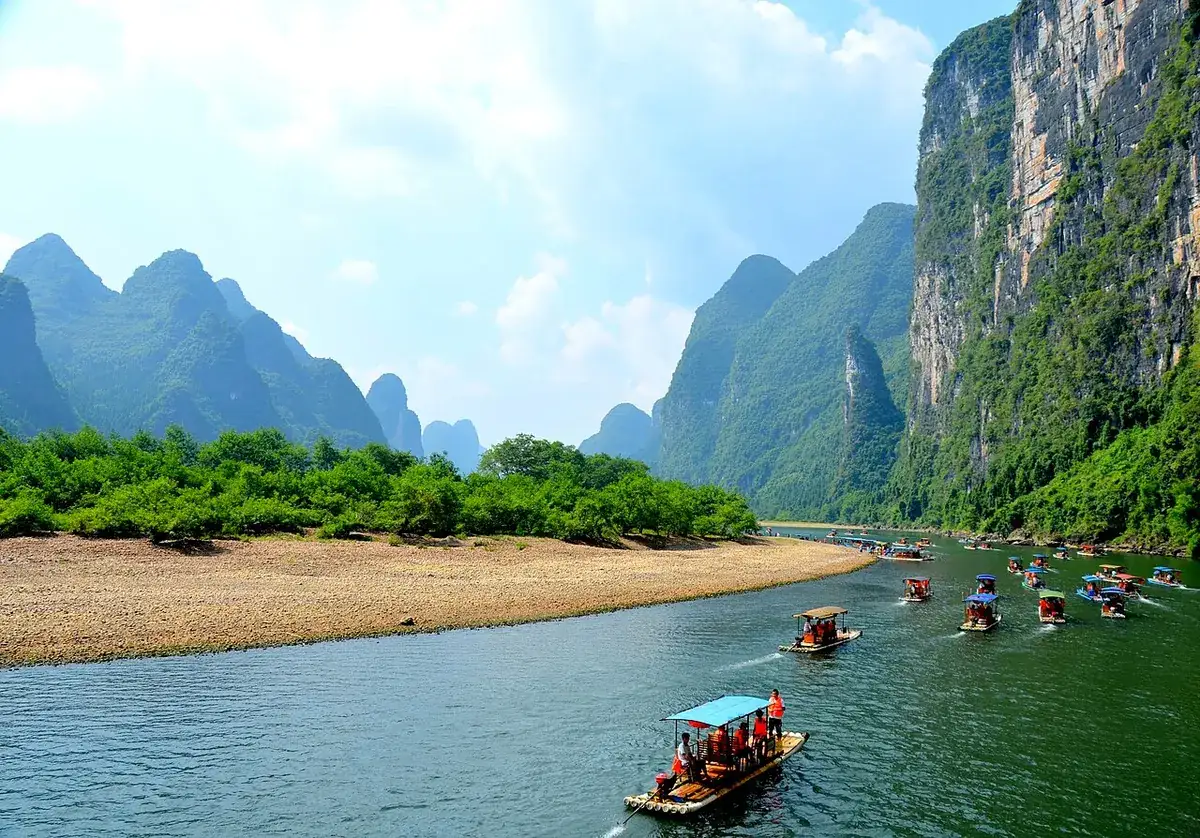
Nanning is a national tourism hub city. Since the Song Dynasty, scholars identified the "Eight Scenes of Yongzhou." Today's top ten landscapes include Yangmei Ancient Charm, Qingxiu Pagoda Shadow, Daming Mountain Splendor, Wangxian Nostalgia, Yiling Divine Palace, South Lake Charm, Longhu Monkey Fun, Yong River Spring Flow, Fengjiang Green Fields, and Nine Dragons Playing with Pearls.
Local Products
Nanning's local specialties include Nanning pineapples, Wuming citrus, Hengzhou jasmine tea, Binyang lotus root, Mashan black goat, Shanglin dried rice noodles, and Long'an banana, reflecting the region's subtropical agricultural richness.
Foreign Exchange
Consular Institutions
Nanning hosts several foreign consular missions, including consulates general of Cambodia, Laos, Myanmar, Thailand, Vietnam, and other ASEAN countries, reflecting its role as the gateway to ASEAN.
Sister Cities
Nanning has established sister city relationships with cities in ASEAN countries, the United States, Australia, and other nations, promoting international cooperation and cultural exchange.
Cooperation Alliances
On December 29, 2020, Nanning became one of the first Chinese cities to join the Lancang-Mekong Tourism City Cooperation Alliance.
Notable Figures
Nanning has produced numerous historical and contemporary figures across politics, military, culture, and science, contributing to the city's rich heritage.
Honorary Titles
Nanning has received numerous honors, including the UN Habitat Scroll of Honour Award, National Civilized City, National Ecological Garden City, National Hygienic City, National Forest City, China Excellent Tourism City, and National Environmental Protection Model City.
Travel information can change. Check current opening hours, reservations and entry requirements before you travel.

Traveller discussion
Start the conversation with a helpful tip or a question.