
Jieyang City
Jieyang CityJieyang City is a prefecture-level city under Guangdong Province, renowned as a hometown of overseas Chinese. Located in southeastern Guangdong, it sits at the geographic axis center between the Guangdong-Hong Kong-Macao Greater
Jieyang City
Jieyang City is a prefecture-level city under Guangdong Province, renowned as a hometown of overseas Chinese. Located in southeastern Guangdong, it sits at the geographic axis center between the Guangdong-Hong Kong-Macao Greater Bay Area and the Haixi Economic Zone. It administers the county-level city of Puning and four districts and counties: Rongcheng, Jiedong, Jiexi, and Huilai, covering 5,240 square kilometers with a permanent population of 5.6536 million. Nearly 7 million overseas Chinese and compatriots from Hong Kong, Macao, and Taiwan trace their roots to Jieyang. In 413 AD, the Eastern Jin Dynasty established Yi'an Commandery, marking the start of prefecture-level administration in the area. In 1991, Shantou City was divided into the three prefecture-level cities of Shantou, Chaozhou, and Jieyang. Jieyang is a birthplace of Chaoshan culture, known for pork trotter rice, Chaoshan cuisine, Gongfu tea, Yingge dance, and Sanshan King worship. Notable figures include writer Xu Dishan, nuclear submarine pioneer Huang Xuhua, and Olympic champions Sun Shuwei and Fu Haifeng. In 2025, Jieyang's regional GDP reached 255.375 billion yuan (approximately US$35.1 billion), up 3.2% year-on-year.
Name Origin and Evolution
The name "Jieyang" dates to the Qin Dynasty. In 214 BC, Qin generals pacified the Nanyue region and established three commanderies. According to historical records, the name derives from Jieyang Ridge. Folk legend holds that the founding ancestor, arriving in the Lingnan region, saw mist-shrouded yet fertile land. He climbed the ridge and parted the mist, revealing sunlight—hence "Jieyang Ridge," meaning "the ridge that parts the mist to reveal the sun."
Historical Evolution
Pre-Qin Period
During the Neolithic Age (approximately 10,000 to 4,000 years ago), early inhabitants had settled in Jieyang. During the Spring and Autumn and Warring States periods, the area belonged to the Minyue territory.
Qin, Han, and Southern-Northern Dynasties Period
In 214 BC, the Qin Dynasty unified Lingnan and established Jieyang County under Nanhai Commandery—the earliest administrative division in eastern Guangdong. In 204 BC, Zhao Tuo established the Nanyue Kingdom, incorporating Jieyang. In 111 BC, Emperor Wu of Han reconquered the region. In 331 AD, the Eastern Jin reorganized the area as Haiyang County. In 413 AD, Yi'an Commandery was established, governing five counties with its seat at Haiyang (present-day Chaozhou). In 483 AD, the Southern Qi established Chengxiang County from Haiyang County.
Song, Ming, and Qing Dynasties Period
In 1121, the Northern Song reestablished Jieyang County from portions of Haiyang County. Jieyang, Haiyang, and Chaoyang were collectively called the "Three Yangs," all under Chaozhou. In 1140, the county seat was established at Yujiao Village (present-day Rongcheng). In 1524, Huilai County was established; in 1563, Puning and Chenghai counties were created; in 1738, Fengshun County was carved from Jieyang. Boundaries then remained largely unchanged for over 220 years.
Republic of China Period
After 1912, the Jieyang area was successively under the Chaoxun Circuit, East River Administrative Commissioner's Office, and Fifth District Administrative Inspector's Office, all headquartered in Shantou.
Modern Era
After 1949, the area was successively under the Chaoshan Special District, Shantou Special District, and Shantou City until 1991. In December 1991, Shantou was divided into Shantou, Chaozhou, and Jieyang prefecture-level cities. The former Jieyang County became Rongcheng District and Jiedong County. In 1993, Puning became a county-level city. In 2012, Jiedong County became Jiedong District. By 2022, Jieyang administered Rongcheng District, Jiedong District, Jiexi County, Huilai County, and managed Puning City, plus four economic functional zones.
Physical Geography
Location and Boundaries
Jieyang lies on Guangdong's eastern coast between 22 degrees 53 minutes and 23 degrees 46 minutes north latitude. The Tropic of Cancer traverses the territory. It borders Meizhou to the north, faces the South China Sea to the south, connects with Shanwei to the west, and neighbors Chaozhou and Shantou to the east. Land area totals 5,240 square kilometers; maritime area, 9,300 square kilometers.
Climate
Jieyang has a southern subtropical monsoon humid climate with abundant sunshine, plentiful rainfall, no snow, and rare frost. The annual average temperature (1992-2004) is 21.8 degrees Celsius, with about 2,014 sunshine hours and 1,756.6 millimeters of rainfall. Disastrous weather includes rainstorms, typhoons, thunderstorms, droughts, floods, frost, and tornadoes.
Geology
Exposed strata date from the late Triassic (approximately 200 million years ago). The Lianhua Mountain Fault is the largest fault zone along eastern Guangdong's coast, running 370 kilometers with a width of 20-30 kilometers. Magmatic rocks are primarily Yanshanian granitic intrusive rocks.
Topography
The Dabei Mountain and Danan Mountain ranges run northeast to southwest, with terrain higher in the north. Mountains and hills comprise 86% of the area; plains and valleys, 14%. The highest peak is Liwangzhang at 1,222 meters in Jiexi County.
Hydrology
Three major river systems—the Rongjiang River, Lianjiang River, and Longjiang River—drain the city, with the Rongjiang River being the largest basin. The Rongjiang River originates from Phoenix Mountain in Luhe County. Twenty main and tributary streams exceed 100 square kilometers in catchment area. The city has 2 large and 19 medium-sized reservoirs with total storage of 307.56 million cubic meters (2022).
Soil
Natural soils include red soil, lateritic red soil (90.23%), yellow soil, coastal marshy saline soil, and coastal sandy soil, covering 285,407 hectares. Paddy soil constitutes 79.62% of cultivated land; dryland soil, 20.38%.
Natural Disasters
Jieyang experiences year-round natural disasters: spring cold rains and droughts, summer floods and tropical cyclones, autumn cold winds, and winter frost. In September 2003, Typhoon Dujuan brought force 8-11 winds, with Huilai's Shengquan station recording 54.5 m/s gusts (force 16), causing direct losses of 366 million yuan (approximately US$44 million).
Natural Resources
Water Resources
The multi-year average water resource totals 6.421 billion cubic meters, with river runoff comprising 96.5%. In 2023, total water resources were 6.099 billion cubic meters, down 21.6%.
Mineral Resources
As of 2004, 36 mineral types had been discovered, including gold, silver, copper, iron, tin, tungsten, rare earths, crystal, and geothermal resources. Most deposits are small and low-grade with limited artisanal mining.
Marine Resources
With 136.9 kilometers of coastline, Jieyang's waters host 143 fish species across 54 families, plus diverse shrimp, crab, and shellfish species, making it an excellent aquaculture zone.
Wind Power Resources
The 136.9-kilometer coastline and 30-plus islands provide abundant wind resources. Annual average wind speed is 2.05 m/s, peaking at 2.8 m/s in Huilai.
Biodiversity
Nationally protected Grade I wildlife includes pythons and salamanders; Grade II species include pangolins, otters, civet cats, clouded leopards, and silver pheasants. Flora includes 51 fern species and 840 angiosperm species. Protected plants include the Cyathea tree fern (Grade I) and Podocarpus and Fujian cypress (Grade II). Forest vegetation is primarily southern subtropical evergreen mixed forest.
Administrative Divisions
As of June 2024, Jieyang administers Rongcheng District, Jiedong District, Jiexi County, and Huilai County, and manages Puning City. The municipal government is at No. 39 Linjiang North Road, Rongcheng District.
Politics
Jieyang's governance follows China's standard prefecture-level structure under the Communist Party of China, with the Municipal People's Congress, Municipal People's Government, and corresponding judicial and consultative organs.
Population
Population Size
As of end 2023, registered population was 7.1188 million; permanent population, 5.6536 million with 52.27% urbanization. By end 2024, permanent population reached 5.6821 million with 52.62% urbanization. The Han Chinese comprise over 99.82% of the total.
Ethnic Groups
Han Chinese have migrated to Jieyang since the Qin-Han era, gradually assimilating indigenous peoples. Mongolian and Manchu settlers during the Yuan and Qing dynasties also assimilated. Today, Han Chinese constitute over 99.89%, with small Zhuang, Miao, Yao, Dong, and Tujia minorities.
Languages
Chaoshan dialect is spoken by about 83.7% of the population, mainly in plains and semi-mountainous areas. Hakka dialect, spoken by 14.4%, is found primarily in Jiexi's mountains and semi-mountainous villages. Bilingual villages account for 1.8%. Chaoshanese preserves ancient Chinese phonetic features absent from modern Mandarin. Jieyang's Hakka has developed a "semi-mountain area" sub-dialect with Hepo speech as its standard.
Religious Beliefs
Four religions are recognized: Buddhism, Taoism, Catholicism, and Protestantism. Taoism appeared earliest during the Sui Dynasty. Buddhism arrived in the Tang Dynasty (627-649 AD). Catholicism came in 1721 via Spanish Dominican missionaries; Protestantism in 1860. As of 2004, the city had 130 Buddhist venues (34,940 followers), 14 Taoist temples (645 followers), 80 Catholic venues (47,422 followers), and 82 Protestant churches (30,640 followers).
Economy
Overview
In 2024, Jieyang's regional GDP reached 252.970 billion yuan (approximately US$34.8 billion), up 3.9%. The primary industry contributed 24.379 billion yuan (approximately US$3.4 billion, up 2.7%); secondary industry, 98.057 billion yuan (approximately US$13.5 billion, up 8.1%); tertiary industry, 130.534 billion yuan (approximately US$18.0 billion, up 1.2%). Public budget revenue was 10.179 billion yuan (approximately US$1.4 billion, up 0.7%). Per capita disposable income was 27,336 yuan (approximately US$3,760, up 6.0%). Fixed asset investment grew 0.9%, with industrial investment up 23% and private investment up 13.2%.
Primary Industry
In 2024, agriculture-forestry-animal husbandry-fishery output totaled 38.648 billion yuan (approximately US$5.3 billion, up 3.2%). Vegetable production reached 2.4665 million tons; fruit, 839,200 tons; aquatic products, 156,800 tons.
Secondary Industry
In 2024, industrial enterprises above designated size grew 9.7%. Manufacturing comprised 88.9% (up 10.4%). Advanced manufacturing grew 24.2%; high-tech manufacturing declined 18.3%. In 2023, the construction industry had 216 qualified enterprises with output of 9.154 billion yuan (approximately US$1.3 billion, up 2.9%).
Tertiary Industry
In 2023, wholesale and retail added 46.553 billion yuan (approximately US$6.4 billion, up 3.4%); transportation and warehousing, 7.443 billion yuan (approximately US$1.0 billion, up 5.0%); finance, 8.034 billion yuan (approximately US$1.1 billion, up 4.3%); real estate, 19.205 billion yuan (approximately US$2.6 billion, up 2.7%). In 2024, retail sales of consumer goods reached 108.159 billion yuan (approximately US$14.9 billion). Import-export volume was 24.5 billion yuan (approximately US$3.4 billion, up 6.6%). Financial deposits reached 343.011 billion yuan (approximately US$47.2 billion, up 4.5%); loans, 165.247 billion yuan (approximately US$22.7 billion, up 6.5%). Insurance premium revenue was 7.84 billion yuan (approximately US$1.1 billion, up 6.3%).
Social Affairs
Education
In 2023, total enrollment was 325,900 students with 1.3004 million currently enrolled and 337,400 graduates. Special education enrolled 61 new students; 268,600 children attended preschool.
Healthcare
As of end 2023, Jieyang had 3,327 health institutions including 75 hospitals and 65 township health centers, with 28,900 health professionals and 25,400 medical beds.
Science and Technology
In 2023, Jieyang had 422 high-tech enterprises, 86 provincial engineering research centers, and 2 provincial key laboratories. Patent grants totaled 9,119, including 220 invention patents (up 64.2%). The city held 912 valid invention patents—1.62 per 10,000 population.
Culture
As of 2023, Jieyang had 6 cultural centers, 7 public libraries, and 7 museums. Radio and television coverage both reached 100%.
Sports
As of 2023, the city had 8 fitness plazas, 1,710 athletic fields, 341 football fields, and 890.02 kilometers of fitness trails. Total sports venue area reached 14.1778 million square meters. Athletes won 3 gold, 13 silver, and 19 bronze at the 16th Provincial Games.
Social Security
In 2023, per capita disposable income was 25,797 yuan (approximately US$3,550, up 4.1%). Urban employee pension insurance covered 660,800 people; urban-rural medical insurance, 5.1241 million. The city had 6,300 urban and 97,700 rural minimum living standard recipients. Registered volunteers numbered 752,800.
Environmental Protection
In 2023, 63.6% of surface water monitoring sections met Grade I-III standards; nearshore seawater quality reached 98.9% good. Air quality was good on 96.7% of days. Forest coverage was 50.9%. The city operated 86 wastewater treatment facilities with daily capacity of 1.106 million tons. Urban waste harmless treatment rate reached 100%.
Transportation
Overview
Jieyang is served by the Guangzhou-Meizhou-Shantou Railway, Xiamen-Shenzhen High-Speed Railway, and multiple expressways. Jieyang Chaoshan Airport is Guangdong's third-largest trunk airport. It is the only prefecture-level city in eastern Guangdong with all transportation modes. In 2023, passenger transport totaled 5.6055 million (up 10.5%).
Highways
National highways G206 and G324 and provincial highways S337, S335, S238, and S236 cross the city. Expressways include Shenhai, Jiepuhui, Shantou-Kunming, Chaohui, Jiehui, and Shantou-Zhanjiang. Total highway mileage reached 8,011.57 kilometers, including 388.95 kilometers of expressways.
Railways
The Meizhou-Shantou Railway serves Jieyang Station and Jieyang Airport Station. The Xiamen-Shenzhen Railway serves Puning Station and Kuitan Station. The Shantou-Shanwei, Jiehui, and Eastern Guangdong Intercity railways were under construction as of 2023.
Water Transport
Navigable inland waterways total 369 kilometers. The Rongjiang River—"golden waterway" of eastern Guangdong—is 175 kilometers long and the province's second-deepest river, navigable by 5,000-ton vessels with direct routes to Hong Kong, Guangzhou, and Zhanjiang. Huilai County has Shenquan, Jinghai, and Zishen ports.
Aviation
Jieyang Chaoshan International Airport, at the geographic center of Jieyang, Shantou, and Chaozhou, serves over 30,000 square kilometers and 30 million people. It is one of three international airports in Guangdong. As of July 2023, it operated 69 routes including 8 international routes to Singapore, Bangkok, Kuala Lumpur, Siem Reap, Phnom Penh, and Sihanoukville. In 2023, it handled 7.1822 million passengers.
Public Transportation
As of July 2023, Jieyang had 7 bus companies operating 60 routes with 716 vehicles (96% new-energy electric). Since 2021, free or discounted fares apply for seniors, disabled persons, military, and students. The city had 3 taxi companies with 102 cruising taxis and 15 ride-hailing platforms with 1,986 vehicles—a 576% increase in compliant capacity since 2022.
Culture and Humanities
Overview
With over 2,200 years of history, Jieyang is a birthplace of Chaoshan culture, known as the "Hometown of Chinese Folk Art" for its stone carving, wood carving, jade carving, paper cutting, porcelain inlay, Chaoju opera, Chaozhou music, Yingge dance, and lion dance.
Cuisine
Jieyang cuisine belongs to the Chaozhou school of Cantonese cuisine—light yet flavorful with expert seafood preparation. Notable dishes include steamed lobster, braised shark fin, eel soup, and lotus seed paste. Chaoshan Gongfu tea is an essential cultural tradition emphasizing the art of tea preparation.
Customs
Folk customs span Chaoshan-speaking and Hakka-speaking areas. The Yangmei Torch Festival, held on the 5th-6th day of the first lunar month, honors Jin Dynasty scholar Jie Zitui. Dragon boat racing features elaborately carved dragon heads. Yingge dance, with over 300 years of history, is a vigorous masculine group dance combining drama, dance, and martial arts—performers paint distinctive facial makeup and strike paired batons to rhythmic drumming.
Arts
Jieyang stone carving is renowned for granite sculptures, especially stone lions. The city is the "Hometown of Chinese Painting," with masters like Lai Shaoqi and Yang Zhiguang. Chaoju opera features distinctive vocal styles with elaborate role categories. Iron-rod puppetry (paper shadow theater), introduced 700 years ago, was designated national intangible cultural heritage in 2011.
Local Specialties
Jiexi Lei tea is a national geographical indication product. Puning dried tofu is famous for its crispy exterior and tender interior. Longjiang mung bean cake features flaky pastry with sweet filling. Puning Nan candy, with nearly a century of history, is made from peanuts, lard, maltose, and sugar.
Cultural Relics
As of July 2024, Jieyang has 4 national-level key cultural heritage sites, including the Jieyang Confucian Academy, Ancient Banyan Martial Temple, Ding's Guanglu Ancestral Hall, and Jieyang City God Temple, plus 43 provincial-level sites.
Intangible Cultural Heritage
Jieyang's intangible cultural heritage includes Yingge dance, Chaoju opera, iron-rod puppetry, and traditional crafts—several designated as national-level items preserving centuries of Chaoshan cultural traditions.
Scenic Spots
Overview
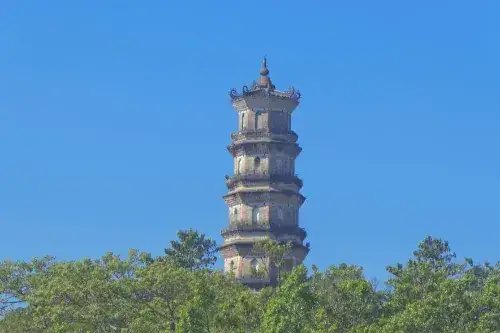
Jieyang is a historic cultural city with the "First Waterfall of Lingnan"—Huangmanzhai Waterfall—and traditional waterside villages. As of July 2024, it has 20 A-level attractions. Notable sites include the Jieyang Confucian Academy, Jinxian Gate, Huangqi Mountain Forest Park, Shuangfeng Temple, and Jieyang Tower. Modern attractions include the Rongjiang River Music Fountain and Wangtian Lake Ecological Tourism Resort.
Key Attractions
Shuangfeng Temple, one of Chaoshan's three great ancient temples, was built in 1140 and relocated in the early Ming Dynasty. It is renowned alongside Kaiyuan Temple in Chaozhou and Lingshan Temple in Chaoyang.
The Huangmanzhai Waterfall Group, a national AAAA-level scenic area in Jiexi County, features five cascading levels. The first, Feihong Waterfall, spans 82 meters with a 56-meter drop. The third, Luojiutian Waterfall, has a 120-meter drop.
The Jieyang Confucian Academy, built in 1140, is the largest and best-preserved building complex of its kind in the Lingnan region. In 1925, Zhou Enlai worked here during the Eastern Expedition; in 1927, Nanchang Uprising leaders held military meetings at this site.
The Huangqi Mountain Scenic Area, 4 kilometers northeast of Rongcheng, covers 1,180 hectares with a 293.1-meter peak. Known since ancient times as "Huangqi Evening Green," it features nine temples, eighteen caves, Qishan Pagoda, and over twenty cliff inscriptions.
External Exchange
Jieyang leverages its nearly 7 million overseas Chinese to maintain extensive cultural and economic exchange networks, with sister-city relationships and cooperation partnerships promoting trade, investment, and cultural programs.
Notable Figures
Jieyang has produced many distinguished figures: writer Xu Dishan, nuclear submarine pioneer Huang Xuhua, Olympic champions Sun Shuwei and Fu Haifeng, Qing Dynasty modernizer Ding Richan, and numerous scholars, artists, and military leaders.
Important Honors
Jieyang is recognized as a National Historical and Cultural City and has received honors as "Hometown of Chinese Folk Art," "Hometown of Chinese Painting," and "Hometown of Chinese Opera," reflecting its rich cultural heritage and artistic achievements.
Travel information can change. Check current opening hours, reservations and entry requirements before you travel.
Traveller discussion
Start the conversation with a helpful tip or a question.