
Yangjiang City
Yangjiang CityYangjiang City, a prefecture-level city under Guangdong Province, also known as Tuocheng, is located on the southwest coast of Guangdong, commanding the strategic gateway of western Guangdong. Surrounded by mountains on three
Yangjiang City
Yangjiang City, a prefecture-level city under Guangdong Province, also known as Tuocheng, is located on the southwest coast of Guangdong, commanding the strategic gateway of western Guangdong. Surrounded by mountains on three sides and facing the South China Sea to the south, it has a subtropical monsoon climate. The land area covers 7,966.8 square kilometers, with maritime waters spanning 12,300 square kilometers. It is a renowned coastal tourism city and a major maritime city of Guangdong Province, and a member of both the Pearl River Estuary West Coast Metropolitan Area and the Beibu Gulf City Cluster. As of February 2025, Yangjiang administers 2 districts, 1 county, and 1 county-level city. As of the end of 2024, the permanent population was 2.6266 million. Yangjiang features diverse landscapes—mountains, sea, hot springs, lakes, forests, and caves—with 39.1 kilometers of developable coastline. The city's name dates to the establishment of Yangjiang County in 598 CE during the Sui Dynasty; it became a prefecture-level city in February 1988. Yangjiang is one of the birthplaces of Gaoliang culture, blending Maritime Silk Road culture, Moyang culture, and Cantonese culture. It focuses on three 100-billion-yuan-level pillar industries: alloy materials, equipment manufacturing, and green energy. In 2025, Yangjiang's GDP reached 167.112 billion yuan (~$23.2 billion USD), growing 3.3% year-on-year. In January 2026, Yangjiang became the top electricity and energy city in Guangdong Province.
Name Origin
The name Yangjiang derives from the former Yangjiang County, named for its proximity to the Moyang River. In 606 CE, during the Sui Dynasty, parts of Anning County and Gaoliang County were merged to form the new Yangjiang County.
History
Pre-Qin Period
The Dushizai Cave Site proves human activity here over 16,000 years ago. The Guizhaishan Site shows ancient human civilization dating back 4,000 years. A large bronze drum unearthed in Yangdong demonstrates that Gaoliang people had mastered advanced bronze casting over 2,000 years ago.
Qin-Han through Southern and Northern Dynasties
In 214 BCE, the Qin Dynasty incorporated the area into Nanhai Commandery. In 111 BCE, the Han Dynasty established Gaoliang County. In 220 CE, the Wu Kingdom created Gaoliang Commandery. In 523 CE, Yangchun County was established, and in 527 CE, Gao Prefecture was founded, governing much of present-day Yangjiang, Enping, and Maoming.
Sui-Tang through Song-Yuan Periods
In 598 CE, Yangjiang County was formally established during the Sui Dynasty. The Tang Dynasty created Chun Prefecture (621 CE) with its seat in Yangchun. The Song Dynasty renamed the area Nan'en Prefecture (1048 CE). Under the Yuan Dynasty, it became the Nan'en Route.
Ming-Qing Period
In 1368 CE, the Ming Dynasty placed Yangjiang and Yangchun under Zhaoqing Prefecture. The Qing Dynasty converted Yangjiang County to a directly administered prefecture (1867), then to a sub-prefecture, and back to a prefecture.
Republic of China Period
In 1912, the county system was restored. The 1920s saw the establishment of early Communist Party organizations and trade unions. Activities were suspended from 1929 to 1938. In 1945, resistance forces fought Japanese troops. In February 1949, the Yangjiang County People's Democratic Government was established.
After the Founding of the People's Republic of China
Yangjiang was liberated on October 26, 1949. In January 1988, Yangjiang County was abolished and Yangjiang City (prefecture-level) was established. The Hailing Island Economic Development Experimental Zone (1992), Yangjiang High-Tech Industrial Development Zone (2003), and Yangjiang Binhai New Area (2014) were subsequently created. In 2015, Yangdong was upgraded from county to district.
Administrative Divisions
As of February 2025, Yangjiang administers 2 districts, 1 county, and 1 county-level city, comprising 10 sub-districts and 38 towns, with 146 communities and 710 villages, plus 2 development zones. The municipal government is at 60 Dongfeng 2nd Road, Jiangcheng District.
Natural Geography
Location and Extent
Yangjiang is situated on the southwest coast of Guangdong within the Moyang River basin. It borders Jiangmen to the east, Yunfu and Maoming to the north, Maoming to the west, and the South China Sea to the south. The total land area is 7,966.8 square kilometers, with hills at 25.6%, mountains 42.0%, and plains 21.8%. The coastline totals 466.82 kilometers, including 40 major islands.
Terrain
The terrain is primarily low mountains and hills, with alluvial plains along the Moyang River. The highest peak, Ehuangzhang, reaches 1,337.6 meters. Yangchun features distinctive karst limestone landscapes.
Climate
Yangjiang has a subtropical climate with pronounced maritime influence. The annual average temperature is 22.9 degrees Celsius, with average annual rainfall of 2,424.8 millimeters. Typhoons are common in summer and autumn. Annual sunshine reaches 1,870.4 hours.
Hydrology
Yangjiang has 403 rivers. The Moyang River—Guangdong's sixth-largest—flows 199 kilometers with a drainage basin of 6,091 square kilometers. Coastal waters feature irregular semidiurnal tides.
Soil
Soil types include mountain yellow earth, lateritic red earth, alluvial soils, coastal saline marsh soils, and limestone soils.
Natural Disasters
Yangjiang is prone to typhoons, heavy rains, floods, and severe convective weather. The area lies within the Southeast China Coastal Seismic Belt (intensity VII). Notable events include a magnitude 6.4 earthquake in 1969 and severe damage from Typhoon Hagupit in 2008.
Natural Resources
Water Resources
As of 2020, Yangjiang's reservoirs had a total capacity of 1.194 billion cubic meters, with total water resources of 8.872 billion cubic meters. Annual consumption was 1.307 billion cubic meters.
Land Resources
Total land area: 795,588.45 hectares, including 148,777 hectares of arable land and 402,814 hectares of forest land.
Mineral Resources
Forty-eight mineral types have been discovered across 278 sites. Limestone for cement is abundant in northern Yangchun. Rich geothermal resources, including rare saltwater mineral hot springs, earned Yangjiang the title "Hometown of Chinese Hot Springs" in 2008.
Marine Resources
The maritime area covers 12,300 square kilometers with 122 islands. The city produces over one-third of Guangdong's marine seedlings. Three national-level marine ranching demonstration zones produce over 100,000 tons annually, valued at over 3 billion yuan (~$417 million USD). Seven fishing ports operate, with Zhapo and Dongping as national central fishing ports.
Biodiversity
Yangjiang hosts over 2,300 plant species, approximately 300 southern medicinal herb varieties, and 20,000 mu of mangrove forests including the Hailing Island Mangrove National Wetland Park. Wildlife includes 366 animal and 209 bird species. Forty-two nature reserves cover 145,700 hectares.
Politics
Population
Population Size
The 2020 census recorded 2,602,959 permanent residents, up 7.48% from 2010. By end of 2024, the population reached 2.6266 million with 57.75% urbanization rate. Registered population was 3.0194 million.
Ethnic Groups
Yangjiang has 43 resident ethnic groups. Minorities total 49,500, including 28,000 Zhuang, 7,500 Yao, and 7,000 Miao.
Language
Primary dialects are Yangjiang speech and Yangchun Cantonese, both Yue (Cantonese) sub-dialects. Minnan and Hakka dialects, plus a Yao language sub-dialect, are also spoken.
Religion
Mazu (sea goddess) worship, introduced during the Song Dynasty, has 13 active temples. Buddhism has 12 venues, including Jingye Temple housing China's largest reclining jade Buddha (7 meters, 27 tons). Catholicism and Protestantism also have historical presence.
Economy
Overview
Yangjiang sits at the intersection of the Greater Bay Area, Beibu Gulf City Cluster, and Hainan Free Trade Zone. In 2024, GDP reached 162.958 billion yuan (~$22.6 billion USD), up 3.5%. The three sectors contributed 26.931, 60.701, and 75.326 billion yuan respectively. Per capita GDP was 62,100 yuan (~$8,625 USD). Fiscal revenue totaled 8.362 billion yuan (~$1.16 billion USD). In January 2026, Yangjiang became Guangdong's top electricity and energy city, with installed capacity exceeding 24.29 million kilowatts.
Primary Industry
In 2024, total agricultural output reached 44.981 billion yuan (~$6.25 billion USD), up 4.4%. Fishery output was 20.393 billion yuan, with aquatic product yield of 1.2317 million tons.
Secondary Industry
Three 100-billion-yuan-level pillar clusters operate: alloy materials, equipment manufacturing, and green energy. Over 13,700 hardware and knife-scissors enterprises make Yangjiang "China's Capital of Knives and Scissors." In 2024, designated enterprise industrial value-added grew 5.5%, with wind power generation up 21.3%.
Tertiary Industry
Yangjiang built China's first million-kilowatt-class offshore wind farm and the world's first typhoon-resistant floating offshore wind turbine, forming a complete wind power industry chain. In 2024, retail consumer goods totaled 47.102 billion yuan (~$6.54 billion USD). Foreign trade reached 25.5 billion yuan (~$3.54 billion USD), up 17.7%. Financial deposits totaled 233.050 billion yuan, with loans at 210.545 billion yuan.
Economic Development Zones
The Yangjiang High-Tech Development Zone (505.9 sq km) focuses on alloy materials and wind power equipment, with 2023 industrial output of 134.441 billion yuan. The Yangdong Economic Development Zone exports 56% of China's hardware and knife-scissors products. The Hailing Island Economic Development Experimental Zone also operates.
Social Services
Education
In 2024, Yangjiang had 15,400 higher education students, 63,400 senior high school students, and 244,500 primary school students. Compulsory education retention rate was 98.81%.
Science and Technology
By end of 2024, Yangjiang had 191 national high-tech enterprises, 57 provincial engineering research centers, and 5,146 patent grants.
Cultural Services
The city has 5 cultural centers, 48 cultural stations, 5 public libraries, and 8 museums, with 100% radio and TV coverage.
Healthcare
Yangjiang has 1,921 health institutions with 16,369 beds and 19,303 health professionals. The People's Hospital and Hospital of Traditional Chinese Medicine are Grade III Class A facilities.
Sports
In 2024, athletes won 22 gold, 18 silver, and 17 bronze medals, including a Paris Olympics taekwondo silver and a Paris Paralympics badminton gold.
Social Security
By end of 2024, 4.677 million participated in pension insurance and 2.1696 million in medical insurance. Social insurance funds generated 7.281 billion yuan in revenue. The city has 11,779 eldercare beds, with 65,100 people receiving minimum living allowance.
Transportation
Overview
Yangjiang serves as a strategic pivot connecting the Pearl River Delta with western Guangdong, historically a key Maritime Silk Road transit station. In 2024, freight transport totaled 81.8792 million tons, and port throughput reached 40.4157 million tons.
Highways
Five expressways, 4 national highways, and 11 provincial highways serve Yangjiang, with total road mileage of 10,812.6 kilometers.
Railways
Yangjiang entered the high-speed rail era in July 2018 with the Shenzhen-Maoming Railway. Five operating railways total approximately 308 kilometers. The Guangzhou-Zhanjiang High-Speed Railway opened in December 2025.
Shipping
Yangjiang Port, a Class I open port, has 17 productive berths. In 2023, throughput reached 36.8686 million tons.
Aviation
Yangjiang Heshan Airport is western Guangdong's largest general aviation airport. The planned Yangjiang Airport (4C-class) is expected to handle 2 million passengers annually by 2035.
Public Transit
The urban bus system runs 257 new-energy electric buses on 54 routes totaling 800 kilometers.
Historical Culture
Overview
Yangjiang culture belongs to the Gaoyang Cantonese cultural sub-region, blending Gaoliang culture, Maritime Silk Road culture, and Moyang culture. Known as the "Hometown of Kites" and "Hometown of Cantonese Folk Songs," the city features dragon boat, lacquerware, root carving, and knife-and-scissors traditions.
Gaoliang Culture
Yangjiang is the core area of ancient Gaoliang, established in 111 BCE. The cultural tradition endured 729 years. During the Southern Dynasties, the Feng-Xian clan, led by Lady Xian, played a pivotal role in developing the Maritime Silk Road and governing the region.
Maritime Silk Road Culture
The Nanhai No. 1 shipwreck, discovered in 1987, yielded nearly 180,000 artifacts—including approximately 160,000 porcelain pieces—making it China's largest single underwater archaeological excavation. This Song Dynasty "Fuchuan" type vessel is recognized by UNESCO as a classic Maritime Silk Road case study.
Cantonese Culture
Yangjiang has a deep Cantonese opera tradition. The Yangchun Cantonese Opera Troupe, established in the 1950s, is the only state-owned performing troupe in the area. Lion dance (Xingshi) traditions are also deeply rooted.
Cultural Relics
Yangjiang has 136 designated cultural heritage sites, including 2 national-level units. The Dushizai Cave Site (cultural layers dating back 14,000 to 16,680 years) and the Tieshijing Coin Casting Site (the only known Southern Han Kingdom lead coin foundry) are nationally protected.
Intangible Cultural Heritage
Yangjiang has 478 intangible heritage items, including 1 national-level entry. Notable traditions: Yangjiang folk songs (oral performance art), Yangjiang kites ("Southern Yao" tradition since the Southern Dynasties), Yangjiang lacquerware decoration (national-level since 2011, 300+ years of history, exported to Southeast Asia, Europe, and America), and fermented black bean (Douchi) brewing techniques.
Art
Yangjiang root carving and ornamental stone art includes malachite (designated Yangchun's city stone) and "root calligraphy" exhibited in Japan and the United States. Yangjiang lacquerware, one of the "Three Treasures of Yangjiang," has 300 years of history and was named a national intangible cultural heritage in 2011.
Customs
Tanka fishing community wedding customs feature matchmaker rituals, pre-dawn boat processions, and saltwater songs. The Dragon Boat upstream racing festival and the Liang Zhennan General's Mansion Cannon Festival in Yangchun are distinctive folk traditions.
Cuisine
Yangjiang cuisine belongs to the Cantonese tradition, emphasizing fresh seafood prepared by steaming. Signature dishes include Spring Cardamom Crucian Carp Soup. Local specialties include Jinsha buns, mugwort cakes, and purple rice cakes.
Local Specialties
Yangjiang yellow-crested goose is one of China's five famous goose breeds. Yangjiang fermented black beans (Douchi), one of the "Three Treasures of Yangjiang," are exported to over 30 countries. As "China's Capital of Knives and Scissors," Yangjiang produces over 60% of national knife and scissor output, with exports exceeding 80% of the national total. Knife-making traces back over 1,400 years.
City Symbols
The White Magnolia was designated as Yangjiang's city tree, and the Royal Poinciana as city flower, both approved on July 30, 2019.
Scenic Spots
Overview
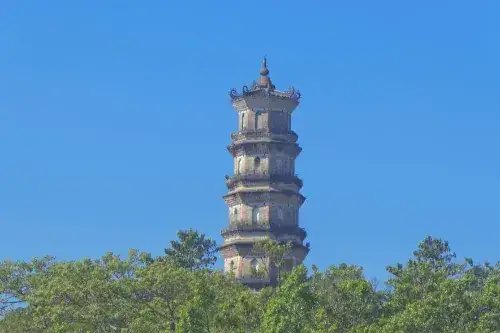
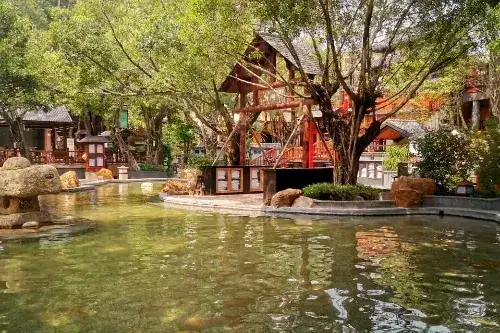
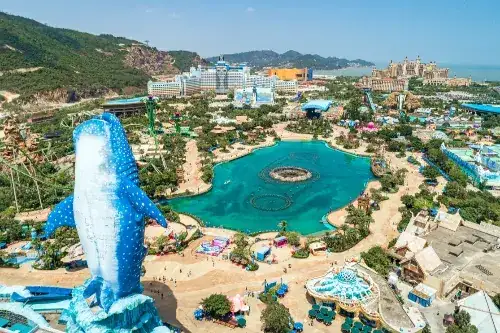
Yangjiang is an "Excellent Chinese Tourism City," "National Garden City," and "National Sanitary City," voted "China's Happiest City 2022." The city has 12 national A-level tourist attractions, including 1 AAAAA-level and 3 AAAA-level scenic spots.
Major Attractions
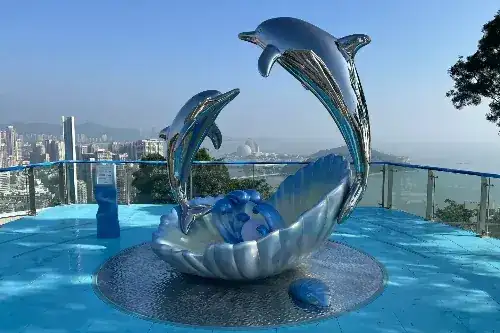
Hailing Island, Guangdong's fourth-largest island (108.9 sq km), is the first 5A-level scenic area in western Guangdong. Lingxiao Cave Scenic Area is a national geological park and AAAA-level attraction known as the "Number One Cave of Southern China," featuring karst landscapes and the 250-meter Baishui Waterfall. The Xianshui Mineral Hot Spring in Yangxi is a AAAA-level resort.
International Exchange
Famous People
Notable figures include poet Ruan Tuizhi, painter Guan Shanyue, composer He Shide, academician Zeng Qingcun (China's Highest Science and Technology Award), painters Huang Anren and Su Tianci, linguist Huang Borong, and singer Zheng Yuan.
City Honors
Yangjiang is recognized as an Excellent Chinese Tourism City, National Sanitary City, National Forest City, China's Hometown of Hot Springs, and was voted "China's Happiest City" in 2022.
Travel information can change. Check current opening hours, reservations and entry requirements before you travel.
Traveller discussion
Start the conversation with a helpful tip or a question.