
Heyuan City
Heyuan CityHeyuan City, a prefecture-level city in Guangdong Province also known as Chacheng, is located in northeastern Guangdong along the middle and upper reaches of the Dongjiang River. It features a southern subtropical monsoon climate
Heyuan City
Heyuan City, a prefecture-level city in Guangdong Province also known as Chacheng, is located in northeastern Guangdong along the middle and upper reaches of the Dongjiang River. It features a southern subtropical monsoon climate with mild temperatures and abundant rainfall. Situated at the junction of the mountainous northeast of Guangdong and the Pearl River Delta plain, it is a hilly area with terrain sloping from northeast to southwest. The water system comprises three major basins — the Dongjiang, Beijiang, and Hanjiang — with nearly a hundred rivers. The total area is 15,653.63 square kilometers. As of March 2026, Heyuan administers 1 district and 5 counties, with a permanent resident population of 2.8142 million as of end-2025. Heyuan is one of the birthplaces of Lingnan culture, with over 2,200 years of history since the establishment of Longchuan County in the Qin Dynasty. In 2025, Heyuan's regional GDP reached 143.457 billion yuan (approximately US$20.2 billion), up 3.3% year-on-year. It has been designated a National Civilized City, National Garden City, and National Health City. Within Guangdong's "one core, one belt, one zone" development framework, Heyuan belongs to the ecological functional zone, cultivating five major industries: electronic information, water economy, advanced materials, modern efficient agriculture, and "six-color tourism."
Name Origin
The name Heyuan relates to the source of three rivers — the Lianping, Zhongxin, and Xinfengjiang. According to the Tang Dynasty Treatise on Commanderies and Counties of the Yuanhe Era: "Heyuan was originally Longchuan County land. The Qi Dynasty established Heyuan County here, named because three hundred li to the east and north lay the sources of three rivers." In 483 CE, Heyuan County was established, and the name was used until 1987. In January 1988, the State Council approved the establishment of Heyuan City.
Historical Evolution
Pre-Qin Period
Over 5,000 years ago during the Neolithic Age, early inhabitants thrived on Heyuan land. The area belonged to the "Fulou State," a branch of the Baiyue people. During the Spring and Autumn and Warring States periods, it was called the land of Baiyue and belonged to the State of Chu.
Qin, Han to Northern and Southern Dynasties
In 214 BCE, Longchuan County was established. Its first magistrate was Zhao Tuo, who later unified Lingnan and was enfeoffed as King of Nanyue. The county seat was at present-day Tuocheng Town in Longchuan. Heyuan was part of ancient Longchuan County under Nanhai Commandery. In 111 BCE, Emperor Wu of Han conquered Nanyue. In 483 CE, Heyuan and Xinfeng counties were established from Longchuan territory.
Sui, Tang to Song and Yuan Periods
In 581 CE, the Sui established Xunzhou (present-day Huizhou). The area underwent several reorganizations through the Tang and Song dynasties. In 1021 CE, Zhenzhou was renamed Huizhou to avoid the taboo of Emperor Renzong's name. In 1279 CE, Huizhou was elevated to a circuit under the Yuan Dynasty.
Ming and Qing Periods
In 1368 CE, Huizhou became a prefecture. In 1518 CE, Heping County was established from Longchuan. In 1569 CE, Yong'an County was created. In 1633 CE, Lianping Zhou was established. During the Qing Dynasty, Heyuan remained under Huizhou Prefecture.
Republic of China Period
In 1919, Heyuan belonged to the Chao-Xun Circuit, soon abolished. In 1925, it came under the Dongjiang Administrative Committee. In 1936, it was placed under the Fourth District Administrative Inspectorate, which moved to Heyuan in 1940. In 1949, it was renamed the Sixth District Administrative Inspectorate.
After the Founding of the People's Republic of China
After the PRC's founding on October 1, 1949, Heyuan successively belonged to the Dongjiang Administrative Committee and the Yuedong Administrative Commissioner's Office. In 1956, it was placed under Huiyang Prefecture. In 1988, with State Council approval, Heyuan County became the prefecture-level Heyuan City. In 1993, the suburban area was renamed Dongyuan County. In May 2014, the Heyuan Jiangdong New Area was established.
Administrative Divisions
As of March 2026, Heyuan administers 1 district (Yuancheng) and 5 counties (Dongyuan, Heping, Longchuan, Zijin, Lianping), plus the Heyuan High-Tech Development Zone and Jiangdong New Area, with 95 townships, 6 sub-districts, 1,251 village committees, and 201 community committees. The municipal government is at No. 19 Yanjiang Middle Road, Yuancheng District.
Natural Geography
Location and Boundaries
Heyuan borders Meizhou (east), Huizhou (south), Shaoguan (west), and Ganzhou of Jiangxi Province (north). Its straight-line distance to Guangzhou, Shenzhen, and Hong Kong is all within 200 km. It spans 114°14′–115°36′E and 23°10′–24°47′N, covering 15,653.63 km².
Geology
Heyuan's tectonic unit belongs to the South China Paraplatform. The northern area features well-developed Paleozoic and Proterozoic formations; the southern area has well-developed Mesozoic strata and magmatic activity. Mesozoic-Cenozoic fault basins occupy about 40% of the city's area.
Topography and Landforms
Mountains account for 53%, hills 36%, and valley plains and basins 11% of the total area. Landform types include mountains, hills, karst, and Danxia landforms. Notable Danxia features include Huo Mountain in Longchuan, Yuewang Mountain in Zijin, and Wanglanghui in Yuancheng District.
Climate
Heyuan has a southern subtropical monsoon climate. The extreme maximum was 39.6°C (1990, Longchuan); the extreme minimum was -5.4°C (1963, Lianping). Average annual precipitation is 1,768.9 mm, with 76% from April to September. Annual sunshine averages 1,687.0 hours; relative humidity averages 77.4%.
Hydrology
The Dongjiang basin covers 87.3% of the city area, the Beijiang 2.1%, and the Hanjiang 10.6%. The second-largest river is the Xinfengjiang, the Dongjiang's largest tributary (85.6 km, 4,817 km² basin). In 1960, a dam created Guangdong's largest reservoir — Xinfengjiang Reservoir, also known as Wanlu Lake.
Soil
Soils are classified into 10 groups, 15 subgroups, 47 genera, and 114 species. Red soil accounts for 38.8% and lateritic red soil for 47.9% of mountain soil area.
Natural Disasters
Main disasters include floods, droughts, typhoons, tornadoes, hail, cold damage, earthquakes, landslides, and pest infestations. Floods generally occur from May to July, with April-September precipitation exceeding 75% of the annual total.
Natural Resources
Water Resources
Average annual surface water totals 15.13 billion cubic meters, ranking top three in Guangdong. Per capita water resources reach 5,000 m³, more than double provincial and national averages. The Xinfengjiang Reservoir consistently meets National Class I surface water standards.
Land Resources
In 2022, Heyuan had 1,378 hectares of wetlands, 106,042 hectares of cultivated land, 1,238,435 hectares of forest land, and 15,236 hectares of grassland. The city has 13 wetland parks, including 2 national-level parks.
Biological Resources
Heyuan has 829 terrestrial vertebrate species (124 mammals, 510 birds, 145 reptiles, 50 amphibians) and 7,055 wild plant species across 280 families. Protected species include python (Class I) and water deer and silver pheasant (Class II). Forest area accounts for 11.95% of Guangdong's total. The city has 97 nature reserves covering 333,900 hectares.
Mineral Resources
56 mineral types have been found at 262 locations, with 36 having proven reserves. Major minerals include iron, tungsten, tin, fluorite, and rare earths. Proven iron ore reserves reach 283 million tons (39% of Guangdong's total), tungsten oxide 240,000 tons (26.9%), and fluorite 6.85 million tons (50.4%).
Politics
Heyuan operates under the CPC Heyuan Municipal Committee and Municipal People's Government, with governance at municipal, county, and township levels.
Population
Population Size
The Seventh National Census shows males at 51.04% and females at 48.96%, with a sex ratio of 104.27. Those aged 0-14 account for 25.28%, 15-59 for 58.25%, and 60+ for 16.47%. As of end-2025, the permanent population was 2.8142 million (down 22,800), with an urbanization rate of 54.21%. Registered population was 3.6096 million.
Ethnic Groups
Over 99% are Han Chinese. The remaining 1% includes 48 minorities, mainly She, Miao, Yao, and Tujia. The Zhangxi She Ethnic Township in Dongyuan County is the only She ethnic township in Guangdong.
Languages
Heyuan's dialect is primarily Hakka, divided into Shuiyuan and Jiaying tones, with some Cantonese influence.
Religious Beliefs
Four religions are present: Buddhism, Taoism, Catholicism, and Protestant Christianity, with venues including Fuyuan Temple and gospel churches.
Economy
Overview
Heyuan cultivates five major industries: electronic information, water economy, advanced materials, modern efficient agriculture, and "six-color tourism." In 2025, regional GDP reached 143.457 billion yuan (approximately US$20.2 billion), up 3.3%. The three-industry structure was 13.3:33.7:53.0. Per capita GDP was 50,770 yuan (approximately US$7,152). Local public budget revenue was 9.534 billion yuan (approximately US$1.34 billion). Per capita disposable income was 30,638 yuan (approximately US$4,315), up 5.3%.
Primary Industry
Heyuan has 18 provincial agricultural parks and 19 Greater Bay Area vegetable basket bases. In 2025, agricultural output value was 29.59 billion yuan (approximately US$4.17 billion), up 5.1%. Grain output was 833,900 tons; meat output 237,200 tons, up 6.4%.
Secondary Industry
Heyuan has 690 above-scale industrial enterprises, including 205 with output exceeding 100 million yuan. Industrial parks housed 537 above-scale enterprises with tax revenue of 3.416 billion yuan (approximately US$481 million), up 27.9%. Operating revenue reached 155.643 billion yuan (approximately US$21.9 billion), with profits of 5.336 billion yuan (approximately US$751 million).
Tertiary Industry
In 2025, retail sales of consumer goods reached 44.961 billion yuan (approximately US$6.33 billion), up 2.0%. Import-export value was 23.49 billion yuan (approximately US$3.31 billion). The city received 12.287 million tourists, with tourism revenue of 13.28 billion yuan (approximately US$1.87 billion), up 11.1%. Financial deposits reached 195.889 billion yuan (approximately US$27.6 billion); loans reached 196.512 billion yuan (approximately US$27.7 billion).
Economic Functional Zones
The Heyuan National High-Tech Zone, established in June 2003, is approximately 150 km from Guangzhou, Shenzhen, and Dongguan. It has three leading industries — electronic information, water beverages and food, and machinery and molds — with over 480 enterprises. In 2015, it became the first national high-tech zone in eastern, western, and northern Guangdong.
Social Affairs
Education
As of end-2025, Heyuan had 502 kindergartens, 290 primary schools (253,000 students), 202 secondary schools, and 2 higher education institutions (19,400 students). Preschool gross enrollment was 99.60%; senior high enrollment 97.75%.
Science and Technology
In 2025, Heyuan organized 36 national/provincial science projects, with 104 provincial engineering research centers, 340 high-tech enterprises, and 2,208 patents granted.
Cultural Affairs
Heyuan has 124 public cultural institutions, 18 performing arts groups, 7 public libraries (3.34 million items), 9 museums (78,100 artifacts), 8 archives, and 6 television and radio stations.
Healthcare
Heyuan has 2,332 health institutions (including 166 hospitals), 20,200 beds, and 28,900 health personnel, including 6,100 licensed physicians and 11,800 registered nurses.
News Media
As of end-2024, Heyuan had 6 TV/radio stations, 241,700 cable TV subscribers, and 3 newspaper types with 16.295 million copies distributed.
Sports
Heyuan has 1,515 sports venues. In 2025, athletes won 12 gold and 11 silver medals in provincial+ competitions. The city hosted 68 mass sports events with 1.31 million participants. The Heyuan team won the 2025 Guangdong Men's Basketball League championship; the Heping football team was runner-up in the 2025 "Village Super League" national finals.
Environmental Protection
In 2025, surface water quality achieved 100% compliance. Air quality excellent rate was 98.9% (361 days). The city had 1,497 sewage treatment facilities (680,200 tons/day capacity), with 100% harmless waste treatment.
Social Security
As of end-2025, 618,300 participated in urban pension insurance, 319,400 in unemployment insurance, and 411,200 in work injury insurance. Medical insurance covered 490,700 urban employees and 2.2527 million rural/urban residents. 64,100 people received minimum living allowance, with 439 million yuan (approximately US$61.8 million) disbursed.
Transportation
Overview
Heyuan is building a transportation hub in the northeastern Greater Bay Area, with an integrated "water-land-air-rail" system using highways and railways as the main framework.
Highways
Total highway mileage is 17,760.69 km, including 720.38 km of expressways. The city has 649,600 civilian motor vehicles. National highways include G105, G205, G236, G238, G355, and G358. Expressways include the Yuegan, Huihe, Meihe, Daguang, Shankun, Wushen, Guanghe, Hehuiguan, and Longxun.
Railways
Heyuan has 393.5 km of railway, including the Beijing-Kowloon Railway (193 km) and Ganzhou-Shenzhen HSR (165.6 km, opened 2021). The Meizhou-Longchuan HSR was under construction. There are 17 stations (3 conventional passenger, 4 HSR passenger, 8 freight).
Water Transport
Before becoming a city, water transport handled over 60% of freight. Wanlu Lake (Xinfengjiang Reservoir) covers 370 km² — South China's largest artificial lake. Navigable river mileage was 223 km as of 2024.
Aviation
A planned Heyuan regional airport has a proposed site at Yihe Town, Dongyuan County.
Public Transit
As of 2017, Heyuan had 38 bus routes. By January 2021, this reached 44 routes covering 682.3 km, an increase of 154.2 km from 2018.
Culture and History
Overview
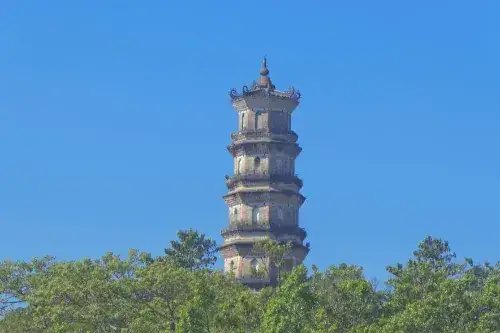
Heyuan is one of the birthplaces of Lingnan culture and the earliest area developed by the Hakka people. The fusion of Central Plains and Baiyue cultures formed the distinctive Heyuan Hakka culture. The city has 759 revolutionary sites, 2 national key cultural heritage units (Guifeng Tower and the Hong Kong Cultural Figures Rescue Command Center site), and 28 provincial-level units.
Dialects
The main dialect is Hakka, divided into Shuiyuan and Jiaying tones.
She Ethnic Culture
The She people are distributed across four counties and Yuancheng District, in 26 townships and 37 villages. The Hakka people brought advanced production techniques while learning from She culture — for example, indigo cultivation was learned from the She. Hakka folk songs also incorporated She and Yao musical elements.
Customs
Traditional ceremonies include Shangdeng (Lantern Raising) and Zhuilong (Dragon Chasing). In Hakka, "lantern" (deng) is homophonous with "male offspring" (ding), symbolizing light and hope. The Shangdeng custom celebrates new family members with handcrafted paper-and-bamboo lanterns. Zhuilong is the climax of the Hakka birth celebration, held in parts of Dongyuan County after the lantern ceremony.
City Symbols
In September 2017, the camphor tree was designated Heyuan's city tree and bougainvillea its city flower.
Historical Sites
Guifeng Tower, built in 1132 CE on Guifeng Mountain by the Dongjiang River, is one of the few surviving Song Dynasty Buddhist pagodas in Lingnan, listed as a national key cultural heritage unit in 2006. The Former Site of the Hong Kong Cultural Figures Rescue Command Center (Laolong Fujian Guild Hall), built during the Qing Dynasty Tongzhi reign, was designated a national key unit in October 2019.
Intangible Cultural Heritage
Heyuan has 111 intangible cultural heritage projects (2 national, 17 provincial) with 94 inheritors. Zijin Huachao Opera, originating from rural sacrificial rituals, was inscribed on the national list in 2006. Zhongxin Lantern from Lianping was inscribed in 2011. Longchuan hand-puppet theater, unique to Longchuan, was listed as provincial heritage in 2009.
Scenic Spots
Overview
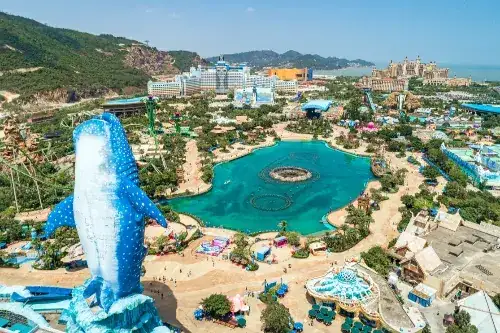
Heyuan has rich tourism resources including Wanlu Lake, Sujiawei, hot spring resorts, Huo Mountain, and Guifeng Tower. It has 1 national tourism resort (Bavarian Manor), 39 open attractions, and 32 A-level scenic areas (1 at 5A, 10 at 4A). With over 18,000 dinosaur egg fossils — the world's largest collection — Heyuan earned the title "Hometown of Chinese Dinosaurs."
Major Attractions
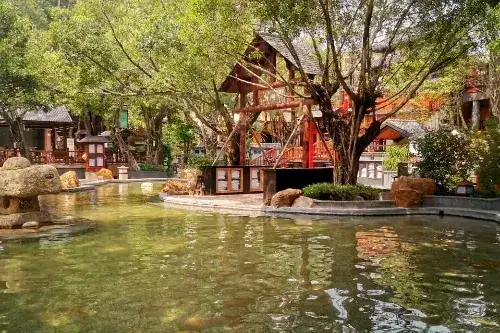
Wanlu Lake Scenic Area in Dongyuan County covers 1,600 km² with 370 km² of water and over 360 islands, designated a National AAAA scenic area. Yulinmen Hot Spring Resort in Zijin County features 86°C springs rich in minerals, with 150 million yuan (approximately US$21.1 million) invested. Bavarian Manor in Yuancheng District covers 10.4 km² with a planned investment of 17.9 billion yuan (approximately US$2.52 billion). Tuocheng Scenic Area, featuring a Tang Dynasty academy rebuilt in 1668, was rated National AAAA in March 2023.
Local Specialties and Cuisine
Cuisine
Heyuan cuisine is primarily Hakka, known for being "rich, salty, and well-cooked." Signature dishes include Dongjiang Stuffed Tofu, Dongjiang Salt-baked Chicken, and Stuffed Three Treasures. Stuffed tofu is the representative Hakka dish — legend says northern migrants, unable to find wheat for dumplings, used tofu to wrap meat filling instead.
Specialties
Heyuan produces citrus fruits, rice noodles with nearly 200 years of history ("Bawanghua" brand), bamboo-shell tea with over 400 years of history (called "fairy tea" by overseas Chinese), and Dahongpao chestnuts known internationally as a "health food."
External Relations
Heyuan maintains exchanges with domestic and international cities, participating in Greater Bay Area and Guangdong-Jiangxi border region cooperation frameworks.
Notable Figures
Heyuan nurtured Ruan Xiaoxian and Liu Ersong, early CPC members who, with Huang Juren, are known as the "Three Heroes of Dongjiang" in Guangdong revolutionary history.
Major Honors
- April 2005: Designated "Hometown of Chinese Dinosaurs"
- 2007: "National Best Example of Ecological Environmental Protection"
- September 2007: "Most Livable and Entrepreneurial City" for Hong Kong, Macao, and overseas Chinese
- December 2009: "China's Top 20 Energy-Saving and Emission-Reduction Cities"
- May 2010: "Most Promising Financial Ecology City"
- January 2011: "International Green Ecological Tourism City"
- November 2011: "National Health City"
- 2012: "National Double Support Model City"
- April 2015: "National Ecological Protection and Construction Demonstration Zone"
- October 2017: "National Garden City"
- October 2020: Re-awarded "National Double Support Model City"
- 2020: "Advanced Blood Donation City Award"
- June 2021: "China's Top 10 Green Economy Cities"
- January 2022: Re-designated "National Health City"
- April 2025: Re-awarded "National Double Support Model City"
- May 2025: Selected for the Seventh "National Civilized City"
Travel information can change. Check current opening hours, reservations and entry requirements before you travel.

Traveller discussion
Start the conversation with a helpful tip or a question.