
Maoming City
Maoming CityMaoming City is a prefecture-level city in Guangdong Province, also known as the "Southern Oil City." Located on the coast of the South China Sea in southwestern Guangdong, it covers a total area of 11,427.63 square kilometers.
Maoming City
Maoming City is a prefecture-level city in Guangdong Province, also known as the "Southern Oil City." Located on the coast of the South China Sea in southwestern Guangdong, it covers a total area of 11,427.63 square kilometers. As of the end of 2024, Maoming had a permanent population of 6.2732 million. By the end of 2025, the city administered 2 districts and 3 county-level cities. In 598 AD, Maoming County was named after the Taoist Pan Maoming, and in 644 AD, Nandang Prefecture was renamed Pan Prefecture after his surname. From the Tang Dynasty to the Republic of China era, Gaozhou served as the political, economic, cultural, and military center of western Guangdong. Maoming was established as a city in 1959 and upgraded to a prefecture-level city in 1975. It is the primary birthplace of Gaoliang Culture with over 2,000 years of history, an important hub for Cantonese culture, and a major national petrochemical and energy base. In 2025, Maoming's regional GDP reached 410.64 billion yuan (approximately US$56.5 billion), up 3.6% year-on-year.
History
The Lingnan region has been inhabited since pre-Qin times. By the late Neolithic Age, approximately 4,500 years ago, indigenous peoples lived in the Maoming area. During the Xia and Shang dynasties, they belonged to the Nanyue tribe. In 214 BC, after conquering Lingnan, the Qin Dynasty established three commanderies, and Maoming was divided between Xiang Commandery and South China Sea Commandery. In 111 BC, Emperor Wu of Han conquered the Nanyue Kingdom and established several commanderies. In 598 AD, Maoming County was named after the Taoist Pan Maoming — the only case in Chinese history where a prefecture was named after a person's surname and a county after their given name. Throughout the Song, Yuan, Ming, and Qing dynasties, the area was administered under Gaozhou Prefecture. After 1949, Maoming was placed under various administrative divisions. In 1958, the Maoming Municipal Preparatory Office was established. In 1959, the State Council designated Maoming as a county-level city, and in 1975, it was upgraded to a prefecture-level city, adopting the city-administering-county system in 1983.
Administrative Divisions
Division History
Maonan District was established in 1985. Between 1993 and 1995, Gaozhou, Huazhou, and Xinyi were upgraded from counties to county-level cities. In 2001, Maogang District was created. In 2014, Maogang District and Dianbai County were merged into the new Dianbai District. In 2024, the Maoming New City management body was formally inaugurated.
Division Details
As of the end of 2025, Maoming City administers 2 districts — Maonan and Dianbai — and manages 3 county-level cities: Xinyi, Gaozhou, and Huazhou. The city comprises 26 sub-districts, 86 towns, 297 communities, and 1,631 villages. Additionally, Maoming has established three economic functional zones: the Guangdong Maoming Binhai New Area, the Maoming High-Tech Zone, and Maoming New City. The municipal government is located at No. 2 Youcheng Sixth Road, Maonan District.
Geography
Maoming is located in southwestern Guangdong, bordered by Yangjiang to the east, Yunfu to the northeast, Guangxi Zhuang Autonomous Region to the northwest, and Zhanjiang to the south. Its geographical coordinates range from 110 degrees 20 minutes to 111 degrees 40 minutes east longitude, and 21 degrees 25 minutes to 22 degrees 43 minutes north latitude. The coastline extends 182.1 kilometers, and the city has 21 islands. The total land area is 11,427.63 square kilometers.
The terrain descends from north to south, with elevations ranging from 1.6 meters to 1,704 meters. Three major mountain ranges — Yunkai, Goulou, and Yunwu — converge in the north. The main peak, Datian Peak, reaches 1,704 meters, making it the second-highest peak in Guangdong. The northern mountains form a natural barrier against winter cold fronts. The central hilly area (approximately 7,500 sq km) is the primary zone for tropical and subtropical economic forestry, while the southern plains and terraces (approximately 2,600 sq km) along the Jian River, Xiaodong River, and Meihua River are the main agricultural zones.
Climate
Maoming is situated south of the Tropic of Cancer in a subtropical monsoon climate zone. Winters are mild and summers long, with abundant heat and rainfall. The annual average temperature ranges from 22.8 to 23.4 degrees Celsius. January is the coldest month (average 15.1–16.3 degrees Celsius) and July the warmest (average 28.3–28.7 degrees Celsius). Annual rainfall is 1,500–1,800 mm, with over 80% concentrated between April and September. Major meteorological hazards include typhoons, heavy rains, droughts, and cold spells.
Natural Resources
Water Resources
Maoming's average annual rainfall totals 20.3 billion cubic meters, with a runoff volume of 11 billion cubic meters. There are 39 rivers with catchment areas exceeding 100 square kilometers, and hydropower reserves of 366,000 kilowatts, of which 279,000 kilowatts are developable. Water resource utilization is 3.7 billion cubic meters, with agricultural use accounting for 83%, industrial use 8%, and domestic use 9%.
Biological Resources
Maoming's vegetation exhibits tropical and subtropical characteristics, with over 1,400 species of higher plants across 120-plus families. A 2020 survey recorded 467 species of wild vertebrates and over 1,500 insect species, including nationally protected species such as the Chinese pangolin. As of 2021, the forest area was 637,700 hectares with a coverage rate of 55.81%.
Mineral Resources
Maoming has identified 53 mineral types across 334 sites. Key minerals include oil shale (proven reserves of 5.4 billion tons), kaolin (575 million tons across 14 sites), titanium (14.67 million tons of ilmenite in Huazhou), and tin (41.47 million tons of ore in Xinyi).
Population
According to the 2020 census, Maoming's permanent population was 6,174,050, an increase of 6.12% over 2010. By the end of 2024, the permanent population reached 6.2732 million, with an urbanization rate of 48.11%. The registered population was 8.2871 million. The city is home to 51 ethnic groups, with 5 ethnic minority villages in Xinyi and Huazhou. By the end of 2025, the permanent population was 6.2646 million with an urbanization rate of 49.54%, and the registered population was 8.2208 million.
Politics
The Maoming Municipal People's Government is the city's administrative authority, headquartered in Maonan District. The city operates under China's standard prefecture-level governance structure, with the municipal party committee and government overseeing the 2 districts and 3 county-level cities.
Economy
Overview
In 2025, Maoming's regional GDP reached 410.64 billion yuan (approximately US$56.5 billion), up 3.6% year-on-year. The primary industry contributed 74.362 billion yuan, the secondary industry 112.308 billion yuan, and the tertiary industry 223.97 billion yuan. Fixed asset investment decreased by 2.8%, while industrial investment grew by 19.0% and advanced manufacturing investment by 34.0%.
Primary Industry
In 2024, the total output value of agriculture, forestry, animal husbandry, and fishery was 120.886 billion yuan (approximately US$16.6 billion), up 2.5%. Grain production reached 1.5431 million tons, fruit production 4.9247 million tons (including 502,100 tons of lychee and 1.9496 million tons of banana), and aquatic products 968,600 tons. Meat production totaled 765,800 tons.
Secondary Industry
In 2024, industrial value-added grew by 1.2%. The construction industry reached 41.769 billion yuan (approximately US$5.7 billion), up 9.7%, with 491 qualified construction enterprises and total output of 127.535 billion yuan.
Tertiary Industry
In 2024, above-scale service enterprises earned 22.69 billion yuan in revenue. Total import-export value reached 17.16 billion yuan, up 26.0%. Financial institution deposits reached 425.841 billion yuan and loans 281.257 billion yuan. Insurance premium income was 11.293 billion yuan.
Social Affairs
Science and Technology
In 2024, Maoming organized applications for 184 national and provincial science projects. A total of 2,551 patents were granted, including 249 invention patents. The city had 218 high-tech enterprises.
Education
In 2024, regular higher education enrolled 27,100 students with 79,600 enrolled. Senior high schools enrolled 60,700 students, junior high schools 121,900, and primary schools had 688,600 students.
Culture
By the end of 2024, Maoming had 20 professional performing arts troupes, 6 public libraries with 3.9238 million volumes, 111 cultural stations, and 1 museum. Radio and television coverage reached 100%.
Healthcare
The city had 3,965 healthcare institutions with 39,600 health professionals and 40,400 hospital beds. The incidence rate of Class A and B infectious diseases was 302.69 per 100,000.
Sports
In 2024, Maoming athletes won 40.5 gold, 34 silver, and 52 bronze medals in provincial and national competitions, including 6 national gold medals.
Social Security
By the end of 2024, 880,100 people participated in urban employee basic pension insurance, and 2.7669 million in urban-rural resident pension insurance. Social insurance fund revenue reached 22.339 billion yuan. The city provided 12,600 beds in residential social service institutions and 11,600 eldercare beds.
Transportation
Overview
Maoming's transportation infrastructure has grown dramatically since 1950. In 2015, the Baoma Expressway opened, connecting all counties. In 2018, the Shenzhen-Maoming Railway began operations, bringing Maoming into the high-speed rail era. In 2024, highway freight reached 122.7 million tons and port cargo throughput was 33.67 million tons, up 6.0%.
Railways
Maoming's railway network spans 319 kilometers, comprising six lines including the Hemaoming, Guangmaoming, Maoming-Zhanjiang, Shenzhen-Maoming, and Luozhan railways. The Guangzhou-Zhanjiang high-speed railway was completed in December 2025. In 2024, railway passenger volume was 8.2252 million, including 7.147 million high-speed rail passengers.
Highways
As of the end of 2024, Maoming had 19,600 kilometers of roads, including 452.11 kilometers of expressways. The road framework consists of National Highways G325 and G207, along with the Maogao Express Line and Maoming Avenue.
Bridges
The Shuidong Bay Bridge, the city's first cross-sea bridge, opened to traffic in 2020.
Water Transport
Maoming Port is an important coastal port and Class I open port in Guangdong, serving as the nearest sea outlet for southwest and central China to Hong Kong, Macao, Taiwan, and Southeast Asia. It comprises three port areas: Shuidong, Bohe, and Bohe New Port.
Public Transportation
Maoming has 8 bus companies operating 103 routes with 1,004 buses. All new buses and taxis are 100% electric. The city plans to build a medium-capacity transit system with 5 lines totaling 98.5 kilometers, including 72 kilometers of modern rail transit.
History and Culture
Local Culture
Maoming is the primary birthplace of Gaoliang Culture, a regional symbol spanning over 2,000 years. The area has been a migration destination for Hakka, Cantonese, and Fujian peoples. The Li people, active from the late Eastern Han to the early Tang Dynasty, were indigenous inhabitants. Lady Xian, a Li leader from the Liang Dynasty to the early Sui Dynasty, governed western Guangdong and Hainan for over a century. The Pan Maoming legend, featuring a Taoist healer who eradicated plagues, has inspired stories, poetry, operas, and films.
Gaoliang Cuisine is one of the four major branches of Cantonese cuisine, characterized by fresh, fragrant, and tender flavors using methods like blanching and boiling with minimal seasonings. The annual "Nianli" festival is unique to Maoming and western Guangdong, featuring temple fairs, deity processions, feasts, and Cantonese opera performances.
Folk Arts
Maoming's folk arts include Cantonese Opera (municipal intangible heritage 2023), Xinyi Piaose — a traditional parade art from Zhenlong Town featuring children suspended on steel frames (provincial heritage 2009), Gaozhou Puppet Theater (national heritage 2006), Gaozhou Bayin Percussion Music (provincial heritage 2013), the High-Stilt Lion Dance from Diancheng Town, and Tiaohuapeng, a Hakka Nuo opera in Huazhou. Traditional crafts include Gaozhou woodblock prints, Xinyi bamboo weaving, Huazhou Tuoluo cake making, and Mianqie seed micro-carving.
Dialects
The main dialects are Cantonese (spoken by approximately 75% of the population, about 4.7 million people), Hakka (locally called "Yaihua," about 800,000 speakers in mountainous areas), and Southern Min dialects including Lihua (about 500,000 speakers) and Haihua (about 300,000 speakers along the coast). A small community of about 30,000 speaks "Jiushizheng," derived from Ming Dynasty military garrison language.
Historical Sites
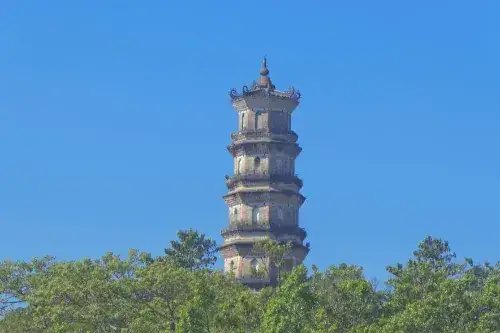
Key historical sites include Baoguang Pagoda (the tallest brick pagoda in Guangdong, built in 1576, a national-level protected cultural relic since 2019), Huazhou Confucian Temple (the largest and best-preserved Confucian temple in western Guangdong), the Gaoliang Ancient City Ruins in Gaozhou (provincial-level protected site since 1999, featuring double walls and moats), Zhenlong Ancient City in Xinyi (founded 621 AD, with 13 surviving academies), Wenming Gate (the "Red Tower," provincial heritage 2019), and the Dahong Kingdom Prince's Mansion (provincial heritage 1990).
Intangible Cultural Heritage
Maoming's intangible cultural heritage includes Lady Xian beliefs (national-level), Pan Maoming legends, and the Nianli festival. Other notable traditions include Dianbai agarwood crafting techniques, Huajuhong (Citrus grandis) medicinal culture (listed in the U.S. Pharmacopeia and selected for COVID-19 treatment formulas), and Huazhou Tuoluo cake making.
Cuisine and Specialties
Gaoliang Cuisine, centered on Maoming, is one of the four major branches of Cantonese cuisine. It emphasizes natural flavors through blanching, boiling, and pan-frying with minimal seasonings, characterized by clear, fresh, fragrant, and tender qualities. Notable specialties include Huazhou Tuoluo cake (a traditional Mid-Autumn offering dating to the Tang Dynasty) and Huajuhong, a traditional medicine cultivated since the Han Dynasty and recorded in Li Shizhen's Compendium of Materia Medica.
Tourism Attractions
Overview
Maoming is a "China Excellent Tourism City" with diverse terrain features from mountain meadows to coastal beaches. As of June 2023, the city had 28 A-level scenic spots, including 10 AAAA-level sites. Coastal tourism highlights form a "six points, one line" route: Bohe Fishing Port, Fangji Island, Romantic Coast, China First Beach, Shuidong Bay, and Gemeihai Park.
Major Attractions
Five featured tourism sectors cover coastal vacations, Lady Xian culture, Pan Maoming wellness, rural tourism, and mountain sports. The city has 5 specialty towns in the provincial cultivation program, including the Gaozhou Alpine Meadow Sports Town and the Dianbai Agarwood Town.
Notable People
Historical figures include Pan Maoming (the city's namesake), Lady Xian (heroine), Feng Ang (general), Gao Lishi (court eunuch), and Yang Yiqing (statesman). Modern notables include Ding Ying (father of Chinese rice science, CAS academician), Gan Zizhao (physicist, CAS academician), Li Lemin (chemist, CAS academician), and entertainers Leo Ku (ancestral home Gaozhou) and Linda Chung (ancestral home Gaozhou).
Honorary Titles
Maoming has received numerous honors including "National Garden City," "National Forest City" (2022), "China Excellent Tourism City," "China Mooncake City" (2018), and "National Civilized City" (2025). The city ranked 75th among China's top 100 prefecture-level cities in 2019.
Sister Cities
No sister city information is currently available.
Travel information can change. Check current opening hours, reservations and entry requirements before you travel.

Traveller discussion
Start the conversation with a helpful tip or a question.