
Shenzhen City
Shenzhen CityShenzhen City, abbreviated as "Shen" and also known as Pengcheng, is a prefecture-level city, sub-provincial city, and city under separate state planning in Guangdong Province. It is a megacity and the core city of the Shenzhen
Shenzhen City
Shenzhen City, abbreviated as "Shen" and also known as Pengcheng, is a prefecture-level city, sub-provincial city, and city under separate state planning in Guangdong Province. It is a megacity and the core city of the Shenzhen metropolitan area. Located in southern Guangdong Province on the eastern shore of the Pearl River estuary, it borders Daya Bay and Dapeng Bay to the east, the Pearl River estuary and Lingdingyang to the west, the Hong Kong Special Administrative Region to the south, and Dongguan and Huizhou to the north, with a total area of 1,997.47 square kilometers. As of the end of 2025, Shenzhen administers 9 districts. Mandarin Chinese is the primary language, with Cantonese and English also widely used. As of the end of 2025, the resident population was 18.2485 million. The terrain is predominantly hilly, with a subtropical monsoon climate featuring long summers, short winters, and abundant rainfall. Shenzhen has a 7,000-year history of human activity and a 1,700-year city-building history. It is one of Guangdong's key hometowns of overseas Chinese, a former revolutionary base, and the birthplace of the East River Column during the Anti-Japanese War. The predecessor of Shenzhen was Bao'an County; the name "Shenzhen" first appeared in historical records in 1410 during the Ming Dynasty. In March 1979, Bao'an County was renamed Shenzhen City, and on August 26, 1980, the Shenzhen Special Economic Zone was established. Shenzhen is China's window of Reform and Opening-up and a new immigrant city, having created the world-renowned "Shenzhen Speed" and earning the nickname "China's Silicon Valley." It is also a national logistics hub and one of China's three major financial centers. In 2025, Shenzhen's GDP reached 3,873.18 billion yuan (approximately US$537.7 billion), a year-on-year increase of 5.5% at constant prices.
History
The earliest predecessor of Shenzhen was Bao'an County under Guangzhou Prefecture. Although the Special Economic Zone's development spans only over 40 years, the area boasts over 6,700 years of human activity, 6,000 years of development and maritime economic history, 1,700 years of urban history, over 600 years of coastal defense history, an 800-year Cantonese (Guangfu) heritage, and 300-plus years of Hakka immigration history.
During the pre-Qin period, the Guangdong region was inhabited by the Nanyue people (a branch of the Baiyue), including the Zhuang, She, and Tanka groups. Shenzhen served as a staging point for the Nanyue people's maritime expeditions, with coastal inhabitants living by fishing and seafaring.
After Qin Shi Huang unified China in 214 BCE, three commanderies — Nanhai, Guilin, and Xiang — were established in Lingnan, with 500,000 people relocated for development. Shenzhen, then part of Nanhai Commandery, absorbed Central Plains culture. Bao'an County was first established as an administrative unit in 331 CE during the Eastern Jin Dynasty, when the Dongguan Commandery was created with jurisdiction over six counties covering roughly the area of present-day Shenzhen, Dongguan, and Hong Kong, with its seat at Nantou.
During the Song Dynasty, Shenzhen was an important hub for southern maritime trade, producing salt and spices. In the Yuan Dynasty, it became known for pearl production. In 1394, the Dongguan and Dapeng garrison posts were established within present-day Shenzhen. Nantou Ancient City, with over 600 years of history, served as the political center of the Shenzhen-Hong Kong-Macau region before the late Qing Dynasty. In 1573, Xin'an County was carved out of Dongguan County.
Between 1842 and 1898, the Qing government signed the Treaty of Nanjing, the Convention of Beijing, and the Convention for the Extension of Hong Kong Territory, ceding and leasing Hong Kong Island, Kowloon, and the New Territories to Britain. Of Xin'an County's original 3,076 square kilometers, 1,055.61 square kilometers were separated, and Shenzhen and Hong Kong have been governed separately since.
In 1914, Xin'an County was renamed Bao'an County to avoid confusion with Xin'an County in Henan Province. After the founding of the People's Republic of China in 1949, the area underwent several administrative changes. In 1953, the county seat was moved from Nantou to Shenzhen Market due to its railway connection and commercial activity. On January 23, 1979, the CPC Guangdong Provincial Committee established Shenzhen City, abolishing Bao'an County. On August 26, 1980, the Shenzhen Special Economic Zone was formally established. In 1988, the State Council granted Shenzhen separate state planning status with provincial-level economic management authority. In 1994, Shenzhen was designated a sub-provincial city. In 2010, the Special Economic Zone was expanded to cover the entire city. In 2019, the central government issued guidelines supporting Shenzhen as a Pilot Demonstration Area for Socialism with Chinese Characteristics.
Administrative Divisions
Division Evolution
Shenzhen's administrative divisions underwent significant changes. In 1982, Luohu District was established. In 1990, Luohu, Futian, and Nanshan districts were formally created within the Special Economic Zone. Bao'an and Longgang districts were established in 1992, Yantian District in 1997. Guangming New District was created in 2007, Pingshan New District in 2009, and Longhua and Dapeng New Districts in 2011. Longhua and Pingshan were upgraded to full districts in 2016, and Guangming became a district in 2018. In December 2018, the Shenshan Special Cooperation Zone was formally established.
Current Divisions
As of December 2025, Shenzhen administers 9 districts: Futian, Luohu, Nanshan, Yantian, Bao'an, Longgang, Longhua, Pingshan, and Guangming (plus one functional zone — Dapeng New District). The municipal government is headquartered at the Shenzhen Civic Center on Fuzhong 3rd Road, Futian District.
Geography
Location
Shenzhen is a coastal city in southern China, adjacent to Hong Kong, located south of the Tropic of Cancer between 113 degrees 43 minutes and 114 degrees 38 minutes east longitude, and 22 degrees 24 minutes and 22 degrees 52 minutes north latitude. The total area is 1,997.47 square kilometers.
Topography
The terrain is higher in the southeast and lower in the northwest, mostly low hills with gentle terraces and coastal plains in the west. The highest peak is Wutong Mountain at 943.7 meters. The eastern area features unique volcanic geological relics and coastal erosion landforms within the Dapeng Peninsula National Geopark, including the Qiniang Mountain volcanic dome and the Dayanding volcanic conduit.
Climate
Shenzhen has a subtropical monsoon climate with long summers and short winters. The average annual temperature is 23.3 degrees Celsius, with historical extremes of 38.7 degrees Celsius (maximum) and 0.2 degrees Celsius (minimum). Annual precipitation averages 1,932.9 millimeters, with 86% falling during the flood season (April to September). Spring weather is variable; summers last over six months with high temperatures and abundant rainfall; autumn and winter are dominated by northeast monsoons with dry conditions.
Hydrology
Shenzhen has over 160 rivers belonging to the East River, bay, and Pearl River estuary systems. Five rivers have catchment areas exceeding 100 square kilometers: Shenzhen River, Maozhou River, Longgang River, Guanlan River, and Pingshan River.
Natural Resources
Water Resources
There are 362 rivers with catchment areas over 1 square kilometer and 168 reservoirs of various sizes. Shenzhen Reservoir, with a capacity of over 40 million cubic meters, is the main water source for Shenzhen and Hong Kong. Total freshwater resources amount to 1.93 billion cubic meters, with per capita resources of only 500 cubic meters — approximately one-third and one-quarter of the national and provincial averages, respectively.
Biological Resources
Shenzhen produces Longgang chicken, Nanshan lychee, Shiyan sand pear, Jingui orange, and Longhua persimmon. Shajing oysters are a renowned local specialty. Nationally protected wildlife includes tiger frogs, pythons, macaques, large civets, leopards, and pangolins.
Marine Resources
Shenzhen's marine waters total 1,145 square kilometers with a coastline of 260.5 kilometers, 50 natural beaches, and 51 uninhabited islands. Notable beaches include Dameisha, Xiaomeisha, Xichong, and Jidiaosha. Natural reserves include the Dapeng Peninsula National Geopark, Shenzhen Bay mangrove wetlands, Wutong Mountain Country Park, and Neilingding Island.
Population
Historically, the Shenzhen area was home to four ethnic groups: Hakka, Cantonese (Guangfu), Fulao, and Tanka. The earliest settlers in western Shenzhen were Cantonese speakers, while Hakka immigrants later settled in the eastern and northern hilly areas. Cantonese families with surnames including Lei, Chen, Zheng, Huang, Pan, Wen, Zeng, Deng, Liao, and Liu mostly migrated during the Song Dynasty. Large-scale Hakka immigration occurred during the Kangxi and Qianlong reigns of the Qing Dynasty, following the coastal evacuation and resettlement policy.
As of the 2020 census, the resident population was 17.5601 million, an increase of 7.1361 million (68.46%) over 2010. By the end of 2025, the population reached 18.2485 million, surpassing 18 million for the first time, with 99.79% classified as urban.
Politics
Current Leadership
The city is governed by the CPC Shenzhen Municipal Committee and the Shenzhen Municipal People's Government, with leadership appointed by the CPC Guangdong Provincial Committee and approved by the State Council.
Past Leaders
Since its establishment in 1979, Shenzhen has been led by a succession of municipal party secretaries and mayors who have guided the city's remarkable transformation from a small border town to a global metropolis.
Economy
Overview
In 2021, Shenzhen's economy ranked fourth among Asian cities, with over 3.85 million business entities — the highest nationally in both total and density. In 2022, the seven strategic emerging industries generated 1,332.402 billion yuan (approximately US$185.1 billion) in value-added, accounting for 41.1% of GDP. The Shenzhen Stock Exchange opened on December 1, 1990, followed by the SME board in 2004, the ChiNext board in 2009, and the Shenzhen-Hong Kong Stock Connect in 2016. The Shenzhen Data Exchange was established in November 2022.
In 2025, Shenzhen's GDP reached 3,873.18 billion yuan (approximately US$537.7 billion), growing 5.5% year-on-year at constant prices. The primary, secondary, and tertiary industries contributed 2.804 billion yuan (approximately US$389 million), 1,448.254 billion yuan (approximately US$201.1 billion), and 2,422.122 billion yuan (approximately US$336.4 billion), respectively. Fixed asset investment declined 21.7%. The consumer price index rose 0.2%.
In 2023, strategic emerging industries generated 1,448.968 billion yuan (approximately US$201.2 billion) in value-added, accounting for 41.9% of GDP. By 2024, these industries grew 10.5%, representing 42.3% of GDP, with high-tech manufacturing accounting for 58.2% of above-scale industrial value-added.
Primary Industry
In 2025, the primary industry's value-added was 2.804 billion yuan (approximately US$389 million), a decrease of 4.5%.
Secondary Industry
In 2025, the secondary industry's value-added was 1,448.254 billion yuan (approximately US$201.1 billion), growing 4.1%. Above-scale industrial value-added grew 5.4%. Manufacturing grew 5.9%, with computer, communications, and electronic equipment manufacturing up 6.2%. High-tech product outputs surged, with 3D printing equipment up 45.1%, industrial robots up 43.1%, and civilian drones up 40.1%.
Tertiary Industry
In 2025, the service sector's value-added was 2,422.122 billion yuan (approximately US$336.4 billion), growing 6.3%. The financial sector grew 12.1%, information technology services 10.3%, and leasing and business services 5.9%. Airport passenger throughput grew 8.1% and port container throughput 6.0%.
Total imports and exports reached 4,553.389 billion yuan (approximately US$632.4 billion), up 1.4%, with exports totaling 2,738.781 billion yuan (approximately US$380.4 billion) and imports 1,814.608 billion yuan (approximately US$252.0 billion), achieving a 33rd consecutive year as China's top export city. Social consumer retail totaled 1,025.993 billion yuan (approximately US$142.5 billion), up 2.3%. Financial institution deposits reached 14,634.695 billion yuan (approximately US$2,032.6 billion), up 7.8%.
In 2024, Shenzhen received 9.765 million overnight inbound tourists, up 36.7%, with tourism foreign exchange earnings of US$7.319 billion, up 93.2%.
Social Affairs
Education
By the end of 2024, Shenzhen had 2,987 schools of all types with 2.7868 million students. There were 1,990 kindergartens, 357 primary schools, 582 secondary schools, and 16 regular higher education institutions with 168,000 students. Shenzhen was designated a national vocational education reform pilot city in 2020. The Xili Lake International Science and Education City X9 University Alliance, established in 2022, includes Shenzhen University, Southern University of Science and Technology, Tsinghua Shenzhen International Graduate School, Peking University Shenzhen Graduate School, and other institutions.
Science and Technology
In 2024, Shenzhen granted 74,675 invention patents, up 20.0%. The city held 358,700 valid invention patents, with 16,347 PCT international patent applications. Technology contract transactions totaled 160.554 billion yuan (approximately US$22.3 billion). The city had 2.5534 million professional and technical personnel.
Culture
By the end of 2024, Shenzhen had 925 public libraries with 68.2413 million volumes, 62 museums, and 13 art galleries. Radio and television population coverage reached 100%.
Sports
Shenzhen was selected as a national sports consumption pilot city in 2020. In 2022, total sports consumption reached 61.748 billion yuan (approximately US$8.6 billion), with per capita consumption of 3,492.21 yuan (approximately US$485). The city hosted the 26th Summer Universiade in 2011, welcoming nearly 10,000 athletes from 152 countries. Shenzhen will host 25 events for the 15th National Games in 2025.
Healthcare
By the end of 2024, Shenzhen had 5,887 medical institutions including 162 hospitals, with 79,561 beds and 132,806 health professionals. Annual medical visits totaled 136.5791 million.
Social Security
By the end of 2024, Shenzhen had 91 residential social service institutions, including 82 elderly care facilities with 14,385 beds. Minimum living allowance payments totaled 53.032 million yuan (approximately US$7.4 million), up 16.2%.
Transportation
Overview
Shenzhen has the highest road network density in China. In 2024, passenger transport reached 228.9046 million trips, up 10.9%. Port cargo throughput was 317.8962 million tons, up 10.9%, with container throughput of 33.3986 million TEU, up 11.8%, ranking fourth globally. The city had 4.3247 million civilian vehicles. Shenzhen built 1,030 supercharging stations, surpassing the number of gas stations, with 420,000 cumulative charging piles.
Highways
By the end of 2024, Shenzhen's highway network totaled 1,056.16 kilometers, including 436.96 kilometers of expressways. The Shenzhen-Zhongshan Link has significantly enhanced cross-estuary connectivity.
Railways
The Guangzhou-Shenzhen Railway was China's first quasi-high-speed railway at 160 km/h. The city is developing a "five main, five auxiliary" rail hub system, with Shenzhen Station, Shenzhen North Station, Xili Station, Airport East Station, and Shenzhen Pingshan Station as main hubs. In 2024, rail passenger volume reached 186 million trips, with Shenzhen North Station handling a record 116 million.
Aviation
Shenzhen Bao'an International Airport is China's fourth-largest airport. In 2024, it handled 61.476 million passengers (ranking 4th nationally, up 16.6%), 1.881 million tons of cargo (ranking 3rd, up 17.6%), and 428,000 flight movements. International passenger traffic reached 5.181 million, up 108.7%, with over 45 international and regional destinations served.
Water Transport
Shenzhen Port is divided into western ports (Nanshan, Dachan Bay, Bao'an) and eastern ports (Yantian, Dapeng). In 2024, container throughput reached 33.38 million TEU, ranking fourth globally. LNG throughput exceeded 13.36 million tons, ranking first nationally for four consecutive years. Maritime automobile exports surpassed 210,000 units.
Ports of Entry
Shenzhen has 16 first-class ports, including 7 highway ports (Luohu, Wenjindu, Huanggang, Shatoujiao, Shenzhen Bay, Futian, and Liantang), 2 railway ports, 6 water transport ports, and 1 aviation port. In 2024, border inspections totaled 240 million person-times, up 45.6%, with 2.76 million inbound foreigners, ranking second nationally.
Public Transit
In 2024, public transit carried 4.166 billion passengers, up 9.2%. Rail transit handled 3.097 billion trips, up 14.2%. Shenzhen's metro system opened in 2004; as of June 2026, the operating network reached 653.7 kilometers with the highest network density in China. On December 31, 2024, daily ridership hit a record 11.885 million. Shenzhen was China's first city to implement driverless bus fare collection (1992), bus-only lanes (1997), and full electrification of public buses (2017). The city had 944 bus routes with 15,000 vehicles and 21,500 taxis.
History and Culture
Origin of the Name
The name "Shenzhen" first appeared in historical records in 1410. The character "zhen" in Cantonese and Hakka dialects refers to a field ditch or small stream, so "Shenzhen" literally means "a deep watercourse in the fields." The name derives from the Shenzhen Market, which was named after a nearby deep watercourse — today's Buji River.
City Symbol
Shenzhen has an official city logo representing its identity as a city of innovation and openness.
Regional Culture
Shenzhen's culture integrates coastal defense culture, Hakka culture, Cantonese (Guangfu) culture, red revolutionary culture, and the spirit of Reform and Opening-up. The Cantonese people, the earliest settlers, arrived during the Song-Yuan transition, mainly residing in western Shenzhen along the Pearl River and west of the Guangzhou-Kowloon Railway. The Hakka people arrived in large numbers after the Qing Dynasty's coastal evacuation and resettlement policy, settling in eastern and northern areas. Approximately 56% of the original registered population spoke Hakka and 44% spoke Cantonese, based on the 1997 Bao'an County gazetteer.
Intangible Cultural Heritage
As of 2021, Shenzhen had 214 intangible cultural heritage items at all levels, including 8 national-level items and 27 provincial-level items, with 176 heritage inheritors and 39 exhibition venues.
Customs and Folkways
Local customs reflect both Cantonese and Hakka traditions. The Hakka people brought their emphasis on education and the farming-reading tradition, establishing schools from traditional private academies to modern institutions. The Pingshan ritual ceremony, held every eight years, was a unique Hakka tradition involving communal worship and festivities over seven days and eight nights, though it was discontinued in 1943.
Dialects
Mandarin is the mainstream language, with Cantonese and English also widely used. The original residents primarily spoke Hakka and Cantonese dialects. All seven major Chinese dialect groups are present in Shenzhen due to immigration from across the country. Approximately 200,000 original residents speak Hakka and 170,000 speak Cantonese. Most public service professionals and young people can communicate in English.
Religion
Buddhism and Taoism are predominant, with Islam, Catholicism, and Protestantism also present. The city has 33 religious activity venues with 139 clergy and over 230,000 believers, about 15% of Guangdong's total. The Tianhou Temple at Chiwan, dedicated to Mazu, has significant historical influence among original residents.
Art
Cantonese opera is popular in Cantonese-speaking areas. Shiyans Hakka folk songs and Gankeng Hakka hat-making are notable cultural traditions. Dapeng Fortress, built in 1394, is a national-level protected cultural heritage site and the origin of Shenzhen's alias "Pengcheng." Nantou Ancient City, with nearly 1,700 years of history, served as the political center of the Shenzhen-Hong Kong region and features Lingnan Cantonese architectural style. Pianist talents including Chen Sa and Zhang Haochen have emerged from Shenzhen, where piano ownership reaches 8.2 per 100 households.
Design
Shenzhen was designated a UNESCO City of Design on November 19, 2008, becoming the sixth globally. The city's design industry, initially driven by Hong Kong influences, has developed significant competitive advantages with numerous design elites influencing both national and international markets.
Animation
Shenzhen is a major Chinese animation production base and was the first city in mainland China to process animation for overseas clients. In the mid-1980s, the first Hong Kong-funded animation company settled in Shenzhen, which at its peak gathered nearly 70% of China's animation talent.
Festivals
Major cultural events include the China (Shenzhen) International Cultural Industries Fair, Shenzhen Reading Month, the Shenzhen Hakka Culture Festival, and the Shenzhen International Piano Concerto Competition.
Scenic Spots
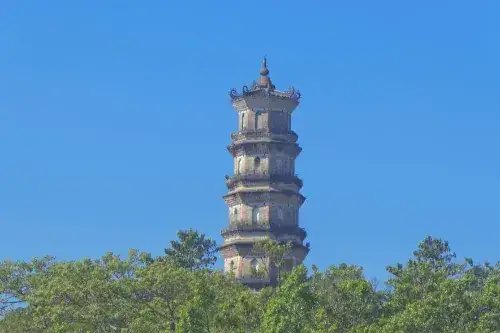
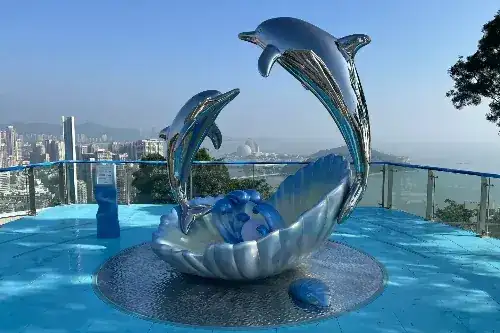
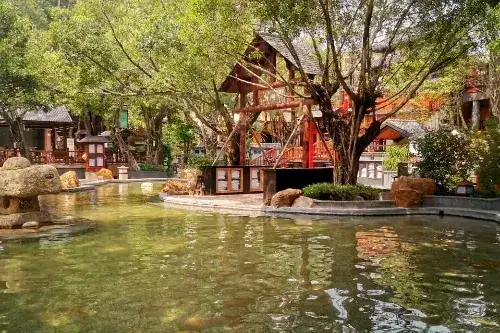
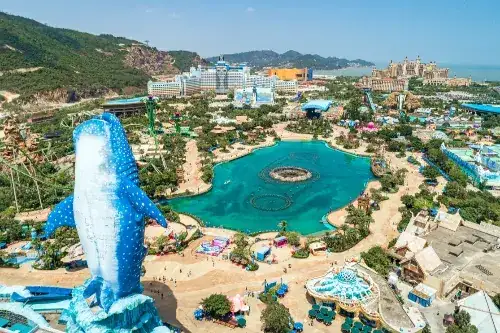
Major attractions include Window of the World, Happy Harbor, Happy Valley, Shenzhen Mangroves, Overseas Chinese Town East, Lianhua Mountain, Bijia Mountain, Wutong Mountain, Yangtai Mountain, Fenghuang Mountain, Dameisha Seaside Park, Xiaomeisha Seaside Amusement Park, Fairy Lake Botanical Garden, Dongmen Old Street, Dapeng Bay, Chung Ying Street, Happy Coast, and Dapeng Fortress. As of May 2022, the city had 1,238 parks of various types.
Local Cuisine
Food Culture
Shenzhen's culinary heritage dates back to the Tang and Song dynasties, and as far as 7,000 years to the Neolithic period. Western Shenzhen features Cantonese cuisine, while the central and eastern areas feature Hakka cuisine. Notable traditions include Anqi Cantonese mooncake-making and Kuichong Hakka tea cake-making, with the latter involving glutinous rice cakes used for sacrificial offerings and festive celebrations.
Local Specialties
Famous local products include Shajing fresh oysters, Nanshan lychee, Xili mango, Dapeng cloud-mist tea, Gongming roast goose, Xixi Jiwei shrimp, Shiyan sand pear, Nan'ao abalone, Nan'ao sea urchin, Pingshan Jingui orange, Fuyong mullet, Songgang preserved duck, Longgang three-yellow chicken, Guangming roast pigeon, and Nanshan sweet peach. Shajing oysters, Nanshan lychee, and Xili mango are the most representative.
Notable Figures
Shenzhen has produced numerous notable figures across technology, business, and the arts, reflecting its dynamic growth as a city of innovation and entrepreneurship.
International Exchange
As of 2024, Shenzhen had established sister city or friendly exchange relationships with 93 cities across 58 countries and regions worldwide.
Honorary Titles
Shenzhen has received numerous honorary designations, including UNESCO City of Design, National Civilized City, National Model City for Comprehensive Fitness, and National Pilot City for Sports Consumption.
Travel information can change. Check current opening hours, reservations and entry requirements before you travel.
Traveller discussion
Start the conversation with a helpful tip or a question.