
Shaoguan City
Shaoguan CityShaoguan City, formerly known as Shaozhou, is a prefecture-level city in northern Guangdong Province, bordering Hunan to the north and Jiangxi to the east. Covering 18,400 square kilometers between 23°53′–25°31′N and 112°53′–11
Shaoguan City
Shaoguan City, formerly known as Shaozhou, is a prefecture-level city in northern Guangdong Province, bordering Hunan to the north and Jiangxi to the east. Covering 18,400 square kilometers between 23°53′–25°31′N and 112°53′–114°45′E, it administers 3 districts, 4 counties, 1 autonomous county, and 2 county-level cities. As of end-2025, the registered population was 3.292 million. Hakka Chinese is the predominant dialect, followed by Cantonese. Located in the southern Nanling Mountains, Shaoguan has a subtropical monsoon climate and serves as the most important land corridor between North/Central China and the southern coast. Its six specialty industries include tea, oil-tea camellia, medicinal herbs, flowers, sericulture, and tobacco. The city's cultural heritage blends Central Plains and Lingnan cultures, producing the distinctive Shao culture intertwined with Hakka, surname, ancient road, and Yao ethnic traditions. In 2025, GDP reached 170.51 billion yuan (approximately $23.5 billion USD), up 3.6%.
Name Origin and Evolution
Shaoguan, anciently called Shaozhou, derives "Shao" from Shaoshi Mountain within the Danxia Mountain area—legend holds that Emperor Shun played the Shao music on these rocks, attracting phoenixes. The character "Guan" (pass) comes from tax checkpoints established during the Ming-Qing dynasties. Shaoguan was one of only twelve tax passes nationwide whose annual revenue exceeded 100,000 taels of silver during the Qianlong reign.
Historical Evolution
Pre-Qin to Northern and Southern Dynasties
Due to the Nanling Mountains barrier, the area had little contact with the Central Plains in antiquity. After Qin unified China in 214 BCE, northern Guangdong lacked county-level administration. During the Han Dynasty, counties were established; after Emperor Wu conquered Nanyue in 111 BCE, five counties were placed under Guiyang Commandery. The Three Kingdoms through Northern and Southern Dynasties saw commanderies and prefectures established amid frequent reorganizations.
Sui-Tang to Ming-Qing
Northern Guangdong's administrative structure stabilized during the Sui-Tang period. The Song-Yuan era maintained consistent territories for Nanxiong, Shaozhou, and Lianzhou. The Ming Dynasty organized Shaozhou and Nanxiong prefectures; the Qing Dynasty preserved this structure, with Shaozhou Prefecture governing six counties.
Republic of China
In 1912, a military administrative office was established in Shaoguan overseeing 11 counties. By April 1949, northern Guangdong was divided into three administrative supervision districts comprising 15 counties.
People's Republic of China
The Shaoguan Municipal People's Government was established in 1949. In January 1977, Shaoguan was elevated to a provincial-level municipality. In June 1983, the Shaoguan Prefecture and Shaoguan City merged into the current Shaoguan Prefecture-level City. By 2021, it administered Zhenjiang District, Wujiang District, Qujiang District, Renhua County, Shixing County, Wengyuan County, Xinfeng County, Ruyuan Yao Autonomous County, and the county-level cities of Lechang and Nanxiong.
Physical Geography
Location and Boundaries
Shaoguan lies in northern Guangdong between 23°53′–25°31′N and 112°53′–114°45′E, with a total area of 18,400 square kilometers—second largest in Guangdong. The urban area covers 2,870.66 square kilometers.
Climate
Shaoguan has a subtropical monsoon climate with hot summers and mild winters. In 2022, the annual average temperature was 20.6°C, with 49.6 days exceeding 35°C. Annual rainfall averaged 2,131.6 mm, 26% above normal, with the wet season spanning March through August.
Geology
Shaoguan lies in the Xiang-Yue fold belt within the southern Nanling Mountains. Strata from Sinian to Quaternary are largely represented (except Silurian). The region features anticlinoria, synclinoria, and extensive fault systems with widely distributed karst landscapes. Major rock types include red conglomerate, sandstone, metamorphic rock, granite, and limestone. Approximately 37 intrusive bodies cover about 10,000 square kilometers—one-third of the total area. The Yanshanian period was most significant for mineralization.
Topography and Landforms
The terrain is predominantly mountains and hills. Three arc-shaped mountain ranges run north to south: the Weiling-Dayuling range (140 km), the Dadongshan-Yaoling range (250 km), and the Qiweishan-Qingyunshan range (270 km). Shikengkong at 1,902 meters is Guangdong's highest peak.
Hydrology and Water Conservancy
Major rivers include the Zhenjiang River, Wujiang River, Mojiang River, Jinjiang River, Nanshui River, Wengjiang River, the Beijiang (North River) mainstream, and Xinfengjiang River. The Beijiang River has been a vital waterway since the Qin-Han dynasties. Shaoguan has 6 large and 34 medium-sized reservoirs. The Lechang Gorge Water Control Project on the Wujiang River has a storage capacity of 344 million cubic meters.
Soil
Shaoguan's soils comprise 7 soil groups including lateritic red earth, red earth, yellow earth, limestone soil, purple soil, and paddy soil across 34 species. Total soil area is 42.15 million mu (approximately 2.81 million hectares).
Natural Disasters
Shaoguan experiences floods, wind-hail storms, droughts, frost disasters, fires, pest infestations, and earthquakes. In April 2024, the city suffered its heaviest April rainfall since 1981, causing direct economic losses of 130 million yuan (approximately $18 million USD).
Natural Resources
Water Resources
In 2023, total surface water resources amounted to 19.98 billion cubic meters, with groundwater resources of 4.89 billion cubic meters. Per capita water consumption was 632 cubic meters.
Land Resources
In 2021, total land area was 1.84 million hectares, including 1.72 million hectares of agricultural land (1.46 million hectares forest), 84,400 hectares of construction land, and 39,100 hectares of unused land.
Mineral Resources
As of end-2021, Shaoguan held 36 valid exploration permits (primarily for rare earths, tungsten, lead, zinc, copper) and 65 mining permits (primarily for lead, zinc, tungsten, iron, fluorspar, and geothermal resources).
Biological Resources
In 2021, forest coverage reached 74.5% with 1.37 million hectares of forest and 101 million cubic meters of standing timber. The city hosts 2,686 higher plant species (271 families, 1,031 genera) including 46 nationally protected species, and 575 terrestrial vertebrate species with 8 under national first-class protection including the Chinese pangolin, clouded leopard, and South China tiger. It has 77 nature protected areas totaling 424,600 hectares. The Guangdong Nanling National Nature Reserve—one of the Pearl River's source areas—houses Guangdong's largest primeval forest. The Danxia Mountain National Nature Reserve, a UNESCO Global Geopark and Guangdong's first World Natural Heritage site, features over 680 red sandstone peaks.
Administrative Divisions
As of September 2025, Shaoguan administers 3 districts (Wujiang, Zhenjiang, Qujiang), 4 counties (Shixing, Renhua, Wengyuan, Xinfeng), 1 autonomous county (Ruyuan Yao), and 2 county-level cities (Lechang, Nanxiong). The municipal government is at 75 Fengdu North Road, Zhenjiang District.
Politics
The city is governed by the Shaoguan Municipal People's Government under the CPC Shaoguan Municipal Committee, within China's local governance framework.
Population
Population Size
As of end-2025, the registered population was 3.292 million (down 1.7%). Permanent residents totaled 2.834 million with 61.03% urbanization. Birth rate was 6.68‰, death rate 9.63‰, natural growth rate -2.95‰.
Ethnic Groups
In 2021, ethnic minorities totaled 56,000 (1.97%), primarily Yao (34,000) and She (6,000) peoples, concentrated in Ruyuan Yao Autonomous County and surrounding areas.
Language
Hakka Chinese is predominant, followed by Cantonese. Northern Guangdong vernacular, Gan, Xiang, Min, and Beijiang boat dialects are also spoken in smaller communities.
Religious Beliefs
In 2021, Shaoguan had five recognized religions—Buddhism, Taoism, Catholicism, Christianity, and Islam—with 52 religious activity venues, over 46,000 believers, and two Buddhist academies.
Economy
Overview
In 2025, GDP reached 170.51 billion yuan (approximately $23.5 billion USD), up 3.6%. The three-sector structure was 15.2:31.1:53.7. Fixed asset investment declined 14.5%; local fiscal revenue reached 12.02 billion yuan (up 14.5%). Per capita disposable income was 36,295 yuan (approximately $5,010 USD), up 4.8%.
Primary Industry
Shaoguan's "6+6" agricultural system combines six leading industries (premium rice, vegetables, fruits, livestock, aquatic products, bamboo) with six specialty industries (tea, oil-tea camellia, medicinal herbs, flowers, sericulture, tobacco). In 2025, agricultural output reached 42.46 billion yuan (up 5.5%) with grain production at 773,500 tons.
Secondary Industry
As one of Guangdong's largest steel production bases, Shaoguan's industries include machinery manufacturing, automotive parts, specialty steel, non-ferrous metals, fine chemicals, and emerging sectors like biopharmaceuticals, semiconductors, and big data. In 2025, 706 above-scale enterprises generated industrial profits of 7.74 billion yuan (up 36.8%).
Tertiary Industry
In 2025, the tertiary sector generated 91.58 billion yuan (up 4.2%). Retail sales reached 45.31 billion yuan (up 2.0%); import-export volume was 19.03 billion yuan. The city received 16.6 million tourists, generating 17.56 billion yuan (approximately $2.42 billion USD) in tourism revenue. Financial deposits reached 308.92 billion yuan.
Economic Functional Zones
The Dongguan-Shaoguan Industrial Transfer Park, established in 2008, features equipment manufacturing with clusters in automotive parts, construction machinery, hydraulic cylinders, and high-end forging.
Social Affairs
Education
In 2025, Shaoguan had 628,200 enrolled students across 2 universities, 3 technical schools, 155 secondary schools, 12 vocational schools, and 210 primary schools. Shaoguan University, founded in 1958, and Guangdong Songshan Polytechnic College are the main institutions.
Healthcare
The city had 2,162 health institutions including 47 hospitals and 96 township health centers, with 26,800 health professionals and 20,900 beds.
Science and Technology
By end-2025, Shaoguan had 22 national "Little Giant" enterprises, 425 high-tech enterprises, and 130 provincial engineering technology research centers. R&D expenditure in 2024 was 1.42 billion yuan (approximately $196 million USD). The city held 3,412 valid invention patents.
Culture
The city had 11 public libraries (4.1 million volumes), 13 museums, and 11 cultural centers. Radio and television coverage both reached 100%.
Sports
In 2025, Shaoguan athletes won 4 national championships and hosted over 100 sporting events including the Guangdong Youth Triathlon Championship.
Social Security
Urban new employment reached 22,500. Pension insurance covered 832,000 urban workers and 1.01 million rural residents. Medical insurance covered 2.86 million people. Subsistence allowances supported 45,100 residents.
Environmental Protection
In 2025, Shaoguan achieved 357 days of good air quality (AQI at or below 100) with PM2.5 averaging 25 micrograms per cubic meter. The city operated 18 wastewater treatment facilities with 557,000-ton daily capacity, achieving 100% harmless waste treatment.
Transportation
Overview
Shaoguan is a Class I railway and highway transportation hub. The Beijing-Guangzhou Railway, Beijing-Zhuhai Expressway, and National Highways 106 and 323 traverse the city, forming a "three railways, eight expressways, two waterways" network.
Highways
The city has 840 km of expressway and 17,700 km of total roads in a "three horizontal, four vertical, one ring" network. Registered civilian vehicles numbered 639,300, including 41,100 new energy vehicles (up 53.4%).
Railways
Operational railways total 525.8 km including the Wuhan-Guangzhou high-speed line (155 km), Beijing-Guangzhou railway (130 km), and Ganzhou-Shaoguan railway (117 km), with 7 passenger and 16 freight stations.
Aviation
Shaoguan Danxia Airport, opened November 2021, is Guangdong's 9th civil airport—a 4C-grade facility with a 2,800-meter runway serving 13 cities.
Water Transport
The city has 386 km of navigable waterways. Shaoguan Port on the Beijiang River has 5 port areas with 66 berths and 11.77-million-ton annual capacity.
Public Transportation
Shaoguan operates 51 bus routes (705.3 km, 368 vehicles) and 299 intercity bus routes (923 vehicles). All 1,205 administrative villages have bus service. Twelve shared bicycle brands operate 8,000 vehicles.
Culture and Humanities
Overview
Over 80% of residents are Hakka Chinese, making Shaoguan one of Guangdong's three major Hakka settlements—"the Fifth Hakka Prefecture." The distinctive Shao culture interweaves Hakka, surname, ancient road, and Yao ethnic traditions.
Folk Customs
Shaoguan preserves over 300 enclosed Hakka tower-houses in Shixing County. Notable Hakka figures include Tang Dynasty chancellor Zhang Jiuling, Song Dynasty official Yu Jing, and Ming Dynasty general Chen Lin. The Lishi Dragon Boat Festival in Zhenjiang District, over a thousand years old, is listed intangible cultural heritage.
Cuisine
"Shaozhou Hakka dishes" feature rich, savory flavors with rice as the staple. Local specialties include Zhoupi salted goose, Xiongzhou braised fish, and Wengyuan red onion meatballs. Products include Yanxishan white-tip tea, Maba oil-sticky rice, Lechang golden plums, Nanxiong pressed duck, and Danxia tribute mandarins.
Traditions
Rural customs follow the 24 solar terms. Practices include auspicious-day business openings, periodic market days, and distinctive wedding customs. The Yao and She peoples maintain unique ethnic traditions.
Arts
Northern Guangdong Tea-Picking Opera (national intangible heritage, 2011) blends folk songs and narrative traditions. The Nanxiong Incense Dragon dance features 18 dancers inserting 1,600–1,800 incense sticks into straw dragons. Ruyuan Yao embroidery uses vibrant silk threads on dark cotton with nature-inspired patterns.
City Symbols
The orchid is Shaoguan's city flower—Wengyuan County is "China's Land of Orchids." The camphor tree is the city tree, with 2,306 ancient specimens.
Other Cultural Heritage
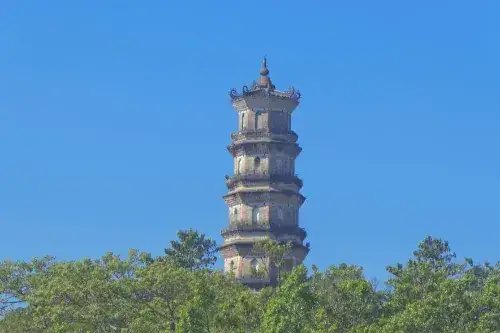
Shaoguan has 2,932 immovable cultural relics and 395 protected sites, including 10 national-level sites: Yunlong Temple Pagoda (Tang), Sanying Pagoda (Northern Song), Mantang Hakka Enclosure (Qing), Shixia archaeological site (Neolithic), Nanhua Temple (Ming-Qing), and Danxia Mountain cliff inscriptions. National intangible heritage includes the Yao Panwang Festival, Tea-Picking Opera, Incense Dragon dance, Yao embroidery, Yao folk songs, and the Zhuji Lane migration legend.
Scenic Spots and Landmarks
Overview
As of December 2022, Shaoguan had 40 national A-level tourist attractions, including one 5A-level, eleven 4A-level, and twenty-seven 3A-level sites.
Major Attractions
Danxia Mountain World Geopark covers 290 square kilometers of Danxia landform with over 680 red sandstone peaks—"China's Red Stone Park." The Mantang Hakka Grand Enclosure in Shixing County is "Lingnan's Premier Enclosure." Nanxiong's Zhuji Ancient Lane is the ancestral homeland of Cantonese peoples and a major roots-tracing destination. The Meiguan Ancient Road connects the Yangtze and Pearl River basins and preserves revolutionary history.
External Exchange
Domestic Exchange
Shaoguan maintains economic cooperation with multiple Chinese cities, particularly through the Dongguan-Shaoguan industrial transfer partnership.
International Exchange
Shaoguan participates in international cultural and economic exchanges as a gateway between inland China and the Pearl River Delta.
Notable Figures
Notable figures include Tang Dynasty chancellor Zhang Jiuling, Song Dynasty official Yu Jing, Ming Dynasty general Chen Lin, and WWII generals Zhang Fakui and Xue Yue.
Major Honors
Shaoguan has been recognized as a National Civilized City, National Garden City, and National Forest City.
Travel information can change. Check current opening hours, reservations and entry requirements before you travel.
Traveller discussion
Start the conversation with a helpful tip or a question.