
Guangzhou City
Guangzhou CityGuangzhou City, abbreviated as "Sui" and also known as Yangcheng (City of Rams) or Huacheng (City of Flowers), is a prefecture-level city in Guangdong Province, the provincial capital, a sub-provincial city, a national central
Guangzhou City
Guangzhou City, abbreviated as "Sui" and also known as Yangcheng (City of Rams) or Huacheng (City of Flowers), is a prefecture-level city in Guangdong Province, the provincial capital, a sub-provincial city, a national central city, a megacity, and a global first-tier city. Located in the central-southern part of Guangdong Province at the northern edge of the Pearl River Delta, it faces the South China Sea and borders Hong Kong and Macau. The city features a hilly terrain that descends from northeast to southwest, with a pronounced maritime climate. The total area is 7,434.4 square kilometers, and the common languages are Cantonese and Mandarin. As of March 2025, Guangzhou administers 11 districts. As of the end of 2025, the permanent population was 19.101 million.
Guangzhou is one of the first National Historical and Cultural Cities, a starting point of the Maritime Silk Road, and is known as the "Millennium Trade Capital." It has been a place of cultural exchange between China and the world since ancient times and is one of the birthplaces of Guangfu culture. Archaeological evidence shows human habitation dating back to the Neolithic period, six to seven thousand years ago. In 214 BCE, the Qin general Ren Xiao built Panyu City (the original name of Guangzhou). Guangzhou was liberated on October 14, 1949. In 1994, it was elevated to a sub-provincial city. Guangzhou serves as the headquarters of the Southern Theater Command of the People's Liberation Army.
Name Evolution
The earliest legendary name for Guangzhou was "Chuting." The widely known aliases "Yangcheng" (City of Rams) and "Suicheng" (City of Grain) originate from a myth in which five immortals riding five rams brought rice ears to the region, blessing the land with eternal freedom from famine. The name "Guangzhou" first appeared in 226 CE when Sun Quan of the Eastern Wu kingdom split Jiao Prefecture into two, with the eastern portion named Guangzhou.
History
Pre-Qin to Qin-Han Period
During the Spring and Autumn and Warring States periods, the Lingnan region was inhabited by the Nanyue people. In 222 BCE, the Qin dynasty launched its first campaign into Lingnan, ultimately unifying the region in 214 BCE and establishing three commanderies including Nanhai, with Panyu (modern Guangzhou) as its administrative seat. After the fall of Qin, Zhao Tuo established the Nanyue Kingdom with its capital at Panyu in 204 BCE. In 111 BCE, Emperor Wu of Han conquered the Nanyue Kingdom, bringing Lingnan under direct central government control.
Sui-Tang to Song-Yuan Period
During the Tang dynasty, Guangzhou developed into a world-renowned eastern port and the starting point of the longest maritime trade route of its time. In 917 CE, Liu Yan established the Southern Han Kingdom with its capital in Guangzhou, promoting regional economic and cultural development.
Ming-Qing to Modern Era
The Ming dynasty established the provincial name "Guangdong." During the Qing dynasty, Guangzhou remained the provincial capital. In 1921, the Guangzhou Municipal Government was established, marking the formal founding of Guangzhou as a city. During World War II, Japanese forces occupied Guangzhou from October 1938 until its liberation in September 1945.
People's Republic of China
On October 14, 1949, Guangzhou was liberated. In 1957, the first China Import and Export Fair (Canton Fair) opened in Guangzhou, becoming an important window for China's international trade. In 2010, Guangzhou hosted the 16th Asian Games.
Natural Geography
Guangzhou is located in southern mainland China at the northern edge of the Pearl River Delta, where the Bei River, Xi River, and Dong River converge and flow into the sea. The city's terrain is hilly, with higher elevations in the northeast and lower in the southwest. The highest peak, Tiantang Peak, reaches 1,210 meters on the border of Conghua District and Longmen County. The urban built-up area covers 1,431.83 square kilometers as of October 2025.
The climate features significant maritime characteristics, with an average annual temperature of 21.7 to 23.1 degrees Celsius and average annual precipitation of 1,923 millimeters. The city experiences abundant rainfall and a subtropical monsoon climate.
Guangzhou has a well-developed river system with 22 rivers having catchment areas exceeding 100 square kilometers. Major rivers include the Bei River, Dong River, Zeng River, and the Guangzhou section of the Pearl River. The city has 298 reservoirs with a total storage capacity of 1.1 billion cubic meters.
Natural Resources
Guangzhou has diverse natural resources. In 2023, total water resources amounted to 6.92 billion cubic meters. The city has 12 wetland parks, including the Haizhu National Wetland Park (869 hectares), the largest national wetland park in a megacity center. The coastal area includes 14 islands, with Hailing Island being the largest at 34 square kilometers. The city has identified 47 types of mineral resources across 820 locations.
Administrative Divisions
As of September 2024, Guangzhou administers 11 districts: Yuexiu, Haizhu, Liwan, Tianhe, Baiyun, Huangpu, Huadu, Panyu, Nansha, Conghua, and Zengcheng, comprising 34 towns and 142 sub-districts.
Population and Language
As of the end of 2025, the permanent population was 19.101 million. The city is home to all 56 of China's ethnic groups, with a minority population of over 980,000. Guangzhou is the largest hometown of overseas Chinese in China, with over 4 million overseas Chinese, compatriots in Hong Kong, Macau, and Taiwan, and returned overseas Chinese and their families. As of 2019, approximately 83,400 foreigners resided in Guangzhou.
Cantonese is the primary local language, with Mandarin also widely spoken. Hakka is used in northern suburban areas including Zengcheng, Huadu, and Conghua. The Guangzhou dialect, a representative form of Cantonese, is spoken by over 70 million people and features nine tones, compared to four in Mandarin.
Religion
Guangzhou has a long religious history, with all five major religions represented: Buddhism, Taoism, Islam, Catholicism, and Protestantism. The city has 91 registered religious venues, including Guangxiao Temple, Liurong Temple, the Huaisheng Mosque (China's first mosque), and the Sacred Heart Cathedral.
Economy
Guangzhou is an international commercial center, a national advanced manufacturing base, and an international science and technology innovation hub. Its largest pillar industry is automotive manufacturing, with 12 vehicle manufacturers and over 1,200 parts enterprises. In 2025, the regional GDP reached 3,203.946 billion yuan (approximately US$439.7 billion), a year-on-year increase of 4.0%. The primary, secondary, and tertiary sectors contributed 31.702 billion yuan, 771.027 billion yuan, and 2,401.217 billion yuan respectively.
In 2024, general public budget revenue was 195.474 billion yuan (approximately US$26.8 billion). Fixed asset investment grew by 0.2%, with industrial investment increasing 13.6%. By March 2026, Guangzhou's financial institution deposits exceeded 10 trillion yuan, making it the fourth Chinese city to reach this milestone.
Primary Industry
Guangzhou is known as the "Land of Fruits," producing lychee, longan, banana, pineapple, papaya, and star fruit. Its flowers and bonsai are renowned nationwide. In 2024, the total output value of agriculture, forestry, animal husbandry, and fisheries reached 61.673 billion yuan (approximately US$8.5 billion).
Secondary Industry
Guangzhou has 35 of the 41 major industrial categories, with six advanced manufacturing clusters each exceeding 100 billion yuan in output. Key industries include automobile manufacturing, electronics, and petrochemicals. In 2024, value-added of designated industrial enterprises declined 3.0%, while next-generation information technology products such as industrial robots grew significantly.
Tertiary Industry
Guangzhou's service sector focuses on shipping, technology services, specialty finance, international trade, and professional services. In 2024, wholesale and retail trade value-added was 406.84 billion yuan, transportation and warehousing 194.95 billion yuan, and finance 304.901 billion yuan. Total retail sales of consumer goods reached 1,105.577 billion yuan (approximately US$151.6 billion). Total import and export value was 1,123.838 billion yuan (approximately US$154.1 billion). As of the end of 2024, Guangzhou had 154 domestic listed companies with a total market capitalization of 1,783.807 billion yuan.
Social Affairs
Education
Guangzhou's educational history dates to the late Western Han dynasty. As of 2024, the city had 183,200 graduate students and 1.498 million undergraduate and vocational college students, with total university enrollment ranking first nationally.
Healthcare
As of the end of 2024, Guangzhou had 6,199 medical institutions (excluding village clinics) with 120,900 beds and 210,300 health professionals. The city provided 190 million outpatient visits and 4.3481 million inpatient services annually.
Science and Technology
In 2024, 112,900 patents were granted, including 37,900 invention patents. The city has 17 national key laboratories, 248 provincial key laboratories, and 63 national-level technology business incubators. Sixty-three academicians of the Chinese Academy of Sciences and Chinese Academy of Engineering work full-time in Guangzhou.
Culture and Sports
Guangzhou has 73 museums and memorial halls, 23 public libraries, and 270 cultural centers. The city has 35,335 sports venues. In 2025, Guangzhou hosted the opening ceremony of the 15th National Games of China.
Transportation
Guangzhou ranks among the top three nationally in sea, land, and air passenger and freight volumes. In 2024, freight volume reached 950.9294 million tons, port cargo throughput 687.411 million tons, and container throughput 26.4513 million TEUs. Guangzhou Baiyun International Airport handled 76.3693 million passengers and 2.3825 million tons of cargo, ranking among the world's busiest airports.
The city has 41 expressways totaling 1,052 kilometers. Guangzhou is one of China's four major railway hubs, with Guangzhou South Station being the busiest passenger station in China. The metro system, opened in 1997, has grown to 779.9 kilometers with 19 lines and 397 stations as of December 2025, with daily ridership of 8.57 million passengers and passenger intensity ranking first in China.
Culture
Guangzhou culture is primarily Guangfu culture within the broader Lingnan cultural tradition. The city is renowned for Cantonese cuisine, one of China's four major culinary traditions, with the famous saying "Eating in Guangzhou." Traditional folk arts include the "Three Carvings, One Color, One Embroidery" (wood carving, ivory carving, jade carving, Canton porcelain, and Canton embroidery). Cantonese opera, Guangdong music, and the Lingnan painting school are collectively known as the "Three Treasures of Lingnan Culture."
Notable cultural landmarks include Chen Clan Ancestral Hall (built 1888-1894), Yuexiu Park (established 1927, featuring the Five Rams Statue, the symbol of Guangzhou), Shamian Island (a historic colonial-era concession), and the Sacred Heart Cathedral. The city has 3,838 immovable cultural relics, including 33 national-level protected sites.
Canton Tower, standing at 600 meters tall (450-meter main tower plus 150-meter antenna), is China's tallest and the world's third-tallest observation tower. Designed by architects Mark Hemel and Barbara Kuit, it is located at the intersection of Guangzhou's new central axis and the Pearl River landscape axis.
Tourism and Attractions
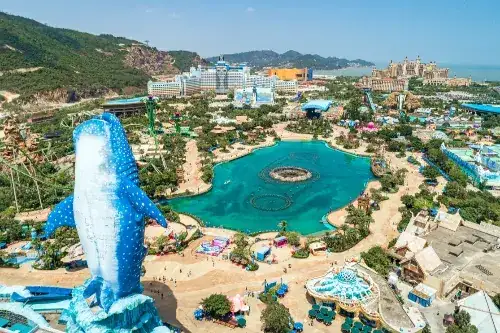
Guangzhou has 103 national A-level tourist attractions, including two 5A-level sites: Baiyun Mountain Scenic Area and Chimelong Tourist Resort. In 2023, the city received 55.4497 million overnight visitors, including 3.7741 million international visitors, with total tourism consumption reaching 330.949 billion yuan (approximately US$45.4 billion).
External Relations
As of April 2026, 71 countries have established consulates general in Guangzhou. The city has established friendly relations with 111 cities in 69 countries, and Guangzhou Port has 60 sister ports, ranking first nationally.
Famous People
Throughout history, Guangzhou has produced numerous prominent figures, including Ren Xiao (Qin dynasty), Zhao Tuo (Han dynasty), Ge Hong (Jin dynasty), Huineng (Tang dynasty), Zhan Ruoshui (Ming dynasty), Qu Dajun (Qing dynasty), Lin Zexu (anti-opium leader), Hong Xiuquan (Taiping Rebellion leader), Kang Youwei and Liang Qichao (reformers), and Sun Yat-sen (leader of the democratic revolution).
Travel information can change. Check current opening hours, reservations and entry requirements before you travel.
Traveller discussion
Start the conversation with a helpful tip or a question.