
Xiangxi Tujia and Miao Autonomous Prefecture
Xiangxi Tujia and Miao Autonomous PrefectureXiangxi Tujia and Miao Autonomous Prefecture is an autonomous prefecture in Hunan Province, located in the northwestern part of the province at the junction of Hunan, Hubei, Chongqing, and Guizhou
Xiangxi Tujia and Miao Autonomous Prefecture
Xiangxi Tujia and Miao Autonomous Prefecture is an autonomous prefecture in Hunan Province, located in the northwestern part of the province at the junction of Hunan, Hubei, Chongqing, and Guizhou. It borders Hubei to the north, Chongqing to the west, and Guizhou to the southwest, with a total area of 15,500 square kilometers. As of end-2025, the prefecture administers 7 counties and 1 county-level city, with a resident population of 2.3606 million. It is a national-level Wuling Mountain Area (Xiangxi) Tujia and Miao Cultural Ecological Protection Zone and a national all-for-one tourism demonstration area, home to Fenghuang County—one of China's first national historic and cultural cities. The prefecture also benefits from the national Western Development Strategy. In 2025, its GDP reached 88.95 billion yuan (approximately $12.2 billion USD), growing 4.2% year-on-year.
History
During the Warring States period, the territory belonged to the Qianzhong Commandery of Chu. In the Western Han Dynasty, it was part of Wuling Commandery. During the Three Kingdoms, it was initially under Shu, then Wu. Under the Western and Eastern Jin, it remained in Wuling Commandery of Jingzhou. During the Sui, Tang, and Five Dynasties, it fell under Qianzhong Circuit. In the Song Dynasty, it was part of Chenzhou and Lizhou under Jinghu North Circuit. The Yuan Dynasty placed it under the Enzhou Pacification Commission and Chenzhou and Lizhou Routes of Huguang Province. The Ming Dynasty established the Yongshun and Baojing Pacification Commissions. The Qing Dynasty set up Yongshun Prefecture and the direct-governance sub-prefectures of Fenghuang, Qianzhou, and Yongshui.
In 1952, the Xiangxi Miao Autonomous Region (prefecture-level) was established with 6 counties, headquartered in Suoli Town, Qiancheng County. In 1955, it was reorganized as the Xiangxi Miao Autonomous Prefecture. On September 20, 1957, the Xiangxi Tujia and Miao Autonomous Prefecture was formally established, headquartered in Jishou County, incorporating 10 counties.
Administrative Divisions
Division History
In 1952, the autonomous region governed 10 counties. In 1953, Qiancheng County was renamed Jishou County and Yongshui County was renamed Huayuan County. By end-2005, the prefecture had 1 county-level city, 7 counties, 7 sub-districts, 66 towns, and 92 townships.
Division Details
As of end-2025, the prefecture administers 7 counties and 1 county-level city. The prefectural government is seated at No. 19 Wulingshan Avenue, Jifeng Sub-district, Jishou City.
Geography
Location
Xiangxi lies in northwestern Hunan at the junction of four provincial-level regions. Its coordinates range from 109 degrees 10 minutes to 110 degrees 23 minutes east longitude and 27 degrees 44 minutes to 29 degrees 38 minutes north latitude, covering 15,500 square kilometers.
Terrain
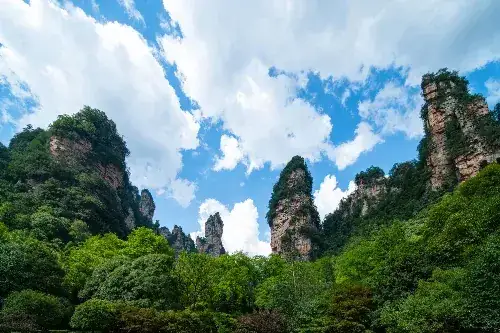
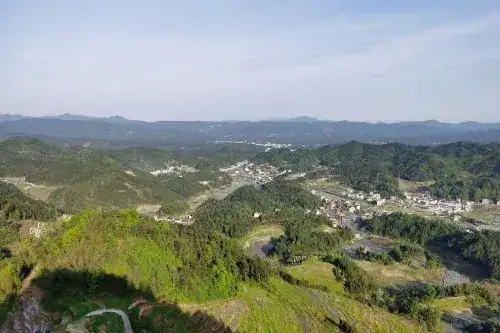
The prefecture sits on the eastern edge of the Yunnan-Guizhou Plateau within the Wuling Mountain area. The terrain slopes from northwest to southeast, with the Wuling Mountains running northeast to southwest. The highest point is Daling Mountain in Longshan County at 1,736 meters; the lowest is the Dalong Stream outlet in Luxi County at 97.1 meters.
Climate
Xiangxi has a subtropical monsoon humid climate. The mean annual temperature ranges from 16.0 to 17.0 degrees Celsius, with January averaging 4.5 to 5.2 degrees (extreme low of minus 15.5 degrees) and July averaging 21.9 to 22.8 degrees (extreme high of 40.6 degrees). The frost-free period averages 282 days. Annual precipitation ranges from 1,284 to 1,417 mm, with 70.8 to 77.3 percent falling between April and September.
Hydrology
The prefecture's rivers belong to the Yangtze River basin, with a total river length of 6,408 km and drainage density of 0.414 km per square kilometer. The largest river is the Yuan River, with an average flow of 1,140 cubic meters per second at the Pushi hydrological station. Major rivers include the Yuan River, Lishui River, Wushui, Youshui, and Mengdong River, with total annual runoff of 12.53 billion cubic meters.
Natural Resources
Water Resources
Total water resources amount to 21.37 billion cubic meters, with average annual runoff of 13.28 billion cubic meters. Hydropower potential is estimated at 1.68 million kW, of which 1.08 million kW is developable, with only 180,000 kW currently developed.
Land Resources
As of end-2020, the prefecture had 200,600 hectares of cultivated land and 158,500 hectares of basic farmland.
Biological Resources
The prefecture hosts over 2,206 vascular plant species across 209 families, including relict species such as dawn redwood, dove tree, and ginkgo. There are 985 medicinal plant species, 19 of which are nationally protected. Wildlife includes 201 protected animal species, with clouded leopard, leopard, white crane, and white-necked long-tailed pheasant under Class I protection.
Mineral Resources
Sixty-three mineral types have been discovered across 485 sites. Manganese industrial reserves rank second nationally at 310.657 million tons, and mercury prospective reserves rank fourth. Manganese, mercury, aluminum, and purple sand clay rank first in Hunan Province.
Population
According to the 2020 census, the resident population was 2,488,105, with ethnic minorities comprising 80.5 percent. The Tujia people constitute 42.75 percent and the Miao people 33.88 percent. As of end-2025, the total population was 2.894 million with a resident population of 2.3606 million. The urbanization rate reached 55.24 percent, with 1.3039 million urban and 1.0567 million rural residents.
Politics
The prefecture operates under the regional ethnic autonomy system, with the prefectural government seated in Jishou City. The founding anniversary on September 20 is observed as a two-day public holiday within the prefecture.
Economy
Overview
In 2025, GDP reached 88.95 billion yuan (approximately $12.2 billion USD), up 4.2 percent. The primary, secondary, and tertiary sectors contributed 14.7 percent, 20.6 percent, and 64.7 percent respectively. Per capita GDP was 37,434 yuan (approximately $5,130 USD), up 5.8 percent. General public budget revenue totaled 7.99 billion yuan (approximately $1.09 billion USD), up 2.3 percent. Per capita disposable income was 24,783 yuan (approximately $3,395 USD), up 6.4 percent—urban income at 35,856 yuan (approximately $4,912 USD) and rural income at 15,906 yuan (approximately $2,179 USD). Fixed asset investment declined 9.8 percent.
Primary Industry
In 2025, total agricultural, forestry, animal husbandry, and fishery output value was 22.88 billion yuan (approximately $3.13 billion USD), up 3.9 percent. Grain output reached 930,000 tons. Fruit production was 1.037 million tons, including 148,000 tons of kiwi. Meat production totaled 138,000 tons, and aquatic products reached 17,000 tons.
Secondary Industry
Above-scale industrial value-added grew 6.7 percent, with manufacturing up 7.1 percent. There were 361 above-scale industrial enterprises, generating revenue of 23.96 billion yuan (approximately $3.28 billion USD), up 11.3 percent. The construction industry's total output was 3.44 billion yuan (approximately $471 million USD), up 5.5 percent.
Tertiary Industry
In 2025, total retail sales of consumer goods reached 33 billion yuan (approximately $4.52 billion USD), up 2.5 percent. Import-export volume was 1.62 billion yuan (approximately $222 million USD), up 46.8 percent. The prefecture received 64.6727 million tourists, up 4.2 percent, with total tourism spending of 72.9 billion yuan (approximately $9.99 billion USD). Financial institution deposits reached 193.05 billion yuan (approximately $26.4 billion USD), up 8.5 percent, and loans reached 172.26 billion yuan (approximately $23.6 billion USD), up 4.9 percent. Insurance premium income was 3.5 billion yuan (approximately $480 million USD).
Social Affairs
Education
As of end-2025, the prefecture had 1,035 schools, including 2 higher education institutions, 26 secondary vocational schools, 29 regular high schools, 143 junior high schools, 194 primary schools, 632 kindergartens, and 7 special education schools. Primary school enrollment rate was 100 percent with a graduation-to-junior-high progression rate of 99.5 percent.
Science and Technology
The prefecture had 6 provincial key laboratories, 15 provincial engineering technology research centers, and 3 technology incubators. 469 patents were authorized, including 80 invention patents. Fiscal science and technology expenditure totaled 268 million yuan (approximately $36.7 million USD), up 15.9 percent.
Culture
The prefecture had 8 art performance troupes, 10 cultural centers, 9 public libraries, and 10 museums. It boasts 30 national-level and 111 provincial-level intangible cultural heritage items.
Healthcare
As of end-2025, the prefecture had 2,677 health institutions including 65 hospitals, 188 township health centers, and 1,767 village clinics. There were 22,899 health professionals, including 8,606 licensed physicians and 10,872 registered nurses, with 15,655 hospital beds.
Sports
The prefecture had 8,979 sports venues, including 30 gymnasiums and 21 swimming pools. Athletes won 3 Asian championships and 3 national championships in 2025.
Social Security
In 2025, 22,000 new urban jobs were created. 1.366 million people participated in basic pension insurance for urban and rural residents. Minimum living allowances were provided to 24,000 urban residents and 158,000 rural residents, with total disbursements of 714 million yuan (approximately $97.8 million USD).
Transportation
Overview
In 2025, total freight transport turnover reached 1.56 billion ton-km, up 9.3 percent. The prefecture had 302,000 motor vehicles, including 283,000 private cars.
Highways
As of end-2025, total road mileage was 14,444 km, including 510 km of expressways.
Railways
The Jiaozuo-Liuzhou Railway passes through the prefecture. On December 6, 2021, the Zhangjiajie-Jishou-Huaihua high-speed railway began operations, ending the prefecture's lack of high-speed rail service.
Water Transport
In 2025, waterway freight volume was 256,400 tons, up 16.1 percent.
Aviation
The prefecture shares Tongren Fenghuang Airport with Guizhou Province's Tongren City, approximately 45 minutes by car from Jishou. The Xiangxi Biancheng Airport officially opened on August 18, 2023.
History and Culture
Dialects
The Tujia language has northern and southern dialects—the northern dialect is spoken in Longshan, Yongshun, Baojing, and Guzhang, while the southern dialect is found in Luxi County. The Miao language belongs to the eastern dialect branch, with eastern and western sub-dialects. Southwestern Mandarin is the dominant Han Chinese dialect.
Intangible Heritage
As of 2024, the prefecture had 1,308 representative intangible heritage projects, including 28 at the national level.
Folk Customs
Tujia wedding customs feature "crying weddings" lasting up to half a month before the bride departs. The Miao people practice "walking marriages," a form of free courtship. Traditional Tujia festivals include Tujia New Year (celebrated one day before the Han Chinese New Year). Miao festivals include Miao New Year, the Dragon Boat Festival, and the Autumn Fair Festival.
Architecture
Mountain dwellings are predominantly wooden structures—pillars, beams, walls, windows, and doors all made of wood with tiled roofs. The three-pillar, four-beam structure is the most common housing type.
Dance
Tujia dances include the hand-waving dance and the eight-treasure bronze bell dance. Miao dances feature the drum dance, dragon-receiving dance, and reed pipe dance.
Clothing
Tujia men wrap their heads with indigo or white cloth and wear short jackets with many buttons. Miao women's attire is elaborate, with silver ornaments being the most common, paired with embroidered pleated skirts.
Cuisine
Sour and spicy flavors are essential to Xiangxi cuisine, embodied in the saying "chili as salt, pickled vegetables as rice." Pickled foods fall into three categories: vegetable, meat, and grain-based. Sour fish is the most famous. Every household grows chili peppers and keeps pickling jars.
Scenic Spots
Overview
The prefecture has 1 World Cultural Heritage site, 14 national-level protected cultural heritage units, and 12 provincial-level units. As of end-2024, there were 46 rated tourist attractions, including 16 at 4A level or above.
Major Attractions
Fenghuang Ancient City — A tourism area composed of the ancient city and Nanhua Mountain, covering 4.39 square kilometers. Founded in the Tang Dynasty and flourishing in the Ming-Qing period, Fenghuang is a national historic and cultural city known as "China's most beautiful small town." Notable natives include writer Shen Congwen and painter Huang Yongyu.
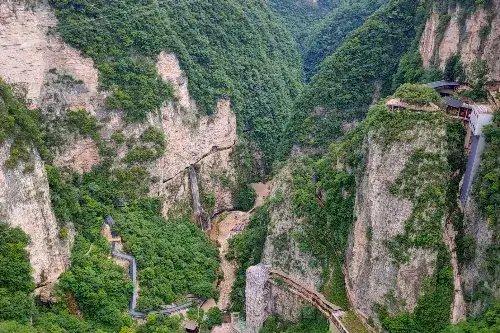
Aizhai-Shibadong-Dehang Grand Canyon Scenic Area — Located in the core zone of the Xiangxi Global Geopark, featuring the Aizhai Bridge (hailed as the "Mount Everest" of the international bridge community), Shibadong Village (birthplace of China's targeted poverty alleviation campaign), and Dehang Grand Canyon.
Furong Town — A historic town with over 2,000 years of history, known as "the thousand-year ancient town on a waterfall." It is a national historic and cultural town and one of China's ten most beautiful towns.
Biancheng Chadong — Located at the junction of Hunan, Guizhou, and Chongqing, it is one of Xiangxi's four famous towns and the setting of Shen Congwen's novel "Border Town."
Qianzhou Ancient City — Located along the Wanrong River in Jishou, founded during the Ming Dynasty's Wanli period, with walls facing water on three sides and mountain on the fourth.
Laosicheng — A national AAAA-level tourist site in Yongshun County, capital of the Tujia chieftain's "small court" for 800 years, founded in 1135. It is the most complete and largest ancient chieftain city site discovered in China, called "China's Machu Picchu."
Mengdong River Rafting — A 47-km rafting route in Yongshun County, praised as "the best rafting in China."
Liye Ancient City — A thousand-year-old city in southern Longshan County on the Youshui River. In 2002, over 37,400 Qin Dynasty bamboo slips were unearthed here—ten times the total previously discovered—comparable in significance to the Terracotta Warriors and Dunhuang manuscripts.
Famous Figures
Notable figures from Xiangxi include Xiong Xiling (Premier of the Republic of China), Shen Congwen (renowned writer), and Huang Yongyu (famous painter).
Honors
The prefecture was named a National Forest City in 2018, designated as a demonstration city for traditional village protection in 2020, and recognized as a pilot unit for AI-boosted teacher team development in 2021.
Travel information can change. Check current opening hours, reservations and entry requirements before you travel.
Traveller discussion
Start the conversation with a helpful tip or a question.