
Loudi City
Loudi CityLoudi City, a prefecture-level city under the jurisdiction of Hunan Province, also known as "Star City" (Xingcheng), is situated at the geographic center of Hunan Province, between latitudes 27 degrees 12 minutes 31 seconds to 28
Loudi City
Loudi City, a prefecture-level city under the jurisdiction of Hunan Province, also known as "Star City" (Xingcheng), is situated at the geographic center of Hunan Province, between latitudes 27 degrees 12 minutes 31 seconds to 28 degrees 14 minutes 27 seconds North and longitudes 110 degrees 45 minutes 40 seconds to 112 degrees 31 minutes 07 seconds East, covering 8,117 square kilometers. As of end-2025, Loudi administers 1 district, 2 counties, and 2 county-level cities, with a permanent population of 3.6828 million. The city lies in a transitional zone where the terrain descends from the second to the third step of China's topography from west to east. It has a central Asian subtropical monsoon humid climate with both monsoonal and continental characteristics. In January 1999, the State Council approved Loudi's upgrade from a prefecture to a city. The name reportedly derives from the celestial intersection of the "Lou Star" and "Di Star" among the Twenty-Eight Mansions, and Loudi is one of the principal birthplaces of Huxiang Culture. The city boasts 9 national 4A-level scenic areas including Meishan Dragon Palace, Zeng Guofan's Former Residence, and Ziquejie Terraces, plus two national forest parks. Loudi is a vital energy and raw materials base with 57 mineral species discovered; its antimony reserves rank first in the world, earning it the titles "World Antimony Capital" and "Modern Steel City." In 2025, Loudi achieved a regional GDP of 223.730 billion CNY (approximately US$31.1 billion), up 5.7% year-on-year.
History
Archaeological evidence shows human activity in Loudi during the Neolithic Age. During the Spring and Autumn and Warring States periods, the area belonged to the Chu state. In the Qin dynasty, Xiangnan County was established under Changsha Commandery. During the Han dynasty, Liandao County was established in 202 BCE. In the Three Kingdoms period, the area was split between Hengyang and Zhaoling commanderies. During the Western and Eastern Jin and Southern Dynasties, it belonged to Shaoling Commandery. Under the Sui, it was part of Changsha Commandery. In the Song dynasty (1072 CE), Xinhua County was established. During the Yuan dynasty, the area was divided between Tianlin and Baoqing routes. Under the Ming and Qing, it was split between Changsha and Baoqing prefectures. Xinhua County was the earliest established county within Loudi.
During the Republic of China era (1912-1949), the area underwent several administrative reorganizations. After the founding of the People's Republic in 1949, it was under Yiyang and Shaoyang prefectures. In 1952, Shuangfeng County and Lantian County (later renamed Lianyuan County) were established. In 1960, Loudi City and Lengshuijiang City were established. In 1977, Lianyuan Prefecture was carved out from Shaoyang, and in 1982 it was renamed Loudi Prefecture. In January 1999, with State Council approval, Loudi was upgraded to a prefecture-level city, with the former county-level Loudi City renamed Louxing District. In 2012, the Loudi Economic and Technological Development Zone was upgraded to national level. In 2021, the Wanbao New Area was merged into the development zone.
Administrative Divisions
As of end-2025, Loudi administers 1 district (Louxing District), 2 counties (Shuangfeng and Xinhua), and 2 county-level cities (Lengshuijiang and Lianyuan), totaling 14 townships, 54 towns, 19 sub-districts, and 2 forest farms. The municipal government is located at 500 Xiangzhong Avenue, Louxing District.
Geography
Location and Extent
Loudi is located at the geographic center of Hunan, bordering Yiyang to the north, Shaoyang to the south, Huaihua to the west, and Xiangtan to the east. The city spans 160 km east-west and 102 km north-south, with a total area of 8,117 square kilometers.
Topography
The terrain is high in the west and low in the east, descending in steps. The western area belongs to the western Hunan mountainous region, while the eastern area belongs to the central Hunan hilly region. The Xuefeng Mountain range enters from western Xinhua. The average elevation is 170 meters, with the highest point at Jiulong Pool in Xinhua (1,622 m) and the lowest at Jiangkou Canyon in Shuangfeng (64 m).
Climate
Loudi has a central Asian subtropical monsoon humid climate with warm temperatures, distinct seasons, and abundant rainfall. The annual average temperature is 16.5 to 17.5 degrees Celsius, with extreme highs of 40.1 degrees and lows of -12.1 degrees. Average annual precipitation is 1,300 to 1,400 mm, concentrated in April through July.
Hydrology
The city has a dense river network, primarily the Zi River and Lian River. The Zi River flows north through Lengshuijiang and Xinhua, with a 112 km course within Loudi. The Lian River, a major tributary of the Xiang River, flows east through Lianyuan, Louxing, and Shuangfeng, with a 108 km course. The city has 66 rivers with catchment areas exceeding 50 square kilometers.
Natural Resources
Water Resources
Annual precipitation totals 11.395 billion cubic meters, generating 3.887 billion cubic meters of surface water. Groundwater averages 2.16 billion cubic meters annually, with theoretical hydropower potential of 325 MW, of which 142.6 MW is developable.
Plant Resources
The city has over 2,500 plant varieties across 78 families and 168 genera, including over 370 rice varieties, more than 30 grain crops, over 70 oil crops, more than 360 economic crops, and over 200 fruit tree varieties.
Animal Resources
The region supports both South China and North China faunal types. Shuangfeng County is a national lean-pig production base. Traditional livestock includes pigs, cattle, poultry, and goats, with aquaculture of turtles, eels, and loaches.
Land Resources
Total land area is 1.21753 million hectares, 3.8% of the provincial total. Cultivated land covers 223,000 hectares (18.5%), forested land 329,000 hectares (27.1%), and unused land 278,000 hectares (22.9%).
Mineral Resources
Loudi has 47 discovered mineral species, with 25 having proven reserves. Antimony reserves rank first nationally and globally. Coal, dolomite, limestone, and marble reserves lead the province. Proven coal reserves total 1.1 billion tons. The Xikuangshan antimony mine in Lengshuijiang is the world's largest.
Population
Population Size
According to the Seventh National Census, Loudi's permanent population was 3,826,996. As of end-2025, the registered population was 4.4376 million, with a permanent population of 3.6828 million. The urbanization rate reached 51.91%, up 1.05 percentage points. The birth rate was 6.20 per mille, death rate 7.47 per mille, and natural growth rate -1.27 per mille.
Ethnic Composition
Loudi is a multi-ethnic city with Han as the majority. 23 ethnic groups have been recorded, including Han, Miao, Tujia, Dong, Mongol, Hui, and Tibetan. The Miao are the largest minority group.
Politics
The municipal government operates under the standard Chinese administrative framework, seated in Louxing District.
Economy
Overview
In 2024, Loudi achieved a regional GDP of 213.163 billion CNY (approximately US$29.6 billion), up 5.4% year-on-year. In 2025, GDP reached 223.730 billion CNY (approximately US$31.1 billion), up 5.7%. The primary, secondary, and tertiary sectors grew by 4.0%, 6.6%, and 5.5% respectively, with a structure of 10.9:37.6:51.5. Per capita GDP was 60,381 CNY (approximately US$8,386), up 6.6%. Local general public budget revenue was 9.352 billion CNY (approximately US$1.3 billion), up 7.0%. Resident per capita disposable income was 30,115 CNY (approximately US$4,182), up 5.7%; urban residents earned 41,578 CNY (approximately US$5,775), and rural residents earned 20,237 CNY (approximately US$2,811).
Primary Industry
Loudi is a major agricultural city, nationally known for grain and hog production. Annual grain output is approximately 1.6 million tons. In 2025, total agricultural, forestry, animal husbandry, and fishery output value was 40.566 billion CNY, up 4.1%. Grain production reached 1.6076 million tons. Pork output was 315,700 tons, with 4.0644 million hogs slaughtered.
Secondary Industry
Loudi was born and thrived on steel, producing the province's first iron, bar stock, plate, and silicon steel. Since 2022, Loudi has been building a "Materials Valley" as its top-priority project, focusing on advanced steel materials and construction machinery. The city has built the world's leading automotive sheet production base and Asia's largest high-end heat-treated sheet base. In 2025, total industrial value-added was 67.912 billion CNY, up 7.4%, with above-scale industrial value-added growing 8.9%. Construction industry output was 69.705 billion CNY, up 3.8%.
Tertiary Industry
In 2025, wholesale and retail added value was 22.187 billion CNY, up 5.4%. Total retail sales of consumer goods reached 97.625 billion CNY (approximately US$13.6 billion), up 2.8%. Total import-export volume was 12.687 billion CNY (approximately US$1.76 billion), down 7.6%. The city received 48.99 million domestic and international tourists, with total tourism spending of 46.15 billion CNY. Financial institution deposits reached 369.04 billion CNY, and loans 250.833 billion CNY. Securities trading reached 575.417 billion CNY, and insurance premium income was 8.059 billion CNY.
Social Affairs
Education
As of end-2025, Loudi had 4 regular institutions of higher education with 52,300 enrolled students. It also had vocational secondary schools (46,300 students), regular senior high schools (106,300 students), junior high schools (187,900 students), and primary schools (288,200 students). Primary school enrollment rate was 100%.
Science and Technology
The city had 17 provincial engineering research centers, 3 nationally recognized enterprise technology centers, and 29 provincial enterprise technology centers. Technical contract transactions totaled 20.165 billion CNY. 1,752 patents were granted, including 452 invention patents.
Culture
Loudi had 5 art performance troupes, 95 public cultural institutions, 7 public libraries, and 6 museums. There were 5 national-level and 14 provincial-level intangible cultural heritage protection units. Radio and TV coverage reached 99.97%.
Healthcare
The city had 4,398 medical and health institutions, including 138 hospitals and 70 township health centers. There were 32,300 health workers, including 13,900 licensed physicians. Hospital beds numbered 23,100.
Sports
Loudi had 13,665 public sports venues, with 3.06 square meters per capita. Athletes won 4 world championships, 2 Asian championships, and 4 national championships in 2025.
Social Security
In 2025, 36,800 new urban jobs were created. Basic pension insurance covered 1.7964 million urban and rural residents and 938,700 urban employees. Basic medical insurance covered 3.5426 million people. Minimum living allowances supported 11,700 urban and 87,100 rural residents.
Transportation
Overview
Loudi is an important transport hub connecting eastern China with the southwest. The Shanghai-Kunming High-Speed Railway, Luoyang-Zhanjiang Railway, and Xiangqian Railway pass through, with the Hu-Nan High-Speed Railway under planning. Multiple expressways form a network. Qiaotouhe General Airport is operational, and Loudi Civil Airport has been approved.
Railway
The Luoyang-Zhanjiang and Shanghai-Kunming railways cross at Louxing District. In December 2014, the Shanghai-Kunming High-Speed Railway opened, bringing Loudi into the high-speed rail era via Loudi South Station. As of August 2025, all counties and districts have railway access.
Highway
The city has national and provincial highways plus expressways including the Shanghai-Ruili, Erguang, Hubei, and Loudi-Huaihua routes. In 2025, highway freight totaled 100.453 million tons. Total highway mileage (excluding expressways) was 16,546 km, with 416 km of expressways. Civilian vehicle ownership reached 608,900.
Aviation
Loudi Chuntian Airport is included in the national 14th Five-Year Plan for civil aviation. Loudi Civil Airport was approved in June 2024. Qiaotouhe Airport in Lianyuan has been operational since 2023.
Public Transit
The urban bus system operates 423 vehicles on 44 routes, totaling 608 km, serving over 50 million passengers annually. Loudi was named a "National Public Transit Model City" in 2023.
Water Transport
Loudi currently lacks a complete navigation network but is advancing the Lian River navigation restoration project, included in the Yangtze River system's key projects. The Loudi Port Master Plan (2035) envisions 5 port areas along the Lian and Zi rivers, with waterway freight costs at half that of road transport.
Historical Culture
Origin of the Name
The name "Loudi" reportedly derives from the celestial intersection of the Lou Star and Di Star among the Twenty-Eight Mansions. Historical records from the Qing dynasty's Xiangxiang County Gazetteer trace the name to the Song dynasty, evolving through several variations before settling on "Loudi."
City Symbol
The rhododendron was designated as Loudi's city flower in 2004. The city's "National Civilized City" logo incorporates the initials "L D" and the character "wen," symbolizing the sunrise, rivers, terraces, and the spirit of its 4.5 million people.
Dialect
Loudi dialect belongs to the Xiang language group (Old Xiang, Loushao sub-branch). It differs significantly from Mandarin and is largely unintelligible to speakers of New Xiang or other Chinese dialects.
Theater
Over 60 folk theater troupes are active in rural central Hunan. Qiaotouhe Town is recognized as the "Hometown of Huagu Opera."
Folk Customs
The Sun River basin has a 300-year tradition of "rowing the auspicious boat," where locals paddle dragon boats to give thanks after prayers are answered.
Cultural Heritage Protection
Loudi preserves numerous cultural heritage sites, including Zeng Guofan's Former Residence and historic villages.
Intangible Cultural Heritage
As of end-2022, Loudi had 5 national-level and 14 provincial-level intangible cultural heritage items.
Cultural Landmarks
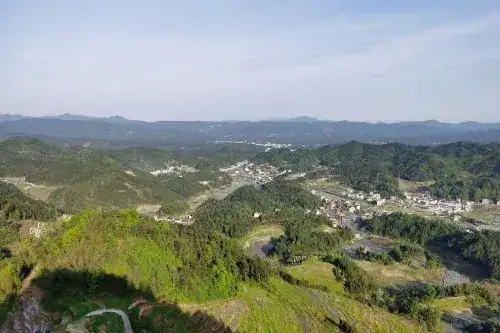
Loudi features Zeng Guofan's Former Residence, the 80,000-mu Ziquejie Terraces (a 4A scenic area), Long Mountain, Meijiang natural scenery, historic towns like Yangshi Town, and residences of revolutionary figures including Cai Hesen, Luo Shengjiao, Cheng Fangwu, and Chen Tianhua.
Specialty Products
Local specialties include Lianyuan refined flour, Yongfeng lantern peppers, Lianyuan black goat, Xinhua Meng'er Tea, and Shuangfeng Biyu Green Tea. The city holds 15 geographical indication trademarks including Xinhua Black Tea, Baixi Tofu, and Xinhua Polygonatum, and 3 geographical indication products including Yongfeng Chili Sauce, Ziquejie Tribute Rice, and Shuiyunfeng Yellow Peach.
Scenic Spots
Overview
Loudi has over 70 scenic and cultural attractions, including Zeng Guofan's Former Residence, Meijiang Scenic Area, Boyuedong Caves, and Shuifumiao Reservoir.
Attractions
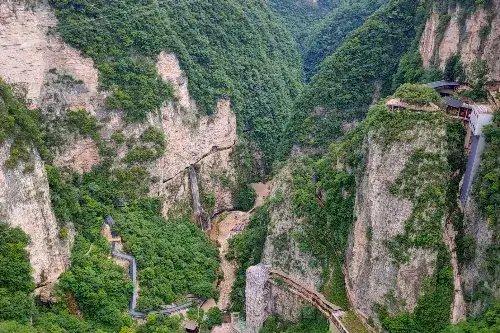
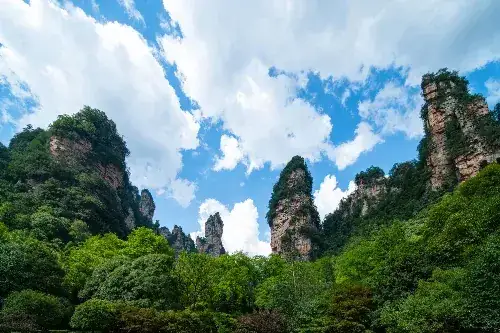
Key attractions include Meijiang Scenic Area (national 4A), Meishan Dragon Palace in Xinhua, Cai Hesen Memorial Hall in Shuangfeng, Daxiong Mountain National Forest Park, Zeng Guofan's Former Residence (Fuhou Hall), Boyuedong Scenic Area (filming location for the 1986 Journey to the West television series), Ziquejie Terraces (national 4A and national scenic area), and Sanliandong Scenic Area (national 4A).
Famous Figures
Loudi has produced numerous historical figures, including Zeng Guofan (Qing dynasty statesman), Cai Hesen (revolutionary), Chen Tianhua (revolutionary writer), Luo Shengjiao (Korean War hero), and Cheng Fangwu (educator and writer).
External Relations
Loudi maintains connections with cities across China as part of the Changsha-Zhuzhou-Xiangtan urban agglomeration and the Yangtze River Mid-Reaches city cluster.
Honors
Loudi has received honors including China's Top Ten Livable Cities (2007), China's Outstanding Tourism City (2007), National Garden City (2012), National Health City (2015), National Blood Donation Advanced City (2018), National Double Support Model City (2020), National Civilized City (2020), and National Public Transit Model City (2023).
Travel information can change. Check current opening hours, reservations and entry requirements before you travel.

Traveller discussion
Start the conversation with a helpful tip or a question.