
Chenzhou City
Chenzhou CityChenzhou, also known as "Fucheng" (City of Fortune) and "Lincheng" (City of Forests), is located in southeastern Hunan Province. It is a prefecture-level city administering 2 districts, 8 counties, and 1 county-level city as of
Chenzhou City
Chenzhou, also known as "Fucheng" (City of Fortune) and "Lincheng" (City of Forests), is located in southeastern Hunan Province. It is a prefecture-level city administering 2 districts, 8 counties, and 1 county-level city as of April 2026. The total area is 19,341.66 square kilometers, and the permanent resident population at the end of 2025 was 4.5574 million. Local dialects fall into three groups: Southwestern Mandarin, Gan, and Hakka. The city has a subtropical monsoon humid climate with four distinct seasons. The terrain is predominantly hilly, with Danxia landform as a distinctive feature; Gaoyiling is its most prominent representative. Leading industries include non-ferrous metals, electronic batteries, and cultural tourism. With over 2,000 years of history, Chenzhou is a birthplace of Chinese agricultural civilization, historically known as the "Land of Nine Immortals and Two Buddhas." In 2025, regional GDP reached 350.208 billion yuan (approximately $48.6 billion), up 5.5%.
Name and Etymology
In 221 BCE, the First Emperor of Qin established Chenzhou County under Changsha Commandery. In December 1994, the prefecture-level city was established. The character "Chen" in seal script combines the characters for "forest" and "city," meaning "city within the forest."
History
Pre-Qin Period
During the Spring and Autumn and Warring States periods, Chenzhou belonged to the State of Chu.
Qin, Han, and Southern and Northern Dynasties
In 221 BCE, Qin Shi Huang established Chenzhou County. The Han Dynasty's Guiyang Commandery was headquartered in Chenzhou, covering much of present-day Chenzhou plus parts of Guangdong. In 265 CE, southern territories were reorganized into Shixing Commandery. In 315 CE, Guiyang and Pingyang commanderies were established, and in 560 CE Luyang Commandery was created.
Sui, Tang, Song, and Yuan
In 589 CE, the Sui Dynasty unified Guiyang and Luyang commanderies into Chenzhou. The name alternated through the Tang Dynasty. During the Five Dynasties, it was briefly renamed Dunzhou (936 CE). Under the Song, Guiyang Monitor became a military prefecture. The Yuan Dynasty established Chenzhou and Guiyang routes under Huguang Province.
Ming and Qing Dynasties
The Ming Dynasty established Chenzhou Prefecture, later demoting it to a directly administered prefecture under Huguang. The Qing maintained this arrangement.
Republic of China Period
In 1913, Chenzhou became Chenzhou County. By 1937 it was the Eighth Administrative Supervision District of Hunan, later reorganized as the Third, governing 10 counties.
After the Founding of the PRC
Chenzhou was liberated on November 25, 1949. After several reorganizations, the State Council approved in December 1994 the establishment of the prefecture-level city, with Beihu and Suxian districts. As of 2016, the city comprised 2 districts, 1 county-level city, 8 counties, 136 townships, and 23 sub-districts.
Physical Geography
Location
Chenzhou lies west of the Luoxiao Mountains and north of the Nanling Mountains, between 112°14′–114°10′E and 24°54′–26°51′N. It borders Jiangxi, Guangdong, Yongzhou, and Hengyang-Zhuzhou.
Climate
Annual average temperature is 17.4°C and annual precipitation 1,452.1 mm—2.22 times the national average. Winters bring continental monsoons; summers bring tropical maritime airflow.
Geology
The city spans the junction of the Nanling and Luoxiao mountains at the Yangtze-Pearl River divide. Devonian, Carboniferous, and Permian strata are most widespread.
Topography
Mountainous and hilly areas comprise nearly three-quarters of the total area. Elevations decrease from southeast (highest peak 2,061.3 m) to northwest (lowest point 70 m). Danxia landform is a distinctive feature.
Hydrology
Chenzhou belongs to both the Yangtze (80.9%) and Pearl River (19.1%) basins, with 543 rivers and 1,030 reservoirs including 4 large and 41 medium-sized. The Mangshan Reservoir has a total capacity of 133 million cubic meters.
Soils
Ten soil groups are present, with red, yellow, and yellow-brown soils accounting for over 70% of the area.
Natural Disasters
Chenzhou is prone to mudslides and landslides during rainy seasons. In 2019, 49 geological disasters occurred, but effective prevention achieved zero casualties for nine consecutive years. In early 2008, a catastrophic ice storm struck southern China; Chenzhou was the epicenter, losing water and electricity for over two weeks.
Natural Resources
Water Resources
Annual average surface water totals 16.44 billion cubic meters, with per capita resources of 3,525 cubic meters—well above the national average.
Land Resources
As of 2017, mountainous land covers 10,542 square kilometers, hills 3,971, and arable land 2,314.
Mineral Resources
Chenzhou has 112 mineral types across 150 sites, with proven reserves of 46 types. Tungsten and bismuth rank first globally, molybdenum first nationally. Microcrystalline graphite accounts for 70% of world reserves. Yongxing County is "China's Silver Capital," processing over 2,000 tons of silver annually.
Biodiversity
Forest coverage is 67.74%. The city has 182 wildlife species, including the South China tiger, clouded leopard, and Mangshan pit viper. Two national-level and two provincial-level nature reserves protect these ecosystems.
Renewable Energy
Chenzhou has 38 underground hot springs (38.64% of the provincial total). Since 2022, lithium-bearing minerals with over 5 million tons of lithium oxide reserves have been discovered in multiple counties.
Administrative Divisions
As of April 2026, Chenzhou administers 2 districts (Beihu, Suxian), 8 counties (Guiyang, Yongxing, Yizhang, Jiahe, Linwu, Rucheng, Anren, Guidong), and 1 county-level city (Zixing). The municipal government is at No. 5 Wuling Avenue.
Politics
The city is governed by the CPC Municipal Committee and People's Government under China's prefecture-level framework.
Population
Population Size
As of the end of 2025, the permanent resident population was 4.5574 million, down 20,400 year-on-year. Urban population was 2.8385 million, with urbanization rate of 62.28%.
Ethnic Groups
Chenzhou has 25 ethnic minorities, with the Yao being the largest at over 80,000. Minorities account for 2.02% of the total. There are 10 ethnic townships.
Language
Dialects fall into three groups: Southwestern Mandarin (Chenzhou Mandarin), Gan-Hakka (centered on Zixing), and local mixed speech of Guiyang and Linwu.
Religion
As of March 2024, Chenzhou has 344 religious venues—275 Buddhist, 39 Daoist, 29 Protestant, and 1 Catholic—with 496 registered clergy and 18 religious organizations.
Economy
Overview
In 2025, regional GDP reached 350.208 billion yuan ($48.6 billion), up 5.5%. Primary, secondary, and tertiary sectors contributed 34.907 billion ($4.8 billion), 135.017 billion ($18.8 billion), and 180.283 billion yuan ($25.0 billion). Per capita GDP was 76,672 yuan ($10,649). General public budget revenue was 20.191 billion yuan ($2.8 billion), up 4.4%. Per capita disposable income was 36,846 yuan ($5,117), with urban at 47,816 yuan ($6,641) and rural at 25,018 yuan ($3,475).
Primary Industry
In 2025, agriculture, forestry, animal husbandry, and fishery added value totaled 36.588 billion yuan ($5.1 billion), up 4.3%. Grain output was 1.9358 million tons, with 5.966 million hogs slaughtered.
Secondary Industry
Industrial value added was 120.541 billion yuan ($16.7 billion), up 7.3%. Manufacturing grew 10.8% and high-tech manufacturing 9.7%. Construction value added was 15.447 billion yuan ($2.1 billion), down 4.7%.
Tertiary Industry
Wholesale and retail added value reached 38.21 billion yuan ($5.3 billion), up 5.0%. Total retail sales were 120.041 billion yuan ($16.7 billion). Import and export value was 49.804 billion yuan ($6.9 billion). The city received 82.896 million domestic tourists (up 8.3%) and 58,100 inbound tourists (up 5.2-fold). Domestic tourism revenue was 88.07 billion yuan ($12.2 billion). Financial deposits reached 459.258 billion yuan ($63.8 billion) and loans 350.68 billion yuan ($48.7 billion).
Economic Zones
Chenzhou High-Tech Zone, established in 2003 and upgraded to national-level in 2015, focuses on electronic information, advanced equipment manufacturing, non-ferrous metal materials, and modern services. In 2020, the China (Hunan) Pilot Free Trade Zone Chenzhou Area (19.84 square kilometers) was approved.
Social Services
Education
In 2025, regular higher education enrolled 16,300 students with 50,400 total. Nine-year compulsory education retention rate was 99.01%.
Healthcare
Chenzhou had 3,981 medical institutions including 117 hospitals, with 34,300 beds and 39,400 health professionals.
Science and Technology
The city has 30 national and provincial innovation platforms. In 2025, 2,271 patents were granted including 398 invention patents. Technology transactions totaled 32.1 billion yuan ($4.5 billion), up 11.9%.
Culture
There are 7 performing arts troupes, 12 museums, and 12 public libraries. Radio and TV coverage both reached 99.95%.
Sports
Chenzhou has 17,482 sports venues including 18 gymnasiums, with 2.2 million regular fitness participants.
Social Security
2.4113 million people participated in basic pension insurance and 4.2857 million in basic medical insurance. 15,800 urban and 120,200 rural residents received minimum living allowances.
Environmental Protection
Chenzhou implements corporate environmental credit evaluation and blacklist systems. In 2025, 100% of water sections met or exceeded Class III standards. Urban sewage treatment rate was 99.4% and harmless solid waste treatment 100%.
Transportation
Overview
Chenzhou has a "three vertical, three horizontal" transport framework with expressways and highways. In 2025, total passenger transport was 18.253 million trips. Civil vehicle ownership was 713,700.
Highways
Major expressways include G76 Xiamen-Chengdu, G4 Beijing-Hong Kong-Macau, and Yue-Shenzhen. National Highways 106 and 107 crisscross the region.
Railways
Chenzhou Station (special-class national station) and Chenzhou West Station (Wuhan-Guangzhou high-speed railway) serve the city. The Beijing-Guangzhou Railway runs through, supplemented by four local lines.
Aviation
Chenzhou Beihu Airport opened September 16, 2021. In 2025, it handled 3,850 flights and 455,600 passengers across 9 routes to 12 destinations, with a 2,600-meter runway.
Water Transport
In 2025, water transport turnover was 27 million passenger-kilometers, with routes on Dongjiang Lake serving tourism.
Public Transit
Chenzhou's bus system runs 47 routes covering the urban area and surrounding townships.
Culture and Humanities
Overview
Chenzhou is Hunan's "South Gate," historically the "thoroughfare between Chu and Yue." It is a birthplace of Chinese agricultural civilization—Emperor Yan (Shennong) reportedly discovered grain and taught farming here. Known as the "Land of Nine Immortals and Two Buddhas," the legend of Su Dan, who cured plagues with well water and orange leaves, gave rise to the famous "Fragrant Well" tale. Tang and Song literary figures including Du Fu, Han Yu, and Liu Yuxi left celebrated poems here.
Cuisine
Jiahe County was named one of Hunan's top ten cuisine counties. Signature dishes include Jiahe Blood Chicken, Qifengdu Fish Noodles (linked to Three Kingdoms scholar Pang Tong), and Mangshan fern-root cake (featured on "A Bite of China II").
Local Specialties
Guiyang tobacco, Linwu duck (one of China's eight famous duck varieties), Yizhang fried pastry rings, and Guidong flower beans are notable products.
Customs
Chenzhou has 27 ethnic groups with rich traditions. Notable customs include the Rucheng Fire Dragon (national intangible cultural heritage, over 1,300 years old), Jiahe bridal laments, the Yao Panwang Festival, and the Anren Spring Equinox Market commemorating Emperor Yan.
Arts
Traditional arts include Kunqu opera, huagu opera, shadow puppetry, and acrobatics. The Hunan Kunqu Opera Troupe, founded in 1964, is one of China's six national Kunqu troupes and has toured internationally.
City Symbols
In 1999, the camphor tree was designated city tree and Chinese rose city flower. In 2014, crape myrtle was added as co-city flower.
Historical Sites
As of 2012, Chenzhou had 1,898 immovable cultural relics and 143 protected heritage units, including 1 national-level, 30 provincial, 9 municipal, and 103 county-level. Excavations of Han and Warring States tombs yielded over 10,000 artifacts.
Scenic Attractions
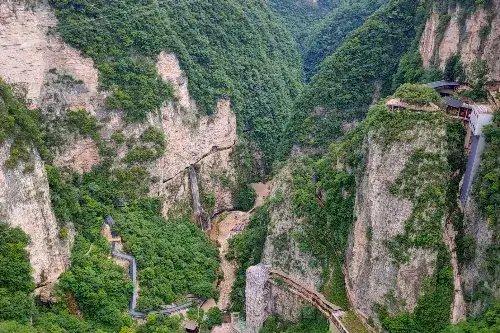
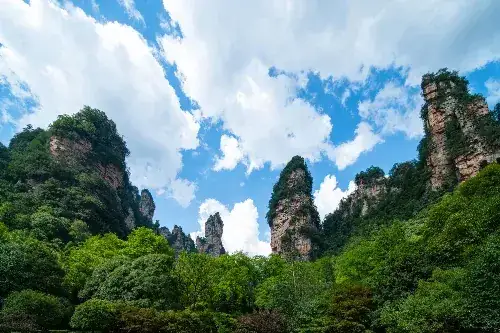
Chenzhou has 70% forest coverage and is designated an Excellent Tourism City and City of Hot Springs. Highlights include the national 5A-level Dongjiang Lake Wetland Park, Mangshan National Forest Park, Suxian Ridge, Feitian Mountain Danxia Geology Park, Yangtian Lake, and Banliang Ancient Village. As of 2018, the city had 22 national-level and 49 provincial-level scenic areas, with national-level count tied for first nationally.
International Exchange
Chenzhou has maintained sister-city relations with African cities for over 20 years, serving as a hub for China-Africa cooperation through the National Sustainable Development Agenda Innovation Demonstration Zone and the China (Hunan) Pilot Free Trade Zone Chenzhou Area.
Notable Figures
Chenzhou has produced notable figures in agriculture, literature, military, and politics across its history.
Honors
Chenzhou has been designated a National Historical and Cultural City, National Green Mining Development Demonstration Zone, Excellent Tourism City of China, and City of Hot Springs.
Travel information can change. Check current opening hours, reservations and entry requirements before you travel.
Traveller discussion
Start the conversation with a helpful tip or a question.