
Zhangjiajie City
Zhangjiajie CityZhangjiajie City, formerly known as "Dayong," is a prefecture-level city in Hunan Province, located in the northwestern part of the province along the middle and upper reaches of the Lishui River in the heart of the Wuling M
Zhangjiajie City
Zhangjiajie City, formerly known as "Dayong," is a prefecture-level city in Hunan Province, located in the northwestern part of the province along the middle and upper reaches of the Lishui River in the heart of the Wuling Mountain area. With abundant sunlight and rainfall, it covers a total area of 9,533 square kilometers. As of September 2025, Zhangjiajie administers 2 districts and 2 counties. As of the end of 2024, the city had a permanent population of 1.4869 million. The municipal government is headquartered at No. 2 Nanzhuang Road, Nanzhuangping Subdistrict, Yongding District. Zhangjiajie is a national key ecological functional zone and an important ecological barrier for the middle and lower reaches of the Yangtze River. It is the birthplace and center of the Hunan-Hubei-Chongqing-Guizhou revolutionary base area. Built on tourism, the city holds six "golden cards": World Natural Heritage site, one of the world's first Global Geoparks, the naming site of "Zhangjiajie landform," China's first national forest park, one of the first batch of national 5A-level tourist attractions, and a National Civilized Scenic Area. It is the permanent host of the World Wingsuit Flying Championship. The city has developed an integrated air, high-speed rail, and expressway transportation network. Hehua International Airport is the first international airport in the Wuling Mountain area and one of the earliest national Class I aviation ports. In 2017, Zhangjiajie was awarded the title of "National Forest City." The city is home to the Zhangjiajie National Forest Park, a national 5A-level tourist attraction listed on the World Natural Heritage List, as well as Tianmen Mountain National Forest Park. In 2025, the city achieved a regional GDP of 66.78 billion yuan (approximately $9.3 billion), a year-on-year increase of 3.0%.
History
Human activity along the banks of the Lishui River dates back to the Neolithic Age. The ancient text "Book of Documents: Canon of Shun" records that "Shun exiled Huandou to Chongshan." According to historical records including the "Yongding Guard Annals" compiled in 1685 and the "Yongding County Annals" revised in 1823, in 221 BCE, when Qin unified the six states and divided the country into 36 commanderies, Dayong and Cili belonged to Qianzhong Commandery, the first administrative division in Hunan, predating even the provincial capital Changsha. Qianzhong Commandery's jurisdiction included Cigu County (located near present-day Taiping Village, Jiangjiaping Township, Cili), Sangzhi County, Dayong County (present-day Yongding District), Shimen County, Anxiang County, Li County, Jinshi, Linli, as well as parts of Gong'an and Hefeng counties in Hubei and Taoyuan County in Hunan.
During the Western Han Dynasty (202 BCE), Emperor Gaozu Liu Bang divided Qianzhong Commandery into Wuling Commandery and split Cigu County into Chanling County and Chong County (encompassing present-day Yongding and Wulingyuan districts and Sangzhi County).
During the Three Kingdoms period (263 CE), Emperor Sun Xiu of Wu, seeing the grand cave opening on Songliang Mountain as an auspicious sign, renamed it Tianmen Mountain and simultaneously changed Wuling Commandery to Tianmen Commandery.
During the Tang Dynasty (621 CE), Emperor Gaozu Li Yuan established Lizhou and Liyang Commandery under Shannan Circuit, governing six counties including Cili and Chongyi County (present-day Yongding and Wulingyuan districts and Sangzhi County).
During the Five Dynasties and Ten Kingdoms period (907-960), the entire territory of present-day Zhangjiajie was under the jurisdiction of the Chu Kingdom.
During the Song Dynasty (963 CE), Emperor Taizu Zhao Kuangyin placed the territory under Liyang Commandery as Cili County, establishing military outposts at Anfu (present-day Sangzhi), Wukou (present-day Yongding), and Suokou (present-day Wulingyuan).
During the Yuan Dynasty (1277 CE), Emperor Shizu Kublai Khan established the Lizhou Route General Administration, governing four counties including Cili, and set up the Maogang Chief Military Command at present-day Yongding District.
During the Ming Dynasty (1369 CE), Cili Prefecture was downgraded to Dayong County under Lizhou. During the Qing Dynasty (1730 CE), the Sangzhi and Maogang tusi (chieftain) systems were replaced with direct imperial administration, and Liding and Jiuxi guard posts were abolished in favor of Anfu County.
During the Republic of China era (1916), Dayong, Sangzhi, and Cili counties were placed under the Chenyuan Circuit. In 1949, with the founding of the People's Republic of China, Zhangjiajie was fully liberated. In 1985, the State Council approved the establishment of Dayong City at the county level. In 1988, it was elevated to a prefecture-level city, establishing Yongding and Wulingyuan districts, with Cili County (transferred from Changde) and Sangzhi County (transferred from the West Hunan Tujia-Miao Autonomous Prefecture) incorporated. On April 4, 1994, with State Council approval, Dayong City was officially renamed Zhangjiajie City.
Administrative Divisions
As of September 2025, Zhangjiajie administers 2 municipal districts and 2 counties: Yongding District, Wulingyuan District, Cili County, and Sangzhi County, comprising 7 subdistricts, 32 towns, 47 townships, and 15 ethnic townships. The municipal government is headquartered at No. 2 Nanzhuang Road, Nanzhuangping Subdistrict, Yongding District.
Geographical Environment
Location and Boundaries
Zhangjiajie is located in northwestern Hunan Province, at the junction of the Yunnan-Guizhou Plateau uplift and the Dongting Lake subsidence zone, between 109 degrees 40 minutes and 111 degrees 20 minutes east longitude and 28 degrees 52 minutes and 29 degrees 48 minutes north latitude. It borders Shimen and Taoyuan to the east, Yuanling County to the south, and Hefeng and Xuan'en counties of Hubei Province to the north. The city spans 167 km east to west and 96 km north to south, with a total area of 9,533 square kilometers.
Topography
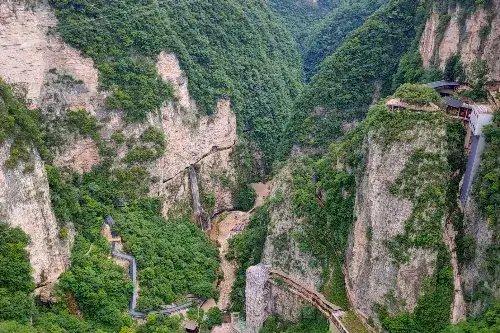
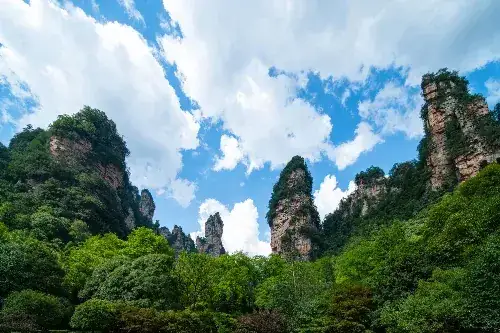
Zhangjiajie features complex and diverse geological strata, including mountains, karst formations, hills, ridges, and plains, with mountainous terrain accounting for 76% of the total area. The most distinctive feature is the quartz sandstone peak forest landform, which is rare worldwide. The terrain is higher in the northwest and slopes southeastward along the Lishui River. Tectonic uplift has created narrow, steep-walled gorges with rapid currents, particularly visible along the Lishui River headwaters, Youshui upper reaches, and the Maoyan River section.
Climate
Zhangjiajie has a subtropical mountain monsoon climate with abundant sunlight, plentiful rainfall, long frost-free periods, and distinct seasons. The annual average temperature is approximately 17 degrees Celsius (January average 5.1 degrees, July average 28 degrees), with annual precipitation of about 1,400 mm and 1,440 sunshine hours. The frost-free period ranges from 216 to 269 days. Due to elevation differences, the city center sits at 183 meters while scenic areas average 1,000 meters, resulting in diurnal temperature variations of up to 10 degrees Celsius.
Hydrology
The city's water systems are centered on the Lishui and Youshui rivers. The Lishui River, one of Hunan's four major rivers, originates in Sangzhi County from three sources that converge at Longjiangkou, then flows through Sangzhi County, Yongding District, and Cili County before reaching Dongting Lake. The main stream runs 313 km through Zhangjiajie with a basin area of 8,135 square kilometers. The Youshui, the largest tributary, originates in Hefeng, Hubei, and flows 250 km through the city with a basin area of 2,565 square kilometers. The city has 212 rivers with drainage areas exceeding 5 square kilometers, including 48 first-order, 101 second-order, 54 third-order, and 8 fourth-order tributaries.
Natural Resources
Mineral Resources
Zhangjiajie's mineral resources are primarily sedimentary in origin, including coal, iron, nickel, and molybdenum, along with low-temperature hydrothermal deposits of lead, zinc, and copper. Non-metallic minerals include limestone, dolomite, marble, fluorite, barite, and silica. The quartz sandstone forming the Wulingyuan scenic area's unique peak forest landform has a silicon dioxide content of 90 to 99.06%, making it a high-quality raw material for quartz glass production. The Qing'anping area also has abundant marble, coal, and iron resources, as well as mineral water.
Biological Resources
Zhangjiajie boasts 850 species of woody plants across 320 genera and 106 families, along with 146 species of vertebrates. The city has 56 nationally protected plant species and 40 nationally protected animal species. Notable rare plants include ginkgo, dove tree, Chinese yew, and cherry blossom. Valuable medicinal herbs include reishi mushroom, gastrodia, polygonum multiflorum, eucommia, and maoyanberry. Rare animals include the giant salamander, serow, South China tiger, clouded leopard, macaque, and civet. Forest coverage reaches 64.61%, ranking first in Hunan Province, with forestry land comprising 71% of the total area.
Population
As of the end of 2024, Zhangjiajie had a permanent population of 1.487 million, with 820,000 urban residents (55.2%) and 667,000 rural residents (44.8%). By district: Yongding District had 506,000, Wulingyuan District 59,000, Cili County 554,000, and Sangzhi County 368,000. By gender, males numbered 755,000 and females 732,000. Zhangjiajie is home to 33 ethnic minority groups, predominantly Tujia, Bai, and Miao, with the minority population totaling 1.1525 million, or 77.19% of the total population.
Politics
The city is governed by the Zhangjiajie Municipal People's Government, headquartered in Yongding District, overseeing the administration of its two districts and two counties within the framework of Hunan Province.
Economy
Overview
In 2025, Zhangjiajie achieved a regional GDP of 66.78 billion yuan (approximately $9.3 billion), a year-on-year increase of 3.0%. The primary, secondary, and tertiary industries contributed added values of 9.49 billion yuan (approximately $1.32 billion, up 3.1%), 7.90 billion yuan (approximately $1.10 billion, down 5.9%), and 49.39 billion yuan (approximately $6.86 billion, up 4.6%) respectively, with an industry structure ratio of 14.2:11.8:74.0. In 2024, the GDP reached 65.44 billion yuan (approximately $9.1 billion, up 3.9%). General public budget revenue was 3.67 billion yuan (approximately $510 million, up 2.2%), with tax revenue of 2.25 billion yuan and non-tax revenue of 1.42 billion yuan. Fixed asset investment declined 5.3% year-on-year.
Primary Industry
Major crops include rice, corn, sweet potato, rapeseed, and legumes. In 2025, agricultural output value reached 15.79 billion yuan (approximately $2.19 billion, up 3.3%), with Chinese medicinal herbs output growing 46.4%, vegetables 4.3%, and tea 10.6%. In 2024, the total output value of agriculture, forestry, animal husbandry, and fishery was 15.71 billion yuan (approximately $2.18 billion, up 3.9%), with grain output reaching 650,200 tons. The city had 574,000 head of live pigs in stock and 891,600 slaughtered.
Secondary Industry
Zhangjiajie's industries include agricultural machinery, cement, nitrogen fertilizer, and cotton-wool textiles. In 2025, above-scale industrial added value declined 7.6% year-on-year, with mining down 4.1%, manufacturing down 10.3%, and utilities up 0.8%. In 2024, above-scale industrial enterprises reported revenue of 12.32 billion yuan (approximately $1.71 billion, up 7.4%) and total profits of 74 million yuan (approximately $10.3 million, up 25.7%). Construction enterprises with qualifications reported total profits of 144 million yuan, with building construction covering 2.496 million square meters.
Tertiary Industry
The service sector showed steady recovery in 2025. As of November, 127 above-scale service enterprises reported 5.9% revenue growth, with key industries growing 10.5%. Leasing and business services grew 16.3%, while resident services and repair services grew 11.5%. In 2024, total retail sales of consumer goods reached 22.77 billion yuan (approximately $3.2 billion, up 2.0%). Foreign trade totaled 550 million yuan (approximately $76.4 million, down 64.4%). By year-end, financial institution deposits reached 129.14 billion yuan (approximately $17.9 billion, up 7.4%) and loans 139.82 billion yuan (approximately $19.4 billion, up 6.8%). Inbound tourism saw explosive growth, surging from 31,000 visitors in 2020 to 1.8306 million in 2024, a 59-fold increase, with visitors from 183 countries and regions.
Social Affairs
Education
As of end-2024, Zhangjiajie had 2 regular universities enrolling 12,570 students (up 16.6%), with 32,867 enrolled students and 8,037 graduates. The city also had 5,168 secondary vocational enrollments, 11,773 regular high school enrollments, 19,133 junior high school enrollments, and 14,946 primary school enrollments, with a 100% primary school enrollment rate. The city had 219 private schools with 28,649 students.
Science and Technology
In 2024, the high-tech industry added value reached 3.47 billion yuan (approximately $482 million, up 6.0%). The city registered 17 scientific achievements, signed 305 technology contracts with a transaction value of 4.04 billion yuan. It maintained 1 national-local joint engineering research center, 4 provincial engineering research centers, 3 provincial engineering technology research centers, and 2 provincial key laboratories. Patent grants totaled 410 (up 13.6%), including 69 invention patents (up 35.3%).
Culture
The city had 272 performing arts troupes, 5 mass art centers and cultural centers, 5 public libraries, and 6 museums and memorial halls. It maintained 5 items on the national intangible cultural heritage list and 36 on the provincial list. Radio coverage reached 94.3% and television coverage 99.4% of the population.
Healthcare
Zhangjiajie had 1,402 health institutions, including 31 hospitals, 5 maternal and child health centers, 17 community health service centers, 300 clinics, and 924 village clinics, with 12,000 health professionals and 7,284 hospital beds. The city also had 5 disease prevention and control centers and 5 health supervision institutes.
Sports
The city had 4,786 sports venues, including 4 gymnasiums, 165 sports fields, and 17 swimming pools, with 658,000 regular participants in physical exercise. The city launched 128 fitness programs, an increase of 156% year-on-year.
Social Security
As of end-2024, 1.415 million residents participated in basic medical insurance and 964,000 in urban-rural basic pension insurance. The city provided minimum living allowances to 4,809 urban residents and 37,718 rural residents. Elderly care institutions had 5,277 beds, serving 2,318 residents. Community elderly care facilities numbered 529. The city also completed renovations of 109 old urban residential communities.
Transportation
Highways
The city's highway network totals 9,288 km, including 185 km of expressways. In 2024, highway freight volume was 30.554 million tons (down 0.4%) and passenger volume 25.605 million persons (up 3.7%). The Chayuan Highway in Wulingyuan District was named one of China's "Ten Most Beautiful Rural Roads" in 2022, connecting Wulingyuan scenic area ticket stations over 13.92 km.
Railways
Zhangjiajie Railway Station, located in Guanliping, Yongding District, is the largest station in northwestern Hunan. The Zhiliu Railway runs through the city, with tourist trains to multiple destinations. Zhangjiajie West Station, opened in December 2019, is a key hub connecting the Qian-Zhang-Chang railway and the Zhang-Ji-Huai high-speed railway, integrating rail, bus, public transit, and maglev connections into a comprehensive transportation hub.
Water Transport
In December 2014, Zhangjiajie opened its first standard navigation channel on the Lishui River, ending the city's history without standard waterways. The Maoyan River waterway tourism route, 22 km long, is one of Hunan's first 10 premium waterway tourism passenger routes. In 2024, waterway passenger volume reached 1.82 million persons (up 107.3%).
Aviation
Zhangjiajie Hehua International Airport, operational since 1994, is a 4D-level tourism airport. Designated as an aviation port in 1997, it operates international routes to Hong Kong, Macao, Seoul, Busan, Fukuoka, and Osaka. It is one of Hunan's two international aviation ports and the only one in the Wuling Mountain area, offering bonded warehouse, duty-free shop, departure tax refund, visa-on-arrival, and designated import supervision facilities. In 2024, the airport handled 1.964 million passengers (up 30.8%).
Historical Culture
Dialect
The Zhangjiajie dialect belongs to the Southwestern Mandarin group, sharing linguistic features with the dialects of Guizhou, Chongqing, and Sichuan. The dialect area includes Zhangjiajie and surrounding regions, including western and southwestern Shimen and western Linli. The dialect features heavy retroflex finals, and mutual intelligibility within the Mandarin dialect zone is high, enabling free communication.
Customs
Local customs reflect the rich traditions of the Tujia people and Han Chinese, encompassing distinctive rituals for major life events, seasonal observances, and community celebrations unique to the Wuling Mountain region.
Festivals
Traditional festivals include: the second day of the second lunar month, the birthday of the Earth God; the Flower Festival on the 15th of the second month, when young girls had their ears pierced and couples married; the third day of the third month for eating mugwort rice cakes; Qingming Festival with willow branches on doorways and colored banners on ancestral graves; the eighth day of the fourth month as "Bathing Buddha Festival," a traditional day of rest for farmers; Dragon Boat Festival with zongzi, calamus wine, and mugwort on doorways, plus dragon boat races on the Lishui River; the sixth day of the sixth month, when Tujia people sun-dry clothes in remembrance of Tusi leader Qin Hou; and Mid-Autumn Festival, when Tujia people "steal melons" from gardens to bless childless couples. In Sangzhi County's Shangdongjie area, families surnamed Xiang celebrate New Year a day early.
Origin of the Name
The character "jie" carries two meanings in this region: territorial boundaries and mountains. Historical records from the Qing Dynasty "Yongding County Annals" and the Republic-era "Cili County Annals" reference places named after the Zhang family. The name "Zhangjiajie" first appeared in the preface of the "Zhang Family Genealogy" dated 1631, written by Zhang Zaichang, the sixth-generation descendant of Zhang Wancong, a military commander of the Yongding Guard. During the Hongzhi era (1488-1506), the imperial court granted the forested lands of present-day Zhangjiajie National Forest Park to Zhang Wancong for his meritorious service. Another legend holds that Zhang Liang, Marquis of Liu in the Western Han Dynasty, retired here and was buried at Shuirao Simen, giving the area its name. In 1994, Dayong City was renamed Zhangjiajie City after the national forest park's international renown.
Intangible Cultural Heritage
As of end-2024, Zhangjiajie has 5 items on the national intangible cultural heritage protection list and 36 on the provincial list, preserving traditional Tujia and regional cultural practices for future generations.
Scenic Spots
Zhangjiajie was established for tourism and is a key domestic tourist city. The Wulingyuan Scenic Area features the world-rare quartz sandstone peak forest gorge landform, comprising four major scenic zones: Zhangjiajie National Forest Park (China's first), Tianzi Mountain Nature Reserve, Suoxiyu Nature Reserve, and Yangjiajie, with a sightseeing area of 264.6 square kilometers. It was among China's first World Natural Heritage sites, first Global Geoparks, and first national 5A-level tourist attractions. Other attractions include Tianmen Mountain National Forest Park ("Soul of Wuling"), Badagongshan National Nature Reserve ("World's Rare Gene Bank of Species"), Wulei Mountain ("Southern Wudang" Taoist sacred site), the Maoyan River ("Hundred-Li Gallery"), and Wanfu Hot Springs. The former residence of He Long and the Hunan-Hubei-Sichuan-Guizhou Revolutionary Base provincial committee site are national key cultural relics protection units.
Local Specialties
Specialty products include Zhangjiajie liquor, wild mushrooms, stone ear, eucommia, kudzu powder, Maoyanberry tea, kiwifruit, turtle-pattern colored stone, Tujia brocade, stone ear stewed with chicken and duck, loach in tofu, sour fish, Tujia three-pot stew, husband-and-wife radish, konjac dried snacks, Tujia hezha (soybean stew), kudzu pastry, Yu Lu tea, and Sangzhi white tea.
Notable Figures
Historical figures include: Mo Chou, Northern Song dynasty top scholar and Minister of Personnel; Zhang Dui, Yuan dynasty scholar and compiler of the National History Academy; Zhou Xu, Ming dynasty scholar and Minister of Works; Qing dynasty generals Liu Mingdeng, Sun Kaihua, and Xi Dacheng, who defended Taiwan, recovered Xinjiang, and fought foreign invaders; revolutionary martyrs Li Binghuan and Tian Bangxuan; 1911 Revolution figures Tang Xizhi and Wang Zhengya; Republic-era generals Tang Zimo and Fujian military governor Sun Daoren; Communist military leaders including Yu Zhaolong, Wang Bingnan, He Jinzhai, and Zhang Yiming; proletarian revolutionary, military strategist, and New China Marshal He Long; senior PLA commanders Liao Hansheng, Yuan Renyuan, and Fan Ziyu; Du Xinwu, known as the "Great Swordsman of North and South"; geologist Tian Qijun; radio expert Zhang Shenchuan; economist Zhuo Jiong; and Chen Nengkuan, a meritorious contributor to China's "Two Bombs and One Satellite" program.
External Relations
Zhangjiajie maintains sister-city relationships and international exchange partnerships, leveraging its global tourism prominence to foster cultural and economic ties with destinations worldwide.
Honorary Titles
Zhangjiajie has received numerous honors including "National Forest City" (2017), recognition as a national key ecological functional zone, designations as a National Civilized Scenic Area, and inclusion among China's first 5A-level tourist attractions. The city continues to build its reputation as a world-class tourism destination through its unique natural heritage and cultural significance.
Travel information can change. Check current opening hours, reservations and entry requirements before you travel.
Traveller discussion
Start the conversation with a helpful tip or a question.