
Shaoyang City
Shaoyang CityShaoyang City, formerly known as Baoqing, is a prefecture-level city in Hunan Province, located in the south-central part of Hunan along the upper reaches of the Zi River. It is bordered by Hengyang to the east, Yongzhou and Gu
Shaoyang City
Shaoyang City, formerly known as Baoqing, is a prefecture-level city in Hunan Province, located in the south-central part of Hunan along the upper reaches of the Zi River. It is bordered by Hengyang to the east, Yongzhou and Guilin to the south, Huaihua to the west, and Loudi to the north, with a total area of 20,824.37 square kilometers. As of July 2025, Shaoyang administers 3 districts, 6 counties, 1 autonomous county, and 2 county-level cities. As of the end of 2025, the permanent population was 6.217 million. The local dialect, Shaoyanghua, belongs to the Old Xiang group and shares similarities with Hengyanghua and Southwestern Mandarin. After the founding of the People's Republic of China, the Shaoyang District Inspector's Office was established in October 1949, and Shaoyang City was established under Shaoyang County. In July 1950, Shaoyang was upgraded to a county-level city. Shaoyang is situated in the subtropical zone and has a typical mid-subtropical humid monsoon climate. It serves as a transitional zone between the Jiangnan Hills and the Yunnan-Guizhou Plateau, with the Xuefeng Mountains forming the eastern edge of the plateau to the west, and the Heng-Shao hilly basin to the east and center. The city's GDP in 2025 reached 288.35 billion yuan (approximately US$40.0 billion), up 0.2% year-on-year, with a three-sector structure ratio of 16.2:32.6:51.2.
History
Pre-Qin Period
As early as the Neolithic Age, early inhabitants lived and settled in the Shaoyang area.
Qin to Northern and Southern Dynasties
During the Qin Dynasty, the territory belonged to Changsha and Qianzhong commanderies. In the early Western Han Dynasty, Zhaoling County was established under the Changsha Kingdom. During the Three Kingdoms period, in the first year of Baoding (266 AD), the Wu state established Zhaoling Commandery with its seat in the present-day urban area, marking the beginning of prefectural-level administration in the region. In the first year of Taikang (280 AD) under the Western Jin, the name was changed from Zhaoling to Shaoling, and the administrative seat was moved to the north bank of the Zi River.
Sui, Tang, Song, and Yuan Periods
During the Sui Dynasty, the commandery system was abolished and the county was renamed Shaoyang County under Tanzhou. In the Tang Dynasty, Shaozhou was established, co-located with Shaoyang County in the present-day urban area. In the first year of Baoqing (1225 AD) under the Southern Song, Emperor Lizong ascended the throne and named his former fiefdom after his reign era, upgrading Shaozhou to Baoqing Prefecture, from which the name Baoqing originated. The Yuan Dynasty established Baoqing and Wugang circuits.
Ming and Qing Periods
In the early Ming Dynasty, Baoqing and Wugang prefectures were established; Wugang was later downgraded to a department.
Republic of China Period
In 1913, Baoqing Prefecture was abolished and Baoqing County was established. In 1928, Baoqing County was renamed Shaoyang County. In 1937, the Sixth Administrative Inspector District of Hunan Province was established in Shaoyang County, overseeing seven counties including Shaoyang, Xinhua, Wugang, Xinning, Chengbu, Xiangxiang, and Anhua.
After the Founding of the People's Republic
After the founding of the People's Republic of China in October 1949, the Shaoyang District Inspector's Office was established in Hunan Province, and Shaoyang City was established under Shaoyang County. In July 1950, Shaoyang was upgraded to a county-level city. Over the following decades, the administrative boundaries underwent numerous adjustments. In 1986, the State Council approved the abolition of Shaoyang District, placing six counties and Chengbu Miao Autonomous County under Shaoyang City's jurisdiction.
Administrative Divisions
Division History
In 1994, Wugang County was abolished and Wugang City was established. In 1997, the State Council approved the restructuring of Shaoyang's urban districts into Shuangqing, Daxiang, and Beita districts. In 2019, Shaodong County was abolished and Shaodong City was established as a county-level city administered by Shaoyang.
Administrative Details
As of July 2025, Shaoyang City administers 3 districts, 6 counties, 1 autonomous county, and 2 county-level cities, comprising 36 subdistricts, 112 towns, 39 townships, and 15 ethnic townships. The municipal government is located at No. 6 Chengbei Road, Daxiang District.
Geography
Location and Territory
Shaoyang City is located in the south-central part of Hunan along the upper reaches of the Zi River, between latitudes 25°58' to 27°40'N and longitudes 109°49' to 112°57'E, with a total area of 20,824 square kilometers.
Geology
Approximately 2.5 billion years ago, the area was an offshore continental slope with a warm, humid climate. By 800 million years ago, the Xuefeng orogeny uplifted the area into land. The region features east-west trending structures approximately 250 kilometers long and 20 to 30 kilometers wide, as well as north-south and northeast structures.
Topography
Shaoyang belongs to the Jiangnan Hills terrain region. Mountains and hills account for about two-thirds of the total area, roughly described as "seven parts mountain, two parts farmland, one part water and roads." The Xuefeng Mountains dominate the west and north, while the Yuechengling range extends across the south. The central and eastern parts form the Heng-Shao hilly basin, tilting from southwest to northeast in a dustpan-shaped depression open toward the northeast.
Climate
Shaoyang is situated in the subtropical zone with a typical mid-subtropical humid monsoon climate. It has four distinct seasons with abundant sunlight, heat, and rainfall. The average annual temperature ranges from 16.1 to 17.1 degrees Celsius, with annual sunshine hours between 1,350 and 1,670.
Hydrology
The city has 595 rivers over 5 kilometers in length, belonging to four major water systems: the Zi, Yuan, Xiang, and Xi rivers, with the Zi River system being the primary one. The Zi River and its tributary, the Shaoshui, flow through the urban area, dividing it into three parts, which later led to the establishment of three districts.
Soils
A 1985 soil survey identified 10 soil types including paddy soil, red soil, and mountain yellow-brown soil, derived mainly from limestone, sandstone, slate, granite, and other parent materials.
Natural Resources
Water Resources
As of 2018, the water surface area was 1.02 million mu (68,000 hectares), with a multi-year average total water resource of 16.06 billion cubic meters. The theoretical hydropower potential is 1.4473 million kilowatts, with 687,700 kilowatts exploitable, concentrated mainly in the southwestern mountainous counties of Chengbu and Suining.
Land Resources
As of 2021, basic farmland covered 343,000 hectares, with high-standard farmland construction reaching 400,000 mu (26,700 hectares).
Biological Resources
The city has 2,826 species of higher plants across 245 families, including 210 timber species and 432 economic forest species. Nationally protected Class I plants include Cathay silver fir, resource fir, and ginkgo. There are 397 species of wild vertebrates across 5 classes, 33 orders, and 102 families, with protected species including clouded leopards, golden leopards, and giant salamanders. Three national-level nature reserves—Suining Huangsang, Xinning Shunhuangshan, and Chengbu Jintongshan—along with the Wugang Yunshan provincial nature reserve have been established.
Mineral Resources
Shaoyang has 74 discovered mineral types including coal, iron, manganese, tungsten, antimony, gold, silver, lead, zinc, and gypsum. There are 140 mining areas including 8 large deposits. Gypsum reserves total 564.5 million tons, and coal reserves reach 309.8 million tons.
Politics
The city's political administration is led by the Municipal Party Committee and Municipal People's Government, operating under China's standard prefecture-level governance structure.
Population
Population Size
As of November 2020, the permanent population was 6,563,520. By the end of 2025, the permanent population was 6.217 million, a decrease of 83,000 from the previous year, with an urbanization rate of 56.1%. The registered population totaled 8.04 million across 2.529 million households.
Ethnic Groups
Shaoyang has 1 autonomous county (Chengbu Miao Autonomous County), 1 ethnic minority majority county (Suining), 15 ethnic townships, and 6 ethnic villages. There are 43 ethnic minorities with 560,000 people, accounting for 6.8% of the total population.
Languages
The Shaoyang dialect belongs to the Old Xiang group, sharing similarities with Hengyanghua and Southwestern Mandarin. It can be subdivided into Shaodonghua, Lianqiaohua, and other local variants.
Religious Beliefs
Daoism was introduced during the Jin Dynasty. Buddhism spread during the Southern Dynasty. Islam was officially introduced in the early Ming Dynasty. Christianity arrived in Shaoyang in 1902.
Economy
Overview
In 2024, Shaoyang's GDP reached 292.63 billion yuan (approximately US$40.6 billion), up 5.1%. Per capita GDP was 46,234 yuan (approximately US$6,400). In 2025, GDP reached 288.35 billion yuan (approximately US$40.0 billion), up 0.2%, with per capita GDP of 46,075 yuan (approximately US$6,400). The three-sector ratio was 16.2:32.6:51.2. Private sector GDP was 209.14 billion yuan (approximately US$29.0 billion), accounting for 72.5% of total GDP. Fixed asset investment decreased by 41.2%. Local general public budget revenue was 11.59 billion yuan (approximately US$1.6 billion), down 5.2%. Per capita disposable income for all residents was 29,305 yuan (approximately US$4,100), up 5.5%.
Primary Industry
In 2025, total agricultural, forestry, animal husbandry, and fishery output reached 79.82 billion yuan (approximately US$11.1 billion), up 4.1%. Grain output was 3.409 million tons, up 1.0%. Vegetable output was 3.685 million tons. The year-end pig inventory was 4.026 million head, with 6.772 million slaughtered.
Secondary Industry
As of the end of 2025, industrial added value decreased by 8.6%. There were 1,142 above-scale industrial enterprises. Major products included 456,000 monitors, 339.3 million tons of cement, and 10.7 million kiloliters of alcoholic beverages. The construction sector had 329 qualified enterprises with total profits of 2.29 billion yuan.
Tertiary Industry
In 2025, total retail sales of consumer goods reached 153.75 billion yuan (approximately US$21.3 billion), down 2.3%. Total import and export value was 11.52 billion yuan (approximately US$1.6 billion), down 21.9%. Real estate investment was 15.16 billion yuan, down 33.3%. The city received 62.608 million domestic tourists, up 10.5%, with total tourism spending of 65.57 billion yuan (approximately US$9.1 billion), up 10.3%. Year-end financial institution deposits reached 523.8 billion yuan (approximately US$72.8 billion), up 8.7%, with loans at 329.17 billion yuan (approximately US$45.7 billion), up 6.3%. Insurance premium income was 10.98 billion yuan (approximately US$1.5 billion), up 3.0%.
Social Services
Science and Technology
High-tech industry added value decreased by 17.1%. A total of 718 technology contracts were signed with a transaction value of 30.38 billion yuan. Patent grants totaled 2,212, including 285 invention patents.
Education
In 2025, regular higher education enrolled 16,000 students. Various secondary vocational education enrolled 26,000 students. Regular senior high schools enrolled 63,000 students. Primary and junior high schools enrolled 152,000 students. Primary school enrollment and graduation rates both reached 100%, with a gross enrollment rate of 93.9% for senior high school education.
Culture
The city had 5 municipal performing arts troupes, 13 cultural centers, and 14 public libraries. There were 16 national-level intangible cultural heritage items. Qiju opera works were performed internationally in Russia and recognized at the 19th China Theatre Festival.
Healthcare
There were 5,888 health institutions including 144 hospitals, 13 maternal and child health centers, 64 community health service centers, and 4,307 village clinics, with 36,000 hospital beds and 52,000 health professionals.
Sports
The city had 19,784 sports venues, including 11 large stadiums. It hosted the 6th Hunan Provincial Middle School Games and organized over 100 events in the "Run, Shaoyang" series, winning 52 gold, 41 silver, and 59 bronze medals at the 2025 Hunan Youth Sports Championships.
Social Security
In 2025, 3.957 million residents participated in basic pension insurance, and 6.122 million participated in basic medical insurance. Urban new employment reached 49,000, with a registered urban unemployment rate of 1.5%.
Transportation
Overview
Shaoyang has historically been a strategic transportation hub, described as "controlling Yunnan and Guizhou above, and commanding Changsha and Hengyang below." In 2025, transportation investment reached 10.18 billion yuan. The Chenglong and Xinxin expressways opened to traffic, adding 221 kilometers of expressway. The year-end civilian vehicle inventory reached 873,000, up 2.8%.
Highways
In December 2002, the Tanshao Expressway opened, marking Shaoyang's entry into the expressway era. By 2016, the city formed a highway skeleton centered on the urban area, with the Shanghai-Kunming Expressway as the east-west axis and the Erguang Expressway as the north-south axis, radiating to the Changsha-Zhuzhou-Xiangtan, Pearl River Delta, Yangtze River Economic Belt, and ASEAN regions.
Railways
In December 2014, the Shaoyang High-Speed Railway North Station was put into operation. In 2018, the Huaihua-Shaoyang-Hengyang Railway opened, connecting the Shanghai-Kunming and Beijing-Guangzhou high-speed rail arteries. In 2025, railway passenger volume reached 9.324 million, up 7.7%.
Aviation
In June 2017, Shaoyang Wugang Airport opened, ushering Shaoyang into the aviation era. In 2018, Wugang Airport handled over 460,000 passengers, ranking fifth in the province.
Water Transport
In March 2017, Shaoyang announced plans to guide the transformation and upgrading of the water transport economy and build a modern water transportation system.
History and Culture
Overview
Shaoyang has a long history, renowned throughout the Xiaoxiang region. Settlements existed as early as the Shang Dynasty. The city was established as a county in the early Western Han Dynasty and went through successive names including Zhaoling, Shaoling, Shaoyang, Minzhou, Shaozhou, and Baoqing. During the Qing Dynasty, the walled city of Baoqing, encircled by the Zi River and Shaoshui with fortifications atop the walls, earned the reputation of being "an impregnable Baoqing."
Festivals and Customs
Local festivals and customs reflect the region's diverse ethnic heritage, particularly the Miao traditions of Chengbu and the cultural practices of the surrounding rural communities.
Literature and Arts
Tantou New Year prints are handcrafted woodblock water-color prints unique to Hunan, produced in Tantou Town, Longhui County, with over 1,300 years of history. The last inheritor, Gao Lamei, created 29 print versions, including "Mice Wedding," which Lu Xun described in his essay collection and which is also collected by the British Museum. In 2006, it was listed as a national intangible cultural heritage item.
Baoqing bamboo carving is a folk craft combining decorative and practical functions, derived from bamboo ware. In 2006, it was included in the first batch of national intangible cultural heritage.
Shaoyang Huagu opera is a local folk drama that originated in the old Shaoyang County area, with music derived from local mountain songs and influenced by Qiju opera and religious music. Qiju opera, the most widely circulated local drama in Shaoyang, features three vocal styles—gaoqiang, kunqiang, and tanqiang—and two major schools, the Yonghe and Baohe.
Historical Relics
Shaoyang has a profound cultural heritage with cultural relics including the North Pagoda, ancient city walls of Baoqing Prefecture, and former residences of Wei Yuan and Cai E. There are 10 national-level protected cultural heritage sites, 56 provincial-level sites, and over 10,000 cataloged artifacts.
Intangible Cultural Heritage
As of the end of 2024, Shaoyang had 14 national-level intangible cultural heritage items, 53 provincial-level items, and 53 provincial-level heritage inheritors.
Scenic Spots
Overview
Shaoyang has over 300 tourist resources, including the World Natural Heritage and 5A-level Langshan scenic area in Xinning, Nanshan National Park, Suining Huangsang, Wugang Yunshan, Longhui Huxingshan, and the former residence of Wei Yuan in Longhui.
Notable Attractions
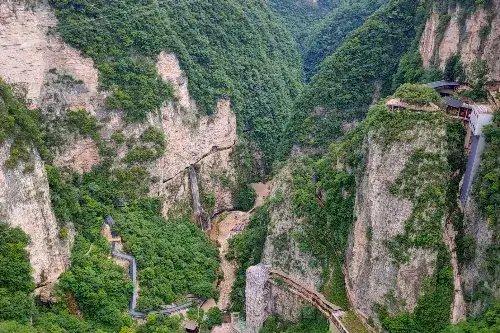
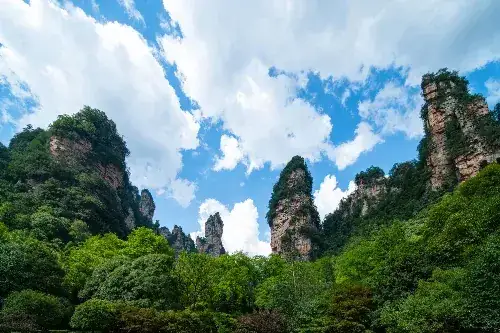
Key attractions include the Langshan Danxia landform, a UNESCO World Natural Heritage site; Nanshan National Park in Chengbu; the Huangsang nature reserve in Suining; Yunshan in Wugang; and the Cai E Memorial Hall in Dongkou.
Cuisine and Specialties
Shaoyang rice noodles are a famous local snack made from rice through six processes: rice selection, fermentation, slurry making, dough pressing, dough beating, and extrusion. The noodles are white, round, thin, and elastic, served after blanching in boiling water and adding seasonings.
Pig blood cakes, also known as blood tofu, are a traditional home-cooked dish. Made from tofu, fresh pork, pig blood, salt, chili powder, and spices, the mixture is shaped into oval balls, sun-dried, and then smoked over a wood fire stove.
Langshan smoked pork uses premium free-range pork, cured with salt, Sichuan pepper, and liquor, then smoked with sawdust for about seven days. Toothpick beef uses grass-fed beef marinated with starch, eggs, onions, chili, and secret spices.
Notable Figures
Notable historical figures from Shaoyang include Wei Yuan, a Qing Dynasty scholar and the author of "Illustrated Treatise on the Maritime Kingdoms"; Cai E, a military leader who played a key role in the movement against Yuan Shikai's imperial restoration; and other prominent scholars and revolutionaries.
Honorary Titles
Shaoyang was selected for the first batch of national demonstration areas for rule-of-law government, the national Double Support Model City list, and Hunan Province's list of regions with outstanding practical achievements.
Travel information can change. Check current opening hours, reservations and entry requirements before you travel.
Traveller discussion
Start the conversation with a helpful tip or a question.