
Xiangtan City
Xiangtan CityXiangtan City, a prefecture-level city under the jurisdiction of Hunan Province, is abbreviated as Tan and nicknamed "Lotus City" (Liancheng) for its abundant Xiang lotus production, also known as "Tan City." The terrain is hig
Xiangtan City
Xiangtan City, a prefecture-level city under the jurisdiction of Hunan Province, is abbreviated as Tan and nicknamed "Lotus City" (Liancheng) for its abundant Xiang lotus production, also known as "Tan City." The terrain is high in the north, west, and south, with low, flat central and eastern areas. As of May 2025, Xiangtan administers 2 districts, 1 county, and 2 county-level cities, covering a total area of 5,006 square kilometers. As of end-2025, the permanent population was 2.6702 million. Xiangtan has been established as a county since the Southern Dynasties, spanning over 1,500 years, and is an important birthplace of Huxiang Culture and the cradle of China's Red Culture. It has earned the praise: "Eternal beauty in central Hunan, producing more heroes than any other prefecture." Xiangtan's luminaries include the great leader Mao Zedong, founding marshal Peng Dehuai, renowned general Huang Gonglu, founding generals Chen Geng and Tan Zheng, cultural figures Qi Baishi, Lyu Ji, and Xiao San, the "Eight Li Brothers," and late Qing dignitaries Wang Kaiyun and Yang Du. Xiangtan is a member of the Yangtze River Mid-Reaches Urban Agglomeration and a central city of the national Chang-Zhu-Tan Urban Agglomeration "Two-Type Society" comprehensive reform pilot zone, and has received honors including China's Outstanding Tourism City, National Garden City, and National Civilized City. In 2023, Hunan's first cross-city subway opened, connecting Changsha and Xiangtan. In 2025, Xiangtan achieved a regional GDP of 307.723 billion CNY (approximately $42.7 billion), up 4.8% year-on-year.
History
The earliest known settlement sites in Xiangtan date to the Daxi Culture period (4400-3300 BCE) at Laohukeng and Duizi Mountain in Xiangtan County. The Daiziping site in Xiangxiang belongs to the Longshan Culture period (2800-2300 BCE). During the Shang and Zhou dynasties, the area was part of the Jingchu region with significant Yue cultural influence, serving as a convergence zone for Central Plains and southern cultures. In the late Warring States period, the Chu state established Changsha Commandery, encompassing all of present-day Xiangtan. During the Western Han, the area belonged to the Changsha Kingdom under kings Wu Rui and Liu Fa. In the early Eastern Han, Xiangxiang County was established under Lingling Commandery. By 215 CE, the area came under Wu rule in Hengyang Commandery, with its seat at present-day Gucheng Township in Xiangtan County. During the Jin dynasty, the area belonged to Hengyang Commandery and later Xiangzhou. Under the Sui, it was part of Tanzhou's Changsha Commandery. In 749 CE (Tang dynasty), the new Xiangtan County was carved from the northern parts of the Sui-era Xiangtan and Hengshan counties, with the county seat moved to Luokou (present-day Yisuhe Town). During the Five Dynasties, the area belonged to the Ma-family Chu Kingdom. Under the Song dynasty, the county seat was moved to Chengzheng Street. In 1295, both Xiangxiang and Xiangtan were elevated to prefectures. In 1370 (Ming dynasty), they were reduced to counties under Changsha Prefecture. The Qing maintained this arrangement. In August 1949, Xiangtan was peacefully liberated. In 1950, Xiangtan City was formally established. In 1983, the city and prefecture merged, implementing the city-administering-county system. In 1986, Xiangxiang became a county-level city, and in 1990, Shaoshan was elevated to a city. In 1992, the urban districts were reorganized into Yuhu and Yuetang districts.
Administrative Divisions
Division History
In 2005, the State Council approved moving the city government seat from Yuhu Road in Yuhu District to Furong Road in Yuetang District. In 2009, Xiangshui Township (138 sq km) was transferred to Yuhu District. In 2010, Xiangtang Township and Jiangshe Town were added to Yuhu District, expanding it to 451.39 sq km. In 2012, several villages from Xiangxiang's Longdong and Jinshi towns were transferred to Shaoshan, expanding it to 247.3 sq km.
Administrative Details
As of May 2025, Xiangtan administers 2 districts (Yuhu and Yuetang), 1 county (Xiangtan County), and 2 county-level cities (Xiangxiang and Shaoshan), along with 3 national-level parks (Xiangtan National High-Tech Industrial Development Zone, Xiangtan Jiuhua Economic and Technological Development Zone, and Xiangtan Comprehensive Bonded Zone) and 5 provincial-level parks. The city government is based in Yuetang District.
Geography
Location and Territory
Xiangtan is located in central Hunan along the middle reaches of the Xiang River, approximately 40 km from both Changsha and Zhuzhou, forming a triangular layout. Its coordinates are 111 degrees 58 minutes to 113 degrees 5 minutes east and 27 degrees 20 minutes 55 seconds to 28 degrees 5 minutes 40 seconds north. The city spans 108 km east-west and 81 km north-south, covering 5,006 sq km. It borders Ningxiang, Wangcheng, and Changsha County to the north; Hengdong, Hengshan, and Lukou District to the south; Zhuzhou and Lukou District to the east; and Shuangfeng County to the west.
Topography
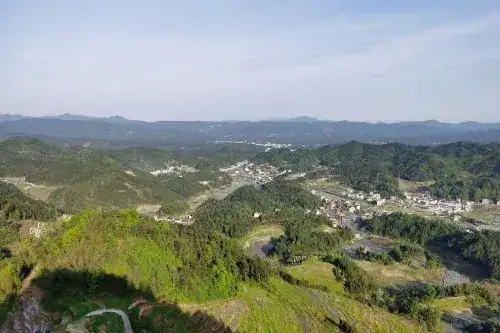
The terrain is high in the north, west, and south, with low, flat central and eastern areas. Nearly 80% of the area lies below 150 meters elevation. The landscape features low mountains and hills, forming a basin-ridge system. Four mountain ranges -- Shaofeng, Baozhong, Chang, and Xiaoxia -- surround the south, west, and north. The Xiang River and its tributaries Lianshui and Juanshui flow through the central and eastern lowlands. The highest point is Baozhong Mountain at 793 meters; the lowest is Jinma Shoal at 30.7 meters.
Climate
Xiangtan has a subtropical monsoon climate with dry summers and autumns, and cold waves in winter and spring. Average annual sunshine ranges from 1,640 to 1,700 hours, with average temperatures of 16.7 to 17.4 degrees Celsius and annual precipitation of 1,200 to 1,500 mm.
Hydrology
Xiangtan belongs to the Xiang River system. Major tributaries include the Juanshui (originating in Shuangfeng County, 70-100 m wide) and the Lianshui (a first-order tributary flowing through Lianyuan, Loudi, and Xiangxiang before joining the Xiang River at Hekou). The Shuifumiao Reservoir is a key water source for Loudi and the Shaoshan irrigation canal, and is a provincial-level wetland reserve.
Natural Disasters
Major natural disasters include droughts, floods, geological disasters, pest damage, wind and hail, frost, and lightning. In 2005, crop drought affected 37,537 hectares, causing direct economic losses of nearly 200 million CNY (approximately $27.8 million). In July 2019, severe flooding affected 36 townships across Xiangtan County, Xiangxiang, Yuhu, and Yuetang districts, with 76,379 people impacted and direct economic losses of 127.654 million CNY (approximately $17.7 million).
Soil
Paddy soil is the primary agricultural soil, covering 110,110 hectares. Red soil is the most widespread type, covering 239,330 hectares in hilly and low-mountain areas below 600 meters. Purple soil (9,845.67 hectares) appears in distinctive reddish-purple bands along the Juanshui River in Xiangtan County and in eastern Xiangxiang. Mountain yellow soil covers 733.6 hectares above 600 meters, and alluvial soil covers 200.8 hectares along the Xiang River.
Natural Resources
Water Resources
Annual rainfall averages about 1,500 mm. In 2015, total water resources averaged 3.775 billion cubic meters, including 3.145 billion cubic meters of surface water and 630 million cubic meters of groundwater. The Xiang, Lian, and Juan rivers all flow through Xiangtan.
Biological Resources
Forests are predominantly plantations with diverse species. Timber species include Chinese fir, Masson pine, camphor, and nanmu; economic species include oil-tea camellia, tung oil tree, and tea. As of 2019, 1,078 wild plant species were recorded, including 779 medicinal species. The city has 4 Class I protected plant species (including dawn redwood, yew, and ginkgo) and 18 Class II protected species. As of 2023, 7 Class I and 46 Class II protected terrestrial wildlife species were documented, including the small civet, crested ibis, and Chinese merganser.
Land Resources
In 2015, cultivated land covered 122,000 hectares (24.3% of total area), with 447 square meters per capita. Soil quality is high, supporting rice-based agriculture.
Mineral Resources
Xiangtan has 38 discovered mineral varieties with 19 having proven reserves. It ranks first in Hunan for metallurgical dolomite, ceramic clay, and cement sandstone; second for refractory clay; and third for manganese and sepiolite. The city's advantageous minerals are manganese (mainly in Yuhu District) and sepiolite (in Xiangtan County, Xiangxiang, and Shaoshan).
Forest Resources
As of May 2023, forest coverage remained above 42.51%, with total standing volume reaching 10.52 million cubic meters. Valuable species include red spring, evergreen oak, and southern yew.
Population
Population Size
As of end-2025, the permanent population was 2.6702 million, including 1.8126 million urban residents, with an urbanization rate of 67.88%, up 0.71 percentage points from the previous year.
Ethnic Composition
The main ethnic minorities in Xiangtan include Tujia, Miao, Mongolian, Dong, Hui, Yao, Manchu, and Zhuang peoples.
Politics
Xiangtan operates as a prefecture-level city under the leadership of the CPC Xiangtan Municipal Committee and the Xiangtan Municipal People's Government, with standard municipal governance structures.
Economy
Overview
As a key industrial city designated during the First and Second Five-Year Plans, Xiangtan has 36 industrial categories and 8 listed companies, including Xiangtan Steel, Geely, and Lens Technology. In 2024, the regional GDP reached 295.706 billion CNY (approximately $41.1 billion), up 5.7%, with per capita GDP of 109,663 CNY. In 2025, the regional GDP reached 307.723 billion CNY (approximately $42.7 billion), up 4.8%, with per capita GDP of 114,779 CNY. The three-sector structure adjusted to 6.3:45.3:48.4. Fixed asset investment decreased 2.8%. Local general public budget revenue was 10.829 billion CNY (approximately $1.5 billion), up 5.7%. Per capita disposable income was 45,628 CNY, up 5.1%, with urban income at 53,297 CNY and rural income at 32,086 CNY.
Primary Industry
In 2025, total agricultural, forestry, animal husbandry, and fishery output reached 34.427 billion CNY (approximately $4.8 billion), up 4.8%. Grain production was 1.2181 million tons, up 0.6%. Pork, beef, and mutton production totaled 241,600 tons. High-standard farmland construction covered 214,400 mu, with 127 water conservancy projects completed at a cost of 2.201 billion CNY.
Secondary Industry
In 2025, above-scale industrial value-added grew 7.6%. Equipment manufacturing grew 15.1%, accounting for 53.6% of above-scale industrial value-added. High-tech manufacturing grew 28.3%. Key products included 8.8534 million tons of steel, 652,200 automobiles (up 128.9%), and 17.8023 million kWh of lithium-ion batteries (up 1,392.1%). Above-scale industrial enterprises achieved total profits of 11.584 billion CNY (approximately $1.6 billion), up 11.7%. Construction value-added was 24.434 billion CNY (approximately $3.4 billion).
Tertiary Industry
In 2025, wholesale and retail value-added reached 39.623 billion CNY (approximately $5.5 billion), up 7.8%. Tourism welcomed 57.22 million visitors with total revenue of 55.505 billion CNY (approximately $7.7 billion), up 8.0%. Social consumer retail totaled 102.851 billion CNY (approximately $14.3 billion), up 5.0%. Total import-export trade was 25.455 billion CNY (approximately $3.5 billion), down 34.3%. Financial institution deposits reached 393.485 billion CNY (approximately $54.7 billion), up 11.1%, and loans reached 334.307 billion CNY (approximately $46.4 billion), up 1.3%. Insurance premium income was 8.181 billion CNY (approximately $1.1 billion).
Social Affairs
Science and Technology
As of end-2025, Xiangtan had 7 national-local joint engineering research centers, 36 provincial ones, 10 nationally recognized enterprise technology centers, and 1 national key laboratory. Patent grants totaled 4,620, including 2,210 invention patents. Technology contract transactions reached 40.115 billion CNY (approximately $5.6 billion).
Education
As of end-2025, Xiangtan had 12 regular universities, enrolling 6,518 graduate students with 18,956 in attendance. Regular higher education enrolled 60,546 students with 201,498 in attendance. Primary school enrollment rate was 100%, and high-stage gross enrollment rate was 99.0%.
Culture
Xiangtan had 12 performing arts troupes, 7 public libraries, 8 museums and memorial halls, and 6 cultural centers. Both radio and TV coverage reached 100%. The intangible cultural heritage system included 2 national, 27 provincial, 64 municipal, and 69 district-level items. National first-class libraries include Xiangxiang City Library and Shaoshan City Library.
Healthcare
Xiangtan had 2,430 medical institutions, including 81 hospitals and 1,197 village clinics. Health professionals numbered 24,594, including 9,857 licensed physicians and 11,612 registered nurses. Total beds numbered 20,745. Major hospitals include Xiangtan Central Hospital, Xiangtan First Hospital, and Xiangtan Traditional Chinese Medicine Hospital (all Grade III, Class A).
Sports
Xiangtan had 8,920 sports venues, including 3 gymnasiums, 394 sports fields, 72 swimming pools, and 224 training rooms. The city conducted 116 mass fitness programs and built 27 new rural fitness projects.
Social Security
In 2025, 62,600 new urban jobs were created. Basic pension insurance covered 964,700 urban employees and 1.0356 million urban-rural residents. Basic medical insurance covered 2.5319 million people. Minimum living allowances were provided to 10,700 urban and 41,200 rural residents. Elderly care institutions had 11,500 beds. Social welfare lottery sales reached 399.1632 million CNY.
Transportation
Overview
In 2025, total highway-waterway freight reached 84.7434 million tons (up 4.9%), and passenger volume was 3.8783 million trips (up 13.7%). Civilian automobile ownership was 507,800 vehicles (up 1.6%), including 476,400 private vehicles.
Aviation
Xiangtan is about one hour from Changsha Huanghua International Airport, with direct flights to Beijing, Shanghai, Shenzhen, Hong Kong, and Bangkok. A future Shaoshan Airport is planned as part of the Chang-Zhu-Tan second airport project.
Railways
The Xiang-Guizhou, Beijing-Guangzhou, and Luoyang-Zhanjiang lines pass through the city. Four railway stations serve Xiangtan: Xiangtan, Xiangtan East (freight), Xiangxiang, and Shaoshan. The Chang-Zhu-Tan intercity railway opened in December 2016, with four stations in Xiangtan. The Shanghai-Kunming high-speed railway passes through with Xiangtan North and Shaoshan South stations. In 2023, Hunan's first cross-city subway opened, connecting Changsha and Xiangtan's subway systems.
Highways
Xiangtan has a dense road network with 7 expressways including the Beijing-Hong Kong-Macao (G4), Shanghai-Kunming (G60), and Ningxiang-Shaoshan (S01). Two national highways (G107 and G320) and 5 provincial highways serve the city. Road network density is 155 km per 100 sq km, triple the national average. The Xiang River divides the urban area into three parts, connected by more than a dozen bridges, including the First through Seventh bridges and various expressway and railway bridges.
Water Transport
The Xiang River flows through the city. Xiangtan Port, extending 42 km from Majiahe to Zhaoshanwan, has 55 berths including 10 of 1,000-ton class. Port throughput reached 11.64 million tons in 2010.
Public Transportation
In 2013, the city consolidated bus companies into 2 operators with 280 new eco-friendly buses. The city now operates 47 routes with over 900 buses at a flat fare of 2 CNY. The taxi fleet numbers 1,400 vehicles. Public bicycle rental systems were launched in Jiuhua (53 stations, 1,100 bicycles) and Shaoshan (11 stations, 360 bicycles).
History and Culture
Origin of the Name
The name "Xiangtan" derives from geographical features. One theory holds it refers to the river bends and deep pools of the Xiang River. The more widely accepted theory traces it to Xiangzhoutan (Zhao Pool) below Zhaoshan -- a deeper stretch of the Xiang River legendary for its association with King Zhao of Zhou. This geographic feature gave its name to the area, formally established as Xiangtan County during the Tang dynasty.
Language and Culture
Xiangtan dialect belongs to Xiang Chinese, with both New Xiang (similar to Changsha dialect) and Old Xiang varieties. New Xiang is heavily influenced by Mandarin and is relatively easy to understand, while Old Xiang retains ancient Chu language features. Xiangxiang dialect is a representative of Old Xiang, spoken in Xiangxiang, Shuangfeng, Louxing, and parts of Lianyuan. The Xiangtan urban dialect has 6 tones with an independent entering tone, closely matching Changsha dialect.
Folk Culture
Traditional customs include dragon and lion dances during Spring Festival, dragon boat races on the Xiang River during the Dragon Boat Festival, and celebrations for the Lantern Festival, Double Third Festival, Tomb-Sweeping Day, Ghost Festival, and Mid-Autumn Festival. Xiangtan Huagu Opera, Xiang Opera, and shadow puppetry face challenges in the modern era. The Qingshanqiao suona was listed as a national intangible cultural heritage in 2008. Dragon boat racing has a long history in Xiangtan, dating to the Ming dynasty when the city was a major commercial hub.
Food Culture
Xiangtan cuisine features fresh, spicy, and rich flavors, excelling in stir-frying, curing, steaming, and stewing. Notable specialties include Xiangtan lotus, Shaziling pig, Hutian stone goat, Majiahe black goat, Xiangtan dwarf Chinese cabbage, and Jiuhua red choysum -- several of which hold agricultural geographical indication brands.
Intangible Cultural Heritage Protection
As of end-2022, Xiangtan had 128 intangible cultural heritage items across 9 categories, including 2 national and 16 provincial items, with 1 national, 7 provincial, and 32 municipal representative inheritors.
Cultural Relics Protection
Xiangtan has 556 immovable cultural relics (including 61 revolutionary relics), with 5 national key protection units (11 sites), 48 provincial units, and 78 municipal units. It also has 95,911 movable cultural relics, including 42,450 revolutionary items.
Local Symbols
In 1986, the camphor tree was designated as the city tree for its evergreen qualities as an excellent shade and landscaping tree. The chrysanthemum, one of China's ten famous flowers and one of the "Four Gentlemen of Flowers," was confirmed as the city flower, reflecting its cold-resistant character celebrated in Tao Yuanming's poetry: "Plucking chrysanthemums by the eastern fence, I leisurely see the southern mountain."
Scenic Spots
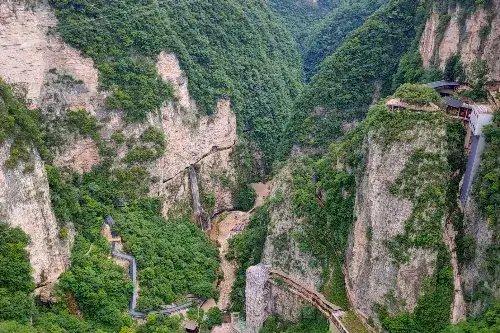
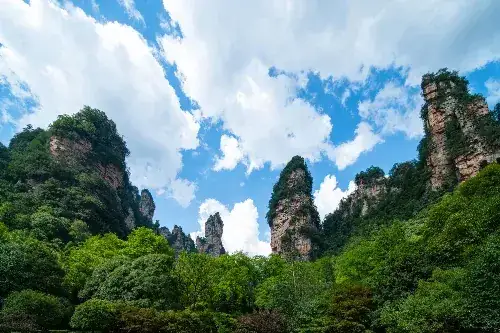
Xiangtan has 7 nature reserves covering 20,792.3 hectares, including Xiangxiang's Dongtaishan National Forest Park (340.5 hectares, 95.45% forest coverage, with 63 families and 187 woody plant species and over 1,000 herbaceous species), the Shuifumiao National Wetland Park (21,266 hectares with 147 families and 802 species of higher plants plus over 200 animal species including the nationally protected black stork), and the Zhaoshan Provincial Forest Park. Tourism centers on three themes: Red tourism (Shaoshan and the Peng Dehuai Memorial), green landscape tourism (Shuifumiao and Zhaoshan), and historical-cultural tourism (Qi Baishi).
Famous Specialties
Notable local products include Xiangtan lotus seeds, Shaziling pig, Hutian stone goat, Majiahe black goat, Xiangtan dwarf Chinese cabbage, and Jiuhua red choysum, several of which hold national agricultural geographical indication certifications.
Sister Cities
Xiangtan maintains international exchange relationships as part of its role within the Chang-Zhu-Tan urban agglomeration, fostering cross-border cooperation.
Notable Figures
Xiangtan has produced numerous prominent figures: revolutionary leader Mao Zedong, founding marshal Peng Dehuai, general Huang Gonglu, founding generals Chen Geng and Tan Zheng, artist Qi Baishi, musician Lyu Ji, poet Xiao San, the "Eight Li Brothers" (eminent scholars), and late Qing statesmen Wang Kaiyun and Yang Du -- all born in Xiangtan.
Honorary Titles
Xiangtan has been honored as China's Outstanding Tourism City, National Garden City, and National Civilized City. It was listed among the third batch of national new urbanization pilot zones in 2016 and ranked among China's top 100 cities for overall well-being in 2018. In 2021, it was recognized by the Hunan provincial government for outstanding governance, and in 2022, the Chang-Zhu-Tan urban agglomeration development plan was formally approved.
Travel information can change. Check current opening hours, reservations and entry requirements before you travel.
Traveller discussion
Start the conversation with a helpful tip or a question.