
Enshi Tujia and Miao Autonomous Prefecture
Enshi Tujia and Miao Autonomous PrefectureEnshi Tujia and Miao Autonomous Prefecture (abbreviated as Enshi Prefecture) is an autonomous prefecture under Hubei Province in southwestern Hubei, with a total area of 24,000 square kilometers. It
Enshi Tujia and Miao Autonomous Prefecture
Enshi Tujia and Miao Autonomous Prefecture (abbreviated as Enshi Prefecture) is an autonomous prefecture under Hubei Province in southwestern Hubei, with a total area of 24,000 square kilometers. It administers 2 county-level cities and 6 counties, with the government seated in Enshi City. As of 2025, the permanent population was 3.3523 million. Enshi has a subtropical monsoon mountainous humid climate. Traces of ancient humans dating back 2 million years have been found here. In 1983, the Exi Tujia and Miao Autonomous Prefecture was established and renamed in 1993. Enshi lies at the heart of the Wuling Mountain area, at the intersection of national strategies including the Yangtze River Economic Belt and Western Development. In 2025, the GDP reached 174.197 billion yuan (approximately US$24.0 billion). The prefecture is a national-level cultural ecology protection area where Ba culture, tusi culture, red revolutionary culture, and Tujia-Miao folk culture converge.
Name and Etymology
At the end of the Eastern Jin Dynasty, Huan Yuanzi built a city here, proclaimed himself King of Shi, and his descendants held the title until the Northern Zhou Dynasty. The Yuan Dynasty implemented the tusi (native chieftain) system. In 1729, Emperor Yongzheng renamed it Enshi County, meaning "imperial grace bestowed upon Shi County."
Historical Evolution
Pre-Qin Period
Over 2 million years ago, ancient humans left traces in the Enshi region. The "Jianshi Man" began primitive life in the Wuling Mountain area, creating early civilization with stone tools. During the Spring and Autumn period, the area belonged to the State of Ba; during the Warring States period, it was part of the State of Chu.
Qin, Han to Northern and Southern Dynasties
Under the Qin Dynasty, the area belonged to Qianzhong Commandery; under the Han, to Nan and Wuling commanderies. During the Three Kingdoms, it was first under Shu, then under Wu. Successive dynasties administered it through various commanderies including Jianping and Tianmen.
Sui, Tang to Song and Yuan Period
Under the Sui, the area belonged to Badong and Qingjiang commanderies. During the Yuan Dynasty, the tusi system was implemented in southern minority areas, establishing tusi such as Sanmao, Tangya, Jindong, Zhongjian, and Shinan.
Ming and Qing Dynasties
The Ming Dynasty maintained the tusi system in the southern region. In 1728, Emperor Yongzheng abolished the Shizhou Guard and established Enshi County. In 1735, Jianshi County was transferred to Shizhou, while Badong and Hefeng were placed under Yichang Prefecture.
Republic of China Period
In 1912, the Republic of China abolished prefectures and established circuits. The Jingnan Circuit was set up in 1915 governing six counties. In 1932, it was reorganized as the Tenth Administrative Inspection District, and in 1936 as the Seventh.
After the Founding of the People's Republic of China
On November 6, 1949, Enshi County was liberated. In 1955, it was renamed the Enshi Commissioner's Office. On August 19, 1983, the State Council approved establishing the Exi Tujia and Miao Autonomous Prefecture. In 1993, it was renamed Enshi Tujia and Miao Autonomous Prefecture. Since 2005, the prefecture day has been celebrated on August 19.
Administrative Divisions
As of July 2026, Enshi Prefecture administers Enshi City, Lichuan City, Jianshi County, Badong County, Xuan'en County, Laifeng County, Xianfeng County, and Hefeng County. The government is seated at No. 21, Lane 1, Wuyang Avenue, Enshi City.
Geographical Environment
Location and Territory
Enshi is located in southwestern Hubei, between 108 degrees 23 minutes and 110 degrees 38 minutes east longitude, and 29 degrees 7 minutes and 31 degrees 24 minutes north latitude. The total area is 24,111 square kilometers, measuring 220 kilometers east-to-west and 260 kilometers north-to-south.
Climate
Enshi has a subtropical monsoon mountainous humid climate with four distinct seasons, warm winters, and cool summers. The average annual temperature is 16.2 degrees Celsius, with 1,232.2 hours of sunshine and a frost-free period of 200 to 300 days. Average annual precipitation is 1,600 millimeters.
Geology
Enshi is located at the southern end of the Neocathaysian third uplift belt. Carbonate rocks cover about two-thirds of the total area. The geological structure is complex, with multiple tectonic systems converging.
Topography and Landforms
The terrain is predominantly mountainous. The highest point is Dawokeng on Shennongjia in Badong at 3,032 meters; the lowest is Hongmiao Ling along the Yangtze in Badong at 66.8 meters. Average elevation is 1,000 meters. The landscape features stepped topography with five levels of planation surfaces.
Hydrology and Water Conservancy
Enshi has approximately 400 rivers over 5,000 meters in length across five water systems: the upper Yangtze, Qingjiang, Youshui, Wujiang, and Lishui. The Qingjiang River flows 278 kilometers through the prefecture with a drainage area of 10,860 square kilometers. As of 2023, the prefecture has 262 reservoirs including 32 large and medium-sized ones.
Soil
The prefecture has 11 soil types. Yellow-brown soil accounts for 56.19% of the total area, with altitudinal zonation transitioning from yellow soil below 800 meters to brown soil above 1,500 meters. Most soils are slightly acidic.
Natural Disasters
Enshi is prone to mountain floods, geological disasters, and extreme weather. In June 2015, severe rainstorms affected Jianshi, Enshi, and Xuan'en, causing 124,698 people affected and direct economic losses of 50.993 million yuan (approximately US$7.0 million).
Natural Resources
Water Resources
Enshi has abundant water resources with an average annual total of 22.42 billion cubic meters. There are 382 rivers over 5,000 meters in length. Average annual groundwater resources amount to 6.249 billion cubic meters, primarily carbonate karst water.
Land Resources
Enshi's total land area accounts for about 13% of Hubei Province, ranking third among provincial cities and prefectures. It has 2.18 million hectares of agricultural land and 1.6588 million hectares of forest land, over three times the cultivated land area of 452,600 hectares.
Mineral Resources
Over 70 mineral types have been discovered with 38 having proven reserves. Key minerals include natural gas, coal, iron ore, pyrite, phosphate, and selenium. Lichuan's Jiannan is the only natural gas field in Hubei. Enshi is renowned for its selenium ore and chrysanthemum stone.
Biological Resources
As of 2023, the prefecture has 4,011 vascular plant species across 219 families, including 6 species under national first-class protection such as dawn redwood and dove tree. Forest coverage reached 67% as of 2024. There are 578 terrestrial vertebrate species, including 18 under national first-class protection. The prefecture has 34 nature reserves covering 2,425 square kilometers. Xingdoushan National Nature Reserve is an important species gene bank, and Qimei Mountain National Nature Reserve was selected as one of the world's best nature reserves in 2023.
Politics
The prefecture operates under the ethnic autonomous prefecture system with a People's Congress and prefecture government, following the system of regional ethnic autonomy established by Chinese law.
Population
Population Size
As of 2025, the permanent population was 3.3523 million with an urbanization rate of 52.33%. The registered population was 3.9464 million. Annual births numbered 16,700 and deaths 28,400.
Ethnic Groups
Enshi is a minority area with concentrated Tujia and Miao populations and scattered Dong, Bai, Mongolian, and Hui groups. The Tujia are mainly south of the Qingjiang River in Laifeng, Hefeng, Xianfeng, Xuan'en, and Lichuan. The Miao are concentrated in Lichuan, Laifeng, Xuan'en, and Xianfeng, accounting for 90.8% of the prefecture's Miao population. The Dong are found in mountainous areas of Xuan'en, Enshi, and Xianfeng.
Language
The Enshi dialect belongs to the Chengdu-Chongqing branch of Southwestern Mandarin, essentially a variant of Sichuan dialect. It shows Tujia and Miao influences. Areas bordering Sichuan show stronger Sichuan dialect features; areas bordering Hunan show Hunan influences. The Tujia and Miao historically had spoken languages but no scripts, and most now use Chinese.
Religious Beliefs
Buddhism, Daoism, Catholicism, Christianity, and Islam all have followers, totaling approximately 100,000 believers. As of 2020, there were 18 religious venues and 43 clergy. Traditional beliefs include nature, totem, and ancestor worship. The Tujia venerate three tusi kings surnamed Qin, Tian, and Xiang; the Miao worship ancestor "Apu Chiyou."
Economy
Overview
Enshi is at the 30-degree north latitude "golden tea belt," at the intersection of the Yangtze River Economic Belt, Western Development, and Central China Rise strategies. It enjoys the reputation of "World Selenium Capital" and "Central China Medicine Treasury." In 2025, GDP reached 174.197 billion yuan (approximately US$24.0 billion), up 5.7%. The industrial structure ratio was 17.9:22.7:59.4. Per capita GDP was 51,772 yuan (approximately US$7,142). Local fiscal revenue totaled 21.405 billion yuan (approximately US$2.95 billion).
Primary Industry
The eight major industries of tea, tobacco, vegetables, medicine, fruit, livestock, grain, and honey have formed a complete chain. The prefecture has 7 million mu of specialty agricultural bases. In 2025, farming and related added value reached 32.939 billion yuan (approximately US$4.54 billion). Total grain output was 1.4674 million tons and tea output 143,800 tons. Products are exported to 53 countries.
Secondary Industry
Six pillar industries each exceed ten billion yuan, including clean energy, selenium product processing, biopharmaceuticals, green building materials, electronic information, and modern tobacco. In 2025, industrial added value reached 30.446 billion yuan (approximately US$4.20 billion), with above-scale industrial growth of 11.8%. High-tech manufacturing grew 36.7%. Construction output was 13.853 billion yuan (approximately US$1.91 billion).
Tertiary Industry
The service sector is the main growth engine. In 2025, wholesale and retail added value was 13.769 billion yuan (approximately US$1.90 billion). Retail sales of consumer goods reached 101.768 billion yuan (approximately US$14.04 billion). Foreign direct investment was US$31.47 million, and foreign trade was 5.81 billion yuan (approximately US$801 million). Banking deposits reached 275.092 billion yuan (approximately US$37.9 billion).
Economic Functional Zones
As of 2022, the prefecture has 8 development zones including Enshi Xidu Industrial Park and Hubei Lichuan Economic Development Zone. The Enshi High-tech Industrial Park was established in 2017, covering approximately 81.77 square kilometers.
Social Services
Education
As of 2025, the prefecture has 570 kindergartens, 423 primary schools with 213,900 students, 206 secondary schools with 221,200 students, 12 vocational schools, and 3 universities with 64,600 students.
Science and Technology
In 2025, high-tech industry added value reached 8.734 billion yuan (approximately US$1.20 billion), 5.0% of GDP. The prefecture received 1,376 patent grants including 90 invention patents, and had 53,200 valid registered trademarks and 528 technology service platforms.
Cultural Affairs
The prefecture has 9 public libraries, 9 cultural centers, and 8 museums with 1.7589 million visitors. Broadcast coverage reached 99.95% and television 99.96%. There were 137 above-scale cultural enterprises with revenue of 7.456 billion yuan (approximately US$1.03 billion).
Healthcare
The prefecture has 2,473 medical institutions including 73 hospitals. There are 30,200 health professionals, including 11,700 physicians and 14,600 nurses. Total beds number 26,000.
Sports
The prefecture hosted the China Road Cycling Open and "Village BA" Central Region finals. The Enshi Ethnic Sports School, established in 1986, has trained Paralympic champion Tian Longbing, world shooting champion Tong Xin, and judo Asian champion Tan Fafang.
Social Security
As of 2025, 730,900 people participated in urban employee pension insurance and 3.4415 million in basic medical insurance. There are 5,000 urban and 121,300 rural minimum living allowance recipients. The prefecture has 144 residential social service institutions with 18,700 beds.
Transportation
Overview
Enshi is called the "throat of Sichuan and barrier of Jingchu." A "highway-railway-air" integrated network has been built. As of 2025, total highway mileage reached 32,757.48 kilometers including 673 kilometers of expressways. Railway mileage was 341 kilometers. Enshi Airport handled 16,010 flight movements.
Highways
In 1949, Badong had only one 56-kilometer road. The Shanghai-Chongqing Expressway opened in 2010. By 2023, total highway mileage reached 31,465 kilometers with 625 kilometers of expressways, achieving county-to-county expressway connectivity. There are 7 national highways totaling 1,509 kilometers.
Railways
The Yiwan Railway opened in 2010, connecting Yichang and Chongqing. In June 2022, the Zhengzhou-Chongqing high-speed railway began service from Badong East, marking Enshi's entry into the high-speed rail era. The prefecture has 6 railway stations with 341 kilometers of operating mileage.
Aviation
Enshi Airport, established in 1958, is one of the earliest airports in Hubei. In 2023, it operated 19 domestic routes to 23 cities. By July 2024, annual passenger throughput exceeded 1 million for the first time.
Water Transport
The prefecture has 24 navigable rivers with 590 kilometers of total navigable mileage. Badong Port and Enshi Port on the Qingjiang River are listed as important ports in Hubei, forming a network with Hefeng, Laifeng, and Xianfeng ports.
Public Transportation
As of 2022, the prefecture added 509 new energy buses, with 72% of the fleet being new energy vehicles, leading the province. Smart systems include real-name ticketing, 4G vehicle monitoring, and Beidou positioning for ferries. Enshi City's transit card achieved nationwide interoperability.
Culture and Humanities
Overview
Enshi has rich ethnic cultural resources including Ba culture, tusi culture, red revolutionary culture, and Tujia-Miao folk culture. The Tangya Tusi City Site is a World Heritage Site inscribed in 2015. The prefecture was part of the Western Hubei and Hunan-Hubei-Sichuan-Guizhou revolutionary base areas.
Cuisine
Enshi's cuisine reflects the fusion of Tujia, Miao, and other ethnic food traditions, creating a distinctive culinary system unique to this multi-ethnic region.
Customs
The Enshi Daughters' Fair, originating over 400 years ago, is a "living fossil" of Tujia folk culture known as the "Valentine's Day of the Tujia people." The Yueban Festival features gatherings, singing, and dancing on the 12th day of the 7th lunar month. Ganbang is a traditional autumn-to-spring hunting activity. Zajiuya (sipping wine) is an ancient Tujia wine custom. The Niuwang Festival (Ox King Festival) honors cattle and was listed as provincial intangible cultural heritage in 2013.
Arts
Lichuan Dengge (Lantern Song), with over 300 years of history, was listed as national intangible cultural heritage in 2011. The Tujia Eight-Treasure Copper Bell Dance is popular in the Youshui River basin. Xuan'en Shuashua is a folk dance recognized as provincial heritage, characterized by humorous duet performances.
Regional Symbols
The prefecture tree is the dawn redwood (Metasequoia), a rare relict "living fossil." The world's only community of over 5,000 dawn redwood mother trees is in Zhonglu, Lichuan. The prefecture flower is the dove tree (Davidia involucrata), a Tertiary relict endemic to China.
Historical Sites and Monuments
The prefecture has 1 World Cultural Heritage site, 9 national key protection units, and 89 provincial-level units. The Tangya Tusi City Site in Xianfeng, covering 80 hectares, was inscribed on the World Heritage List in 2015. The Dashui Well Ancient Building Complex in Lichuan is a national key protection unit.
Intangible Cultural Heritage
The prefecture has 1 world, 16 national, 66 provincial, and 142 prefecture-level intangible cultural heritage items. Notable heritage includes Tujia brocade (Xilankapu), a handwoven textile dating from the Qin and Han dynasties; Enshi Bench Dragon; and Nanju opera, listed as national heritage in 2008 with a repertoire of 980 plays.
Scenic Spots
Overview
In 2023, the prefecture had 41 A-level tourist attractions including 3 at 5A and 23 at 4A, receiving 85.9057 million visitors. Xianfeng Pingba Camp was selected as a national "summer tourism destination," and Lichuan was rated a preferred summer tourism city.
Key Attractions
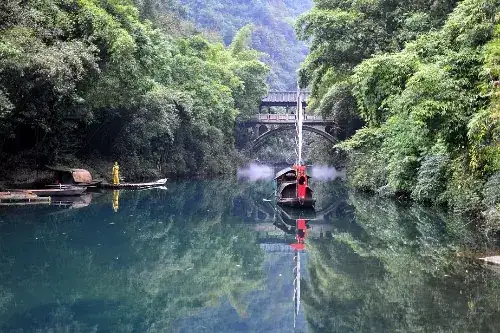
Enshi Grand Canyon, a 5A scenic area spanning 108 kilometers, is renowned as a "world geological wonder" and "natural museum of karst landforms." Enshi Tusi City showcases Tujia, Miao, and Dong architectural arts. Tenglong Cave, a 5A area and national geological park, is one of the world's largest caves with 59.8 kilometers explored. Shennongxi (Shennong Stream), a 5A area, flows 60 kilometers from Shennongjia into the Yangtze. Suobuya Stone Forest, a 4A area formed 460 million years ago, features unique karst landscapes.
External Exchange
The prefecture maintains external exchange programs and sister-city relationships to promote regional cooperation and cultural exchange.
Notable Figures
The prefecture has produced outstanding athletes through the Enshi Ethnic Sports School, including Paralympic champion Tian Longbing, world shooting champion Tong Xin, judo Asian champion Tan Fafang, and national kayaking champion Li Tiantian.
Major Honors
Enshi Prefecture has received numerous national and provincial honors for cultural heritage preservation, ecological protection, tourism development, and ethnic unity.
Travel information can change. Check current opening hours, reservations and entry requirements before you travel.
Traveller discussion
Start the conversation with a helpful tip or a question.