
Huanggang City
Huanggang CityHuanggang City, formerly known as Huangzhou, is a prefecture-level city in Hubei Province, located between 114°24′–116°07′E longitude and 29°45′–31°40′N latitude. Situated in eastern Hubei at the southern foot of the Dabie Mou
Huanggang City
Huanggang City, formerly known as Huangzhou, is a prefecture-level city in Hubei Province, located between 114°24′–116°07′E longitude and 29°45′–31°40′N latitude. Situated in eastern Hubei at the southern foot of the Dabie Mountains on the north bank of the middle Yangtze River, it borders Henan to the north, Anhui to the east, and faces Ezhou, Huangshi, and Jiujiang across the river to the south. The total area is 17,457.20 square kilometers. As of April 2024, Huanggang administers one municipal district, seven counties, and two county-level cities. As of the end of 2025, the permanent population was 5.75 million. Huanggang features a subtropical monsoon climate and has been inhabited since the Paleolithic era. On December 23, 1995, the State Council approved establishing the prefecture-level Huanggang City, with its seat in Huangzhou. Located at the junction of Hubei, Henan, Anhui, and Jiangxi provinces, it is an important component of the Wuhan Metropolitan Circle and was the center of the Hubei-Henan-Anhui Revolutionary Base Area. In 2025, Huanggang's GDP reached 330.359 billion CNY (approximately 45.9 billion US dollars), up 5.1%, with the three-sector structure at 17.5:32.3:50.2.
History
Name Origin
Huanggang derives its name from Mount Huanggang. According to the Huangzhou Prefecture Gazetteer from the Ming Dynasty Hongzhi reign (1501): "Mount Huanggang is south of the prefectural city." In 598 CE, Huanggang County was established, named after the ancient State of Huang. During the Qing Dynasty it was called Gulougang. The mountain is located near Anguo Temple in present-day Huangzhou District.
Administrative Evolution
Huanggang has been inhabited since the Paleolithic era. During the Xia and Shang period, this region was the territory of Gao Yao's descendants (present-day Yingshan and Lu'an). During the Spring and Autumn and Warring States periods, it belonged to the State of Chu.
After Qin unified the six states, the area was divided between Nan and Jiujiang commanderies, later under Hengshan Commandery. During the Chu-Han conflict, Xiang Yu established the Kingdom of Hengshan with its capital at Zhucheng (present-day Huangzhou). In 121 BCE, Emperor Wu of Han established Jiangxia Commandery. During the Eastern Han, Qichun Marquisate was established in 47 CE. During the Three Kingdoms, the area was split between Wei's Yiyang Commandery and Wu's Qichun Commandery.
During the Southern and Northern Dynasties, Northern Qi established Bazhou (present-day Huangzhou) and Northern Zhou renamed Luozhou as Qizhou and Nansi Prefecture as Huangzhou. During the Sui and Tang, Huangzhou and Qizhou were established as commanderies. During the Ming Dynasty in 1368, they became Huangzhou and Qizhou prefectures, merging under Huangzhou by 1378. The Qing Dynasty largely followed Ming precedents, with Huangzhou Prefecture coming under Hubei Provincial Administration in 1664.
During the Republic of China period, Huangzhou Prefecture was abolished in 1912. In 1932, the region was divided into administrative inspection districts. During the War of Resistance Against Japan, the Hubei-Henan Border Anti-Japanese Base Area was established. After the PRC's founding in 1949, the Huanggang Administrative Office was created. On December 23, 1995, the State Council established the prefecture-level Huanggang City with Huangzhou District and Tuanfeng County.
Administrative Divisions
As of April 2024, Huanggang administers one district, seven counties, and two county-level cities: Hong'an, Luotian, Yingshan, Xishui, Qichun, Huangmei, and Tuanfeng counties, plus Wuxue and Macheng cities, and Huangzhou District. Additional zones include the Longgan Lake Management Area, Huanggang High-tech Zone, Huanggang Airport Economic Zone, and Bailian River Demonstration Area. The municipal government is at No. 8 Qiyi Road, Huangzhou District.
Geography and Environment
Location and Boundaries
Huanggang is in eastern Hubei at the southern foot of the Dabie Mountains on the north bank of the middle Yangtze. The municipal seat is 78 km west of Wuhan. The total area of 17,457.20 square kilometers accounts for 9.4% of Hubei's territory, with 12.2% plains, 10.3% terraced land, 43.3% hills, and 34.2% mountains.
Topography
The terrain slopes from north to south. The Dabie Mountains form the northeastern boundary with 96 peaks above 1,000 meters. The highest point, Tiantangzhai's main peak on the Luotian-Yingshan border, reaches 1,729 meters. The central hills are mostly below 300 meters, and the southern plain-lake district sits at 10–30 meters.
Climate
Huanggang has a subtropical continental monsoon climate with a Jianghuai microclimate. Average annual temperature is 15.7–17.1 degrees Celsius, with 237–278 frost-free days and 1,223–1,493 mm of annual rainfall.
Hydrology and Water Conservancy
Six major river systems — the Daoshui, Jushui, Bahe, Xishui, Qishui, and Huayang — originate in the Dabie Mountains and flow south into the Yangtze, which traverses 215.5 km through the city. Huanggang has 38 lakes over 30 hectares, 3,731 tributaries, and 1,237 reservoirs with a total capacity of 5.063 billion cubic meters.
Natural Disasters
Huanggang experiences floods, droughts, earthquakes, and autumn cold. The Dabie Mountains block cold air from the north while lifting warm moist air, causing heavy rainfall. Since 1959, 19 years saw region-wide flooding and 18 major droughts occurred.
Natural Resources
Water Resources
Total water resources amount to 8.47045 billion cubic meters. Theoretical hydropower potential is 464,000 kilowatts, with 348,000 kilowatts developable and annual generation of 960 million kilowatt-hours.
Land Resources
In 2019, Huanggang had 448,240 hectares of cultivated land, including 328,300 hectares of paddy fields.
Mineral Resources
Huanggang has 46 mineral types across 249 deposits. Phosphate ore reserves total 22.186 million tons (mainly Huangmei and Wuxue), and fluorite exceeds 2.6 million tons (mainly Hong'an). Five rivers contain about 100 million tons of yellow sand, the largest such base on the middle and lower Yangtze. Metallic minerals include iron, copper, lead, zinc, gold, and silver.
Biological Resources
Huanggang has 61 nature reserves covering 177,600 hectares (10.2% of the city). It hosts 1,487 wild plant and 634 wild animal species, making it central China's best-preserved biological gene bank. Forest coverage is 32.4%, with 575 woody plant species including 41 rare ones.
Geothermal Resources
Huanggang has abundant geothermal resources, with 10 sites discovered as of 2024. Key sites include Tanghe in Yingshan and Sanlidian in Luotian, with developable reserves of about 11.02 million cubic meters per year.
Population
Population Size
As of November 1, 2020, the permanent population was 5,882,719, down 4.53% from 2010's 6,162,069. As of end-2025, it was 5.75 million, with 3.0429 million urban and 2.7071 million rural residents, yielding 52.92% urbanization.
Ethnic Groups
The population is predominantly Han Chinese, with 45 ethnic minorities. Seven groups — Tujia, Zhuang, Hui, Miao, Kazakh, Li, and Tu — each have over 200 members.
Religion
Major religions include Buddhism, Daoism, Christianity, Catholicism, and Islam. As of 2016, there were 20 religious organizations, 807 registered clergy, and 538 activity sites. The Wuzu Temple in Huangmei County, renowned since the Tang Dynasty, is known as the "Ancestral Court of the World."
Politics
The city is governed by the Huanggang Municipal People's Government based in Huangzhou District, overseeing ten county-level units and multiple special management zones.
Economy
Overview
In 2024, GDP was 321.665 billion CNY (approximately 44.7 billion US dollars), up 6.2%. Primary industry added 60.648 billion CNY (approximately 8.4 billion US dollars); secondary industry 106.279 billion CNY (approximately 14.8 billion US dollars); tertiary industry 154.738 billion CNY (approximately 21.5 billion US dollars).
In 2025, GDP reached 330.359 billion CNY (approximately 45.9 billion US dollars), up 5.1%. Primary industry added 57.944 billion CNY (approximately 8.0 billion US dollars); secondary industry 106.752 billion CNY (approximately 14.8 billion US dollars); tertiary industry 165.663 billion CNY (approximately 23.0 billion US dollars). The structure shifted to 17.5:32.3:50.2.
In 2024, fixed-asset investment grew 3.3% across 2,762 projects totaling 412.166 billion CNY (approximately 57.2 billion US dollars). Budget revenue was 18.803 billion CNY (approximately 2.6 billion US dollars), up 5.8%. Livelihood spending was 59.4 billion CNY (approximately 8.25 billion US dollars), or 83.0% of the budget.
Primary Industry
In 2025, agricultural output value was 105.407 billion CNY (approximately 14.6 billion US dollars), up 3.5%. Grain output was 2.7518 million tons from 5.949 million mu. Animal husbandry output was 22.845 billion CNY (approximately 3.2 billion US dollars), with pig slaughter at 5.0397 million head.
Secondary Industry
In 2025, there were 1,806 above-scale industrial enterprises, with value added up 7.1%. Manufacturing grew 8.7%; mining 2.5%; power and utilities fell 4.3%. Construction had 998 enterprises with output of 82.495 billion CNY (approximately 11.5 billion US dollars), down 16.3%.
Tertiary Industry
In 2025, retail sales reached 172.712 billion CNY (approximately 24.0 billion US dollars). Foreign trade was 15.71 billion CNY (approximately 2.18 billion US dollars), down 12.1%. Contract foreign investment was 90.37 million US dollars, up 1189.16%. Bank deposits reached 663.283 billion CNY (approximately 92.1 billion US dollars) and loans 411.099 billion CNY (approximately 57.1 billion US dollars). Insurance premiums were 14.419 billion CNY (approximately 2.0 billion US dollars).
Social Affairs
Education
In 2025, Huanggang had 1,940 schools with 1.0197 million students, including 977 kindergartens, 629 primary schools, 239 junior highs, 62 senior highs, 17 vocational schools, and 4 universities including Huanggang Normal University.
Science and Technology
High-tech industry value added was 48.12 billion CNY (approximately 6.7 billion US dollars), 14.6% of GDP. The city had 6 provincial research institutes, 3 provincial key laboratories, and 4,337 patents authorized.
Culture
Huanggang has 12 mass art centers, 12 public libraries with 6.597 million books, and 21 museums with 170,500 collections. Radio coverage is 99.74% and television 99.69%.
Healthcare
As of end-2025, Huanggang had 4,177 medical institutions including 101 hospitals. There were 41,543 health professionals and 47,947 hospital beds.
Sports
In 2024, the Huanggang Marathon and Dabie Mountains series became influential regional events. Athletes won 59 gold and 158 total medals at provincial competitions.
Social Security
In 2025, 67,400 new urban jobs were created. Pension insurance covered 1.1268 million urban employees and 3.5722 million rural residents. Medical insurance covered 5.1782 million. Social assistance funds of 1.68 billion CNY (approximately 233 million US dollars) were distributed to 172,100 minimum-living-allowance recipients and 53,400 special-assistance recipients.
Transportation
Overview
Huanggang is served by the Yangtze waterway, three airports (Wuhan Tianhe, Jiujiang, Ezhou Huahu), seven railways including the Beijing-Kowloon line, seven Yangtze bridges, and eight expressways.
Highways
As of end-2024, total highway mileage was 35,300 km including 798.7 km of expressways and 6,642 bridges. Freight volume was 236.3221 million tons.
Railways
In April 2022, the Huangzhou-to-Huangmei high-speed railway opened, bringing high-speed rail to Dabie Mountain counties. By 2023, 20.7 km of new railway was added.
Aviation
In July 2024, the first "Huanggang-made" goods flew directly to Chicago via the Huahu flight, marking the Ezhou Huahu International Airport Huanggang Cargo Station's official operation.
Historical Culture
Overview
With over 2,000 years of history, Huanggang produced Chan Buddhist patriarchs Daoxin, Hongren, and Huineng; Bi Sheng (movable type printing); Li Shizhen (author of Compendium of Materia Medica); geologist Li Siguang; poet Wen Yiduo; philosopher Xiong Shili; and Wang Ya'nan (translator of Das Kapital).
Huanggang Dialect
Huanggang's linguistic classification is disputed. Zhao Yuanren grouped it with Xiaogan as "Chu language." Yuan Jiahua placed it in Southwestern Mandarin. The Language Atlas of China classifies it as Jianghuai Mandarin (Huangxiao subgroup).
Cuisine
Specialties include Wuxue Crispy Sugar (said to relieve coughs), Huangzhou Dongpo Pork (created by Su Shi during his Huangzhou exile), Huangzhou Shaomei pastry, Tuanfeng "Dog's Paw" pastry, Xishui Crab Roe Tofu, Xishui Nine-Hole Lotus Root Powder (a tribute product since the Ming-Qing era), Qichun Sour Rice Noodles (200 years of traditional fermentation), Luotian Dabie Mountain Hanging Pot, and Macheng Meat Cake.
Customs
Dragon boat racing during the Dragon Boat Festival is a long tradition in Huangmei County. The Shuangfeng Mountain Temple Fair commemorates Chan patriarch Daoxin on the third lunar month's third day; he distributed mustard-green rice cakes to prevent spring epidemics, a practice still observed.
Arts
Theatrical genres include Huangmei Opera, Chu Opera, Han Opera, Tea-Picking Opera, and Dongqiang Opera (a national intangible cultural heritage). Folk crafts include Huangmei cross-stitch, Hong'an embroidery, Yingshan flower-wrapping, and Qichun Guanyao pottery.
City Symbols
City trees: Zelkova and Ginkgo. City flowers: Plum blossom and Azalea.
Scenic Spots
Overview
As of end-2022, Huanggang had one 5A-level, 23 4A-level, and 101 total A-level scenic areas, plus the Hubei Huanggang Dabie Mountains Global Geopark.
Important Attractions
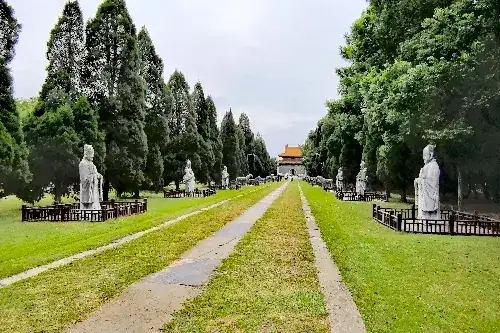
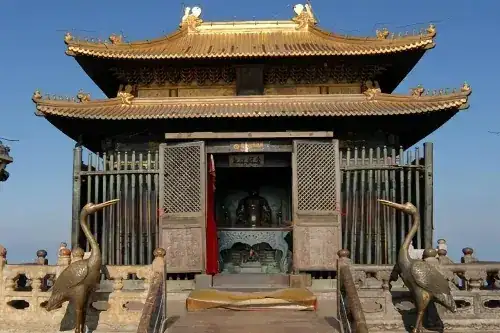
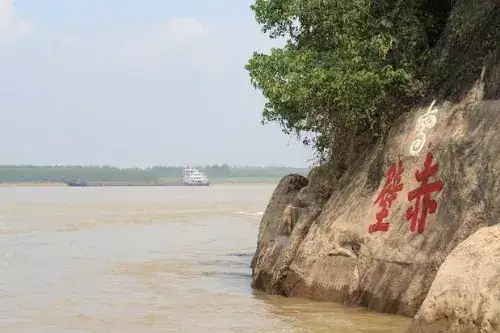
Yi'ai Lake National Wetland Park, named after Su Dongpo's Record of the Yi'ai Pavilion, sits in the city center. Luotian Tiantangzhai Scenic Area covers 42.8 square km with peaks reaching 1,729 meters. The Dabie Mountains Main Peak Scenic Area in Yingshan features primeval forests and seven natural wonders. Bodaofeng in Luotian, at 1,404 meters, preserves Wei-Jin and Ming dynasty sites. Dongpo Red Cliff, a National Key Cultural Relic Protection Unit, inspired Su Shi's famous odes. Taohuachong in Yingshan rises to 1,698.7 meters, the Dabie range's second-highest peak. Sanjiao Mountain in Xishui has 28 peaks and 156 attractions.
External Exchange
Sister cities include Piaseczno, Poland (2010); Imus, Philippines (2012); Cannaland, South Africa (2014); Yorba Linda, USA (with Hong'an County, 2014); Osijek, Croatia (2018); Westland, New Zealand (2018); Bamenda, Cameroon (with Hong'an County, 2019); and Weifang, China (2020).
Notable Figures
Huanggang produced Chan Buddhist patriarchs Daoxin, Hongren, and Huineng; Bi Sheng, inventor of movable type printing; Li Shizhen, author of the Compendium of Materia Medica; geologist Li Siguang; poet Wen Yiduo; and philosopher Xiong Shili, among many others.
Honors and Titles
Huanggang holds titles including National Health City, Chinese Calligraphy City, National Garden City, and National Double Support Model City. In April 2025, it was again awarded "National Double Support Model City (County)."
Travel information can change. Check current opening hours, reservations and entry requirements before you travel.
Traveller discussion
Start the conversation with a helpful tip or a question.