
Jingmen
JingmenJingmen, also known as the "Gateway of Jingchu," is located in central Hubei Province. As a prefecture-level city, it lies between 111°51'–113°29' E longitude and 30°32'–31°36' N latitude, covering a total land area of 12,400 square
Jingmen
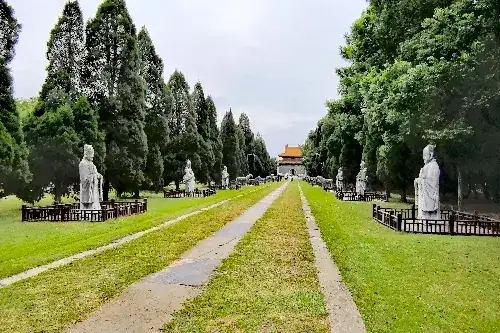
Jingmen, also known as the "Gateway of Jingchu," is located in central Hubei Province. As a prefecture-level city, it lies between 111°51'–113°29' E longitude and 30°32'–31°36' N latitude, covering a total land area of 12,400 square kilometers. As of April 2026, Jingmen administers one county, two districts, and two county-level cities. As of end-2025, the resident population was 2.5343 million. The local dialects fall into two categories: Southwestern Mandarin and Northern dialect. Jingmen has a subtropical monsoon climate with an average annual temperature of 16.7°C and average annual precipitation of 961.8 mm. The terrain is high on three sides (east, west, and north) and low in the center and south, forming a southward-opening basin with low mountain valleys, rolling hills, and plain lake areas. Jingmen is a historically and culturally renowned city in Hubei, a major national energy and chemical industry base, and a national circular economy demonstration city. It has one national-level high-tech industrial development zone and five pillar industries: equipment manufacturing, renewable resource utilization and remanufacturing, electronic information, new energy and new materials, and the health industry. Jingmen boasts profound cultural heritage, having nurtured the Qujialing Culture—the oldest civilization in the middle Yangtze River basin—and Lao Laizi, one of the founders of Daoism. The Guodian Chu Slips, which profoundly influenced ancient Chinese intellectual history, were unearthed here. The city is home to the Mingxian Mausoleum, a UNESCO World Heritage Site and national 5A tourist attraction. In 2025, Jingmen's regional GDP reached 260.226 billion CNY (approximately $36.1 billion USD), a year-on-year increase of 6.2%.
Name Origin
At the southern end of the Jingshan mountain range's tail, there is a mountain whose "peaks stand facing each other, with the top open and the bottom closed, shaped like a gate," resembling the gate of Jingshan. It was thus called Jingmen Mountain, and the place name Jingmen derives from this mountain.
Historical Evolution
Pre-Qin Period
Jingmen has a long history dating back to the Neolithic Age, when people settled along the Han River, Changhu Lake, and Zhanghe River systems. During the Xia and Shang dynasties (c. 21st–11th century BCE), Jingmen belonged to the Jingzhou region. Around the 12th century BCE, descendants of Shang King Wuding established the State of Quan on the west bank of the Han River (present-day Maliang Town, Shayang County), regarded as the "first county in ancient China." During the Spring and Autumn and Warring States periods, the Chu people expanded southward, eventually conquering the states of Ran and Quan. Under King Wen of Chu (689 BCE), the Chu capital was established at Ying (present-day Jinan City, Jiangling), making Jingmen a close suburb of the Ying capital, with Zhongxiang serving as a secondary capital.
Qin-Han to Northern and Southern Dynasties
In 278 BCE, Qin general Bai Qi captured Ying and established Nanjun Commandery, setting up Dangyang County in present-day southern Jingmen. During the Western Han, Bian County was established in northern Jingmen, and Dangyang County was placed in the southern suburbs. Wang Mang elevated Bian County to Nanshun Commandery. The Eastern Jin established Wuning Commandery at Bian County. During the Southern and Northern Dynasties, Changning Commandery was renamed Yongning Commandery.
Sui-Tang to Song-Yuan Period
In 805 CE, Emperor Dezong of Tang established Jingmen County by splitting Changlin County—the origin of the name Jingmen. In 940 CE, the Later Jin established Jingmen Military Prefecture. During the Northern Song (972 CE), both Dangyang County and Jingmen Military Prefecture were re-established. In 1277 CE, the Yuan dynasty elevated Jingmen Military Prefecture to Jingmen Prefecture.
Ming-Qing Period
In 1376 CE, the Ming dynasty reduced Jingmen Prefecture to Jingmen County. In 1531 CE, Jingmen was reassigned to Chengtian Prefecture (present-day Zhongxiang). In 1791 CE, the Qing dynasty elevated Jingmen to a directly governed prefecture under Hubei's provincial administration, overseeing Dangyang and Yuan'an counties.
Republic of China Period
In 1912, Jingmen Directly Governed Prefecture was reduced to Jingmen County under Xiangyang Circuit. In February 1949, Jingmen was liberated.
After the Founding of the PRC
After the founding of the People's Republic of China, Jingmen remained a county. In 1979, the original Jingmen County was split into Jingmen City and Jingmen County. In 1983, they were merged into the prefecture-level Jingmen City, with Dongbao and Shayang districts established. In 1996, Jingshan County and Zhongxiang City were transferred to Jingmen. In 2001, Duodao District was established. In 2016, Jingmen High-Tech Zone and Duodao District implemented integrated development. In 2018, Jingshan County was abolished and replaced by county-level Jingshan City.
Natural Geography
Location and Territory
Jingmen is located in central Hubei Province, in the hilly terrain of northern Hubei at the southern foot of Mt. Dahong, within the Han River basin. It spans 111°51'–113°29' E and 30°32'–31°36' N, with a maximum east-west span of 155 km and north-south span of 131 km. The total land area is 12,400 square kilometers, accounting for 6.67% of Hubei's total.
Climate
Jingmen has a subtropical monsoon climate with an average annual temperature of 16.7°C and average annual precipitation of 961.8 mm. Precipitation is concentrated from May to September (60%–70% of annual total). In 2023, the average temperature reached a historic high of 17.7°C, with annual precipitation of 825.8 mm, 14.1% below the multi-year average.
Geology
The northeastern areas of Zhongxiang and Jingshan feature folded fault-block mountains composed of Paleozoic and Mesozoic carbonate and clastic rocks. The northwestern Dongbao District consists mainly of Permian-Triassic limestone. The central and southern areas along the Han River lie within Cenozoic subsidence basins.
Topography
The terrain features low mountains, hills, ridges, and plain lake areas. The highest point is Zhaigongyan in Kedian Town, Zhongxiang City, at 1,050 meters. The lowest point is the bed of Changhu Lake in Shayang County and the riverbed at Panjiawan, Yonglong Town, Jingshan, at 27 meters.
Hydrology and Water Conservancy
The Han River, the largest river in the territory, flows north to south through 154 km, with a basin area of 9,362 square kilometers (76% of the city's total). The city has 756 reservoirs (7 large, 31 medium, 718 small), 797 water gates, and 741 pumping stations. Total water storage and diversion capacity is 5.3 billion cubic meters.
Soil
Jingmen's zonal soil is yellow-brown earth. The city's soils fall into five major categories: paddy soil, yellow-brown earth, purple soil, limestone soil, and alluvial soil, with the first four accounting for over 96% of the total land area. The northern hills are composed mainly of purple soil and sandstone, while the southern plains feature extensive alluvial soil.
Natural Resources
Water Resources
The multi-year average total water resources amount to 4.182 billion cubic meters, with surface water resources of 4.0752 billion cubic meters and groundwater resources of 1.48981 billion cubic meters. The average water production coefficient is 0.189.
Land Resources
According to the 2023 land survey, the total land area is 1,233,951.35 hectares, including 496,484.64 hectares of cultivated land, 418,352.26 hectares of forest land, 103,263.21 hectares of urban-industrial land, and 156,014.86 hectares of water areas.
Mineral Resources
Over 50 mineral species have been identified, including phosphate rock (577.658 million tons, 3rd in the province), gypsum (1,413.801 million tons, 1st in the province), and cement-grade limestone (1,410.967 million tons, 1st in the province). Geothermal resources have been identified at four locations with water temperatures of 26°C–60°C.
Biological Resources
The city has over 300 terrestrial wildlife species, including over 200 bird species. Nationally protected species include the Chinese merganser (Class I) and golden pheasant (Class II). Forest coverage reaches 29.47% with 545.43 million mu of forest area. The vascular flora includes 186 families, 927 genera, and 2,323 species, including 53 rare and endangered protected plants.
Administrative Divisions
As of April 2026, Jingmen administers Shayang County, Jingshan City, Zhongxiang City, Dongbao District, and Duodao District (Jingmen High-Tech Zone), plus two functional zones: Zhanghe New District and Qujialing Management District. The municipal government is at 142 Xiangshan Avenue, Duodao District.
Politics
Political governance follows the standard structure of a Chinese prefecture-level city, with a municipal people's congress, government, and political consultative conference.
Population
Population Size
As of the 2020 census, the resident population was 2,597,927, with males at 50.70% and females at 49.30%. As of end-2025, the resident population was 2.5343 million, with an urbanization rate of 63.32%. The birth rate was 3.78 per mille, death rate 7.31 per mille, and natural growth rate -3.53 per mille.
Ethnic Groups
Jingmen has 37 ethnic minority groups with approximately 16,300 people, including one ethnic township (Jiuli Hui Township in Zhongxiang) and one ethnic village (Sanxia Tujia Village in Shayang).
Language
Local dialects fall into two categories: Southwestern Mandarin (Shayang, Jingshan, Dongbao, Duodao, Qujialing) and Northern dialect (mainly Zhongxiang).
Religious Beliefs
The main religions are Islam, Catholicism, Protestantism, Daoism, and Buddhism. Islam was introduced to Shayang in 1889. Catholicism arrived in 1661–1663 through French Jesuit missionaries. Protestantism was introduced in the late Qing dynasty through three denominations. Daoism's earliest record dates to the Liang dynasty (503–557 CE). The oldest Buddhist temple, Zunsheng Temple in Shayang, dates to 402 CE.
Economy
Overview
In 2025, the regional GDP reached 260.226 billion CNY ($36.1 billion USD), up 6.2%. Primary industry contributed 35.136 billion CNY ($4.9 billion USD), secondary industry 102.899 billion CNY ($14.3 billion USD), and tertiary industry 122.192 billion CNY ($17.0 billion USD). Per capita GDP was 102,350 CNY ($14,215 USD). General public budget revenue was 14.531 billion CNY ($2.02 billion USD). Urban residents' per capita disposable income was 47,833 CNY ($6,643 USD), and rural residents' was 29,026 CNY ($4,031 USD).
Primary Industry
Agriculture is thriving, with the "five ones" project (rice, oil, crayfish, pork, and flowers). In 2025, agricultural added value reached 38.566 billion CNY ($5.36 billion USD), up 3.9%. Grain output was 2.9711 million tons, and aquatic products reached 562,200 tons.
Secondary Industry
Jingmen is a major national energy and chemical base, ranking 4th in Hubei by industrial output. In 2025, total industrial added value was 91.437 billion CNY ($12.7 billion USD), up 7.1%, with 1,056 above-scale enterprises. Construction added value was 11.683 billion CNY ($1.62 billion USD).
Tertiary Industry
In 2025, wholesale and retail added value was 23.745 billion CNY ($3.3 billion USD); transport and postal services 13.805 billion CNY ($1.92 billion USD); accommodation and catering 6.772 billion CNY ($940 million USD); finance 9.303 billion CNY ($1.29 billion USD); real estate 9.964 billion CNY ($1.38 billion USD). Total retail sales of consumer goods reached 113.919 billion CNY ($15.82 billion USD). Import and export value was 24.83 billion CNY ($3.45 billion USD). Financial institution deposits reached 402.906 billion CNY ($55.96 billion USD) and loans 245.136 billion CNY ($34.05 billion USD). Insurance premium income was 9.698 billion CNY ($1.35 billion USD). Domestic tourists numbered 54.2969 million, with tourism revenue of 33.415 billion CNY ($4.64 billion USD).
Economic Functional Zones
Jingmen High-Tech Zone, in the southern urban area, was elevated to a national-level high-tech industrial development zone in 2013, covering 100 square kilometers. Since 2016, it has implemented integrated development with Duodao District. Its five pillar industries include equipment manufacturing, renewable resource utilization, electronic information, new energy and materials, and the health industry. Major companies include AVIC, GEM, and EVE Energy.
Social Affairs
Education
As of end-2025, Jingmen had 592 schools of all types, including 3 universities, 12 secondary vocational schools, 131 general secondary schools, 139 primary schools, 4 special education schools, and 303 kindergartens, with 336,461 enrolled students and 23,816 full-time teachers.
Healthcare
The city had 2,096 health institutions, including 60 hospitals, with 22,424 health professionals (8,635 licensed physicians and 10,731 registered nurses) and 20,840 beds.
Science and Technology
In 2025, 98 science projects were implemented, with 2,467 technology contracts totaling 22.584 billion CNY ($3.14 billion USD). Patent grants reached 3,086, including 533 invention patents. Above-scale high-tech industry added value reached 63.029 billion CNY ($8.75 billion USD), up 14.6%.
Culture
Jingmen has 7 museums, 6 public libraries (2.065 million volumes), and 6 cultural centers. Radio and TV coverage rates were 100% and 99.9% respectively. The Jingmen Museum, founded in 1984, opened its new 25,490-square-meter facility in 2023, housing over 60,000 artifacts.
Sports
In 2025, Jingmen won 784 medals at provincial and higher-level youth competitions (257 gold), held 178 mass sports events, and built 27 new public sports facilities.
Social Security
As of end-2025, 812,800 people participated in urban employee basic pension insurance and 1.1871 million in urban-rural resident pension insurance. The city had 91 eldercare institutions with 15,209 beds.
Environmental Protection
In 2025, 95.5% of surface water met Class III or better standards. Centralized drinking water source compliance was 100%. PM2.5 average concentration was 41.5 micrograms per cubic meter, down 4.8% year-on-year.
Transportation
Overview
Jingmen is a key freight and logistics hub in central China, with four railways and four expressways intersecting here. In 2025, road and waterway freight volume was 120.09 million tons (up 7.0%), and passenger volume was 6.72 million. The city had 530,305 civilian motor vehicles.
Highways
The highway network features the Erguang, Zaoshi, Suiyue, and Hurong expressways forming a "three vertical, one horizontal" framework, supplemented by "eight vertical, six horizontal, two ring" trunk roads. Total highway mileage reached 16,732 km.
Railways
Four conventional railways—Jiaoliu, Changjing, Haoji, and Jingsha—pass through Jingmen, totaling over 420 km. The Jingjing Railway opened in December 2024. Two high-speed railways are under construction: the Wuhan-Jingmen-Yichang section of the Huyurong HSR and the Xiangyang-Jingmen section of the Hunan HSR, intersecting at Jingmenxi Station. Key stations include Jingmen, Jingmenxi, Shayangxi, Zhongxiang, and Jingshan.
Aviation
In 2017, Zhanghe New District became one of China's first national general aviation industry comprehensive demonstration zones. Zhanghe Airport is the country's only A1-class general airport with three runways (land and water), with over 300 flyable days annually and controlled airspace of 2,665 square kilometers. It serves as the AG600 amphibious aircraft test flight base.
Water Transport
Jingmen has two provincial key ports—Zhongxiang and Shayang—on the Han River, with 10 thousand-ton berths. In 2023, port throughput reached 3.8275 million tons, with 9,829 TEU containers. Inland waterway navigable mileage totaled 458 km.
Public Transportation
Jingmen's intelligent bus dispatch system manages 38 bus routes and over 500 buses, covering the entire central urban area and radiating to suburban towns within 20 km. The fleet includes 105 pure electric, 42 electric-hybrid, and 403 natural gas buses.
Culture and Humanities
Overview
Jingmen has profound cultural heritage, including the Qujialing Culture (the oldest civilization in the middle Yangtze basin), Ming culture, Chu culture, Daoist culture, and agricultural culture. The city features diverse local cuisine, folk music, traditional crafts, and customs. Notable heritage sites include the Qujialing archaeological site, the Guodian Chu Slips, and the Mingxian Mausoleum.
Cuisine
Local specialties include Jingmen wedding cakes (intangible cultural heritage, 2020), Yin's Taiji cakes from Dongbao District, Panlong vegetables (a Ming dynasty imperial dish from Zhongxiang), scallion oil cakes from Shayang, Tuanlin fish rolls, Chen's rice noodles from Duodao District, Jingshan bridge rice (national geographical indication product), Shayang Changhu crabs, and Jishan dragon rice.
Customs
Notable customs include the Jishan Temple Fair (from Chu royal ancestral rites in Shayang's Jishan Town), the Puyun Zen Temple Fair (3rd day of 3rd lunar month), the "touching autumn" Mid-Autumn tradition, the "beam-stealing and beam-raising" house-building custom, and the unique "woman marries, man weds" marriage custom in Sunqiao, Jingshan, dating to the early Ming dynasty.
Arts
Traditional arts include Xianling Imperial Music (Ming dynasty), Han River boatmen's work songs, Han River rammers' songs, Shayang folk songs (tied to seasonal farming), Pailou "ten-class" percussion music, Shayang "ten-piece" gong-and-drum music, Xianju suona horn playing (with unique nose-playing technique), "story-pushing" folk dance from Zhanghe, Juzhang shadow puppetry from Dongbao, and Dongbao Liangshan opera (over 150 plays).
Intangible Cultural Heritage
Multiple items are listed at national, provincial, and municipal levels, including traditional food crafts, folk music, and performing arts such as the Han River rammers' songs and Shayang ten-piece gong-and-drum music.
Historical Sites
Key historical sites include the Qujialing archaeological site, the Mingxian Mausoleum (UNESCO World Heritage Site), and the Guodian Chu Slips excavation site.
Regional Symbols
The city flower is the crape myrtle (Lagerstroemia), known as "hundred-day red" for its long June-to-September bloom. Chrysanthemum is also widely planted, with annual exhibitions. The goldenrain tree (Koelreuteria) is an important native ornamental and street tree. The duijie white ash (Fraxinus), a rare nationally protected species unique to Jingmen, is known as a "living fossil plant."
Scenic Spots and Historical Sites
Overview
As of April 2024, Jingmen has 19 national-level attractions. The city holds titles including National Civilized City, China Excellent Tourism City, National Garden City, and National Forest City. Major attractions include the Dahongshan National Scenic Area, Shayang rapeseed flower sea ("China's most beautiful rapeseed flower sea"), Zhongxiang ("World Longevity Township"), and Jingshan ("Asian Birdwatching Township"). Major tourism projects include the Jingmen Garden Expo, Mochou Village, Shengjingshan Paragliding Base, and the Love-Flyer Aviation Community.
Major Attractions
Key attractions include the Mingxian Mausoleum (World Heritage Site), Qujialing Archaeological Site Park, and various cultural and natural scenic areas.
External Exchange
Jingmen maintains sister-city relationships and external exchange programs with various domestic and international partners.
Famous Figures
Notable historical figures associated with Jingmen include Lao Laizi, one of the founders of Daoism, and other cultural luminaries from the Chu state era.
Important Honors
Jingmen has been recognized as a National Civilized City, National Circular Economy Demonstration City, National Forest City, National Garden City, and National Health City.
Travel information can change. Check current opening hours, reservations and entry requirements before you travel.
Traveller discussion
Start the conversation with a helpful tip or a question.