
Yichang City
Yichang CityYichang City is a prefecture-level city under Hubei Province, located in the southwestern part of Hubei at the boundary between the upper and middle reaches of the Yangtze River. It has a subtropical monsoon humid climate with f
Yichang City
Yichang City is a prefecture-level city under Hubei Province, located in the southwestern part of Hubei at the boundary between the upper and middle reaches of the Yangtze River. It has a subtropical monsoon humid climate with four distinct seasons. The city covers an area of 21,000 square kilometers, bordering Jingzhou and Jingmen to the east, Shimen County of Hunan Province to the south, Enshi Tujia and Miao Autonomous Prefecture to the west, and Shennongjia Forestry District and Xiangyang to the north. As of May 2025, Yichang administers 5 municipal districts, 3 counties, 2 autonomous counties, and 3 county-level cities. As of the end of 2025, the permanent population was 3.9006 million. Known anciently as "Yiling," the name was changed to "Yichang" during the Qing Dynasty, meaning "suitable for prosperity." Yichang is the birthplace of Qu Yuan, the founder of Chinese romantic literature, and Wang Zhaojun, an envoy of ethnic unity in ancient times. Yichang's Zigui County is known as the "Hometown of Dragon Boats in China." Yichang is an important comprehensive transportation hub in Hubei Province. It is home to the Three Gorges Project and the Gezhouba Water Control Project, with over 400 hydropower stations, earning it the reputation as the "World Capital of Hydropower." Yichang has been selected as a National Civilized City for four consecutive terms and is a China Excellent Tourism City and a Famous Historical and Cultural City of Hubei Province. In 2025, Yichang achieved a regional GDP of 646.442 billion yuan (approximately 89.8 billion US dollars), a year-on-year increase of 6.1%.
History
Yichang has a long history, with evidence of "Changyang Man" activity in the Qingjiang River basin. Dozens of Neolithic sites discovered within the territory prove that Chinese ancestors lived and thrived here seven to eight thousand years ago.
In ancient times, the area belonged to the Xiling tribe. According to the Yichang Prefecture Gazetteer, during the Xia, Shang, and Zhou dynasties, Yiling was part of ancient Jingzhou. During the Spring and Autumn and Warring States periods, it was a strategic western stronghold of the Chu State.
Qin, Han, and Southern-Northern Dynasties Period
In 221 BCE, the commandery-county system was established, and Yiling was redesignated as Wu County. During the Western Han Dynasty, Yiling belonged to Nan Commandery of Jingzhou. In 208 CE, Yiling was renamed Linjiang Commandery, and in 210 CE it was renamed Yidu Commandery, administering four counties. During the Three Kingdoms period, in 222 CE, it was renamed Xiling Commandery. During the Jin Dynasty's Taikang era (280-289 CE), it was redesignated as Yiling County. When the Eastern Jin Dynasty established a new county in the western part of Yiling, it was named "Yichang," signifying a prayer for national prosperity - the name "Yichang" first appeared in historical records.
Sui, Tang, Song, and Yuan Periods
In 607 CE, Xiazhou was renamed Yiling Commandery. During the early Tang Dynasty, it was renamed back to Xiazhou. In 1280 CE, during the Yuan Dynasty, Xiazhou was elevated to Xiazhou Route.
Ming and Qing Periods
In the early Ming Dynasty, Xiazhou Route was changed to Xiazhou Prefecture. In 1376, it was renamed Yiling Prefecture. During the Qing Dynasty, in 1735, Yiling Prefecture was elevated to Yichang Prefecture. In 1876, the Sino-British Treaty of Yantai was signed, and Yichang was opened as a treaty port. The following year, Yichang established a customs office and formally opened to foreign trade.
Republic of China Period
In 1912, Donghu County was renamed Yichang County. On July 16, 1949, the People's Liberation Army liberated Yichang.
People's Republic of China Period
On November 15, 1949, the entire Yichang territory was liberated. In June 1979, Yichang was reestablished as a province-administered city. In March 1992, Yichang Prefecture and Yichang City were merged. In 2001, Yichang County was abolished and Yiling District was established.
Administrative Divisions
Evolution of Divisions
In 1949, the prefecture administered nine counties. In 1955, Zhijiang County was merged into Yidu County and reestablished in 1962. In 1986, Xiling, Wujiagang, and Dianjun districts were established. In 1987, Yidu County became Zhicheng City (renamed Yidu City in 1998). In 1988, Dangyang County became a city. In 1995, Xiaoting District was established. In 2001, Yichang County was abolished and Yiling District was established.
Division Details
As of May 2025, Yichang administers 5 municipal districts (Yiling, Xiling, Wujiagang, Dianjun, and Xiaoting), 3 counties (Yuanan, Xingshan, and Zigui), 2 autonomous counties (Changyang Tujia and Wufeng Tujia), and 3 county-level cities (Yidu, Zhijiang, and Dangyang), with 24 subdistricts, 67 towns, and 19 townships. The municipal government is located at No. 102 Yanjiang Avenue, Xiling District.
Geography
Location
Yichang is located in southwestern Hubei, at the junction of the upper and middle Yangtze River reaches, in the transition zone from the Wuling and Qinba mountains to the Jianghan Plain. It spans 110 degrees 15 minutes to 112 degrees 04 minutes East longitude and 29 degrees 56 minutes to 31 degrees 34 minutes North latitude, with a total area of 21,000 square kilometers.
Topography
Yichang's terrain ranges from 2,427 meters (Xiannv Mountain in Xingshan County) to 35 meters (Yanglin Lake in Zhijiang City), a vertical difference of 2,392 meters. The landscape descends stepwise from west to east, forming mountains (69% of total area), hills (21%), and plains (10%).
Climate
Yichang has a subtropical monsoon humid climate with four distinct seasons. Average annual precipitation is 1,215.6 mm. The average temperature is 16.9 degrees Celsius, with extremes of 41.4 degrees Celsius (July) and minus 9.8 degrees Celsius (January). The frost-free period lasts 250-300 days.
Hydrology
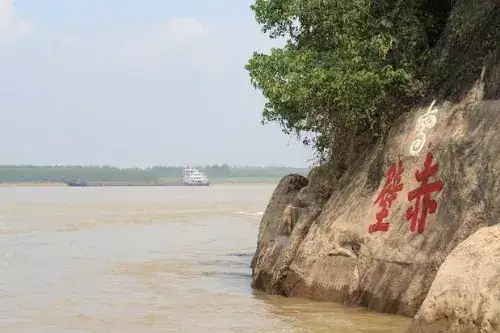
All rivers in Yichang belong to the Yangtze River basin. There are 183 rivers with drainage areas of 30 square kilometers or more, totaling 5,070 kilometers. The six major rivers with drainage areas exceeding 1,000 square kilometers are the Yangtze, Qingjiang, Juzhang, Xiangxi, Huangbo, and Yuyang rivers. Yichang has 11 lakes on the provincial protection list, concentrated in the eastern plains.
Natural Resources
Water Resources
Yichang's total water resources amount to 16.629 billion cubic meters. Per capita water resource occupancy is 4,026 cubic meters, ranking fourth in the province.
Mineral Resources
Yichang has discovered 89 mineral types in 10 categories, accounting for 51.4% of all minerals discovered nationwide. Phosphorus reserves total 4.385 billion tons, with retained reserves of 4.055 billion tons (54.16% of the provincial total). Crystalline graphite reserves of 1.749 million tons make it the only flake graphite mine in central-southern China.
Biological Resources
Yichang has 5,582 species of seed plants (one-seventh of the national total), including 47 nationally protected species. It has 601 species of terrestrial vertebrates in 109 families. Nationally first-class protected wildlife includes the golden snub-nosed monkey, black leaf monkey, South China tiger, leopard, clouded leopard, sika deer, and forest musk deer.
Population
As of November 1, 2020, Yichang's permanent population was 4,017,607 (Seventh National Population Census). As of the end of 2025, the permanent population was 3.9006 million, with an urbanization rate of 67.31%; registered population was 3.7723 million.
Politics
(The original article does not provide detailed content for this section.)
Economy
Overview
In 2025, Yichang achieved a regional GDP of 646.442 billion yuan (approximately 89.8 billion US dollars), up 6.1%. The primary, secondary, and tertiary industries added 69.634 billion yuan (approximately 9.67 billion US dollars), 255.4 billion yuan (approximately 35.47 billion US dollars), and 321.408 billion yuan (approximately 44.64 billion US dollars), respectively. The industrial structure ratio adjusted to 10.8:39.5:49.7. Per capita GDP was 165,180 yuan (approximately 22,942 US dollars), up 6.4%.
Local general public budget revenue was 32.705 billion yuan (approximately 4.54 billion US dollars), up 11.2%. Per capita disposable income for all residents was 42,714 yuan (approximately 5,933 US dollars), up 5.4%; urban residents earned 50,874 yuan (approximately 7,066 US dollars); rural residents earned 27,524 yuan (approximately 3,823 US dollars).
Primary Industry
In 2025, total agricultural, forestry, animal husbandry, and fishery output was 124.342 billion yuan (approximately 17.27 billion US dollars), up 4.3%. Grain output was 1.5432 million tons. Pig slaughter reached 6.3221 million head. Aquatic product output was 226,500 tons.
Secondary Industry
In 2025, value-added of industrial enterprises above designated size grew 7.3%. Manufacturing grew 8.6%, and high-tech manufacturing grew 15.9%, accounting for 17.1% of the total. Total electricity consumption was 29.269 billion kWh, up 8.2%.
Tertiary Industry
In 2025, total retail sales of consumer goods reached 237.624 billion yuan (approximately 33.0 billion US dollars), up 4.4%. Total foreign trade was 54.45 billion yuan (approximately 7.56 billion US dollars), up 9.3%, with exports of 44.36 billion yuan (approximately 6.16 billion US dollars) and imports of 10.09 billion yuan (approximately 1.40 billion US dollars). Actual foreign investment used was 66.49 million US dollars, up 8.6%. Yichang received 141 million domestic tourists, up 20.8%, with tourism revenue of 142.7 billion yuan (approximately 19.82 billion US dollars), up 22.5%. Bank deposits reached 740.117 billion yuan (approximately 102.8 billion US dollars), and loans reached 731.914 billion yuan (approximately 101.7 billion US dollars). Insurance premium income was 17.533 billion yuan (approximately 2.43 billion US dollars), up 8.3%.
Social Affairs
Science and Technology
In 2025, high-tech industry value-added was 124.502 billion yuan (approximately 17.29 billion US dollars), up 4.2%, accounting for 19.3% of GDP. There were 248 engineering technology research centers and 132 key laboratories. Patent grants totaled 6,335, including 1,420 invention patents.
Education
As of the end of 2025, Yichang had 7 regular universities, 16 secondary vocational schools, 167 regular secondary schools, 206 primary schools, and 388 kindergartens.
Culture
As of the end of 2025, Yichang had 189 cultural institutions, 20 museums and memorials, 32 theaters and cinemas, and 15 public libraries with 6.106 million volumes.
Healthcare
As of the end of 2025, Yichang had 3,087 health institutions (including village clinics), including 188 hospitals and health centers. There were 37,751 health professionals and 29,727 beds.
Sports
As of the end of 2025, Yichang had 33 sports venues. Athletes won 136 gold medals at provincial and above competitions.
Social Security
In 2025, Yichang added 99,700 new urban jobs, up 1.1%. As of the end of 2025, 1.5057 million people participated in urban basic pension insurance, 614,100 in unemployment insurance, 796,500 in work-related injury insurance, and 3.731 million in basic medical insurance. 84,100 residents received minimum living allowances. Elderly care services had 38,500 beds.
Transportation
Overview
Yichang's transportation network centers on the Yangtze River golden waterway, three railways (Jiaozuo-Liuzhou, Yichang-Wanzhou, and Hankou-Yichang), five expressways, and Sanxia Airport. In 2025, total highway mileage was 38,115.73 kilometers. Freight volume by highway and waterway was 271 million tons, up 9.0%. Port cargo throughput was 156 million tons.
Water Transport
After the Three Gorges Dam was built, the Yangtze became a maritime highway connecting Chongqing and Hubei. The port system involves the Yangtze main stream, two tributaries (Qingjiang and Xiangxi), and four reservoirs. A total of 72 port shoreline sections are planned, totaling 104.8 kilometers.
Railway
Yichang is an important regional railway hub with the Hu-Yu-Rong (Shanghai-Chongqing-Chengdu) High-Speed Railway, Jiaozuo-Liuzhou Railway, Yichang-Wanzhou Railway, Hankou-Yichang Railway, and Ya-Yi Railway. On December 26, 2025, the Wuhan-Yichang section of the Hu-Yu-Rong Yangtze River High-Speed Railway opened. Major stations include Yichang East, Yichang, Yichang North, Yichang South, and Dangyang West.
Public Transit
Yichang's urban rail transit Phase 1 plan includes three lines totaling 72.2 kilometers. The city has 846 buses, 1 BRT corridor, 94 bus routes totaling 1,033 kilometers, with an annual passenger volume of 150 million.
History and Culture
Local Culture
Yichang was the cradle of Chu Culture and Ba Culture. It nurtured Qu Yuan, Wang Zhaojun, and scholar Yang Shoujing. Literary figures such as Li Bai, Du Fu, Bai Juyi, Ouyang Xiu, Su Shi, and Lu You also gathered here, leaving poems that enriched Yichang's cultural heritage.
Yichang is known as the "hometown of the Three Kingdoms," with 36 stories from Romance of the Three Kingdoms set here. It is the burial place of Guan Yu, with the Guandi Mausoleum. Qu Yuan, recognized as one of the "Four World Cultural Celebrities," and Wang Zhaojun, one of the "Four Great Beauties of Ancient China," were both born here. Zigui's "Qu Yuan Hometown Dragon Boat Festival Customs" are listed as national intangible cultural heritage.
Etymology
Yichang was anciently called Yiling, known as the "Gateway to the Three Gorges" and the "Throat of Sichuan and Hubei." During the Eastern Jin Dynasty, when a new county was established in the Xiling Gorge area from Huangniu Rock to Heiyanzi, it was named "Yichang," praying for national prosperity - the name first appeared in historical records.
Scenic Spots
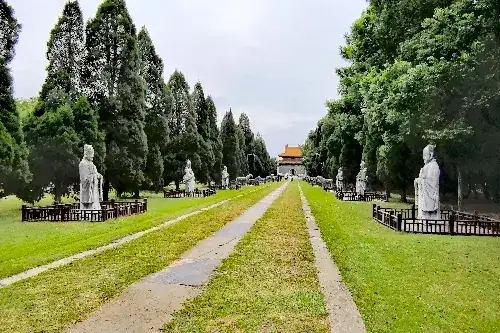
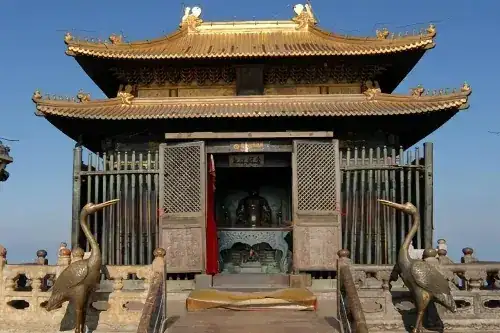
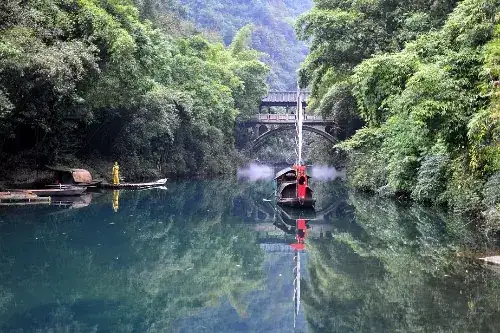
Yichang has numerous historical and cultural sites, including Sanyou Cave, Baima Cave, Taohua Village, Huangling Temple, Jinshi Cave, Baiguoshu Waterfall, Xiaofeng Hanging Coffins, Xiaoting Ancient Battlefield, Gaolan Scenery, the Gezhouba Project, and Yuquan Temple. As of the end of 2024, Yichang has 71 scenic areas rated 3A and above, including 4 at 5A level and 27 at 4A level.
Local Specialties
(The original article does not provide detailed content for this section.)
Notable Figures
Notable figures from Yichang include Qu Yuan, founder of Chinese romantic literature; Wang Zhaojun, one of the Four Great Beauties of ancient China; Leizu, legendary inventor of sericulture; and Yang Shoujing, a renowned Qing Dynasty scholar.
Honorary Titles
Yichang has been selected as a National Civilized City for four consecutive terms, a China Excellent Tourism City, and a Famous Historical and Cultural City of Hubei Province. It is also known as the "World Capital of Hydropower."
Travel information can change. Check current opening hours, reservations and entry requirements before you travel.
Traveller discussion
Start the conversation with a helpful tip or a question.