
Shiyan City
Shiyan CityShiyan City, also known as "Motor City" and "China's Truck Capital," is a prefecture-level city in Hubei Province, classified as a Type II large city. Located between 31°30'–33°16'N and 109°29'–111°16'E, it lies in central China,
Shiyan City
Shiyan City, also known as "Motor City" and "China's Truck Capital," is a prefecture-level city in Hubei Province, classified as a Type II large city. Located between 31°30'–33°16'N and 109°29'–111°16'E, it lies in central China, in northwestern Hubei, in the middle and upper Han River valley of the Qinba mountain area, with the Qinling Mountains to the north and the Daba Mountains and Han River to the south. Wudang Mountain traverses the entire territory. The total area is 23,680 square kilometers. As of February 2026, Shiyan administers 3 municipal districts, 4 counties, and 1 county-level city. As of the end of 2025, the permanent population was 3.1245 million. Shiyan has a long history: over one million years ago, early humans lived here. The discovery of "Yunxian Man" challenged the single-origin theory of human evolution. The city's "Han River culture" has deep roots. The name "Shiyan" (literally "Ten Weirs") derives from ten irrigation weirs built along local rivers. Shiyan is known as "China's Truck Capital" and "China's Commercial Vehicle Capital." Wudang Mountain, Danjiang water, and the automobile city are Shiyan's three world-class calling cards. It is a regional center at the junction of Hubei, Henan, Shaanxi, and Chongqing, and a core city of the western Hubei ecological and cultural tourism circle. It is home to the Danjiangkou Reservoir, the water source of the South-to-North Water Diversion Project's middle route, and the headquarters of Dongfeng Commercial Vehicle Co., Ltd. The city has received honors including National Civilized City, National Hygienic City, and National Forest City. In 2025, Shiyan's GDP reached 270.48 billion yuan (approximately 37.9 billion US dollars), up 6.4% at constant prices.
History
Pre-Qin Period
Shiyan is one of the birthplaces of ancient humans in China. In the late 1980s, archaeologists excavated hominid skull fossils dating back over one million years at Qingqu in Yunxian, classified as Homo erectus and named "Yunxian Man," filling a gap in the evolutionary timeline of Asian ancient humans. During the Xia Dynasty, the area belonged to Liangzhou and Yuzhou. During the Shang Dynasty, ancient state entities such as Yong, Peng, and Wei existed here. During the Western Zhou, states including Yong, Wei, Jun, Yang, Jiao, and Jun coexisted. In the Spring and Autumn Period, the State of Chu conquered Yong and Jun, establishing Hanzhong Commandery and Shangyong County. During the Warring States Period, Shiyan initially belonged to Chu's six Shangyong counties, then was ceded to Qin around 312 BCE.
Qin, Han to Northern and Southern Dynasties Period
After unifying China, the Qin Dynasty implemented the commandery-county system, placing Shiyan under Hanzhong and Nanyang commanderies. During the Western Han, Emperor Wu divided the nation into thirteen regional inspectorates; Shiyan fell under the Yizhou and Jingzhou inspectorates. During the Three Kingdoms period, the area belonged to Cao Wei's Jingzhou, with two commanderies and eight counties. During the Jin and Northern and Southern Dynasties, the area saw frequent administrative reorganizations with two commanderies and eleven counties.
Sui, Tang to Song and Yuan Period
The Sui Dynasty established a two-level prefecture-county system. Wudang County was renamed Junzhou. During the Tang Dynasty, the area was under Shannan Circuit. The Song Dynasty placed Shiyan under Jingxi and Shaanxi circuits. The Yuan Dynasty implemented the provincial system, with Shiyan under Henan-Jiangbei and Shaanxi provinces, establishing Junzhou, Fangzhou, and several counties including Wudang, Yunxian, Fangling, and Zhushan.
Ming and Qing Period
In 1376, the Ming Dynasty established Yunyang Prefecture under the Huguang Branch Administration. The Yunyang Pacification Commission, established in 1476, governed eight prefectures, nine circuits, nine sub-prefectures, and sixty-four counties across Hubei, Henan, Sichuan, and Shaanxi — the largest administrative unit of its kind, lasting 205 years with 120 successive senior officials. During the Qing Dynasty, Huguang was split into Hubei and Hunan. Shiyan remained under Yunyang Prefecture, governing six counties: Yunyang, Fangxian, Zhushan, Zhuxi, Baokang, and Yunxi.
Republic of China Period
In the early Republican era, Shiyan's counties belonged to Hubei's Anxiang-Yunjing Circuit, later renamed Xiangbei Circuit. In 1932, the area became the 11th Administrative Inspection District with its office in Yunyang. In 1948, the area was administered under the Shaannan Region's Fourth Prefecture. By May 1949, all of Shiyan was liberated, and the Liangyun Prefecture was established, governing six counties.
After the Founding of the People's Republic of China
In 1950, the Liangyun Special District was transferred to Hubei Province and renamed Yunyang Special District. In 1952, it was merged into Xiangyang Special District. In 1965, Yunyang Special District was reestablished. In 1969, Shiyan City was established as a county-level city under Yunyang. In 1973, Shiyan was elevated to a provincially-administered city, merging administration with the Second Automotive Works (now Dongfeng Motors) under a unified leadership. In 1983, Jun County was converted to Danjiangkou City. In 1994, Yunyang Prefecture was merged with Shiyan City to form the new prefecture-level Shiyan City. In 2014, Yun County was converted to Yunyang District.
Administrative Divisions
Division Evolution
In 1997, the Wudang Mountain Tourism Economic Zone was established with county-level administrative authority. In 2012, the Shiyan Economic Development Zone was upgraded to a national-level economic and technological development zone. In 2014, Yun County became Yunyang District.
Division Details
As of February 2026, Shiyan administers 3 municipal districts, 4 counties, and 1 county-level city, comprising 13 subdistricts, 72 towns, 34 townships, 1,782 villages, and 178 communities. The municipal government is located at No. 8 Beijing Middle Road, Maojian District.
Geography
Location and Territory
Shiyan lies in the eastern Qinba mountain area and the middle-upper Han River region, bordering Henan to the northeast, Shaanxi to the north and west, and Chongqing to the south. The Daba Mountains extend across the south, while the Qinling range shields the north. The Han River flows eastward through the territory. The city spans approximately 200 km east-west and 195.5 km north-south.
Geology
The geological structure is complex, situated at the intersection of the Kunlun-Qinling latitudinal tectonic system, the Huaiyang epsilon-type structural system, and the Neocathaysian tectonic system. Major faults include the Qingfeng Fault (northeast-east trend, 30–150 m wide), Zhushan Fault (northwest trend, 130 km long), and Liangyun Fault (northwest trend, 120 km long). South of the Qingfeng Fault lies the Yangtze Platform; to the north lies the Qinling fold system, further divided into the Jinjiling synclinorium, Wudang anticlinorium, and northern Daba fold zones.
Topography and Landforms
Shiyan's mountain ranges belong to three systems: the eastern Qinling Mountains in the north, Wudang Mountain in the center, and the eastern Daba Mountains in the southwest. The terrain is high in the north and south, lower in the middle, sloping from southwest to northeast. The highest point is Congping in Zhuxi at 2,740.2 m; the lowest is Panjiayan in Danjiangkou at 87 m. Main landform types include hills, low mountains, medium mountains, high mountains, valley plains, and intermontane basins.
Climate
Shiyan has a subtropical monsoon climate. The multi-year average temperature is 15.4°C, with extremes of 41.9°C (1996) and -11.9°C (1976). Average annual precipitation is 769.6 mm, concentrated in June–September (59.2% of annual total).
Hydrology
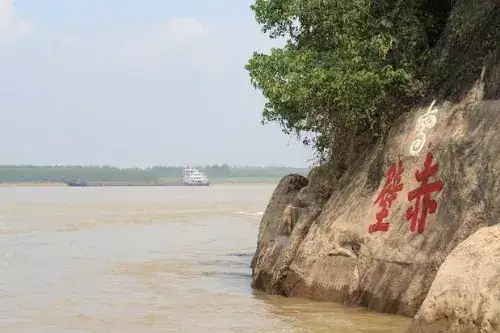
Shiyan has 2,489 rivers. The Du River, the city's largest, runs 338.6 km with a drainage area of 12,431 km², ranking second among Hubei's medium and small rivers. The Han River flows through Yunxi, Yunyang, and Danjiangkou, covering 216 km within the city.
Natural Resources
Animal Resources
Shiyan has rich wildlife, with 413 species of nationally and provincially protected terrestrial vertebrates across 88 families and 29 orders. Twenty-two species are under national Class I protection, including golden snub-nosed monkeys, leopards, and golden eagles. Eighty species are under national Class II protection. An additional 311 species are protected for ecological, scientific, and social value.
Plant Resources
Vegetation shows vertical zonation: northern subtropical deciduous broadleaf forests below 1,200 m, warm-temperate deciduous-coniferous forests at 1,200–2,000 m, and temperate evergreen coniferous-broadleaf mixed forests above 2,000 m. The city has 2,796 vascular plant species across 201 families, including 8 national Class I protected species such as dove tree, dawn redwood, and ginkgo, and 28 national Class II protected species.
Mineral Resources
Sixty-two mineral types have been discovered, with 28 having proven reserves and 215 mining sites registered. Key minerals include coal, iron, vanadium, copper, turquoise, and rare earth elements. Turquoise, placer gold, niobium, and vanadium reserves rank first in Hubei Province.
Population
Population Size
As of the 2020 census, the permanent population was 3,209,004. As of the end of 2025, it was 3.1245 million, with an urbanization rate of 65.55%, up 1.05 percentage points year-on-year.
Ethnic Composition
Shiyan is a key area for ethnic minority work in Hubei, with 45 ethnic minority groups including Hui, Manchu, Tujia, and Mongolian. There are approximately 15,900 ethnic minorities, 1 ethnic township, 8 ethnic villages, and 1 ethnic school.
Ethnic Groups and Religion
As home to Wudang Mountain, a world-famous Taoist sanctuary, Shiyan has all five major religions: Buddhism, Islam, Catholicism, Taoism, and Protestantism. There are 64 registered religious activity venues and 342 certified clergy, with Taoism having the most at 234.
Politics
Economy
Overview
In 2025, Shiyan's GDP reached 270.48 billion yuan (approximately 37.9 billion US dollars), up 6.4%. By sector: primary industry 24.35 billion yuan (approximately 3.4 billion US dollars), up 4.3%; secondary industry 97.9 billion yuan (approximately 13.7 billion US dollars), up 7.8%; tertiary industry 148.23 billion yuan (approximately 20.8 billion US dollars), up 5.7%. The industrial structure ratio was 9:36.2:54.8, with per capita GDP of 86,322 yuan (approximately 12,090 US dollars). Fixed asset investment grew 4.7%. General public budget revenue was 16.818 billion yuan (approximately 2.35 billion US dollars), up 8.8%; expenditure was 51.326 billion yuan (approximately 7.19 billion US dollars). Per capita disposable income was 33,922 yuan (approximately 4,753 US dollars), up 5.5%; urban residents' was 43,461 yuan (approximately 6,087 US dollars); rural residents' was 17,324 yuan (approximately 2,426 US dollars).
Primary Industry
In 2025, the gross output of agriculture, forestry, animal husbandry, and fishery was 42.822 billion yuan (approximately 6.0 billion US dollars), up 4.5%. Grain production reached 841,800 tons, up 0.46%. Tea output was 34,200 tons, up 8.29%. Pork, beef, mutton, and poultry meat totaled 202,200 tons, up 3.0%. Aquatic products reached 59,400 tons, up 4.66%.
Secondary Industry
As of the end of 2025, Shiyan had 1,335 designated-scale industrial enterprises, with value-added growing 12.3%. Automobile manufacturing grew 14.8%, and high-tech manufacturing grew 12.9%, accounting for 9.1% of industrial value-added. Construction output was 61.199 billion yuan (approximately 8.57 billion US dollars), down 10.7%.
Tertiary Industry
In 2025, total retail sales of consumer goods grew 3.6%. Above-quota wholesale and retail sales reached 91.397 billion yuan (approximately 12.8 billion US dollars), up 14.6%. Express delivery volume reached 82.28 million pieces, up 16.25%. Financial institution deposits reached 439.283 billion yuan (approximately 61.5 billion US dollars); loans reached 306.874 billion yuan (approximately 42.97 billion US dollars). Insurance premium income was 10.82 billion yuan (approximately 1.52 billion US dollars), up 7.95%.
Social Affairs
Science and Technology
In 2025, Shiyan secured 292 provincial and above research projects, with technology investment of 88.423 million yuan (approximately 12.4 million US dollars). Technology contracts totaled 26.412 billion yuan (approximately 3.7 billion US dollars), up 8.33%. Fourteen projects received provincial science and technology awards.
Education
Shiyan has 1,658 schools of all types, including 6 higher education institutions, 10 secondary vocational schools, 34 general high schools, 92 junior high schools, and 820 primary schools. Total enrollment is 612,200 students with 51,300 staff. Institutions include Hubei University of Automotive Technology, Hubei University of Medicine, Hubei Industrial Vocational and Technical College, and Hanjiang Normal University.
Culture
The city has 7 performing arts troupes, 8 public libraries (2.727 million volumes), 10 cultural centers, and 13 museums. In 2025, 1,711 art events attracted 7.66 million attendees. Designated-scale cultural industry revenue was 7.38 billion yuan (approximately 1.03 billion US dollars).
Healthcare
Shiyan has 2,885 medical institutions including 72 hospitals, with 34,621 health professionals (13,136 physicians and 16,217 nurses) and 32,100 beds. Total patient visits reached 26.427 million.
Sports
In 2025, Shiyan hosted the Dongfeng Commercial Vehicle 2025 Shiyan Marathon, a China Athletics Association A1-certified event with full marathon, half marathon, and health run categories, totaling 20,000 participants.
Social Security
As of the end of 2025, 2.3796 million people participated in basic pension insurance, 2.9951 million in basic medical insurance, 395,100 in work injury insurance, and 310,600 in unemployment insurance.
Transportation
The Xiangyu Railway traverses Shiyan, with 73 daily passenger train pairs calling at Shiyan Station, connecting to Beijing, Shanghai, Guangzhou, and other major cities. National Highways 209 and 316 intersect here. The Han River provides waterway transport. Multiple expressways form a three-horizontal, one-vertical transportation hub. Wudang Mountain Airport opened in February 2016. In 2025, freight transport volume was 39.32 million tons, up 2.4%; passenger volume was 10.519 million, down 16.1%. Railway stations include Shiyan Station, Shiyan East (HSR), Wudangshan Station, and Danjiangkou (HSR).
History and Culture
Origin of the Name
Local residents built ten irrigation weirs along the Bai'er River for farmland irrigation, giving the city its name "Shiyan" (literally "Ten Weirs").
Historical Sites
Intangible Cultural Heritage
As of 2023, Shiyan had 130 municipal and above intangible cultural heritage projects, including 11 national-level, 37 provincial-level, and 82 municipal-level projects.
Folk Activities
Dragon boat racing during the Dragon Boat Festival is a long-standing custom. The Han River Dragon Boat Festival, held at the confluence of the Han and Du rivers in Yunyang, is known as a "living fossil" of Han River culture and was listed as Hubei provincial intangible cultural heritage in 2011.
Specialties
Shiyan is one of Hubei's four major tea production areas. Its tea polyphenol content reaches 35%, far above the national average of 23–26%. The "Wudang Dao Tea" brand has earned titles including "China's First Cultural Famous Tea" and "China Well-Known Trademark." Danjiangkou topmouth culter is a regional specialty fish from the Danjiangkou Reservoir, known for its upturned mouth and distinctive red eye line.
Cuisine
Local specialties include Zhuxi cured meats, sesame flatbread, steamed pork with fire-roasted noodles, and Huanglong fish head. Zhuxi cured meats feature a distinctive savory-salty flavor with unique curing techniques and spices, independent of other Chinese regional cuisines. Sesame flatbread is a Yunyang specialty made with leavened dough, salt, and scallions, topped with sesame seeds and oven-baked. Huanglong fish head, originating from Huanglong Dam, creatively combines the freshness of fish with the spiciness of chili peppers.
City Symbols
In 2019, the Shiyan Municipal People's Congress designated camphor and goldenrain tree as city trees, and crape myrtle and pomegranate as city flowers. Previously, from 1986, camphor and pomegranate held these roles, with southern magnolia and Chinese rose added in 1987 as companion symbols.
Scenic Spots
Shiyan is a mountain city and "China Excellent Tourism City," featuring the World Cultural Heritage site and Taoist holy mountain Wudang Mountain. Major attractions include:
1. Shiyan urban area: Saiwudang Nature Reserve, Niutou Mountain Forest Park, Sifang Mountain Botanical Garden, Huanglong Ancient Town, and Dongfeng Commercial Vehicle assembly line.
2. Danjiangkou: Danjiangkou Reservoir and Dam, Wudang Mountain rafting, Tai Chi Gorge, and Jinglegong.
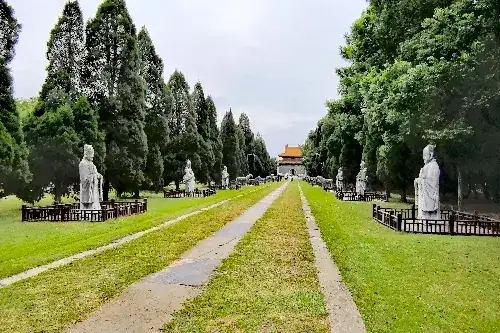
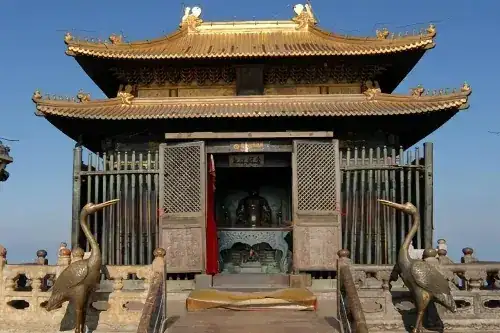
3. Wudang Mountain Special Zone: Yuxu Palace, Taizipo, Zixiao Palace, Nanyan Palace, Golden Summit, and Tai Chi Lake.
4. Yunyang District: Qinglongshan Dinosaur Egg Fossil Group National Nature Reserve, Longyin Gorge, and Canglang Mountain National Forest Park.
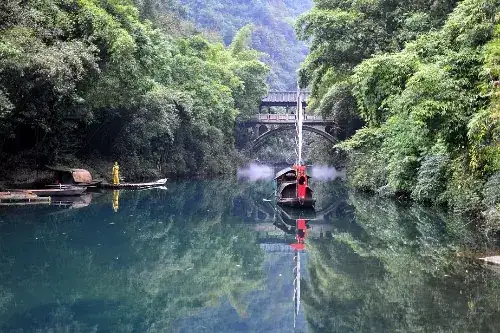
5. Yunxi County: Wulong River Scenic Area, Longtan River, and Shangjin Ancient City.
6. Zhushan County: Nuwa Mountain Heavenly Pool, Jiuhua Mountain Forest Park, and Shangyong Ancient City.
7. Zhuxi County: Chu Great Wall pass at Guanya, and Shibali Long Gorge.
8. Fang County: Wild Man Valley and Cave, and hot spring resort.
Notable Figures
Notable figures from Shiyan include: Yin Jifu, a major collector of the "Book of Songs" and military strategist, revered as the "ancestor of Chinese poetry"; Chen Niangu, a Qing Dynasty official whose story inspired the legendary "Chen Shimei" character; Zhang Zhenwu (1877–1912), democratic revolutionary and key organizer of the Wuchang Uprising; Yang Xianzhen (1896–), Marxist philosopher; Shi Yang, proletarian revolutionary; Zheng Qinwen, tennis player and 2024 Paris Olympics women's singles gold medalist; He Wei, CCTV sports commentator; and actors Zhang Wanyi and Lin Junyi.
Honors and Titles
Shiyan has received numerous honors including National Civilized City, National Hygienic City, China Livable City, National Garden City, and National Forest City.
Sister Cities
Shiyan's sister cities include Craiova (Romania), Kassel (Germany), Engels (Russia), Wanju (South Korea), Tianjin Hexi District, Beijing Fengtai District, Zibo, Huai'an, Nanchong, Weinan, Siping, Bo'le, and Maoming.
Travel information can change. Check current opening hours, reservations and entry requirements before you travel.
Traveller discussion
Start the conversation with a helpful tip or a question.