
Xinyang City
Xinyang CityXinyang City, also known as Shencheng, is a prefecture-level city in Henan Province, located in the southern part of the province at the junction of Hubei, Henan, and Anhui provinces. The terrain slopes from south to north, with
Xinyang City
Xinyang City, also known as Shencheng, is a prefecture-level city in Henan Province, located in the southern part of the province at the junction of Hubei, Henan, and Anhui provinces. The terrain slopes from south to north, with the western and southern areas forming the southern Henan mountainous region composed of Tongbai Mountain and Dabie Mountain. The central area consists of hilly terrain, while the north features the Huang-Huai Plain and low-lying land. It belongs to a transitional zone between subtropical and warm temperate climates with a pronounced monsoon influence, covering a total area of 18,916 square kilometers. As of 2026, Xinyang administers 2 districts and 8 counties. As of the end of 2025, the resident population stood at 5.957 million. In the first year of the Taiping Xingguo era of the Song Dynasty (976 CE), to avoid the name taboo of Emperor Taizong (Zhao Guangyi), Yiyang Jun was renamed Xinyang Jun, marking the first historical appearance of "Xinyang" as a place name. In June 1998, the prefecture-level city of Xinyang was formally established. Xinyang is an important transportation hub in southern Henan, a Tier-3 city whose cultural heritage blends Chu culture and Central Plains culture, situated at China's geographic and climatic transition zone between north and south. Located in the core area of the Dabie Mountain revolutionary old base, it is hailed as "the cradle of the Red Army and the hometown of generals," and also known as the landscape Tea Capital and "China's Maojian Capital." The city is home to scenic attractions such as Jigong Mountain, Lingshan Temple, and Xijiuhua Mountain. In 2025, Xinyang's GDP reached 319.67 billion yuan (approximately $44.7 billion), growing 6.0% year-on-year at comparable prices.
Historical Evolution
During the Shang and Zhou dynasties, the area of present-day Xinyang was home to multiple vassal states including Shen, Xi, Xian, Huang, Jiang, Jiang, and Liao.
During the Spring and Autumn and Warring States periods, beginning in the ninth year of King Zhuang of Chu (688 BCE), the State of Chu successively conquered these states and established counties directly under its central administration, including Shen County, Xi County, and Qisi County, marking the beginning of Xinyang's county-level administration.
The Qin Dynasty administered counties through commanderies. Most of the area belonged to Jiujiang Commandery, with seven counties established within its territory. The Han Dynasty continued the Qin system. During the Three Kingdoms period, the area belonged to the Wei state. In the reign of Emperor Wen of Wei, Yiyang Commandery was established, marking the beginning of Xinyang's commandery-level administration.
During the Eastern Jin Dynasty, the seat of Yuzhou was moved to Xiyang (present-day Guangshan County), marking the beginning of Xinyang's prefecture-level administration. By the end of the Eastern Jin, Yiyang Commandery was re-established and its seat moved to Pingyang County (present-day Xinyang), making Xinyang a provincial capital for the first time.
During the Northern and Southern Dynasties, the area changed hands among the Liu Song, Southern Qi, and Liang dynasties. In the Sui Dynasty, Shenzhou was renamed Yizhou and then Yiyang Commandery. During the Tang Dynasty, the area comprised Shenzhou and Guangzhou under the Huainan Circuit. In 712 CE, the seat of Guangzhou was moved to Dingcheng (present-day Huangchuan County), governing five counties.
In the first year of the Taiping Xingguo era of the Northern Song (976 CE), to avoid the name taboo of Emperor Taizong (Zhao Guangyi), Yiyang Jun was renamed Xinyang Jun, governing Xinyang and Luoshan counties. During the Yuan Dynasty, the provincial system was established, and the area belonged to the Henan-Jiangbei Province. Xinyang Jun was converted to Xinyang Prefecture, then to a prefecture in 1277, and back to azhou in 1278. In 1283, its seat was moved to Luoshan County.
During the Ming Dynasty, Xinyang Prefecture administered Luoshan and Queshan counties. In the Qing Dynasty, Guangzhou was elevated to a directly administered prefecture in 1724, governing Guangshan, Gushi, Xi, and Shangcheng counties.
After the founding of the Republic of China in 1912, prefectures were abolished and replaced with counties. In 1913, Xinyang Prefecture and Guangzhou were converted to Xinyang County and Huangchuan County, respectively. During the War of Resistance Against Japan, the Communist Party of China led the people in establishing the southern Henan anti-Japanese base area.
After the founding of the People's Republic of China, Xinyang was divided into the Xinyang and Huangchuan special districts. In 1952, the Huangchuan special district was merged into Xinyang. In 1965, the Zhumadian area was separated from Xinyang. On June 9, 1998, Xinyang Prefecture and the county-level Xinyang City and Xinyang County were abolished, and the prefecture-level Xinyang City was established with Shihe District and Pingqiao District.
Administrative Divisions
Division Evolution
In 1913, Xinyang and Guangzhou were converted to counties. In 1932, a ninth administrative inspection district was established with its office in Huangchuan, governing eight counties. In 1949, the Xinyang Commissioner's Office was established. In 1952, the Huangchuan and Xinyang commissioner's offices were merged. In 1998, the prefecture-level Xinyang City was established with Shihe and Pingqiao districts and eight counties. In 2011, Gushi County was elevated to a province-directly-administered county under Xinyang's custodial management. In 2022, the Yu-Southeast High-Tech Industrial Development Zone was inaugurated as a provincial agency managed by the Xinyang municipal party committee and government.
Division Details
As of 2026, Xinyang City administers 2 districts and 8 counties: Shihe District, Pingqiao District, Huangchuan County, Guangshan County, Xi County, Xinxian County, Luoshan County, Shangcheng County, Huaibin County, and Gushi County, along with 1 national high-tech zone, 9 provincial development zones, and the under-construction Yu-Southeast High-Tech Industrial Development Zone. The city has 47 sub-districts, 89 towns, and 79 townships, totaling 215 township-level administrative divisions. The municipal government is seated at No. 98, New Fifth Avenue, Yangshan New District, Pingqiao District.
Geography
Location
Xinyang is located in the Central China region, in southern Henan Province, between 113 degrees 45 minutes and 115 degrees 55 minutes east longitude and 30 degrees 23 minutes and 32 degrees 27 minutes north latitude. It sits at the junction of Hubei, Henan, and Anhui provinces, in the upper reaches of the Huai River, between the northern foothills of Dabie Mountain and the upper Huai River. It borders Zhumadian to the north, Fuyang and Lu'an of Anhui Province to the east, Huanggang, Suizhou, and Xiaogan of Hubei Province to the south, and Nanyang to the west. The city spans approximately 205 kilometers east to west and 142 kilometers north to south, with a total area of 18,916 square kilometers.
Topography
The terrain slopes from south to north, forming a stepped landscape of alternating ridges and valleys. The western and southern mountainous region, composed of Tongbai Mountain and Dabie Mountain, covers nearly 7,000 square kilometers (36.9% of the total area). The two mountain ranges connect to form a continuous ridge along the Henan-Hubei border, serving as the watershed between the Yangtze and Huai river systems. Dabie Mountain extends about 200 kilometers within Xinyang, accounting for 80% of the southern Henan mountainous area. Its eastern section features peaks above 1,000 meters, while the western section is lower and gentler. Tongbai Mountain extends 69 kilometers within Xinyang, accounting for 20%. The highest peak is Jingangtai (1,584 meters) in the Dabie range. The central hilly area covers over 7,000 square kilometers (38.5%), with elevations of 50-100 meters. The northern plain and lowland area covers over 4,000 square kilometers (24.6%).
Climate
The Huai River flows through northern Xinyang, with most of the city lying south of it. The area belongs to a subtropical-to-warm-temperate transitional zone with pronounced monsoon climate. Average annual sunshine ranges from 1,900 to 2,100 hours; mean annual temperature is 15.3-15.8 degrees Celsius with a frost-free period of 220-230 days; annual rainfall averages 993-1,294 millimeters with relative humidity of 74-78%. Spring is variable with frequent rain; summer is hot and humid with abundant precipitation; autumn is cool and clear; winter is dry and cold with short freezing periods. In 2025, the city's average annual temperature was 17.7 degrees Celsius with average annual precipitation of 1,025.4 millimeters.
Hydrology
Xinyang has numerous rivers belonging to the Yangtze River and Huai River systems. The Huai River basin accounts for 98.2% of the total area, while the Yangtze system accounts for only 1.8%. The Huai River flows 363.5 kilometers from west to east across the city. There are 10 major tributaries with basin areas exceeding 1,000 square kilometers, 49 exceeding 100 square kilometers, and 126 exceeding 50 square kilometers. Major southern tributaries originating from Tongbai and Dabie Mountains include the Shi River, Zhugan River, Huang River, Bailu River, Guan River, and Shi River, all flowing into the Huai River in a southwest-to-northeast direction. Annual average rainfall is 1,098 millimeters, with precipitation concentrated in the main flood season of June through August, accounting for 54% of the annual total.
Natural Resources
Water Resources
Xinyang has relatively abundant water resources within Henan Province, with a multi-year average total of 7.519 billion cubic meters and per capita water resources of 1,003 cubic meters. The city has 6 large reservoirs, 15 medium reservoirs, and 971 small reservoirs, totaling 992 and earning it the nickname "City of a Thousand Lakes." Total water storage capacity reaches 6 billion cubic meters. The city's hydropower potential is 99,700 kilowatts, with a developable capacity of 72,800 kilowatts and annual power generation of 208 million kilowatt-hours.
Plant Resources
Xinyang has over 2,200 species of higher plants across 189 families, representing more than 95% of the provincial total. These include over 150 timber species (pine, fir, oak, catalpa, willow, locust), 90-plus oil-bearing plants (camellia, tung tree, Chinese tallow, walnut), nearly 100 starch plants, 110-plus fiber plants, 310-plus medicinal plants (including platycodon, pinellia, lingzhi mushroom), 19 bamboo species, and various aromatic and forage plants. The city also hosts over 70 nationally and provincially protected rare and endangered plant species, including ginkgo, dawn redwood, Chinese swamp cypress, dove tree, Chinese yew, and Dabie Mountain five-needle pine.
Animal Resources
The area's unique geography provides favorable conditions for diverse wildlife. Over 2,031 animal species have been recorded, including 380-plus terrestrial vertebrate species (83% of the provincial total) and 1,650 invertebrate species. Mammals include 47 species such as the yellow-throated marten, badger, otter, wolf, fox, raccoon dog, dhole, small civet, large civet, and leopard (endangered or extinct). Over 300 bird species have been recorded. The Dongzhai Bird Nature Reserve in Luoshan County hosts 293 bird species, including the white-crowned long-tailed pheasant, whooper swan, great bustard, white-naped crane, and Oriental white stork. The crested ibis is a national first-class protected species.
Mineral Resources
Xinyang has 49 proven mineral types. Non-metallic mineral resources are particularly abundant. The Shangtianti non-metallic deposit is the largest in Asia, with perlite reserves of 100 million tons (over half the national total). Other significant resources include vitric tuff (36.94 million tons), zeolite (58 million tons), rutile ore (54.21 million tons), zinc ore (450,000 tons), and fluorite ore (886,000 tons). As of the end of 2025, 51 mineral types had been discovered, with 15 having confirmed reserves and 15 under development.
Population
As of the end of 2025, Xinyang's resident population was 5.957 million, including 3.251 million urban and 2.706 million rural residents. The urbanization rate reached 54.58%, up 0.73 percentage points. There were 29,000 births (birth rate: 4.77 per thousand) and 56,000 deaths (death rate: 9.40 per thousand), resulting in a natural growth rate of -4.63 per thousand.
Politics
Economy
Overview
In 2025, Xinyang's GDP reached 319.67 billion yuan (approximately $44.7 billion), growing 6.0% year-on-year. The primary, secondary, and tertiary sectors contributed 50.996 billion yuan, 100.010 billion yuan, and 168.664 billion yuan respectively, growing 3.7%, 5.4%, and 7.5%. Per capita GDP was 53,461 yuan (approximately $7,485), up 6.8%. The industrial structure was 15.9:31.3:52.8.
Total fiscal revenue was 19.627 billion yuan (approximately $2.75 billion), up 1.2%. General public budget revenue was 13.716 billion yuan (approximately $1.92 billion), up 5.9%, with tax revenue at 8.453 billion yuan. General public budget expenditure was 62.446 billion yuan (approximately $8.74 billion), down 6.6%, with education spending at 12.682 billion yuan and social security spending at 9.186 billion yuan.
Per capita disposable income was 30,528 yuan (approximately $4,274), up 5.6%. Urban per capita disposable income was 40,384 yuan (approximately $5,654), up 4.8%; rural per capita disposable income was 22,305 yuan (approximately $3,123), up 6.4%. Fixed asset investment grew 5.6%, with primary industry investment up 38.4%, secondary industry up 27.9%, and tertiary industry down 6.1%.
Primary Industry
In 2025, total grain sown area was 842.16 thousand hectares, with rice at 507.39 thousand hectares and wheat at 311.93 thousand hectares. Total grain output reached 5.8857 million tons, up 1.0%. Oil crop output was 569,400 tons (up 1.8%), vegetable output 4.5899 million tons (up 3.5%), and aquatic products 299,600 tons. Meat output (pork, beef, mutton, poultry) totaled 481,200 tons, up 9.7%.
Secondary Industry
In 2025, above-scale industrial value-added grew 8.3%. By ownership type, state-controlled enterprises grew 1.4%, collective enterprises 195.9%, joint-stock enterprises 9.0%, and foreign-invested enterprises 5.4%. By key industry, traditional industries grew 13.1%, strategic emerging industries 5.2%, and high-tech industries 8.1%. Total installed power generation capacity reached 7.99 million kilowatts, up 18.7%, including 2.43 million kilowatts thermal, 1.02 million hydro, 1.76 million wind, and 2.78 million solar. Construction industry total output was 28.776 billion yuan (approximately $4.03 billion), up 2.6%.
Tertiary Industry
In 2025, wholesale and retail added value was 19.594 billion yuan (up 5.6%); transportation, warehousing, and postal services 13.740 billion yuan (up 17.8%); accommodation and catering 7.595 billion yuan (up 5.2%); finance 11.898 billion yuan (down 0.1%); real estate 20.768 billion yuan (up 3.4%); and other services 77.946 billion yuan (up 8.8%).
Total retail sales of consumer goods reached 118.641 billion yuan (approximately $16.6 billion), up 5.3%. Total import and export value was 6.15 billion yuan (approximately $861 million), up 3.8%, with exports at 3.93 billion yuan and imports at 2.21 billion yuan. New foreign-invested enterprises numbered 8.
Tourism revenue reached 36.16 billion yuan (approximately $506 million), up 1.5%, with 60.716 million visitors received. As of the end of 2025, total RMB deposits in financial institutions stood at 680.629 billion yuan (approximately $95.3 billion), up 9.6%, with household deposits at 602.302 billion yuan (up 11.2%). Total RMB loans stood at 285.192 billion yuan (approximately $39.9 billion), up 0.5%.
Postal business volume totaled 4.296 billion standard units (up 28.0%), with express delivery volume of 356 million pieces (up 42.3%). Mobile phone 4G users numbered 1.877 million and 5G users 4.229 million. Internet users totaled 8.846 million.
Small Lighthouse Enterprises
The "Small Lighthouse" enterprise program, initiated under Henan Province's manufacturing digital transformation initiative, recognizes small and medium-sized enterprises that demonstrate outstanding results in digital application across R&D, production, operations, sales, and logistics. These enterprises serve as replicable models for industry-wide digital transformation. Guangshan County's Xinbao Auto Electric Co., Ltd. was designated as a 2025 Henan Province Digital Leader and "Small Lighthouse" enterprise, recognized for its strong technical capabilities, optimized business models, and high-quality efficiency.
Social Services
Education
As of 2025, Xinyang had 9 regular higher education institutions with 58,500 enrollments and 180,800 students. There were 25 secondary vocational schools, 82 regular senior high schools, 328 junior high schools, 671 primary schools, and 10 special education schools. Preschool enrollment was 128,900 children. The "two exemptions and one subsidy" program allocated 1.028 billion yuan, and financial aid was provided to 608,500 students.
Science and Technology
As of the end of 2025, Xinyang had 140 provincial engineering technology research centers, 523 municipal-level centers, and 8 provincial key laboratories. A total of 1,209 technology contracts were signed with a transaction value of 6.72 billion yuan. The city had 1 national engineering research center, 16 provincial engineering research centers, 1 national enterprise technology center, and 25 provincial enterprise technology centers. There were 127 qualified inspection and testing institutions, and 27 products received national geographical indication protection.
Cultural Services
As of the end of 2025, the city had 203 art performance groups, 17 cultural centers, 12 public libraries, and 41 museums. There were 14 national-level protected cultural heritage sites, 121 provincial-level sites, and 4 entries on the national intangible cultural heritage list. On May 9, 2025, the Chinese Embassy in Singapore hosted a "Tea and the World" tea ceremony event attended by approximately 60 people including ambassadors' spouses and women leaders.
Healthcare
As of the end of 2025, Xinyang had 5,004 medical and health institutions, including 302 hospitals and township health centers, 11 maternal and child health centers, and 11 disease control centers. Total beds numbered 45,293, with 52,804 health professionals including 21,548 licensed physicians and 24,030 registered nurses.
Sports
In 2025, Xinyang athletes won 22 gold medals and earned 22 provincial championships.
Social Security
In 2025, 76,200 new urban jobs were created, and 23,400 laid-off workers achieved reemployment. As of the end of 2025, 4.6226 million people participated in urban-rural social pension insurance, 1.1885 million in urban employee basic pension insurance, and 7.0563 million in basic medical insurance. Urban minimum living allowance disbursements totaled 178 million yuan, benefiting 41,400 urban residents; rural minimum living allowance disbursements totaled 1.026 billion yuan, benefiting 340,400 rural residents.
Environmental Protection
In 2025, total water consumption was 2.012 billion cubic meters (up 0.5%). Above-scale industrial energy consumption per unit of value-added fell 5.79%. Total social electricity consumption was 19.622 billion kilowatt-hours (up 8.8%). Water quality at monitored river sections met Class I-III standards at 100%. The proportion of good air quality days reached 84.1%, with PM2.5 average concentration at 35.0 micrograms per cubic meter (down 0.1%). The city had 9 nature reserves covering 190,100 hectares, including 4 national-level reserves, with a forest coverage rate of 36.83%.
Business Associations
The Henan Dabie Mountain Chamber of Commerce and its Guangshan Branch, along with the Guangshan County Tea Industry Alliance, represent key business organizations in Xinyang. The Guangshan Branch president is Sun Lin, and the Tea Industry Alliance secretary-general is Lu Tao.
Transportation
Transport
Xinyang serves as a vital regional transportation and logistics hub, situated within a 300-kilometer radius of three provincial capitals: Zhengzhou, Wuhan, and Hefei. Three railway lines (Beijing-Guangzhou, Beijing-Kowloon, Nanjing-Xi'an) and the Beijing-Guangzhou high-speed railway, five expressways (Beijing-Hong Kong-Macau, Daguang, Huaigu, Shanghai-Shaanxi, Huaixin), and six national highways crisscross the city, forming multiple cross intersections. Minggang Airport offers direct flights to 17 cities including Beijing, Shanghai, Guangzhou, Shenzhen, Chongqing, Xi'an, Kunming, Hangzhou, Chengdu, and Haikou. The Huai River ports at Huaibin and Gushi connect to the Yangtze River and the sea, forming a comprehensive water-land-air transportation system.
Freight
In 2025, freight turnover (excluding rail and aviation) grew 1.9%, while passenger turnover declined 5.3%. Airport passenger throughput reached 303,900. As of the end of 2025, total highway mileage was 29,760 kilometers, including 992 kilometers of expressways. Registered small vehicles numbered 978,400, with private vehicles at 945,300.
History and Culture
Origin of the Name
During the Spring and Autumn period, Xinyang was the State of Shen, later conquered by King Wen of Chu. In the Qin Dynasty, it belonged to Yiyang Township of Nanyang Commandery. The Cao Wei state established Yiyang Commandery. In 976 CE, the name was changed to "Xinyang" because the character "Xin" was identical to "Shen" in ancient texts, signifying this as the former land of the Shen State. An alternative theory holds that Emperor Taizong (Zhao Guangyi), avoiding the character "Yi," renamed it "Xinyang" since "Xin" and "Yi" were close in meaning.
Cultural Relics
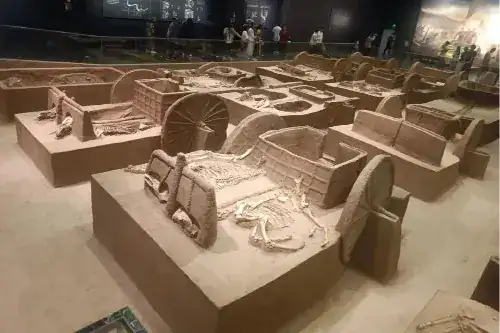
As of the end of 2022, Xinyang had 7,494 recognized cultural heritage sites, ranking fourth in Henan Province. These include 14 national-level, 97 provincial-level, 119 municipal-level, and 419 county-level protected units. The city has 34,309 registered cultural artifacts, including 6,265 precious items and 28,044 general items, some of which hold significant importance in the province's collection.
Cuisine
Situated on China's north-south divide, Xinyang's cuisine is renowned for its fresh, fragrant, crisp, and mellow flavors, with stewing as the primary cooking technique and eco-friendly health ingredients. Signature dishes include clear-stewed Nanwan fish head, old duck soup, braised罐 meat, stuffed goose, pork intestine soup, braised turtle, clear-stewed beef tripe, stuffed chicken, pan-fried tofu, and Xinyang hot dry noodles.
Dialect
Xinyang's dialect has been shaped by multiple influences, forming a blend of Jianghuai Mandarin, Southwest Mandarin, Central Plains Mandarin, with significant Gan and Hakka vocabulary. Northern areas lean toward Central Plains Mandarin, southern areas toward Jianghuai Mandarin, and western areas show Hubei dialect influence. Hakka dialect is distributed in parts of the central-southern and northern regions.
Arts
Huangchuan shadow puppetry, dating to the reign of Emperor Wu of Han, later spread to South Asia, Persia, Egypt, Turkey, and the West. Luoshan shadow puppetry, flourishing since the Jiajing era of the Ming Dynasty, is one of China's four major shadow puppet schools and a national intangible cultural heritage. Guangshan flower drum opera, listed as national intangible cultural heritage in 2014, blends folk tunes, mountain songs, Chu opera, and Huangmei opera. Shangcheng flower umbrella dance, originating in the Tang Dynasty and flourishing through the Song and Qing dynasties, is a precious folk cultural treasure.
Boutique Guesthouses
Xinyang has built and operated 145 "Xinyang Courtyards" as part of its "attract visitors to Xinyang" strategy, integrating rural tourism, urban leisure, e-commerce logistics, and cultural creativity. These distinctive courtyards offer visitors small, refined, and unique experiences, carefully designed to avoid homogenization and short-term thinking, with each courtyard featuring its own distinctive cultural character.
Folk Customs
In Guangshan, Shangcheng, Xinxian, and parts of Huangchuan, there is a Lantern Festival tradition of delivering lanterns to ancestral graves on the 15th day of the first lunar month. Regardless of distance, people return home to place a lamp at their ancestors' graves as an act of remembrance and gratitude. The local saying goes: "The 15th is as important as the New Year." The custom reportedly dates to the early Ming Dynasty and is associated with founding emperor Zhu Yuanzhang, becoming the most solemn ancestral worship ceremony in the region.
Festivals and Events
The Xinyang Tea Culture Festival is held annually from April 28 to 30, co-hosted by the All-China Federation of Supply and Marketing Cooperatives and the Henan provincial government. In 2025, the China Green Tea Brand Conference was held in Shihe District from April 27 to 29, focusing on brand development, technological innovation, and market expansion for the green tea industry. Xinyang Maojian, one of China's top ten famous teas, carries nearly 3,000 years of tea-making wisdom, renowned for its "fine, round, smooth, straight, and silver-tipped" characteristics. The Tang Dynasty tea sage Lu Yu praised in "The Classic of Tea" that "for the Huainan tea region, Guangzhou (present-day Xinyang) is the best," and the Song Dynasty literary giant Su Dongpo marveled that "among Huainan teas, Xinyang is first."
Ancestral Culture
Located between the Yellow River and Yangtze River basins, Xinyang's strategic position has made it a crossroads of cultures since ancient times. The area hosts 24 prehistoric cultural sites of the Peiligang, Longshan, and Qujialing cultures. Xinyang is the birthplace of several Chinese surnames and an important ancestral homeland for many people in Fujian and Taiwan, earning it the title "Central Plains Overseas Chinese Hometown."
City Image
Scenic Spots
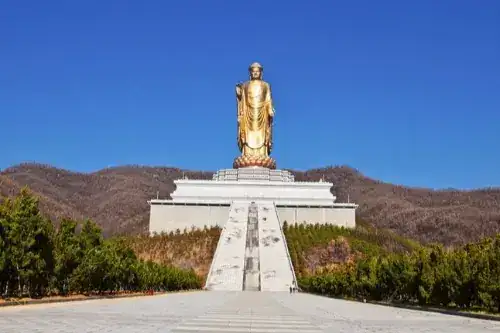
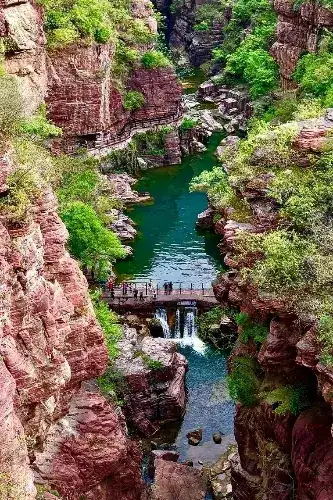
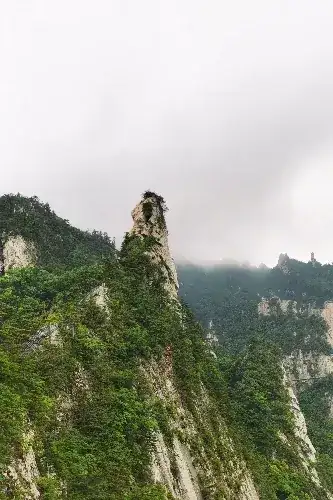
Lingshan Scenic Area, located in southwestern Luoshan County, covers 61.5 square kilometers with six sub-scenic areas including Lingshan Temple, Xiaoyao Cave, Golden Summit, and Jiuli Luoyan Lake. Tangquanchi Scenic Area in Shangcheng County is a renowned hot spring and mountain resort, with springs formed approximately 100 million years ago, yielding 650 tons daily at 56-58 degrees Celsius, rich in strontium, silver, titanium, and other mineral elements. Jingangtai Geological Park, straddling the Henan-Anhui border, features the main peak Jingangtai at 1,584 meters, the highest peak in the Dabie range within Henan.
The old Eight Scenic Spots of Xinyang were established by poet Zhang Yue during the Qianlong era, including sights such as Pine Wind at Xian Ridge, Moon on the Shi River, and Morning Glow at Shen Pagoda. In 2010, eight new scenic spots were renovated, including Lake View Pavilion, Tea Pavilion, Sage Gathering Hall, and Shen Bo Tower.
Specialties and Cuisine
Xinyang Maojian is one of China's top ten famous teas and a renowned Henan specialty. In 2017, it was ranked second among "China's Top Ten Tea Regional Public Brands," with a brand value of 6.352 billion yuan (approximately $889 million) in 2018, ranking second nationally. Xinyang was awarded the title "China's Maojian Capital." Other local specialties include Xinyang Black Tea, Huainan pig, Xi County fragrant rice balls, Xinyang chestnuts, Luoshan Qilin watermelon, Guangshan freshwater shrimp, Chinese kiwifruit, ginkgo, and loquat.
Signature local dishes include Xinyang glutinous rice cakes, Huangchuan tribute noodles, Huaibin hemp duck, Gushi goose, Xinyang pressed duck, Nanwan fish, Huanggang fish soup, Luoshan pork intestine soup, Luoshan hollow hanging noodles, Shangcheng old duck soup, Shangcheng scallion-roasted quail, stuffed fish tubes, and egg-filled flatbread.
Notable Figures
Notable historical figures from Xinyang include Sun Shu'ao, Huang Xie, Fei Yi, Wei Yan, Chen Yuanguang, Ma Zuchang, He Jingming, Song Shijie, Zhou Zupei, Xu Shiyou, Li Desheng, Zheng Weishan, You Taizhong, Sima Guang, and Deng Yingchao.
Honorary Titles
Xinyang has received numerous honorary titles, including: Top 10 Happiest Cities in China, China Excellent Tourist City, National Health City, National Garden City, National Greening Model City, National Ecological Demonstration City, China Top 10 Green Economy Cities, National Double Support Model City, and Toilet Revolution Outstanding City Award.
In 2017, Xinyang was named one of China's safest cities and ranked among the top 50 most investment-potential cities. It was designated a National Forest City. In 2019, it received the China City Green Competitiveness honor. In 2020, Xinyang was named a National Civilized City and received the National Voluntary Blood Donation Advanced City award. In 2021, it was selected as a demonstration city for systematic sponge city development. In 2022, it was reconfirmed as a National Health City, ranked 100th on the China Top 100 Vigorous Cities list, and selected as a climate finance pilot city. In 2023, it was named a seventh-batch Ecological Civilization Construction Demonstration Zone and selected as a first-batch carbon peak pilot city. In April 2025, Xinyang was named a National Double Support Model City at the naming conference in Beijing.
Travel information can change. Check current opening hours, reservations and entry requirements before you travel.
Traveller discussion
Start the conversation with a helpful tip or a question.