
Nanyang City
Nanyang CityNanyang City, known in ancient times as Wan, is a prefecture-level city in Henan Province and a sub-center of the province. It is designated by the State Council as an important transportation hub in central China and a regional
Nanyang City
Nanyang City, known in ancient times as Wan, is a prefecture-level city in Henan Province and a sub-center of the province. It is designated by the State Council as an important transportation hub in central China and a regional center at the junction of Henan, Hubei, and Shaanxi provinces. Located between 32 degrees 17 minutes to 33 degrees 48 minutes north latitude and 110 degrees 58 minutes to 113 degrees 49 minutes east longitude, it covers a total area of 26,600 square kilometers. As of April 2025, Nanyang administers 2 districts, 10 counties, and 1 county-level city, with the municipal government seated in Wolong District. As of the end of 2025, the resident population was 9.395 million. Nanyang sits on the transitional slope between China's second and third topographic tiers, featuring a basin-type landscape of mountains, hills, and plains. It has a typical monsoonal continental semi-humid climate with four distinct seasons, abundant sunshine, and ample rainfall. The name "Nanyang" derives from its location south of the Funiu Mountains and north of the Han River. Nanyang is a major birthplace of Chu-Han culture, known for legendary stories such as "Three Visits to the Thatched Cottage" and "Yang Xu's Suspended Fish." It is hailed as "China's Rose Hometown," "World Mugwort Capital," and "China's Jade Carving Hometown." Notable attractions include the Xixia Dinosaur Relic Park, Xixia Laojieling, Wolonggang Wuhou Shrine, and Huangshan Site. Nanyang is also a National Civilized City, National Health City, China Excellent Tourist City, National Innovative Pilot City, and National Forest City. As a national commodity grain and cotton base, it is known as the "Granary of the Central Plains." Its pillar industries include advanced equipment manufacturing, automobiles and parts, optoelectronics, textiles, biomedicine, and new energy. In 2025, Nanyang's GDP reached 516.786 billion yuan (approximately 71.8 billion USD), a year-on-year increase of 6.5%.
Name Origin
Nanyang's ancient name "Wan" was established as Wan Yi in 687 BCE during the Spring and Autumn period. The name "Nanyang" first appeared in Warring States historical records. According to the Comprehensive Mirror in Aid of Governance, the Qin dynasty established Nanyang Commandery because the area lies "south of the southern mountains and north of the Han River," following the geographic convention of "south of mountains, north of rivers."
History
Pre-Qin Period
During the Xia dynasty (c. 21st to 16th century BCE), Nanyang belonged to Yuzhou. During the Shang dynasty (c. 16th to 11th century BCE), the area was called "Nanxiang." During the Western Zhou dynasty, multiple vassal states were established, including the Shen, Lu, and Chu states. During the Spring and Autumn period, most of these states were conquered by Chu. By the late Warring States period, Bai Qi of Qin captured Wan, and King Zhao of Qin established Nanyang Commandery in 272 BCE, the first use of "Nanyang" as an administrative name.
Qin and Han Dynasties
During the Qin dynasty (221 to 206 BCE), Nanyang Commandery was headquartered at Wan and governed 14 counties. During the Western Han dynasty, the region was divided between Nanyang and Hongnong commanderies with 25 counties. During the Eastern Han dynasty, Nanyang Commandery governed 37 counties.
Three Kingdoms to Northern and Southern Dynasties
During the Three Kingdoms period (220 to 265 CE), the region had Nanyang and Nanxiang commanderies under Wei. During the Western Jin, Nanyang became a principality. The Eastern Jin and Sixteen Kingdoms period saw the area change hands among various regimes. During the Northern and Southern Dynasties, Nanyang was contested between southern and northern regimes, eventually falling under Northern Wei control. Emperor Xiaowen of Northern Wei relocated the Jingzhou seat to Rangcheng (modern Dengzhou) to strengthen control over Nanyang.
Sui, Tang, and Five Dynasties
During the Sui dynasty (581 to 618 CE), the region had Nanyang, Yuyang, Xiyang, Huaian, and Chongling commanderies. During the Tang dynasty, the area was divided into Dengzhou and Tangzhou under the Shannan East Circuit. During the Five Dynasties, Dengzhou and Tangzhou continued with changing military designations.
Song, Jin, and Yuan Dynasties
During the Northern Song, the region had Tangzhou and Dengzhou under the Jingxi South Circuit. After the Jingkang Incident, local forces resisted the Jin invasion until the 1141 peace treaty ceded Nanyang to Jin. During the Jin dynasty, Dengzhou, Tangzhou, Yuzhou, and Shenzhou were established. During the Yuan dynasty, Nanyang Prefecture was established under the Henan-Jiangbei Branch Secretariat, governing 5 prefectures and 13 counties.
Ming and Qing Dynasties
During the Ming dynasty (1368 to 1644), Nanyang Prefecture under Henan Province governed 2 sub-prefectures and 11 counties. During the Qing dynasty, Dengzhou and Yuzhou were reduced to departments. Xichuan was elevated to a sub-prefecture in 1905.
Republic of China Period
After the 1911 Revolution, the region underwent multiple administrative reorganizations. In 1913, old prefectures were converted to counties. In 1932, the Sixth and Seventh Administrative Inspectorate Districts were established and later merged. During the civil war period (1947 to 1948), liberated zones were established, and Xixia County was carved out of western Neixiang in May 1948.
People's Republic of China
After the founding of the People's Republic in 1949, Nanyang underwent multiple administrative changes. In 1965, Sheqi County was established from parts of Nanyang, Fangcheng, Tanghe, and Biyang counties. In 1994, the State Council abolished Nanyang Prefecture and established the prefecture-level Nanyang City, with Wancheng and Wolong districts replacing the former county-level city and county.
Administrative Divisions
Division History
Nanyang's administrative structure evolved through dynastic changes. In 1994, the prefecture-level Nanyang City was established with 2 districts, 10 counties, and 1 county-level city. The Nanyang High-Tech Industrial Development Zone was established in 1995, and additional functional zones were created in subsequent years.
Division Details
As of April 2025, Nanyang administers 2 districts (Wolong and Wancheng), 10 counties (Nanzhao, Fangcheng, Xixia, Zhenping, Neixiang, Xichuan, Sheqi, Tanghe, Xinye, and Tongbai), and 1 county-level city (Dengzhou). Additional functional zones include the High-Tech Industrial Development Zone, Urban-Rural Integration Demonstration Zone, Guanzhuang Advanced Manufacturing Development Zone, and Wolong Comprehensive Bonded Zone, with 243 townships and sub-districts in total.
Geography
Location
Nanyang is located in southwestern Henan Province at the junction of Henan, Hubei, and Shaanxi provinces. It borders Zhumadian and Xinyang to the east, Xiangyang, Shiyan, and Suizhou (Hubei) to the south, Shangluo (Shaanxi) to the west, and Sanmenxia, Luoyang, and Pingdingshan to the north. It spans 263 kilometers east to west and 168 kilometers north to south, with a total area of 26,600 square kilometers, accounting for 16% of Henan Province's total area.
Topography
Nanyang sits on the transitional slope between China's second and third topographic tiers, featuring a basin-type landscape. Mountains cover 9,709 square kilometers (36.5% of the total), including the Funiu Mountains to the north, Xichuan karst low mountains to the southwest, and Tongbai Mountains to the east. Hills cover 7,980 square kilometers (30%), and plains cover 8,911 square kilometers (33.5%), mostly within the Nanyang Basin.
Climate
Nanyang has a typical monsoonal continental semi-humid climate at the transition zone between the northern subtropical and warm temperate zones. The average annual temperature is 16 degrees Celsius, with extremes ranging from minus 10.9 to 40.6 degrees Celsius. Average annual precipitation is 1,066.3 millimeters, with summer receiving the most rainfall.
Hydrology
Nanyang's rivers belong to three major water systems: the Han River (Yangtze basin) in the central and western areas, the Huai River in the southeast, and a small portion of the Yellow River basin in the north. Major rivers include the Dan, Tang, Bai, Huai, Guan, and Tuan rivers. The Danjiangkou Reservoir, primarily located in Xichuan, is the largest artificial freshwater lake in Asia and serves as the water source for the South-to-North Water Diversion Project's central route.
Natural Resources
Water Resources
Nanyang has abundant water resources with 184 rivers having catchment areas over 50 square kilometers. Total water resources amount to 6.942 billion cubic meters, with groundwater resources of 1.062 billion cubic meters. There are 2 large reservoirs, 26 medium reservoirs, and 489 small reservoirs, with a total storage capacity of 2.535 billion cubic meters.
Mineral Resources
As of 2025, 86 mineral types have been discovered in Nanyang, with proven reserves for 61 types and 36 under active exploitation. Metallic minerals include gold, silver, copper, iron, lead, zinc, nickel, vanadium, and molybdenum. Non-metallic minerals include natural soda, graphite, quartz, fluorite, and marble. Dushan jade is particularly renowned. Energy minerals are primarily petroleum.
Forest Resources
Nanyang is a major forestry city with 8 nature reserves, including 5 national-level reserves. The Funiu Mountain area supports substantial forest ecosystems with significant ecological value.
Biological Resources
Nanyang records 393 terrestrial vertebrate species, including 62 mammals, 286 birds, 31 reptiles, and 14 amphibians. The "Nanyang cattle" breed is one of China's five major local cattle breeds. The city also has 2,733 vascular plant species across 186 families, including over 50 nationally protected wild plant species such as Qinling fir, yew, and ginkgo. Xixia kiwifruit and Nanzhao magnolia rank among the top nationally.
Population
Population Size
As of the end of 2025, Nanyang's resident population was 9.395 million, including 5.1513 million urban residents, with an urbanization rate of 54.83%. The birth rate was 5.50 per mille, death rate 9.26 per mille, and natural growth rate was minus 3.77 per mille.
Ethnic Composition
Nanyang has 49 ethnic minority groups with a total minority population of 288,000. The Hui people (169,000) are concentrated in Zhenping, Fangcheng, Dengzhou, and Tanghe; the Mongolian people (73,000) in Zhenping, Xichuan, and Sheqi; and the Manchu people (33,000) in Neixiang, Xichuan, and Nanzhao. Nanyang is also one of the largest Uyghur population centers outside Xinjiang.
Dialects
Nanyang dialects belong to the Central Plains Mandarin group. Due to its location at the north-south boundary, Nanyang became a convergence point for northern and southern dialects, forming a transitional character. The dialect has internal eastern, western, and central variations, and is gradually converging toward Standard Mandarin.
Religion
Nanyang's location at the crossroads of north and south facilitated religious spread. Taoism arrived during the Eastern Han, Buddhism during the Eastern Jin, and Islam was brought by Hui merchants from Shaanxi and Hebei. Catholicism was introduced in 1644 by French missionaries, and Protestantism arrived in 1880. Nanyang holds an important position in Chinese religious history.
Politics
The municipal government operates under the leadership of the Municipal Party Committee and the People's Congress. Key administrative functions are divided among various municipal departments overseeing urban development, economy, and public services.
Economy
Overview
In 2025, Nanyang's GDP reached 516.786 billion yuan (approximately 71.8 billion USD), growing 6.5% year-on-year, ranking third in Henan Province. The three-industry structure was 15.3:31.9:52.8. The general public budget revenue was 22.827 billion yuan (approximately 3.17 billion USD), up 2.7%. Per capita disposable income was 32,012 yuan (approximately 4,446 USD), up 4.9%. Fixed asset investment grew 5.5%, with industrial investment increasing 16.2%.
Primary Industry
Nanyang is a major national commodity grain and cotton base, known as the "Granary of the Central Plains." In 2025, the primary industry's value added was 79.064 billion yuan, up 3.6%. Key crops include wheat, corn, cotton, and peanuts. The city is recognized as "China's Rose Hometown" and the "World Mugwort Capital."
Secondary Industry
In 2025, the secondary industry's value added reached 164.864 billion yuan, up 5.7%. Key industrial sectors include advanced equipment manufacturing, automobile and parts production, optoelectronic information, textiles and garments, biomedicine, and new energy. Industrial investment grew 16.1%, accounting for 60.1% of total fixed asset investment.
Tertiary Industry
In 2025, the tertiary industry's value added was 272.858 billion yuan, up 8.0%, accounting for 52.8% of GDP. The service sector encompasses tourism, commerce, logistics, and finance, leveraging the city's rich historical and cultural heritage. Nanyang's tourism industry benefits from 71 A-level scenic spots, including 26 at 4A level or above, 60 star-rated hotels, and 82 travel agencies.
Social Services
Education
As of 2025, Nanyang has 8 regular higher education institutions with 150,900 enrolled students, 142 regular high schools, 456 junior high schools, and 1,405 primary schools. The city also has 57 vocational-technical schools and 14 special education schools, with a total of 788,000 students receiving financial aid.
Science and Technology
Nanyang has 133 provincial-level or higher enterprise technology centers (including 11 national-level), 369 provincial engineering technology research centers, and 5 provincial key laboratories. In 2025, the city obtained 4,615 authorized patents with 3,367 valid invention patents, and signed 5,828 technology contracts worth 22.9 billion yuan (approximately 3.18 billion USD).
Culture
Nanyang has multiple art performance venues, libraries, and museums. The city's cultural institutions preserve and promote Chu-Han cultural heritage through various exhibitions and festivals. The Nanyang Han Stone Carvings Museum houses the nation's largest collection of Han dynasty stone carvings.
Sports
Nanyang maintains sports facilities including stadiums, swimming pools, and training centers. The city has produced athletes competing at national and international levels and has hosted sporting events including the National Peasant Games.
Healthcare
Nanyang has a comprehensive healthcare system with multiple tertiary hospitals, including Nanyang Central Hospital. Medical services cover both urban and rural areas, with ongoing investment in healthcare infrastructure and public health programs.
Social Security
In 2025, Nanyang created 80,800 new urban jobs. The city's pension insurance covered 1.18 million enterprise employees, unemployment insurance covered 870,500 people, and worker medical insurance covered 987,200 people. Minimum living allowances were distributed to 21,100 urban residents and 475,300 rural residents. The city has 1,160 eldercare service institutions with 123,700 beds.
Transportation
Overview
Historically a major land and water transport hub, Nanyang was described as "commerce spreading throughout the world, wealth crowning the nation" during the Western Han dynasty. In modern times, the Jiaoliu and Ningxi railways form a cross pattern at Nanyang, supplemented by the Zhengzhou-Chongqing high-speed railway and the Haoji railway. Expressway mileage exceeds 1,000 kilometers. Nanyang is designated as a national comprehensive transportation hub city and a national logistics hub for commercial services.
Railways
The Jiaoliu Railway (formerly Jiaozhi Railway) and Ningxi Railway intersect in the urban center, forming a cross pattern. The city has 9 operational railway stations, including connections to the Zhengzhou-Chongqing high-speed railway and Haoji railway.
Highways
Nanyang has 6 national expressways, 8 Henan provincial expressways, 8 national highways, and 27 provincial highways. As of 2025, expressway mileage reached 1,123 kilometers, with 1.6929 million registered civil vehicles (including 1.597 million private vehicles).
Water Transport
The Tang River shipping project is under construction, leveraging the Han River and Yangtze River "golden waterways" to restore Nanyang's historical connectivity to the sea. In 2024, water transport handled 967,800 passengers.
Civil Aviation
Nanyang Jiangying Airport is one of Henan Province's important civil aviation ports, connecting to over 20 major Chinese cities. In 2024, the airport handled 806,700 passengers.
History and Culture
Overview
As a national famous historical and cultural city, Nanyang has 7,000 years of civilization history and over 2,800 years of city-building history. It is a major birthplace of Chu-Han culture. During the Warring States period, Nanyang was a nationally renowned iron-smelting center. During the Western Han, it was one of six major metropolises. Emperor Guangwu of Han (Liu Xiu) launched his campaign from Nanyang, earning the city the titles "Southern Capital" and "Imperial Homeland." Nanyang has 24 nationally protected cultural heritage sites, 26 museums with over 210,000 precious artifacts, 13 national-level intangible cultural heritage items, and 55 provincial-level items.
Historical Sites
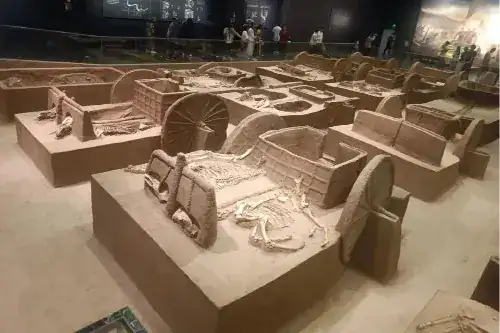
Key sites include ancient ruins such as the Xinghuashan Paleolithic ape-man site in Nanzhao, the Baligang Neolithic site, the Huangshan site (a major Yangshao and Qujialing culture jade workshop settlement), and Han dynasty iron-smelting ruins. Notable tombs include those of Zhang Heng (the Eastern Han astronomer) and Zhang Zhongjing (the Eastern Han physician). The Nanyang Prefectural Yamen is the only fully preserved prefectural government office in China, and the Neixiang County Yamen is the best-preserved ancient county government in China.
Intangible Cultural Heritage
Nanyang is one of China's richest areas for intangible cultural heritage, covering all ten major categories. The city has 13 national-level, 55 provincial-level, 219 municipal-level, and 1,152 county-level intangible cultural heritage representative projects. National-level items include Bantou Qu music, Wan Bang opera, and Da Diao Qu music, with the number of national-level projects ranking first in the province.
Customs
The "Taizhuang Gushi" (carried ancient costume performance) originated in 1673 when Shanxi immigrants settled in the Qinghua area of Nanyang. Performed during the Lantern Festival and temple fairs, it features children standing on tables carried by performers, depicting scenes from over 240 traditional operas, blending dance, drama, and acrobatics. It is known as "a unique treasure of the Central Plains." The Zhang Zhongjing commemoration has been held since the Ming and Qing dynasties, with thousands visiting the Medical Sage Shrine to pay respects, and since 2002 the city has hosted an annual Traditional Chinese Medicine Culture Festival.
Scenic Spots
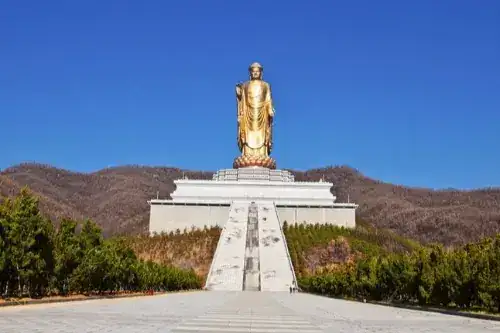
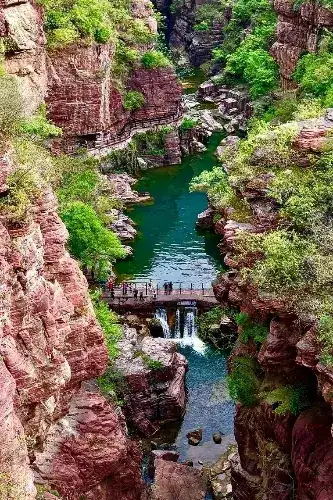
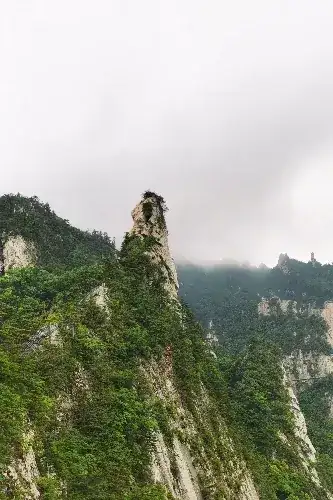
Nanyang is a China Excellent Tourist City with 71 A-level scenic spots (including 26 at 4A level or above), 60 star-rated hotels, and 82 travel agencies. Major attractions include the Xixia Dinosaur Relic Park, Xixia Laojieling National Nature Reserve, Wolonggang Wuhou Shrine, Baotianman Nature Reserve, and the Nanyang Han Stone Carvings Museum.
Local Specialties
Nanyang's cuisine features wheat-based staples, with rice in some areas like Tongbai. Dumplings originated in Nanyang as "Jiaoer." Breakfast includes mutton soup, beef soup, spicy soup, and fried dough sticks. Local specialties include Xichuan sauerkraut, Nanyang oil tea, Tongbai soybean tendons, Zhenping roast chicken, Bowang flatbread, Xinye meat sauce, Tanghe pork knuckles, and Fangcheng braised noodles.
Related Events
On May 28, 2026, a passenger van collision on the G40 Shanghai-Shaanxi Expressway in the Tongbai Maoji section of Nanyang resulted in 13 fatalities and 3 injuries. The vehicle was overloaded with 16 people against a 9-person capacity. The Ministry of Public Safety dispatched a working group to Nanyang to guide the investigation.
Sister Cities
Nanyang has established sister-city relationships with international cities to promote exchange and cooperation in culture, economy, and technology.
Notable Figures
Nanyang has produced numerous legendary figures throughout history, known as the "Five Sages of Nanyang": Jiang Ziya (strategist sage), Fan Li (merchant sage), Zhang Heng (science sage), Zhang Zhongjing (medicine sage), and Zhuge Liang (wisdom sage). Emperor Guangwu of Han (Liu Xiu) rose to power from Nanyang. The poet Li Bai praised Nanyang: "This land abounds in heroes, towering and unattainable." Over 800 Nanyang natives are recorded in historical records. In modern times, Nanyang has produced academician groups led by Yang Tingbao, educator groups led by Feng Youlan, jurist groups led by Zhang Wenxian, and writer groups led by Eryuehe. Nanyang is known as "Henan's Academician Hometown," with Nanyang-born academicians accounting for nearly one-quarter of all Henan-born academicians.
Honors and Titles
Nanyang has been designated as a National Civilized City, National Health City, China Excellent Tourist City, National Innovative Pilot City, National Forest City, and National Garden City.
Travel information can change. Check current opening hours, reservations and entry requirements before you travel.
Traveller discussion
Start the conversation with a helpful tip or a question.