
Sanmenxia City
Sanmenxia CitySanmenxia, a prefecture-level city in Henan Province also known as Shanzhou, is situated in western Henan, south of the Yellow River, at the junction of Henan, Shanxi, and Shaanxi provinces. The area features a warm-temperate
Sanmenxia City
Sanmenxia, a prefecture-level city in Henan Province also known as Shanzhou, is situated in western Henan, south of the Yellow River, at the junction of Henan, Shanxi, and Shaanxi provinces. The area features a warm-temperate continental monsoon semi-arid climate, with landscapes dominated by mountains, hills, and loess plateaus, covering 9,936 square kilometers. As of June 2026, the city administers 2 districts, 2 counties, and 2 county-level cities. As of end-2025, the resident population was 1.995 million. The city has 3,107 rivers belonging to the Yellow River and Yangtze River water systems. Sanmenxia was established as a city in March 1957, downgraded to county-level in 1961, and re-elevated to a prefecture-level city in 1986. Known for the saying "five mountains, four ridges, and one plain," the city is a regional transportation hub connecting the three provinces. Yangshao Culture, Daoist culture, and Guo State culture all originated here. In 2025, the city's GDP reached 170.261 billion yuan (approximately $23.5 billion USD), up 6.1%.
Name Origin
Sanmenxia is located in western Henan at the junction of three provinces, bordering Luoyang to the east, Nanyang to the south, Weinan and Shangluo of Shaanxi to the southwest, and facing Yuncheng of Shanxi across the Yellow River to the north. According to legend, during antiquity, devastating floods ravaged the Central Plains. Yu the Great, responsible for flood control, abandoned his father Gun's "primarily blocking" approach in favor of "primarily dredging, combining dredging with blocking." He carved open Longmen (Dragon Gate) in the middle reaches of the Yellow River and split a mountain blocking the water into three gorges with his divine axe, naming them Human Gate, Divine Gate, and Ghost Gate—hence the name Sanmenxia ("Three Gate Gorge"). The area lies at the foot of Xiaoshan Mountain, a foothill of the Qinling range, where the ancient Hangu Pass stands. Since Xiaoshan and Hangu Pass were collectively known as the "Xiaohan" barrier in ancient times, Sanmenxia is also called "Xiaohan." Each autumn and winter, tens of thousands of white swans fly, swim, and forage on the clear waters of the Sanmenxia Reservoir, earning the city the reputation of "City of Swans."
History
Late Neolithic Period
Large clan tribes appeared here approximately 6,000 years ago.
Pre-Qin Period
Around the 21st to 13th centuries BCE, this area was a central region under the Xia and Shang dynasties. During the Western Zhou dynasty, it belonged to the State of Jiao and the State of Guo. In the Spring and Autumn period, it first belonged to Guo, then to Jin. During the Warring States period, it was divided among the states of Han, Qin, and Wei. Under the Qin dynasty, it was part of Sanchuan Commandery.
Western Han to Northern and Southern Dynasties
In the early Han dynasty, the area belonged to Hongnong Commandery; after Emperor Ling of Han, it belonged to Hengnong Commandery. During the Three Kingdoms period, it was part of Wei's Hengnong Commandery. Under the Jin dynasty, it belonged to Sizhou's Hongnong Commandery. During the Northern Wei dynasty, Shanzhou was established, a designation that continued through the Ming and Qing dynasties.
Republic of China Period
During the Republican era, the area first belonged to Yuxi Circuit and Heluo Circuit, later becoming the Eleventh Administrative Inspectorate of Henan Province. In 1944, the Chinese Communist Party led the people of western Henan to establish the Western Henan Anti-Japanese Base Area. In 1945, the War of Resistance Against Japan ended in victory.
After the Founding of the People's Republic of China
Around the founding of the People's Republic of China, the Shanzhou Commissioner's Office was established. In 1952, the Shanzhou and Luoyang commissioner's offices merged. In March 1957, the State Council approved the establishment of Sanmenxia City under direct Henan provincial administration. In 1961, it was downgraded from a prefecture-level to a county-level city. In 1986, with State Council approval, Sanmenxia was re-elevated to a prefecture-level city.
Administrative Divisions
In March 2015, Shan County was dissolved and Shanzhou District was established, with its government seated at No. 18 Shanzhou Avenue, Daying Town. As of June 2026, Sanmenxia administers 2 districts, 2 counties, and 2 county-level cities: Hubin District, Shanzhou District, Lingbao City, Yima City, Lushi County, and Mianchi County—comprising 32 townships, 29 towns, and 13 sub-districts, with 1,211 villages and 172 communities. The municipal government is seated at No. 47 Xiaoshan Middle Road, Hubin District.
Geography
Location and Boundaries
Sanmenxia lies in western Henan between 33 degrees 31 minutes to 35 degrees 5 minutes north latitude and 110 degrees 21 minutes to 112 degrees 1 minute east longitude, at the junction of Henan, Shanxi, and Shaanxi provinces, south of the Yellow River. It borders Luoyang to the east and northeast (Xin'an, Yiyang, Luoning, and Luanchuan counties), Nanyang's Xixia County to the south, Luonan, Danfeng, and Shangnan counties of Shangluo, Shaanxi to the southwest, Tongguan County of Weinan, Shaanxi to the west, and faces Ruicheng, Pinglu, and Yuanqu counties of Yuncheng, Shanxi across the Yellow River to the north. The east-west span is 153 kilometers, the north-south width is 132 kilometers, and the total area is 9,936 square kilometers.
Geology
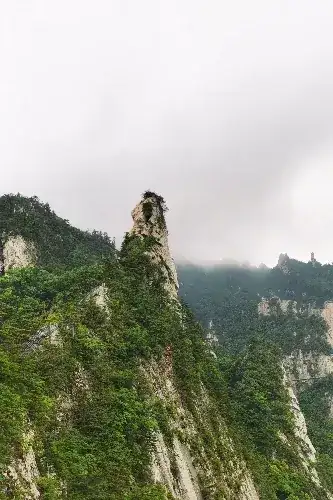
Sanmenxia has diverse terrain, described as "five mountains, four ridges, and one plain." From north to south, five major mountain ranges are distributed: Xiaoshan, Xiaoqinling, Xionger, Funiu, and Waifang. Sanmenxia sits at the convergence of these mountain ranges.
Topography and Landforms
Sanmenxia lies at the intersection of the eastward extension of the Qinling Mountains with the Funiu, Xionger, and Xiaoshan ranges, with an average elevation between 300 and 1,500 meters. Mountainous areas cover 5,750 square kilometers (54.8%), hilly areas 3,777 square kilometers (36%), and plain areas 969 square kilometers (9.2%). Laoyachanao Peak in Xiaoqinling, at 2,413.8 meters, is the highest peak in Henan Province, now protected within the Xiaoqinling National Nature Reserve. The urban area sits on a terrace on the south bank of the Yellow River, surrounded by water on three sides, forming a peninsula-like shape.
Climate
Sanmenxia is in a mid-latitude inland region. Except for the subtropical climate of the low hilly areas south of Xionger Mountain in Lushi County, most of the area has a warm-temperate continental monsoon semi-arid climate with four distinct seasons: average annual temperature of 14.2 degrees Celsius, annual rainfall of 400 to 700 millimeters, a frost-free period of 215 days, and approximately 2,055.4 hours of annual sunshine.
Hydrology
Sanmenxia has 3,107 rivers of various sizes, belonging to the Yellow River and Yangtze River water systems. The Yellow River basin covers 9,376 square kilometers (89.3% of the total area). The Yellow River main stream enters Lingbao from Tongguan County in Shaanxi, flowing through 16 townships across Lingbao, Shanzhou, Hubin, and Mianchi, with a total length of 225 kilometers; its historical maximum flood peak reached 36,000 cubic meters per second (1843). The Yangtze River system primarily consists of the Laoguan and Qi rivers in southern Lushi County, with a basin area of 1,120 square kilometers (10.7%). Besides the Yellow River, 33 rivers have basin areas exceeding 100 square kilometers.
Natural Resources
Water Resources
In 2023, Sanmenxia's total water resources amounted to 2.79489 billion cubic meters, 41.3% above the multi-year average and 47.3% higher than 2022. Five reservoirs managed by the water authority had a total storage of 146.61 million cubic meters at year-end.
Land Resources
Sanmenxia has 2,300 hectares of wetlands, 142,700 hectares of arable land (2.1411 million mu), 65,100 hectares of orchard land (976,500 mu), and 57,900 hectares of grassland (869,200 mu).
Biological Resources
The city has 144 families, over 780 genera, and more than 2,100 species of vascular plants, including rare species such as Euptelea, Magnolia biondii, hemlock, katsura, yew, and Manchurian ash. Over 600 genera and 1,300 species have medicinal value. Wild fruit species include kiwi, wild grape, hawthorn, schisandra, wild cherry, and strawberry. The city hosts over 140 species of wild terrestrial vertebrates, including 20 reptile species, over 70 bird species, 42 mammal species, and 8 amphibian species. Notable species include the golden pheasant, long-eared owl, kestrel, goral, musk deer, wolf, dhole, raccoon dog, leopard, and wild boar. The serow is a Class I national protected species, while the giant salamander, swan, bean goose, mandarin duck, and otter are Class II protected species.
Mineral Resources
Sanmenxia has rich mineral resources, with 413 mineral deposits discovered—27 large, 56 medium, and 320 small or smaller. Sixty-six mineral types have been identified, with proven reserves for 50. The three major advantage minerals are gold, bauxite, and coal. Gold resources total 605.42 tons with 226.96 tons retained; bauxite reserves total 479 million tons with 440 million retained; coal reserves total 1.487 billion tons with 1.041 billion retained. An oil well at Hangu Pass in Lingbao produces 17.13 tons of crude oil daily, with estimated resources reaching 107 million tons.
Politics
The municipal government of Sanmenxia is seated at No. 47 Xiaoshan Middle Road, Hubin District.
Population
Population Size
As of end-2025, Sanmenxia had a resident population of 1.995 million, including 1.225 million urban and 770,000 rural residents, with an urbanization rate of 61.42%. There were 10,500 births (birth rate 5.25 per mille), 16,600 deaths (death rate 8.30 per mille), and a natural growth rate of -3.05 per mille.
Ethnic Groups
Besides the Han majority, 32 ethnic minorities reside in Sanmenxia, including Hui, Uyghur, Mongolian, Manchu, Zhuang, Korean, Tibetan, Miao, Yi, and others.
Language
The Sanmenxia dialect belongs to the Fenhe cluster of Central Plains Mandarin.
Religious Beliefs
Religious practice in Sanmenxia has evolved from predominantly Buddhism to a coexistence of Buddhism, Protestantism, Catholicism, and Islam.
Economy
Overview
In 2025, Sanmenxia's GDP reached 170.261 billion yuan (approximately $23.5 billion USD), up 6.1%. The primary, secondary, and tertiary industries added 18.129 billion, 70.701 billion, and 81.431 billion yuan respectively (up 4.3%, 5.9%, and 6.6%). Total fixed-asset investment grew 5.4%, with secondary industry investment surging 17.4%. Real estate investment declined 24.4%, though second-hand housing transactions rose 32.7%. Total fiscal revenue was 20.865 billion yuan (approximately $2.9 billion USD, up 1.7%). Per capita disposable income was 32,469 yuan (approximately $4,480 USD, up 5.1%), with urban income at 40,487 yuan (approximately $5,590 USD) and rural income at 23,534 yuan (approximately $3,250 USD). Per capita consumption expenditure was 22,890 yuan (approximately $3,160 USD, up 3.8%).
Primary Industry
In 2025, grain was sown on 164,490 hectares with total output of 744,000 tons (down 1.4%). Vegetable output reached 1.2461 million tons (up 2.1%) and edible mushroom output was 126,800 tons (up 3.8%). Meat production totaled 113,700 tons (up 10.6%), including 83,400 tons of pork. Aquaculture output was 11,700 tons (up 0.9%).
Secondary Industry
Above-scale industrial value-added grew 8.4% in 2025, with mining up 14.5% and manufacturing up 9.0%. Notable growth sectors included metal products (+197.8%), electrical machinery (+48.5%), automobile manufacturing (+21.8%), and pharmaceuticals (+13.8%). High-tech industry grew 8.0%, and strategic emerging industries grew 9.7%. Above-scale industrial enterprises recorded revenue of 222.497 billion yuan (approximately $30.7 billion USD, up 12.4%) with total profits of 9.537 billion yuan (approximately $1.3 billion USD, down 5.8%). Installed power generation capacity reached 8.128 million kilowatts (up 4.5%), with renewable energy accounting for 47%.
Tertiary Industry
In 2025, the wholesale and retail sector added 14.368 billion yuan (up 4.9%), transportation and warehousing 7.484 billion yuan (up 3.5%), accommodation and catering 3.513 billion yuan (up 5.5%), and finance 5.712 billion yuan (up 5.9%). Express delivery volume reached 67 million pieces (up 32.3%). Total retail sales reached 55.647 billion yuan (approximately $7.7 billion USD, up 6.1%). Import-export value was 18.91 billion yuan (approximately $2.6 billion USD, down 18.5%). Financial institution deposits reached 235.466 billion yuan (approximately $32.5 billion USD) and loans stood at 133.41 billion yuan (approximately $18.4 billion USD). The city received 52.1668 million tourist visits, with total tourism revenue of 40.156 billion yuan (approximately $5.5 billion USD).
Social Affairs
Science and Technology
As of 2025, Sanmenxia had 185 high-tech enterprises, 377 technology-based SMEs, and 64 provincial engineering technology research centers. Annual patent grants reached 850, with 698 valid invention patents. Technology contract transactions totaled 1.833 billion yuan, up 76.6%.
Education
In 2025, Sanmenxia had 33,200 students in regular and vocational higher education, 31,900 in 17 secondary vocational schools, 43,900 in senior high schools, 75,500 in junior high schools, and 147,600 in primary schools. Special education programs served 1,481 enrolled students.
Cultural Affairs
As of 2025, the city had 38 performing arts troupes, 7 cultural centers, 7 public libraries, and 7 state-owned museums. There were 12 nationally significant cultural heritage sites and 64 provincial-level sites. Radio coverage reached 99.86% and television coverage 99.87% of the population.
Healthcare
As of 2025, Sanmenxia had 2,125 medical institutions, including 58 hospitals (25 public, 33 private) and 2,046 grassroots facilities, with 17,302 beds and 21,330 health professionals. Total clinical visits reached 15.2156 million person-times.
Sports
In 2025, Sanmenxia athletes won 35 gold, 27 silver, and 31 bronze medals. The city had 6,632 social sports instructors.
Social Security
In 2025, Sanmenxia added 37,600 new urban jobs and re-employed 15,600 unemployed workers. Rural labor transfer employment reached 407,400. Urban employee basic pension insurance covered 533,100 participants, urban-rural resident pension covered 1.077 million, and basic medical insurance covered 1.5245 million urban-rural residents. Minimum living allowances supported 7,485 urban and 44,806 rural residents. The city commenced construction of 2,303 affordable housing units and began renovating 19,318 units in older urban neighborhoods.
Transportation
Overview
Sanmenxia has historically been a strategic gateway connecting Qin (Shaanxi) and Jin (Shanxi), serving as a vital passage for east-west trade. Together with Yuncheng and Linfen in Shanxi and Weinan in Shaanxi, it forms the Yellow River Golden Triangle Economic Cooperation Zone. In 2025, highway freight transport reached 51 million tons (up 1.9%) with freight turnover of 15.195 billion ton-kilometers (up 4.5%).
Highways
Sanmenxia has 3 expressways: the Lianhuo Expressway, Hohhot-Beihai Expressway, and Zhenglu Expressway, with 6 additional expressway projects under construction. The city maintains 5 national highways and 13 provincial highways, totaling 1,596 kilometers of trunk roads. Rural roads total 8,268.8 kilometers.
Railways
Railways within Sanmenxia total 496 kilometers, including the Zhengzhou-Xi'an High-Speed Railway (154 km), the Longhai Railway (189 km), and the Haoji Railway (153 km). Three local railways—Huda, Mian-Yang, and Mian-Zhang—connect to the Longhai Railway, forming a trunk-branch railway network serving the regional economy.
Water Transport
Sanmenxia is a non-water-network inland area. The Yellow River flows 220 kilometers through the city, with 140 km upstream and 80 km downstream of the Sanmenxia Dam. Water transport is limited to ferry crossings and tourism, with 4 key reservoir areas, 15 ferry crossings, and 4 tourist piers. The city has 19 transport vessels and 230 crew members. In 2020, water transport carried 35,865 passengers.
Culture and History
Overview
Yangshao Culture, Daoist culture, and Guo State culture all originated in Sanmenxia. The city is also the site where the Yellow Emperor cast his cauldron, where Laozi wrote the Dao De Jing, and where Bodhidharma, founder of Chan Buddhism, passed away. The city has 6 nationally significant cultural heritage sites, 33 provincial-level sites, and over 70,000 catalogued artifacts. The Lingbao Xipo Site was selected as one of six priority sites for the Chinese Civilization Origins Project, and the Xiaohan Ancient Road was inscribed as a World Cultural Heritage site.
Customs
The Nancun area preserves the tradition of "crying weddings," where brides cry from the night before through arrival at the groom's home, expressing attachment to family. Another custom involves funeral processions for elders: the entire village accompanies the coffin, beating drums and gongs, circling the village before proceeding to the west gate as a tribute.
Hele noodles are the highest hospitality fare along the Yellow River. Made with a wooden noodle press, these fine, chewy noodles are served hot with scrambled eggs and tomatoes or cold with sesame oil, garlic, and cucumber. Neighbors collaborate to prepare them for visiting guests.
Arts
The Sanmenxia Puju Opera Academy has established a museum integrating production, education, and research, creating 25 historical and 5 modern plays and staging over 500 public-benefit performances.
Intangible Cultural Heritage
As of 2024, Sanmenxia had 5 items on the national intangible cultural heritage list (pit courtyard construction techniques, Lingbao paper-cutting, Lushi paper-cutting, Laozi legends, and Shanzhou drum storytelling), 44 on the provincial list, and 151 on the municipal list, with 2 national-level, 48 provincial-level, and 285 municipal-level representative inheritors. Sanmenxia is one of the birthplaces of Chinese paper-cutting, and local artists brought this art to the 2008 Beijing Olympics, 2010 Shanghai World Expo, and 2022 Beijing Winter Olympics.
Historical Sites
As of 2024, Sanmenxia had 1 World Cultural Heritage site, 12 nationally significant cultural heritage sites, 64 provincial-level sites, and 93 municipal-level sites, totaling over 3,413 cultural heritage points. Yangshao Culture, named after its 1921 discovery at Yangshao Village in Mianchi County, is a late Neolithic culture dating back 5,000 to 7,000 years. Over 5,000 Yangshao Culture sites have been discovered nationwide, with more than 200 in Sanmenxia. The discovery marked a milestone in Chinese field archaeology.
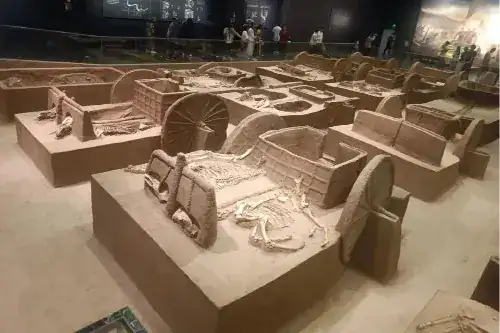
The Yellow Emperor's Cauldron-Casting Site at Jingshan in Lingbao spans 300 square kilometers with 50 Yangshao-period sites, and the Xipo Site was named one of China's Top Ten Archaeological Discoveries of 2006. The State of Guo, established in the early Western Zhou dynasty, profoundly influenced Zhou history and culture. The Guo State cemetery was discovered at Shangcunling in the 1950s; two large-scale excavations yielded artifacts of exceptional quantity and craftsmanship. The Guo State Museum was built on the excavation site in 2000.
Scenic Spots
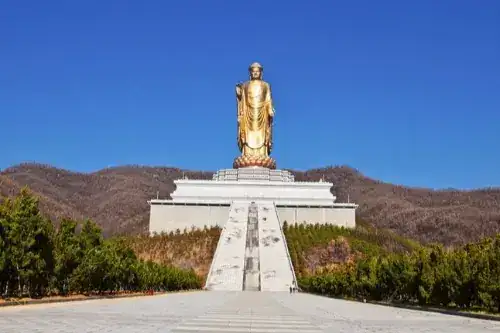
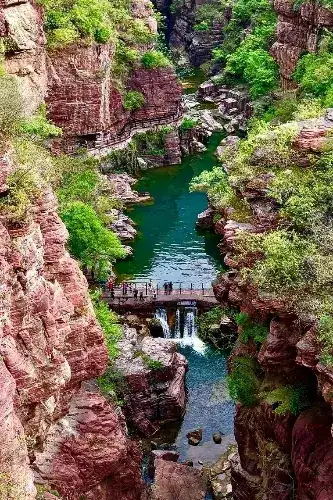
Sanmenxia's notable attractions include the Yangshao Culture Site, the Pillar Rock in the Yellow River (a symbol of the Chinese nation's indomitable spirit), the Yellow Emperor's Cauldron-Casting Site, Hangu Pass ("the eternal pass, source of Daoism"), the Guo State Museum, underground pit courtyard dwellings, Kongxiang Temple, the Ancient Yellow River Plank Road, Baolun Temple Pagoda, the Qin-Zhao Alliance Platform, and Hongqing Temple Grottoes. As of 2025, the city had 32 A-level scenic areas (19 at 4A level, 9 at 3A, and 4 at 2A), 30 travel agencies, and 11 star-rated hotels.
Food and Specialties
Food
Lushi chicken is one of Henan's three major local chicken breeds, an ancient breed suited for free-range mountain rearing. Yangshao apricot, a fruit specialty of Mianchi County named after the Yangshao Culture, has an egg-shaped fruit that separates from the pit when ripe, earning it the nickname "ringing apricot." Lingbao is Henan's largest apple production base, with over 100 million jin (50 million kg) in annual output. Lingbao apples are known for their large size, vibrant color, high sugar content, and rich aroma, with over 120 varieties.
Specialties
Local specialties include premium apples from Lingbao's Sihe Mountain, walnuts, Lingbao jujubes, Mianchi Yangshao apricots, Niuxin dried persimmons, the Ten-Bowl Feast, Lingbao meat sandwiches, and Lingbao large-knife noodles.
Notable Figures
(Information to be supplemented.)
Honors
Sanmenxia has been designated as a National Garden City, National Forest City, and Outstanding Tourism City of China. It has been named a National Double Support Model City, recognized for voluntary blood donation, and included in the "Zero-Waste City" construction list and the national key city list for waste material recycling systems during the 14th Five-Year Plan period. In April 2025, it was again named a National Double Support Model City (County).
Travel information can change. Check current opening hours, reservations and entry requirements before you travel.
Traveller discussion
Start the conversation with a helpful tip or a question.