
Puyang City
Puyang CityPuyang City, historically known as Diqiu, Chanzhou, and Kaizhou, is a prefecture-level city in Henan Province, located in the northeastern part of the province. It serves as a regional center at the junction of Henan, Shandong, a
Puyang City
Puyang City, historically known as Diqiu, Chanzhou, and Kaizhou, is a prefecture-level city in Henan Province, located in the northeastern part of the province. It serves as a regional center at the junction of Henan, Shandong, and Hebei provinces. The city borders Jining and Heze in Shandong to the east and south, Anyang in Henan to the west, Handan in Hebei to the north, Liaocheng and Tai'an in Shandong to the northeast, and Xinxiang in Henan to the southwest. The total area is 4,188 square kilometers. As of the end of 2024, Puyang administers 1 district and 5 counties, with a resident population of 3.691 million.
Puyang is the northeast gateway of Henan, an important maritime access route for the Central Plains Economic Zone, and home to the Zhongyuan Oilfield. It is a major petrochemical base, national petroleum machinery equipment manufacturing base, and a national down jacket processing hub. The city's three pillar industries are petrochemicals, equipment manufacturing, and green food. Puyang has a rich history as a National Famous Historical and Cultural City, recognized as a National Civilized City, National Hygienic City, and International Garden City. As one of the birthplaces of the Chinese nation, it is known as the "Ancient Capital of Emperor Zhuanxu" and the "Hometown of Emperor Shun." In 1987, a clam-shell dragon pattern dating back over 6,400 years was unearthed at the Xishuipo site, hailed as the "First Dragon of China." Puyang is also renowned as the "Hometown of Chinese Acrobatics." In 2025, the city's GDP reached 210.617 billion yuan (approximately USD 29 billion), a year-on-year increase of 5.6%.
History
Pre-Qin Period
Neolithic traces of human activity have been found in Puyang, with the area entering patrilineal clan society around 6,000 years ago. In antiquity, Puyang was located on the Heji Plain at the intersection of the Huaxia group led by the Yellow Emperor and the Dongyi group led by Shaohao. The great battle between the Yellow Emperor and Chiyou took place here. After the Yellow Emperor, Zhuanxu unified the Central Plains, establishing his capital at Diqiu (present-day Gaocheng, southeast Puyang). During the Xia Dynasty, the Kunwu clan established the state of Kunwu in Puyang. In the Shang Dynasty, the area served as a secondary capital. During the Western Zhou Dynasty, the area was part of the State of Wei and developed rapidly. In the Spring and Autumn period, Duke Cheng of Wei moved his capital to Diqiu, making it the political, economic, and cultural center of Wei. The Battle of Chengpu and the Battle of Tieqiu occurred here. The world's earliest recorded craftsman slave uprising — the Baigong Rebellion — took place in 478 BCE. During the Warring States period, Wei's territory shrank until only Puyang remained.
Qin to Northern and Southern Dynasties
After Qin unified China, the Jin Dike was constructed to contain the Yellow River. During the Han Dynasty, Puyang remained the seat of Dong Commandery. Emperor Wu of Han personally led efforts to block the Huzi River breach. In 69 CE, the famous water conservancy expert Wang Jing oversaw large-scale dike construction along the Yellow River. During the Three Kingdoms and Jin Dynasties, Puyang was part of Wei Commandery. The Northern Wei Dynasty established Chanzhou here.
Sui, Tang, Song, and Yuan Dynasties
In the Sui Dynasty, several counties were re-established. The Yongji Canal (part of the Grand Canal system) passed through Puyang, greatly facilitating transportation. During the Tang and Song, Puyang was an important administrative center. The Song Dynasty constructed imperial tombs and water conservancy projects in the area.
Ming and Qing Dynasties
During the Ming Dynasty, Puyang was called Kaizhou, administering Qingfeng and Nanle counties. The area saw significant agricultural recovery and development. By the mid-Ming period, 600 square kilometers were reclaimed for farming. From 1526 to 1642, the Yellow River flooded repeatedly, causing devastation. During the Qing Dynasty, Kaizhou was redesignated as Puyang County.
Republic of China Period
In 1913, Kaizhou was renamed Kaixian, but due to name conflicts with Sichuan and Guizhou provinces, it was renamed Puyang County the following year. During the Anti-Japanese War, resistance governments were established across the area, and the Hebei-Shandong-Henan border region administrative office was formed.
After the Founding of the People's Republic of China
After 1949, the Puyang Commissioner's Office administered 11 counties. In 1952, Pingyuan Province was abolished, and Puyang was placed under Henan Province. In 1954, Puyang and Anyang commissioner districts merged. In 1983, the State Council approved the establishment of Puyang as a prefecture-level city.
Administrative Divisions
As of the end of 2024, Puyang City administers 5 counties (Puyang, Qingfeng, Nanle, Fan, and Taiqian) and 1 district (Hualong). The municipal government is located at 158 Renmin Road, Hualong District.
Physical Geography
Location
Puyang is located in northeastern Henan, on the lower reaches of the Yellow River, at the junction of Hebei, Shandong, and Henan provinces. It is situated between latitudes 35°20′N and 36°12′N and longitudes 114°52′E and 116°5′E, approximately 200 kilometers from Zhengzhou, Jinan, and Shijiazhuang.
Topography
Puyang lies on the North China Plain and the Yellow River alluvial plain. The terrain is generally flat, sloping from southwest to northeast. The highest point reaches 61.8 meters above sea level, and the lowest is 39.3 meters. Flatlands cover about 70% of the total area, lowlands 20%, sand dunes 7%, and water bodies 3%.
Climate
Puyang has a warm temperate semi-humid monsoon continental climate with four distinct seasons. The average annual temperature is 13.4°C, with July being the hottest month (27°C average) and January the coldest (-2.2°C). The frost-free period lasts about 205 days. Average annual precipitation is 580.8 mm.
Hydrology
Puyang has 97 rivers, mostly small-to-medium, belonging to the Yellow River and Hai River systems. The Yellow River flows through the city for approximately 168 kilometers. The Jindi River, a tributary of the Yellow River, flows 125 kilometers through the city.
Natural Disasters
Puyang's major natural disasters include floods, droughts, locust plagues, and earthquakes, with floods and droughts being the most destructive. Over the 2,500 years the Yellow River flowed through Puyang, it breached its banks over 100 times and changed course 8 times.
Natural Resources
Puyang is rich in petroleum, natural gas, salt, and coal resources. The Zhongyuan Oilfield is a major petroleum production base. The city also has abundant geothermal and groundwater resources.
Population
As of the end of 2023, Puyang had a resident population of 3.701 million, with an urbanization rate of 52.57%. The population includes 183.10 million males and 187.00 million females, with a gender ratio of 97.9:100.
Economy
Overview
In 2025, Puyang's GDP reached 210.617 billion yuan (approximately USD 29 billion), up 5.6% year-on-year. The city has 8 advanced manufacturing development zones and 1 modern service industry development zone, with over 1,500 enterprises and 148,000 employees.
Primary Industry
Puyang is an important grain production base in China. Major crops include wheat, corn, rice, soybeans, and sweet potatoes. In 2024, the total grain output was 3.0628 million tons, up 2.2% year-on-year. Specialized products include edible mushrooms from Qingfeng, quality rice from Fan County, and fresh-cut flowers from the Economic Development Zone.
Secondary Industry
Industry is the core of Puyang's secondary sector, with petrochemicals, equipment manufacturing, and food processing as three pillar industries. Modern home furnishing, down garments, and bio-based materials are three specialized sectors. As of 2020, the equipment manufacturing sector had 209 above-scale enterprises covering over 2,300 products across the entire petroleum industry chain. The petrochemical industry generated over 80 billion yuan (approximately USD 11 billion) in revenue in 2023. In 2024, above-scale industrial value-added grew 11.5% year-on-year.
Tertiary Industry
The tertiary sector focuses on six areas: modern logistics, financial services, information services, cultural tourism, health and elderly care, and commerce/e-commerce. Puyang has 8 key logistics parks with over 870 enterprises and 70,000 freight vehicles. In 2024, the wholesale and retail sector generated 17.462 billion yuan (approximately USD 2.4 billion) in value-added, up 6.9%.
Social Affairs
Education
Puyang has a comprehensive education system including universities, secondary schools, and primary schools. The city has invested heavily in educational infrastructure and vocational training.
Science and Technology
Puyang maintains science and technology innovation platforms and has established cooperation with research institutions. The city promotes technology transfer and industrial upgrading.
Culture
Puyang has a rich cultural heritage with 22 A-level tourist attractions, including 4 AAAA-level sites. The city has 918 immovable cultural relics. Puyang acrobatics is nationally renowned.
Healthcare
The city has a network of hospitals and clinics providing comprehensive medical services, with steady improvements in healthcare infrastructure and capacity.
Transportation
Puyang is connected by highways, railways, and waterways. The city has 688 public buses (all new energy vehicles) operating 41 routes. The transportation network connects Puyang to major cities across the region.
Culture and History
Cultural Relics and Historic Sites
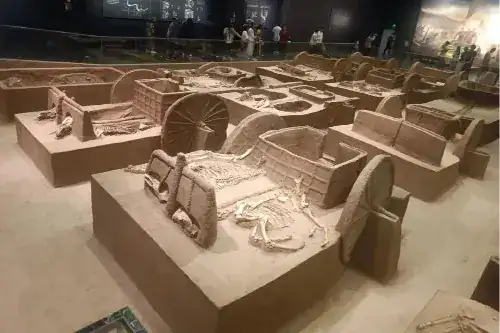
Puyang has 8 national-level protected cultural heritage sites, 38 provincial-level sites, and 61 municipal-level sites. Notable sites include the Qicheng Ruins, Xishuipo Site, and Gaocheng Site. The Qicheng Ruins, covering 160,000 square meters, is one of the best-preserved ancient city sites in northern Henan, dating back to the Peiligang Culture 8,000 years ago. The Xishuipo site is famous for the 6,400-year-old clam-shell dragon pattern, known as the "First Dragon of China."
Intangible Cultural Heritage
Puyang is the "Hometown of Chinese Acrobatics." The Cangjie Temple Fair is one of the largest temple fairs in northern Henan, recognized as a provincial intangible cultural heritage.
Regional Symbols
The Chinese rose (Chinese rose) is the city flower of Puyang, and the Chinese scholar tree (Chinese scholar tree) is the city tree.
Famous Attractions
Key attractions include the Cangjie Mausoleum Cultural Tourism Scenic Area (a 4A-level national scenic spot), Pushui Town, and various cultural and ecological parks. The city received 29.958 million domestic and international tourists in 2023, with tourism revenue of 6.17 billion yuan (approximately USD 850 million).
Local Cuisine
Puyang is a major grain production area where wheat flour is the staple. Local specialties include Puyang marinated fish, Puyang zhuangmo (stuffed flatbread), Liubaiju sausage, Pucheng roast lamb, and Puyang rolled cold noodles (a traditional snack popular year-round, especially in summer).
Notable Figures
Puyang has produced many historical figures throughout Chinese history, particularly from ancient times, given its significance as a birthplace of Chinese civilization.
Major Honors
Puyang has been recognized as a National Civilized City, National Hygienic City, National Garden City, International Garden City, Best Ecological Civilization Tourism City in China, and Excellent Tourism City in China.
Travel information can change. Check current opening hours, reservations and entry requirements before you travel.
Traveller discussion
Start the conversation with a helpful tip or a question.