
Jiaozuo City
Jiaozuo CityJiaozuo City is a prefecture-level city in Henan Province, located in the northwestern part of the province. It borders Lingchuan County and Zezhou County of Jincheng City, Shanxi Province to the north; Xingyang City and Gongyi
Jiaozuo City
Jiaozuo City is a prefecture-level city in Henan Province, located in the northwestern part of the province. It borders Lingchuan County and Zezhou County of Jincheng City, Shanxi Province to the north; Xingyang City and Gongyi City of Zhengzhou City, and Mengjin District of Luoyang City across the Yellow River to the south; Jiyuan City to the west; and Huixian City, Huojia County, and Yuanyang County of Xinxiang City to the east. The city has a warm-temperate continental monsoon climate with four distinct seasons and a total area of 4,071 square kilometers. As of July 2026, Jiaozuo administers 4 districts, 4 counties, and 2 county-level cities. As of the end of 2025, the permanent population was 3.467 million. Jiaozuo has a 5,000-year history of civilization and a 3,000-year history of urban development, formerly known as Shanyang, Huaizhou, and Huaiqing Prefecture. During the Tang Dynasty, it was divided among Huaizhou Henei Commandery under Hebei Circuit, Mengzhou, Henan Commandery under Henan Circuit, and Xingyang Commandery of Zhengzhou. During the Qing Dynasty, it belonged to Huaiqing Prefecture of Henan Province. In 1910, the Qing government established Jiaozuo Town in Xiuwu County. On September 8, 1945, Jiaozuo City was established. In March 1948, Jiaozuo City was abolished and replaced by Jiaozuo County. In October 1949, Jiaozuo County was converted into the Jiaozuo Mining District. On July 9, 1956, the State Council abolished the Jiaozuo Mining District and established Jiaozuo City. In March 1982, Jiaozuo became a city under direct provincial administration. Jiaozuo is a National Civilized City, National Health City, Outstanding Tourism City of China, National Forest City, National Garden City, National Water Ecological Civilization City, and National Innovation-Driven Demonstration City. Located at the intersection of north-south and east-west China, Jiaozuo is a gateway city of the Zhengzhou Metropolitan Area, a regional center of the Central Plains Urban Agglomeration and the Henan-Shanxi border area, an important node in Henan's "rice-character" high-speed rail network, and a major material distribution hub in northwestern Henan. It is the hometown of historical figures including Sima Yi, Han Yu, Li Shangyin, Xu Heng, and Zhu Zaiyu. It is also the gathering place of the "Seven Sages of the Bamboo Grove" and the retirement destination of Emperor Xian of Han. The city is home to the Yuntai Mountain World Geopark, comprising three 5A-level scenic areas—Yuntai Mountain, Qingtian River, and Shennong Mountain—along with Qinglong Gorge and Fenglin Gorge. In 2025, Jiaozuo achieved a regional GDP of 247.96 billion yuan (approximately $34.4 billion USD), up 6.5% year-on-year. The three-sector industrial structure was 5.8:41.6:52.6. Per capita GDP was 71,221 yuan, up 7.3%.
History
The Jiaozuo administrative area had human settlements as early as the matriarchal clan commune period over 8,000 years ago.
During the Xia Dynasty, the area belonged to Jizhou and was called Tanhuai. The "Tribute of Yu" (Yu Gong), which divided the realm into nine provinces, placed this area in Jizhou.
During the Shang Dynasty and Western Zhou, it was within the royal domain. According to the "Book of Han: Treatise on Geography," after the Zhou conquered the Shang, the area was divided among the states of Yong, Yu, and Wen.
During the Eastern Zhou, it was the Nanyang territory of the Jin state; during the Warring States period, it belonged to the states of Wei and Wey.
During the Qin Dynasty, it was part of Sanchuan Commandery. From the Han to the Three Kingdoms period, it belonged to Henei Commandery. During the Jin Dynasty, it was divided among the Henei Commandery of Sizhou, Ji Commandery, and Xingyang Commandery.
During the Southern and Northern Dynasties, it was divided among Henei and Xingyang Commanderies. Under the Northern Wei, it was split among Huaizhou Henei Commandery, Wude Commandery, Sizhou Ji Commandery, Xingyang Commandery, and Donghengnong Commandery; under the Northern Qi, it belonged to Sizhou Ji Commandery.
During the Sui Dynasty, it belonged to Henei, Ji, and Xingyang Commanderies. During the Tang Dynasty, it was divided among Huaizhou Henei Commandery under Hebei Circuit, Mengzhou, Henan Commandery under Henan Circuit, and Xingyang Commandery of Zhengzhou.
During the Five Dynasties, it belonged to Huaizhou and Mengzhou; during the Song Dynasty, it was divided among Huaizhou Henei Commandery under Hebei West Circuit and Jiyuan Commandery under Jingxi North Circuit; during the Jin Dynasty, it was split between Huaizhou and Mengzhou under Henan South Circuit. During the Yuan Dynasty, it was divided between Huaiqing Route and Mengzhou under the Yannan Hebei Circuit. During the Ming Dynasty, it belonged to Huaiqing Prefecture (headquartered at Henei, present-day Qinyang) under Henan Province.
During the Qing Dynasty, it belonged to Huaiqing Prefecture of Henan Province, with the counties of Henei, Jiyuan, Xiuwu, Wuzhi, Wen, Meng, Yuanwu, and Yangwu. In 1910, the Qing government established Jiaozuo Town in Xiuwu County.
In 1912, counties were abolished and prefectures retained; Henei County was renamed Huaiqing Prefecture. In 1913, prefectures were abolished and counties retained; Huaiqing Prefecture became Qinyang County. In August 1927, Boai County was carved from the eastern part of Qinyang County. In 1932, the former Huaiqing Prefecture counties came under the Fourth Administrative Inspectorate of Henan Province. On September 8, 1945, Jiaozuo was liberated and Jiaozuo City was established under the Eighth Special District of the Taihang Region. In March 1948, the Taihang Fourth Special District abolished Jiaozuo City and established Jiaozuo County. In May 1949, the Taihang Region's Fourth Special District was reorganized as the Xinxiang Special District (headquartered in Jiaozuo, relocated to Xinxiang in 1953), administering Jiaozuo and Xinxiang cities and 9 counties. In August, the CCP Pingyuan Provincial Committee and Provincial Government were established in Xinxiang. In September, the Pingyuan Provincial Government placed 15 counties under the Xinxiang Special District, and the Jiaozuo Mining Bureau was established.
In October 1949, Jiaozuo County was converted into the Jiaozuo Mining District. In November 1952, Pingyuan Province was abolished, and the Jiaozuo Mining District and surrounding counties were transferred to the Xinxiang Special District of Henan Province.
On July 9, 1956, the State Council approved the establishment of Jiaozuo City under direct provincial administration, abolishing the Jiaozuo Mining District. In December 1958, Jiaozuo City was entrusted to the Xinxiang Special District for administration. In January 1974, it came under dual leadership of Henan Province and the Xinxiang Special District. In March 1982, Jiaozuo became a province-administered city.
Administrative Divisions
Division Evolution
In December 1959, Xiuwu County and Boai County were transferred to Jiaozuo City. In August 1960, Xiuwu County, Boai County, and Wen County were abolished and merged into Jiaozuo City and Qinyang County. In October 1961, they were restored under the Xinxiang Special District. In September 1983, Xiuwu and Boai counties were transferred to Jiaozuo City. In January 1986, Jiyuan, Qinyang, Wen, Meng, and Wuzhi counties were transferred to Jiaozuo. In August 1988, Jiyuan County became Jiyuan City (province-administered since 1997). In September 1989, Qinyang County became Qinyang City. In May 1996, Meng County became Mengzhou City. In March 2010, the Jiaozuo New District was established (renamed the Jiaozuo Urban-Rural Integration Demonstration Zone in 2014). In October 2015, the Jiaozuo High-Tech Industrial Development Zone was upgraded to national level.
Division Details
As of July 2026, Jiaozuo City administers 4 districts (Jiefang, Shanyang, Zhongzhan, and Macun), 4 counties (Wen, Boai, Wuzhi, and Xiuwu), and 2 county-level cities (Qinyang and Mengzhou), plus the Jiaozuo Urban-Rural Integration Demonstration Zone. The Municipal People's Government is located at 889 Renmin Road, Jiefang District.
Geography
Location and Territory
Jiaozuo is located in northwestern Henan Province, between latitudes 34°48′16″–35°29′30″N and longitudes 112°32′48″–113°39′45″E. It rests against the Taihang Mountains to the north, bordering Shanxi Province; faces the Yellow River to the south, across from Zhengzhou and Luoyang; adjoins Jiyuan City to the west; and borders Xinxiang City to the east. The city spans 102 km east to west and 77 km north to south, covering 4,071 square kilometers.
Topography and Landforms
Jiaozuo sits at the transition zone between the Taihang Mountains and the North Henan Plain, with higher terrain in the north and lower in the south. Landform types include the Taihang piedmont inclined plain, piedmont transition depressions, Qin River alluvial fan plain, Qingfeng Ridge uplands, and Yellow River floodplains. Mountains range from 200 to 1,320 meters with exposed bedrock and steep slopes. Hills below 200 meters have fragmented rocks and gentle slopes. Plains descend from north to south at elevations of 85–200 meters. Boai County, resting against the Taihang Mountains and the Qin River, has over 11 square kilometers of bamboo forest, earning the reputation of "Little Jiangnan at the Foot of the Taihang Mountains."
Hydrology
Jiaozuo's rivers belong to the Yellow River and Hai River systems. The Yellow River system, dominated by the Qin River and Dan River, covers 1,923 square kilometers (47.2% of the city's area). The Hai River system, dominated by the Sha River and Dashilao River, covers 2,148 square kilometers.
Climate
Jiaozuo has a warm-temperate continental monsoon climate. The historical average annual temperature is 14.4°C, with extremes of 43.3°C and −17.9°C. Annual effective accumulated temperature is 4,875°C. Spring is dry and windy, summer hot and rainy, autumn has warm days and cool nights, and winter is cold and dry. Warming is pronounced from March to June, cooling rapid from September to December. Northeast and northwest winds prevail, with maximum gusts reaching force 11–12. Annual sunshine totals 2,413 hours, with total solar radiation of 117 kcal/cm². Average annual precipitation is 584 mm, concentrated in July–September (70%), with winter receiving only 7%. The difference between wet and dry years can be 3–4 fold. Average atmospheric pressure is 1,004 millibars, surface evaporation 2,006 mm, relative humidity 62%, and frost period 128 days.
Natural Resources
Water Resources
Jiaozuo has 23 rivers with drainage areas exceeding 100 square kilometers, two major artificial canals (the Yin-Qin and Guangli Canals), and several large reservoirs including Qunying, Qingtian River, Baiqiang, and Shunjian. It is also a natural groundwater basin with proven reserves of 3.54 billion cubic meters. The South-to-North Water Diversion Middle Route passes through the city.
Mineral Resources
Jiaozuo has over 40 surveyed mineral varieties (25% of the province's total). The coal field extends 65 km east to west with retained reserves of 3.24 billion tons of high-quality anthracite. Refractory clay reserves total 46.87 million tons (9.5% of provincial reserves), with heat resistance of 1,650–1,770°C. Iron ore reserves reach 27.26 million tons (mainly magnetite, 32% iron). Pyrite reserves of 34.76 million tons account for 41% of the provincial total. Limestone industrial reserves reach 3.3 billion tons (100 billion tons potential), with CaO content of 52–54%. Other minerals include copper, quartz, marble, aluminum, zinc, phosphorus, and antimony. As of 2025, 27 mineral varieties had been discovered, with 16 having proven reserves.
Land Resources
Developed land includes farmland (2.579 million mu), forestland, grassland, and industrial-construction land. The city has about 500 square kilometers of piedmont ridges with solid geology, ideally located near mining sites, water sources, and transportation corridors—prime industrial land.
Biological Resources
Jiaozuo has rich flora and fauna. Over 190 wildlife species include macaques, leopards, tigers, roe deer, musk deer, and foxes, with 20+ nationally protected species. The area belongs to the North China deciduous vegetation zone, with 875 woody plant species (143 families) and 469 herbaceous species (69 families). Nationally protected rare trees include yew, Kadsura tree, ginkgo, and Eucommia. Main crops are wheat, corn, and rice; main economic crops include peanuts, cotton, soybeans, and the "Four Huai Medicines" (Huai chrysanthemum, Huai rehmannia, Huai yam, and Huai achyranthes).
Population
Population Size
According to the Seventh National Population Census (November 1, 2020), Jiaozuo's permanent population was 3,521,078, down 0.53% from 3,539,860 in 2010.
As of end-2022: 3.524 million permanent residents (64.35% urbanization). As of end-2023: 3.520 million (65.25% urbanization; natural growth rate −1.13‰). As of end-2024: 3.496 million (66.22% urbanization; natural growth rate −0.37‰). As of end-2025: 3.467 million (66.90% urbanization; birth rate 6.00‰, death rate 8.33‰).
Ethnic Composition
In 2023, Jiaozuo had 34 ethnic groups. The minority population was 80,300 (2.2% of total), led by the Hui (78,100), followed by Manchu (1,278), Mongolian (475), and Uyghur (23).
Politics
Economy
Overview
In 2024, Jiaozuo achieved a regional GDP of 236.92 billion yuan (final-verified at 236.13 billion yuan; approximately $32.8 billion USD), up 5.4% year-on-year. The primary, secondary, and tertiary sectors grew by 3.1%, 6.2%, and 5.1% respectively.
In 2025, the regional GDP reached 247.96 billion yuan (approximately $34.4 billion USD), up 6.5%. The primary sector contributed 14.41 billion yuan (+3.9%), secondary 103.10 billion yuan (+6.0%), and tertiary 130.45 billion yuan (+7.3%), with a structure of 5.8:41.6:52.6. Per capita GDP was 71,221 yuan, up 7.3%.
In 2025, general public budget revenue was 13.51 billion yuan (approximately $1.87 billion USD), up 5.1%, with tax revenue of 9.46 billion yuan (70.0% of total). General public budget expenditure was 32.55 billion yuan (approximately $4.52 billion USD). Fixed-asset investment grew 5.8%, with infrastructure investment up 32.3% and industrial investment up 2.0%.
Jiaozuo's industrial transformation from a "black image" to a "green theme" has been included in high school geography textbooks and is known as the "Jiaozuo Phenomenon."
Primary Industry
Jiaozuo was the first city in northern China to achieve "ton-grain" status, with wheat yields per mu leading the nation. The nation's first Wheat Museum was built here, and the city was named "China's High-Quality Wheat Capital." It is the origin of the "Four Huai Medicines": Huai chrysanthemum, Huai rehmannia, Huai yam, and Huai achyranthes.
In 2025, grain planting area was 4.2133 million mu, with wheat at 2.2395 million mu. Total grain output was 2.113 million tons (down 0.4%). Oil crop output was 130,000 tons (up 3.1%). Pig, cattle, sheep, and poultry meat totaled 126,200 tons (up 11.3%). Year-end live pig inventory was 447,500 head, with 840,000 slaughtered (up 7.7%).
Secondary Industry
Jiaozuo has a strong industrial foundation and is an important birthplace of industrial civilization in Henan. In 1898, the British Peking Syndicate opened coal mines here, making it the first in the province to have a power plant, electric lighting, running water, railways, and higher education, earning it the nickname "Little Shanghai of the Central Plains." It was an industrial base built during the First through Third Five-Year Plans. After reform and opening-up, township enterprises flourished, and three Jiaozuo counties (Jiyuan, Qinyang, and Mengzhou) ranked among the "Eighteen Luohans" of Henan's county economies. Jiaozuo has 38 of 41 industrial categories, is a National Torch Program auto parts specialty base, national aluminum industry base, and national new industrialization demonstration base, with three 100-billion-yuan industrial clusters in equipment manufacturing, green food, and auto parts. Nine products lead internationally, 11 lead in their industries, and 26 lead domestically.
In 2025, above-scale industrial value-added grew 8.2%, with a sales rate of 99.4%. Manufacturing grew 10.6% while mining fell 4.1%. Strategic emerging industries grew 11.6% (26.5% of total), high-tech industries grew 35.8% (7.0%), and new high-tech industries grew 16.3% (58.6%). Above-scale industrial enterprises achieved revenue of 253.76 billion yuan and profits of 11.58 billion yuan. Construction output was 14.67 billion yuan (up 3.0%).
Tertiary Industry
In 2025, total retail sales of consumer goods grew 6.6%, with urban and rural retail growing 6.7% and 6.2% respectively. Key growth categories: beverages (+96.3%), daily necessities (+58.0%), clothing (+35.6%), grain/oil/food (+22.7%), and automobiles (+10.3%). Online sales grew 14.8%.
Total import/export value was 23.24 billion yuan, up 4.0% (exports: 18.87 billion yuan; imports: 4.37 billion yuan). Foreign direct investment reached $3.6 million USD. Postal business volume was 5.526 billion standard units (up 22.0%), and express delivery reached 682 million pieces (up 21.2%). The city received 83.15 million tourists, with tourism revenue of 63.42 billion yuan.
Banking: RMB deposits reached 360.96 billion yuan (up 9.5%), with household deposits at 284.83 billion yuan (up 9.7%). Loans reached 227.04 billion yuan (up 5.3%). Seven listed companies were headquartered in the city. Insurance premium income was 11.45 billion yuan, with claims of 4.34 billion yuan.
Social Affairs
Science and Technology
In 2020, Jiaozuo issued guidelines for building an "emerging science and innovation city." In July 2024, it ranked third in the province for comprehensive S&T level. In 2025, Jiaozuo again received an "Excellent" rating in the national resource-exhausted city transformation evaluation, with high-tech industries accounting for 58.1% of above-scale industrial value-added.
As of end-2025: 101 provincial-level or higher enterprise technology centers (4 national), 296 engineering technology research centers, 10 provincial key laboratories, and 9 international joint laboratories. The city had 565 national high-tech enterprises and 901 national tech SMEs. Twenty-nine Henan Science and Technology Awards were achieved, with technology contract transactions totaling 12.37 billion yuan. The city also had 130 accredited testing agencies, 7 metrology institutions, and 12 national geographical indication products.
Healthcare
Jiaozuo has several Grade-3A hospitals including Jiaozuo People's Hospital, Second People's Hospital, Hospital of Traditional Chinese Medicine, Maternal and Child Health Hospital, and the PLA Joint Logistics Support Force 988th Hospital Jiaozuo Campus. As of end-2025: 3,344 medical institutions including 108 hospitals and 3,181 grassroots facilities (1,979 village clinics, 67 township health centers). Total beds: 26,583; health professionals: 34,767 (13,723 physicians, 15,944 nurses).
Sports
Jiaozuo is the birthplace of Tai Chi. Developed over nearly 400 years, it has formed Chen, Yang, Wu, Sun, and He styles, spreading to 150+ countries with over 600 million practitioners. In 2005, it was named "Tai Chi Holy Land." In 2020, Tai Chi was inscribed on the UNESCO Representative List of Intangible Cultural Heritage. In 2025, the city hosted 317 events, winning 60 national championships. Major venues include the Tai Chi Sports Center.
Education
In 2025, regular higher education enrolled 68,800 students with 192,200 enrolled and 49,700 graduates. Regular high schools enrolled 27,600 with 77,600 enrolled. Junior high schools enrolled 45,500 with 138,000 enrolled. Primary schools enrolled 36,700 with 260,300 enrolled.
Culture
As of end-2025: 7 public performing troupes, 12 cultural centers, 11 public libraries, 28 national key cultural heritage sites, 139 provincial sites, and 13 national intangible cultural heritage items. Broadcast and TV coverage both reached 100%.
Social Security
In 2025: 64,800 new urban jobs and 15,900 rural labor transfers. Per capita disposable income was 37,116 yuan (up 5.5%); urban disposable income 43,026 yuan; rural 28,426 yuan. Social insurance participants: 956,700 pension, 523,500 unemployment, 433,200 work injury, 671,200 medical. Minimum living allowance assistance covered 117,600 urban and 681,600 rural person-times.
Environmental Protection
In 2025, 40% of monitored river sections met Class I–III water standards, with 0% worse than Class V. Air quality good days accounted for 67.4%, with PM10 at 71 μg/m³ and PM2.5 at 39 μg/m³. Forest cultivation covered 29,000 mu. The city has 17 protected natural areas: 2 national nature reserves, 4 scenic areas (3 national, 1 provincial), 3 provincial wetland parks, 2 geoparks (1 national, 1 provincial), and 6 forest parks (1 national, 5 provincial).
Transportation
Jiaozuo is a gateway city of the Zhengzhou Metropolitan Area and an important node on the Taiyuan-Zhengzhou-Hefei development axis, with a comprehensive transport network of railways and expressways.
Highways
As of 2020, total highway mileage reached 7,382 km (expressways: 204 km; trunk roads: 653 km; rural roads: 6,525 km), with a density of 181 km per 100 km². Five expressways cross the city: Heze-Baotou, Erguan-Guangzhou, Yan-Taihang, Yan-Yellow River, and Jincheng-Xinxiang. In 2025, highway freight totaled 214 million tons (up 8.6%). Civilian vehicles reached 767,900 (up 2.2%), including 686,900 private cars.
Railways
Six railway lines run through Jiaozuo: Jiaoliu, Taijiao, Xinjiao, Houyue, Hunan High-Speed, and Beijing-Guangzhou, with two major freight marshaling stations at Yueshan and Daiwang. The Zhengzhou-Jiaozuo intercity railway opened in June 2015, with 41 daily services. The Zhengzhou-Taiyuan High-Speed Railway serves Jiaozuo Station and Jiaozuo West Station. High-speed rail reaches Beijing, Shanghai, Guangzhou, and 10 other provincial capitals. In April 2026, a scheduled sea-rail intermodal freight train from Jiaozuo to Qingdao Port opened.
Public Transportation
Jiaozuo operates 41 bus routes totaling 786 km with 1,050 stops, achieving 500-meter service radius coverage. Intercity services include Jiaozuo-Zhengzhou station buses, Jiaozuo-Luoyang express buses, and Jiaozuo-Jincheng intercity buses (10 yuan on weekdays, free on holidays).
History and Culture
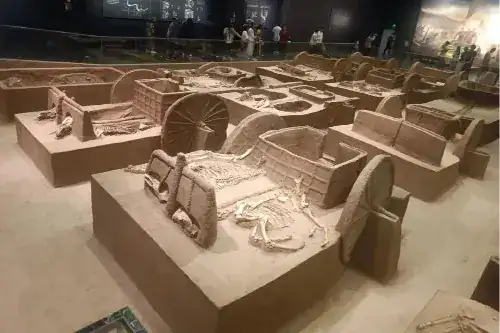
Jiaozuo has profound historical and cultural heritage. Known in ancient times as Jizhou Tanhuai, and historically called Henei, Shanyang, Huaizhou, Huaimeng, and Huaiqing, it is one of the central areas where early human activity appeared in China and a cradle of Yellow River culture and Chinese civilization. Sites include Peiligang, Yangshao, and Longshan culture remains, with late Paleolithic sites dating back 10,000–20,000 years, over 30 Yangshao sites (5,000+ years old), and nearly 40 Longshan sites (4,000 years old). The Early Shang city site at Fucheng was named one of China's "Top Ten Archaeological Discoveries of 1999." Jiaozuo's Macun District was the starting point of King Tang of Shang's revolution, the forward base for King Wu of Zhou's campaign against King Zhou, and the headquarters of Emperor Guangwu's restoration of the Han Dynasty.
Jiaozuo has rich revolutionary heritage. The 1925 Jiaozuo coal miners' strike in support of the May 30th Movement was praised by Mao Zedong as "particularly capable of fighting." Jiaozuo was the front line of the Taiyue and Taihang anti-Japanese bases, and the birthplace of the 9th Column of the Jin-Ji-Lu-Yu Field Army—the origin of China's airborne forces. Zhaibuchang Village was the founding site of the 9th Column.
Intangible Cultural Heritage
As of August 2021, Jiaozuo had 13 national-level intangible cultural heritage items (including Chen-style Tai Chi, the Dong Yong legend, suona art, and Huaibang opera), 70 provincial items, and 172 municipal items.
Cultural Relics and Historic Sites
As of August 2021, Jiaozuo had 3,014 cultural relic sites: 28 national key protected units, 103 provincial units (ranking third in Henan), and 675 municipal/county-level units.
City Image
The Chinese rose (Rosa chinensis) is the city flower, designated on September 26, 1984. The Chinese scholar tree (Sophora japonica) is the city tree, officially designated on April 23, 2015.
Religion
In 2023, Jiaozuo had five major religions—Buddhism, Daoism, Islam, Catholicism, and Protestantism—with 226 approved religious venues (43 Buddhist, 15 Daoist, 79 Islamic mosques, 7 Catholic, and 82 Protestant). There were 456 clergy members and 98,637 believers, with 7 municipal and 26 county-level religious organizations.
Scenic Spots
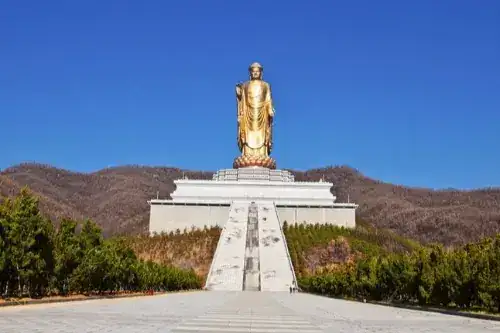
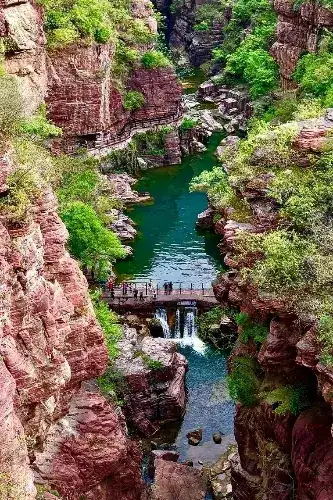
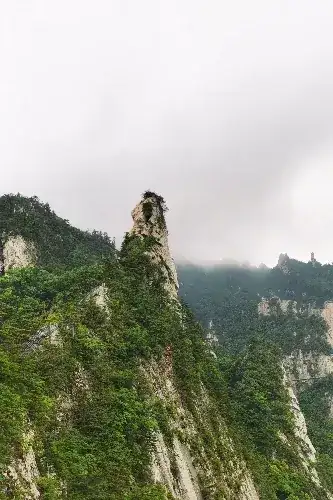
As of end-2025, Jiaozuo had 46 A-level tourist attractions, including 36 at 3A level or above. The crown jewel is the Yuntai Mountain World Geopark, comprising Yuntai Mountain, Qingtian River, Shennong Mountain (all 5A-level), Qinglong Gorge, and Fenglin Gorge.
Local Specialties
The "Four Huai Medicines"—Huai chrysanthemum, Huai rehmannia, Huai yam, and Huai achyranthes—are renowned local specialties, along with Jiaozuo's high-quality wheat products.
Notable Figures
- Bu Shang (Zi Xia): Late Spring and Autumn period native of Wen County, one of the "Ten Wise Ones of Confucius" and the Seventy-Two Disciples.
- Sima Yi (Zhongda): Three Kingdoms statesman and strategist, founder of the Western Jin Dynasty.
- Sima Yan (Anshi): Son of Sima Zhao, founding emperor of the Jin Dynasty.
- Shan Tao (Juyuan): One of the "Seven Sages of the Bamboo Grove."
- Xiang Xiu (Ziqi): Wei-Jin era philosopher and writer, one of the "Seven Sages of the Bamboo Grove."
- Lian He (Zijun): Granted the surname Lian by Emperor Taizong of Tang.
- Han Yu (Tuizhi): Tang Dynasty literary figure, leading advocate of the Classical Prose Movement, ranked first among the "Eight Great Prose Masters of the Tang and Song."
- Li Shangyin (Yishan): Renowned late Tang poet, paired with Du Mu as the "Younger Li-Du."
- Guo Xi (Chunfu): Northern Song painter and art theorist.
- Xu Heng (Zhongping): Yuan Dynasty statesman, educator, astronomer, and thinker.
- Zhu Zaiyu (Boqin): Ming Dynasty musicologist and mathematician who created the twelve-tone equal temperament.
- Chen Wangting (Zouting): Creator of Chen-style Tai Chi.
- Cao Jin (Huaipu): Qing Dynasty magistrate of Fengshan County in Taiwan, built irrigation canals known as "Lord Cao's Canal."
Sister Cities
City Honors
Jiaozuo has been awarded National Civilized City, National Health City, Outstanding Tourism City of China, National Forest City, National Garden City, National Water Ecological Civilization City, and National Innovation-Driven Demonstration City.
Travel information can change. Check current opening hours, reservations and entry requirements before you travel.
Traveller discussion
Start the conversation with a helpful tip or a question.