
Anyang City
Anyang CityAnyang City, a prefecture-level city in Henan Province, formerly known as Xiangzhou and Zhangde, located at the junction of Henan, Shanxi, and Hebei provinces. Total area: 7,413 sq km. As of end-2025, resident population: 5.35 mi
Anyang City
Anyang City, a prefecture-level city in Henan Province, formerly known as Xiangzhou and Zhangde, located at the junction of Henan, Shanxi, and Hebei provinces. Total area: 7,413 sq km. As of end-2025, resident population: 5.35 million. Anyang is one of China's Eight Great Ancient Capitals, birthplace of Oracle Bone Script and the Book of Changes (Zhou Yi), and a center of Huaxia Civilization, known as the "Seven-Dynasty Ancient Capital." In 2025, GDP reached 276.58 billion yuan (approximately US$38.4 billion), up 5.5%.
Name Origin
The name first appeared in the Records of the Grand Historian (c. 275 BCE). Located north of the Qi River, it was named Anyang — "north of water is called yang."
Historical Evolution
Pre-Qin Period
Humans inhabited the area 25,000 years ago. Around 1300 BCE, King Pan Geng of Shang moved the capital to Yin (present-day Yindu District), where it remained 254 years across 12 kings. The famous Houmuwu Ding was unearthed here. In 1046 BCE, King Wu of Zhou conquered Shang.
Qin, Han to Southern and Northern Dynasties
After Qin unified China, Anyang was divided among commanderies. In 401 CE, Xiangzhou was established. During the Eastern Wei, the capital moved to Yecheng.
Sui, Tang to Song and Yuan
Xiangzhou served as the administrative seat through the Song Dynasty. In 1191, it was elevated to Zhangde Prefecture. The Yuan renamed it Zhangde Route.
Ming and Qing Dynasties
Zhangde Prefecture continued as the administrative center, with the name formally standardized.
Republic of China Period
In 1913, Zhangde Prefecture was abolished during early Republic administrative reforms.
After the Founding of the PRC
On November 30, 1952, Pingyuan Province was dissolved, and Anyang was incorporated into Henan Province.
Administrative Divisions
Division History
Anyang's boundaries have been adjusted multiple times since 1949, including the transfer of Neihuang and Hua counties from Puyang in the late 1980s.
Division Details
As of June 2026, Anyang administers 4 districts (Wenfeng, Beiguan, Yindu, Long'an), 4 counties (Anyang, Tangyin, Hua, Neihuang), and 1 county-level city (Linzhou).
Natural Geography
Location and Territory
Located between 35°12′–36°22′N and 113°37′–114°58′E in northernmost Henan, at the junction of three provinces, with a total area of 7,413 sq km.
Geology
Features Carboniferous-Permian strata in the western coal region and alluvial deposits in the eastern plain.
Topography and Landforms
Terrain descends from west to east. The west consists of Taihang Mountains foothills; the east belongs to the Huanghuaihai Plain (about 60% of total area). Elevation ranges from 1,739 m to 48 m.
Climate
Warm temperate continental monsoon climate with distinct seasons. Average temperature 13.6°C, precipitation 582.9 mm. In 2024, average temperature was 15.6°C.
Hydrology
The city spans the Hai River and Yellow River basins. Major rivers include the Huan (Anyang) River, Zhang River, and the Red Flag Canal.
Soil
13 soil types, with hydromorphic soils largest (48.69%), then cinnamon soils (32.77%).
Natural Disasters
Major hazards include droughts (most frequent, nine in ten years), floods, hailstorms, and earthquakes. The city sits on the North China Plain seismic belt.
Natural Resources
Water Resources
A water-scarce city with per capita resources of 276 cubic meters. 55 reservoirs with 447 million cubic meters total storage. External transfers include 930 million cubic meters from the South-to-North Water Diversion.
Land Resources
3,817 sq km arable land, 1,515 sq km forest land, 1,235 sq km urban/industrial land.
Biological Resources
Over 2,000 plant species and 207 animal species, including 9 under national first-class protection (golden eagle, black stork). 12 nature reserves cover 353 sq km.
Mineral Resources
Over 50 mineral types discovered, 14 with proven reserves. Key resources: coal (2.08 billion tons), limestone (3.98 billion tons), iron ore (3 million tons).
Population
Population Size
End-2025: 5.35 million (down 44,000). Urbanization rate 57.6%. Population aged 60+: 21.4%.
Ethnic Groups
43 ethnic groups including Han, Hui, Mongol, and Manchu. Minority population exceeds 10,000.
Language
Dialects span Jin and Central Plains Mandarin groups. Preserves the ancient entering tone (rusheng). Linzhou dialect belongs to the Jin-Hanxin group.
Religious Beliefs
Five major religions: Buddhism (introduced 368 CE), Protestant Christianity, Catholicism, Islam, and Taoism.
Politics
A key regional center in Henan, part of the Beijing-Tianjin-Hebei coordinated development zone and Yellow River Basin ecological protection core area.
Economy
Overview
2025 GDP: 276.58 billion yuan (approximately US$38.4 billion), up 5.5%. Sector ratio 7.7:39.3:53.0. Per capita GDP: 51,485 yuan (approximately US$7,150). Per capita disposable income: 33,344 yuan (urban 42,904, rural 23,214).
Primary Industry
2025 grain output: 3.86 million tons from 8.43 million mu. Distinctive brands include Neihuang peanuts and Duli millet. Meat output: 336,200 tons, up 10.4%.
Secondary Industry
Above-scale industrial value added grew 7.3%. Installed power capacity: 11.12 million kW (solar+wind: 70.6%). Construction output: 103.95 billion yuan.
Tertiary Industry
Services contribute over 60% of growth. Retail sales: 103.5 billion yuan, up 5.7%. Import/export: 10.62 billion yuan, up 33.7%. Tourism: 100.19 million visitors, revenue 88.67 billion yuan (approximately US$12.3 billion).
Economic Functional Zones
Key zones: Anyang National High-Tech Development Zone (national level 2010), Anyang Zhongyuan High-Tech Zone, and Red Flag Canal Economic Development Zone in Linzhou (national level 2012).
Social Affairs
Science and Technology
130 provincial engineering research centers, 7 provincial key labs, 1 national key lab. Technology contracts: 10.53 billion yuan.
Education
2,481 schools including 7 higher education institutions and 987 primary schools. Enrollment exceeds 1.1 million. Notable: Anyang Normal University (1908) and Anyang No. 1 Middle School (1946).
Culture
13 art troupes, 13 cultural centers, 10 public libraries. Key institutions: Anyang Museum (1958, 100,000+ artifacts) and Red Flag Canal Memorial Hall. In June 2024, an Oracle Bone Script cultural event was held at the new Yin Ruins Museum.
News Media
Anyang Broadcasting Television (established 2010) produces Anyang News and Live Anyang.
Healthcare
6,412 medical institutions, 34,435 beds, 49,396 health professionals. Notable: Anyang People's Hospital (1887) and Anyang TCM Hospital (1954).
Sports
22 national championships in 2025. 22,612 sports venues. Fitness guidance: 21,900 person-times.
Environmental Protection
All river monitoring sections met Class I-III standards. Air quality good-days: 68.5%. PM10: 72 μg/m³ (down 12.2%), PM2.5: 43 μg/m³ (down 15.7%).
Social Security
2.91 million in pension insurance, 5.32 million in medical insurance. 96,077 on minimum living allowances. 184 elderly care institutions with 17,500 beds.
Transportation
Overview
Regional transportation hub. 2025: freight 196 million tons, passengers 50.96 million.
Highways
13,218 km of roads (density 178.3 km/100 sq km). Expressways include Beijing-Hong Kong-Macao, Nanlin, and Daguang, totaling 291 km.
Railways
Beijing-Guangzhou HSR and regular rail run north-south; Jin-Yu-Lu railway crosses east-west. Total: 274.4 km (47 km HSR). Stations: Anyang (1905), Anyang East (2012), Anyang West.
Aviation
Anyang Red Flag Canal Airport (opened November 2023) is a 4C regional airport serving 11.6 million people. Anyang Yindu Airport is for training.
Public Transit
945 vehicles, 64 routes, 1,028 km network. 100% bus stop coverage within 500 m. All villages have bus access.
Culture and History
Overview
A "Seven-Dynasty Ancient Capital" — Shang, Cao Wei, Later Zhao, Ran Wei, Former Yan, Eastern Wei, and Northern Qi. 7 national intangible heritage items.
Festivals and Customs
"Beige" folk art features children on high frames. The "sending sheep" custom (bread gifts from grandparents) follows the wheat harvest.
Literature and Arts
Folk arts include Tangyin paper-cutting and Neihuang farmer paintings. A "Famous City of Chinese Calligraphy" with 74 national-level calligraphers. Huaidiao opera is over 1,500 years old.
City Symbols
City tree: Chinese scholar tree (designated 1985). City flower: crape myrtle, "Hundred-Day Red" (designated 1984).
Heritage Conservation
2 World Cultural Heritage sites (Yin Ruins, Grand Canal Anyang section), 6 national-level protection units, 80 provincial units. 8 villages on the Traditional Villages list.
Intangible Cultural Heritage
7 national items including Hua County Daping Opera (500 years old), Tangyin Pao Weizi, and Neihuang Luoqiang. 36 provincial items.
Scenic Spots
Overview
37 national-level attractions: 2 AAAAA (Yin Ruins, Red Flag Canal - Taihang Grand Canyon), 7 AAAA. 2023: 69.86 million tourists, revenue 67.43 billion yuan (approximately US$9.4 billion).
Key Attractions
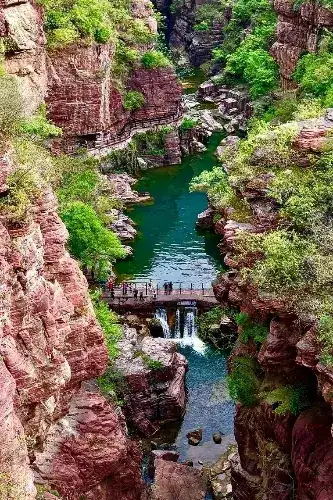
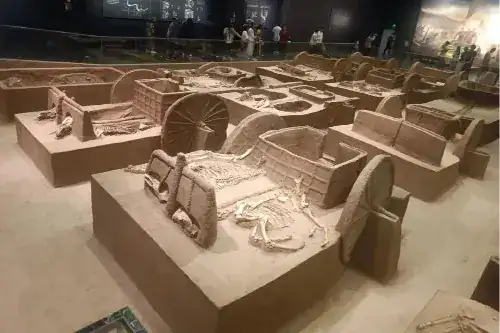
The Yin Ruins — World Cultural Heritage, first confirmed Shang Dynasty capital, 30 sq km. Grand Canal (Hua County section) — 8,240 m of preserved waterway. National Museum of Chinese Writing — showcases Chinese writing evolution. Red Flag Canal — 1,500-km water project on Taihang Mountain cliffs, "Eighth Wonder of the World." Taihang Grand Canyon — 89 sq km, 90% vegetation coverage.
Cuisine and Specialties
Cuisine
Mild-flavored local specialties: Daokou roast chicken, Anyang flat noodle dish, Laomiao beef, Chuwang buckwheat cake, and Neihuang stuffed intestines. Fenjiang rice porridge is a beloved traditional food.
Specialties
Neihuang jujubes (Tang Dynasty tribute), Anyang snakegourd fruit (geographical indication), Liaohua pastries (200+ years), Anyang jade carvings (3,000 years), and Baliying sweet melons.
International Exchange
Friendly exchanges with 29 cities across 15 countries, including Anyang (South Korea), Odawara (Japan), Lethbridge (Canada), Lamballe (France), and Dire Dawa (Ethiopia).
Notable Figures
Anyang has produced numerous notable historical figures throughout its history as an ancient capital and cultural center.
Major Honors
Anyang has received various national-level honors recognizing its historical, cultural, and economic significance.
Travel information can change. Check current opening hours, reservations and entry requirements before you travel.
Traveller discussion
Start the conversation with a helpful tip or a question.