
Heze City
Heze CityHeze, known as China's Peony Capital, is a prefecture-level city in Shandong Province at the junction of Shandong, Jiangsu, Henan, and Anhui provinces. It borders Jining to the east, Xuzhou (Jiangsu) and Suzhou (Anhui) to the south
Heze City
Heze, known as China's Peony Capital, is a prefecture-level city in Shandong Province at the junction of Shandong, Jiangsu, Henan, and Anhui provinces. It borders Jining to the east, Xuzhou (Jiangsu) and Suzhou (Anhui) to the southeast, Shangqiu (Henan) to the south, Kaifeng and Xinxiang (Henan) to the west, and Puyang (Henan) to the north, covering 12,238.62 square kilometers. As of March 2025, Heze administers 2 districts, 7 counties, and 1 provincial-level new district. By end-2024, the permanent population was 8.5082 million, with an urbanization rate of 54.64%. Known in antiquity as Caozhou, the city's name derives from Mount He to the south and Lake Leize to the north, bestowed in 1735. Heze boasts a long history as the "Center of the World," with legendary figures including Fuxi, Shun, Sun Bin, and Wu Qi born here. In 2025, Heze achieved a GDP of 493.74 billion yuan (approximately $69.1 billion).
History
Heze is a cradle of Chinese civilization, where the Xia tribe from the Loess Plateau and the Dongyi tribe from central Shandong hills merged with the Hua tribe over 7,000 years ago. Fuxi, the primordial ancestor of Chinese mythology, was born here. The Yellow Emperor, Yan Emperor, and Chiyou fought battles in this region, completing the first great fusion of the Huaxia people. Leaders of the Five Emperors period—Zhuanxu, Diku, Yao, Shun, and Yu—also lived here.
By the Neolithic period 4,000 years ago, early inhabitants had settled throughout the area. During the Shang dynasty, King Tang established his capital at Bo (present-day Cao County). The fifth Shang capital, "Pi," was near present-day Yuncheng. According to the Bamboo Annals and Records of the Grand Historian, King Zu Yi moved the capital here, making it the seat of five Shang kings for nearly a century.
During the Zhou dynasty, Heze occupied the "Center of the World." The vassal state of Cao was entirely within present-day Heze. Through the Spring and Autumn and Warring States periods, the territory was gradually annexed by Song, Lu, Qi, Qin, and Wei. At the end of the Qin dynasty, Xiang Yu defeated the Qin main force near Cao County, and Liu Bang held his imperial coronation at Fanshui in Dingtao, founding the Western Han dynasty.
During the Han dynasty, the region produced China's first agricultural treatise, the Book of Fanshengzhi. The first Eastern Han emperor, Liu Xiu, was born in present-day Dongming County. In 578 CE, the area was renamed Caozhou. In 1735, Caozhou was elevated to a prefecture governing 10 counties.
After the founding of the People's Republic in 1949, Pingyuan Province was established, and parts were merged into the Heze Special District. By 1953, it governed 10 counties, essentially forming present-day Heze. In 2000, the State Council approved elevating Heze to a prefecture-level city, with the former county-level city renamed Mudan District. In 2016, Dingtao County became Dingtao District. As of early 2025, Heze administers Mudan District, Dingtao District, and the counties of Cao, Chengwu, Shan, Juye, Yuncheng, Juancheng, and Dongming—2 districts and 7 counties—plus the Heze Luxi New District.
Administrative Divisions
As of March 2025, Heze governs 2 districts (Mudan, Dingtao), 7 counties (Cao, Chengwu, Shan, Juye, Yuncheng, Juancheng, Dongming), and 1 provincial-level new district (Heze Luxi New District), comprising 167 townships, towns, and sub-district offices (4 townships, 129 towns, 34 sub-districts), and 5,033 villages. The municipal government is at 1009 Zhonghua Road, Heze.
Natural Geography
Location and Territory
Heze lies in southwestern Shandong between 34°39′–35°52′N and 114°45′–116°25′E, stretching 157 km north-south and 140 km east-west, covering 12,238.62 square kilometers.
Geological Structure
The geology is covered by Quaternary deposits, belonging to the Luxi Fault Uplift and North China Fault Depression of the Sino-Korean Paraplatform. Major faults divide the region into alternating uplifts and depressions, including the Heze, Jiaxiang, and Fengpei uplifts, and the Dongming, Yuncheng, Chengwu, and Jinxiang depressions. The Liaokao Fault is the largest in the region.
Topography
Situated in the lower Yellow River basin, Heze is mostly alluvial plain except for 10 square kilometers of low hills in Juye County. Elevations range from 68 to 37 meters, gently descending southwest to northeast.
Climate
Heze has a warm-temperate monsoon continental climate with four distinct seasons. The 30-year average temperature is 13.9°C, with July at 26.9°C and January at -0.8°C. Annual precipitation averages 801.4 mm (2023), with 60% in summer. Annual sunshine averages 2,388.7 hours, and the frost-free period averages 211 days.
Hydrology
Except for 379 square kilometers of Yellow River floodplain, the remaining 11,849 square kilometers belong to the Huai River basin's Nansi Lake system. The Yellow River flows 185 km along the northwestern boundary. Major river systems include the Dongyu, Zhuzhao New, and Wanfu Rivers, plus the Old Yellow River channel—all seasonal rivers with significant flow variation.
Soil Types
Soils are classified into four types: fluvo-aquic, saline, alkaline, and aeolian sandy soil.
Natural Disasters
Heze is prone to meteorological disasters including torrential rain and flooding, high temperatures, hail, lightning, drought, strong winds, freezing, and heavy snow, occurring across all seasons.
Natural Resources
Water Resources
The multi-year average local water resource total is 1.90355 billion cubic meters, with per capita availability of 188 cubic meters. Surface water resources total 634.46 million cubic meters and groundwater 1.67465 billion cubic meters. External water includes Yellow River water (931 million cubic meters allocated) and Yangtze River water (75 million cubic meters). The city has built 9 Yellow River diversion gates and 8 irrigation districts.
Land Resources
As of 2019, Heze has 770,663 hectares of arable land, 84,093 hectares of forest, 233,379 hectares of urban-industrial land, and 29,495 hectares of transportation land.
Mineral Resources
Heze has 16 mineral types across four categories: energy (coal, petroleum, natural gas, geothermal), metallic (iron, placer gold), non-metallic (limestone, clay, dolomite), and water-gas (groundwater, mineral water). Proven coal reserves total 80 billion tons, ranking second in Shandong, including the Juye, Shan County, and Cao County coalfields.
Biological Resources
Heze has 74 families and 162 genera of woody plants, with main species including poplar, elm, locust, paulownia, and cypress. Over 700 edible plant species and 100+ medicinal species exist here. Major crops include wheat, corn, cotton, peanuts, and soybeans. Heze is nationally renowned as the "Hometown of Watermelons," "Hometown of Tomatoes," "Hometown of Asparagus," and "Hometown of Garlic."
Over 300 terrestrial wildlife species inhabit Heze, including 200+ bird species (with 20+ under national protection), 8 amphibians, 19 mammals, and 10 reptiles. The city is a major livestock center, with sheep raising ranking first nationally among agricultural areas and cattle third. The Luxi Yellow Cattle, Grey Goat, and Small-tailed Han Sheep are distinctive breeds.
Population
According to the Seventh National Census, males comprised 50.78% and females 49.22%. The 0–14 age group was 25.10%, 15–59 age group 56.57%, and 60+ age group 18.32%. By end-2023, the total population was 10,208,715, with permanent population of 8.6355 million and urbanization rate of 53.83%. By end-2024, the permanent population was 8.5082 million with urbanization rate of 54.64%.
Politics
Heze's municipal government operates under the CPC Heze Municipal Committee, with People's Congress, People's Government, and CPPCC systems at municipal, county, and township levels.
Economy
Overview
In 2024, Heze achieved a GDP of 480.258 billion yuan (approximately $67.2 billion), up 6.1%. Primary industry value-added was 43.943 billion yuan (~$6.2 billion, +2.9%), secondary 208.517 billion yuan (~$29.2 billion, +7.0%), and tertiary 227.798 billion yuan (~$31.9 billion, +5.9%). The industrial structure was 9.2:43.4:47.4.
Fixed asset investment grew 6.3%. General public budget revenue was 32.919 billion yuan (~$4.6 billion, +4.0%), expenditure 71.042 billion yuan (~$9.9 billion, -3.3%), with livelihood spending at 79.8%. Consumer prices rose 0.1%. Per capita disposable income reached 28,712 yuan (~$4,020, +6.2%), with urban residents at 37,356 yuan (~$5,230) and rural at 20,844 yuan (~$2,918). Per capita consumption expenditure was 19,199 yuan (~$2,688).
Primary Industry
In 2024, agriculture, forestry, animal husbandry, and fisheries output totaled 77.338 billion yuan (~$10.8 billion, +3.3%). Grain output was 8.1634 million tons from 11.896 million mu. Livestock output was 21.173 billion yuan with meat production of 786,900 tons. Fishery output was 1.984 billion yuan. Agricultural machinery power reached 13.2539 million kilowatts, with mechanization at 92.4%.
Secondary Industry
In 2024, industrial value-added was 175.958 billion yuan (~$24.6 billion, +7.4%), with above-scale industrial value-added growing 8.6%. Chemical raw materials manufacturing grew 20.2% and agricultural food processing 9.4%. High-tech industry output grew 12.7%, accounting for 42.01% of above-scale output. Construction output was 40.351 billion yuan (~$5.6 billion, +5.8%).
Tertiary Industry
In 2024, the service sector achieved value-added of 227.798 billion yuan (~$31.9 billion, +5.9%), accounting for 47.4% of GDP and contributing 46.6% to economic growth. Above-scale service revenue grew 12.5%, with transportation and warehousing up 12.9%, scientific services up 20.7%, and business services up 23.4%.
Retail sales of consumer goods reached 223.805 billion yuan (~$31.3 billion, +6.6%). Import-export value was 62.981 billion yuan (~$8.8 billion, -14.2%). Actual foreign investment was $432 million. Postal revenue totaled 4.523 billion yuan (~$0.6 billion). Financial deposits reached 778.186 billion yuan (~$108.9 billion), loan balances 493.929 billion yuan (~$69.2 billion), and insurance premiums 17.517 billion yuan (~$2.5 billion).
Transportation
Overview
Heze has developed a modern comprehensive transportation system integrating railways, highways, aviation, water transport, and pipelines.
Highways
Total highway mileage exceeds 28,000 km, including 523 km of expressways. Major routes include the G1511 Ri-Lan, G35 Ji-Guang, G0321 De-Shang, and G3511 He-Bao expressways, connecting all counties. National and provincial highways total 1,730 km.
Railways
Railway length is 315 km, including 154 km of the Beijing-Kowloon line and 118 km of the Xinshi line. Heze Station handles 53 passenger train pairs daily. In 2025, railway passenger volume exceeded 10 million. The Luxi High-Speed Railway's Heze section is operational with Heze East Station, Juye North Station, and Zhuangzhai Station. The Beijing-Xiong'an-Shangqiu High-Speed Railway is under construction (Heze section: 148.8 km), making Heze a key high-speed rail hub.
Heze East Station in Dingtao District covers 160,000 square meters, with a 60,000-square-meter station building, 6 platforms, and 15 tracks.
Aviation
Seven airlines operate 17 routes from Heze Mudan Airport to 26 cities including Beijing, Shanghai, and Guangzhou. In 2025, passenger throughput reached 838,000 and cargo 1,514 tons, up 40.8%.
Water Transport
Inland navigation began in 2018 with the Zhushui River channel. The New Wanfu River channel opened in 2021 as Heze's first Class III waterway. In 2025, port throughput reached 10.023 million tons, up 40%.
Public Transportation
The urban bus fleet reached 1,100 vehicles operating 55 regular and 270+ customized routes. Intercity buses connect Heze to all counties at 3 yuan fare—the province's lowest—with 24 routes and 507 vehicles.
Social Affairs
Science and Technology
In 2024, Heze organized 652 science programs (598 at or above provincial level), achieving 372 important results. Effective invention patents totaled 4,008 (4.62 per 10,000 people). Patent pledge financing contracts registered 154, with pledged funds of 1.775 billion yuan (~$248 million).
Education
By end-2024, Heze had 4 higher education institutions (91,600 students), 50 secondary vocational schools (91,300), 91 senior high schools (252,600), 376 junior high schools (505,700), and 1,245 primary schools (847,700).
Cultural Affairs
By end-2024, Heze had 28 museums, 10 cultural centers, 10 public libraries (7.3439 million volumes), 12 performing arts troupes, and 168 township cultural stations. Radio coverage reached 98.96% and television 99.65%.
Sports
By end-2024, Heze had 10 sports schools with 6,984 students. Athletes won 203 gold, 146 silver, and 166 bronze medals at provincial and higher-level competitions.
Healthcare
By end-2024, Heze had 5,954 health institutions including 407 hospitals with 62,516 beds. Health personnel totaled 72,697, including 29,035 physicians and 32,158 nurses.
Social Security
In 2024, 77,700 new urban jobs were created. Basic pension insurance covered 6.2184 million, basic medical insurance 8.7256 million, unemployment insurance 526,600, and work-related injury insurance 836,100. The city had 197 welfare institutions with 36,968 beds.
Environmental Protection
In 2024, the air quality composite index was 4.44 (improving 3.7%). PM2.5 averaged 44 micrograms per cubic meter, PM10 was 80, SO2 was 6, and NO2 was 23. Good air quality days reached 245.
Work Safety
In 2024, workplace accidents and fatalities decreased by 13.6% and 8.9% respectively. The fatality rate per 100 million yuan GDP was 0.0106.
Culture and History
Overview
Heze is renowned as China's Peony Capital, a Hometown of Opera, Calligraphy and Painting, Martial Arts, and Folk Arts. Peony cultivation began in the Sui dynasty, flourished through Tang and Ming, and by the Qing dynasty Heze had become China's peony center, earning the reputation that "Caozhou peonies are the finest under heaven."
Cultural highlights include peony culture, opera with diverse theatrical traditions, calligraphy and painting, martial arts (five counties designated "Hometowns of Martial Arts"), Yellow River culture, Water Margin culture connected to Song Jiang and Chao Gai from Yuncheng County, and intangible cultural heritage ranking among the top nationally for prefecture-level cities.
Origin of Place Name
The name "Heze" derives from Mount He to the south and Lake Leize to the north. In antiquity called Tao and known as the "Center of the World," the Western Han called it Jiying Commandery. The name Heze was bestowed in 1735.
Cultural Relics
As of August 2022, Heze has 11 national-level and 124 provincial-level protected cultural relic sites.
Intangible Cultural Heritage
As of February 2024, Heze has 1 UNESCO-level, 32 national-level, 112 provincial-level, and 345 municipal-level intangible cultural heritage items, with 22, 112, and 420 inheritors at respective levels.
Special Cuisine
Heze's food traditions follow Shandong cuisine (Lu cuisine)—robust flavors and vividly colored dishes.
Local Specialties
Heze is famous for peony products, Luxi Yellow Cattle, Grey Goat, Small-tailed Han Sheep, and agricultural products including watermelon, tomato, asparagus, and garlic.
Customs
Heze's ram-fighting tradition dates to the Three Kingdoms period, when Cao Cao's troops were inspired by watching rams butt heads. Cockfighting has been practiced since the Spring and Autumn period. The Caozhou Lantern Festival, held on the 15th day of the first lunar month, features elaborate displays originating in the Qing Qianlong era.
Arts
Dough figurine crafting (miansu) originated in Qing dynasty Caozhou. Juye County's acrobatic tradition spans over 400 years, with performers winning international acclaim. Dingtao shadow puppetry, founded around 1821 by the Feng family, is listed as provincial intangible cultural heritage.
Regional Symbols
The peony serves as Heze's city flower, reflecting its identity as China's Peony Capital.
Language
The Heze dialect belongs to the Yan-He group of Central Plains Mandarin, similar to Henan dialect, characterized by rich vocabulary, colloquial directness, and distinctive humor.
Scenic Spots
Overview
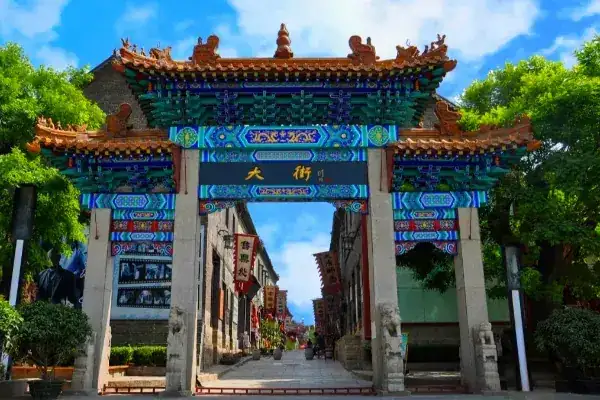
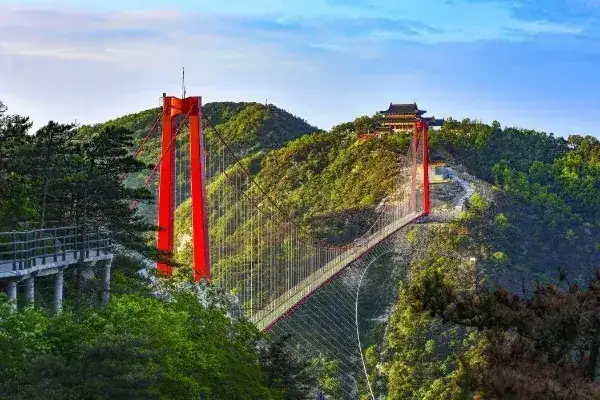
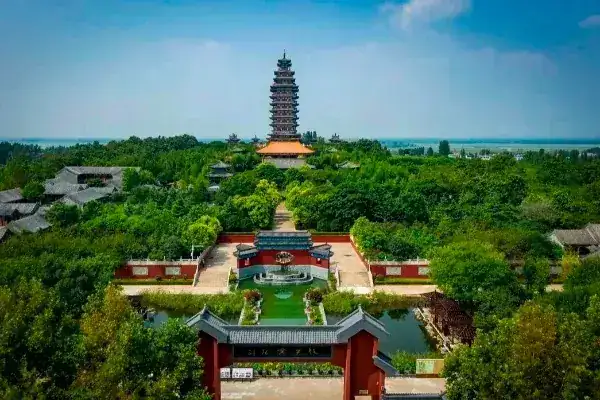
As of 2025, Heze has 43 A-level tourist attractions, including 9 at 4A, 24 at 3A, and 10 at 2A level. The city has 1 national agricultural tourism demonstration site, 8 provincial rural tourism key villages, 1 provincial comprehensive tourism demonstration area, and 1 provincial tourism resort. Twenty wetland parks have been established (4 national, 10 provincial).
Major Attractions
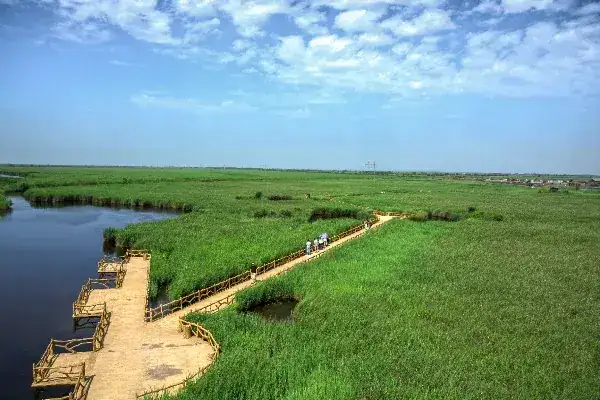
Heze has 10 nature reserves. Notable sites include the Cao County Old Yellow River National Wetland Park, with 34,000 mu of water surface and 10,000 mu of lotus ponds; the Dongming Yellow River National Wetland Park; and provincial-level wetland parks and forest parks across Juye, Shan, Juancheng, and Chengwu counties.
Notable Figures
Heze produced numerous historical figures including Fuxi (mythical ancestor), Shun (legendary emperor), Wu Qi (military strategist), Sun Bin (military tactician), Fanshengzhi (agricultural scientist), and Fan Li (merchant and strategist).
Honors
Heze is designated as China's Peony Capital, a National Civilized City, and a National Forest City, included in national strategies such as the Central Plains Economic Zone, Central Plains City Cluster, Huaihe River Ecological Economic Belt, and Yellow River Basin Ecological Protection and High-Quality Development.
External Relations
Domestic Relations
Heze maintains sister-city relationships and economic cooperation with multiple domestic cities, participating in inter-provincial cooperation and regional strategies including "Breakthrough Heze" and the Lunan Economic Circle.
International Relations
Heze has established international friendship city relationships, with 39 newly established foreign-invested enterprises and $432 million in actual foreign investment in 2024.
Travel information can change. Check current opening hours, reservations and entry requirements before you travel.
Traveller discussion
Start the conversation with a helpful tip or a question.