
Liaocheng City
Liaocheng CityLiaocheng, formerly known as Dongchang, is a prefecture-level city in Shandong Province, located in western Shandong at the junction of Hebei, Shandong, and Henan provinces. It borders the Zhangwei River to the west and neighb
Liaocheng City
Liaocheng, formerly known as Dongchang, is a prefecture-level city in Shandong Province, located in western Shandong at the junction of Hebei, Shandong, and Henan provinces. It borders the Zhangwei River to the west and neighbors Jining, Tai'an, and Jinan to the south, and Dezhou to the north, with a total area of 8,628 square kilometers. As of the end of 2024, the resident population was 5.8034 million, with an urbanization rate of 57.05%. Human activity dates back 6,000 years, with over 2,500 years of urban history. It is the only city where the Yellow River and the Grand Canal truly intersect, blending Yellow River culture, canal culture, and agricultural culture. In 2025, Liaocheng's GDP reached 330.415 billion RMB (approximately $46.5 billion), growing 5.6% year-on-year. By sector, the primary industry added 43.898 billion RMB ($6.2 billion), up 4.0%; the secondary 134.308 billion RMB ($18.9 billion), up 5.2%; and the tertiary 152.209 billion RMB ($21.4 billion), up 6.3%.
History
Liaocheng is one of the earlier cradles of human civilization, originally inhabited by the Dongyi tribe. Around 6,000 years ago, during the Dawenkou Culture period, humans began hunting and farming along ancient river channels, manufacturing stone, bone, and shell tools. During the Longshan Culture period (4,600 to 4,000 years ago), the population grew rapidly and city clusters emerged. The Jingyanggang cultural city, covering about 400,000 square meters, is believed to have been a political center and the capital of the legendary Emperor Shun.
During the Xia, Shang, and Zhou dynasties, the area belonged to the domain of Yanzhou. In the Shang Dynasty, Weizi, a half-brother of King Zhou of Shang, was enfeoffed in Liaocheng. During the Warring States period, the city of Liao became an important settlement in the western State of Qi. After Qin established the commandery-county system, the region belonged to Dong Commandery. Throughout subsequent dynasties, administrative divisions changed frequently under various commanderies and prefectures.
In the Republic of China era, the region passed through Jixi Circuit and Donglin Circuit before counties came under direct provincial administration in 1928. In 1949, the Liaocheng Administrative Commissioner's Office was established under Pingyuan Province, which was dissolved in 1952, returning Liaocheng to Shandong. In August 1997, the Liaocheng Prefecture and county-level Liaocheng City were dissolved, and prefecture-level Liaocheng City was established with Dongchangfu District.
Administrative Divisions
As of January 2024, Liaocheng administers 2 municipal districts (Dongchangfu and Chiping), 5 counties (Yanggu, Shen, Dong'e, Guan, and Gaotang), and 1 county-level city (Linqing), plus 1 national-level economic and technological development zone. The municipal government is seated at No. 24 Dongchang West Road.
Geography
Location
Liaocheng is located in western Shandong at the junction of three provinces, situated between 115 degrees 16 minutes to 116 degrees 32 minutes east longitude and 35 degrees 47 minutes to 37 degrees 2 minutes north latitude, with a total area of 8,628 square kilometers.
Geological Structure
The city's geology belongs to the North China Platform. The Liaokao (Liaocheng to Lankao) fault belt divides the city into two secondary structural units. Since the Late Tertiary, the area has received extensive Quaternary sediments, primarily Yellow River flood alluvium, with thicknesses of 30 to 270 meters.
Topography
Liaocheng sits on the Yellow River alluvial plain, with elevations from 22.6 to 49.0 meters, higher in the southwest and lower in the northeast. Six types of micro-landforms exist, with highlands accounting for 46.8%, slopes 43.6%, and depressions 9.6%. Over 10 small limestone hills exist in Dong'e County.
Climate
The city has a temperate monsoon climate with semi-arid continental characteristics. The frost-free period averages 193 to 201 days. Annual average temperature is 13.1 degrees Celsius, ranging from -2.5 degrees in January to 26.7 degrees in July. Annual precipitation averages 578.4 mm, with summer receiving 64.3%. Annual sunshine totals 2,567 hours.
Hydrology
Over 1,400 river channels belong to the Yellow River and Hai River basins. Major rivers include the Yellow River, Jindi River, Tuhai River, and Majia River. There are 21 major lakes, including Dongchang Lake and Yuqiu Lake. As of 2021, 59 rivers had basin areas exceeding 50 square kilometers.
Soil
Soils formed from Yellow River alluvial deposits include four types: fluvo-aquic soil (93.8%), saline soil (2.2%), aeolian sandy soil (3.9%), and cinnamon soil (0.1%).
Natural Disasters
Main natural disasters include droughts, floods, windstorms, hail, and earthquakes, with droughts more frequent than floods. In 2023, the city experienced 3 natural disasters affecting 5 counties and 28 towns, with no casualties.
Natural Resources
Water Resources
In 2022, total water resources amounted to 2.101 billion cubic meters. Total water supply was 1.785 billion cubic meters, of which 42.2% came from inter-basin transfers (Yellow River and Yangtze River diversions), 43.1% from groundwater, and 9.9% from local surface water. The city has four large Yellow River irrigation districts.
Land Resources
As of 2022, the total area included 518,501 hectares of cultivated land, 77,264 hectares of forest land, and 163,602 hectares of urban and industrial land.
Plant Resources
Over 20 families and 130 species of wild plants have been recorded. The city has 68 families and 234 species of wild vascular plants, with ginkgo and dawn redwood under national first-class protection. A total of 351 cultivated tree species exist across 66 families and 139 genera.
Animal Resources
As of 2021, 295 species of wild animals were recorded, including 17 mammal species, 225 bird species, 8 reptile species, 7 amphibian species, and 38 fish species. Notable species include the great swan, a national second-class protected animal, and the reed parrotbill, a globally endangered species endemic to China.
Mineral Resources
As of 2020, 13 mineral types had been discovered, including coal, petroleum, natural gas, geothermal energy, iron, limestone, and rock salt. Proven reserves include 1.78 billion tons of coal. The Yanggu-Chiping coalfield and the Guyun rock salt mine in Shen County are both large-scale deposits.
Population
As of the seventh national census, males accounted for 50.63% and females 49.37%, with a sex ratio of 102.54. Those aged 0 to 14 comprised 23.47%, 15 to 59 comprised 57.57%, and 60 and above comprised 18.96%. As of the end of 2024, the resident population was 5.8034 million, with an urbanization rate of 57.05%, up 1.25 percentage points year-on-year.
Politics
Liaocheng's governance follows the standard Chinese administrative structure, with the municipal Party committee and people's government leading the city's political, economic, and social affairs.
Economy
Overview
In 2024, Liaocheng's GDP reached 316.796 billion RMB (approximately $44.6 billion), growing 5.7% at constant prices. The primary, secondary, and tertiary sectors contributed 42.923 billion RMB ($6.0 billion), 131.182 billion RMB ($18.5 billion), and 142.691 billion RMB ($20.1 billion), respectively, with a structure of 13.5:41.5:45.0. Fixed asset investment grew 5.1%, with manufacturing investment up 20.2%. General public budget revenue was 25.71 billion RMB ($3.6 billion), up 5.1%. Per capita disposable income was 28,873 RMB ($4,065), up 5.1%, with urban residents at 37,147 RMB ($5,232) and rural residents at 21,262 RMB ($2,993). Renewable energy generation grew 37.4%.
Primary Industry
In 2024, the gross output value of agriculture, forestry, animal husbandry, and fishery was 83.35 billion RMB ($11.7 billion), up 4.2%. Grain output reached 5.8893 million tons, up 1.0%. Vegetable output was 10.088 million tons, up 4.0%. Meat output reached 905,600 tons, up 11.4%. Notable agricultural brands include Dong'e black donkey, Yanggu chili pepper, Shen County muskmelon, and Guan County ganoderma.
Secondary Industry
Industrial value-added reached 113.202 billion RMB ($15.9 billion), up 7.0%. Above-scale industrial value-added grew 8.4%, with six key industries including chemical raw materials, metal products, ferrous metal smelting, food processing, textiles, and general equipment accounting for 41%. Above-scale industrial revenue was 482.629 billion RMB ($68.0 billion), up 4.5%, with 74 enterprises exceeding 1 billion RMB in revenue. Construction output was 39.404 billion RMB ($5.5 billion), up 5.3%.
Tertiary Industry
The service sector achieved value-added of 142.691 billion RMB ($20.1 billion), up 5.2%, contributing 41.9% to economic growth. Total retail sales of consumer goods reached 108.53 billion RMB ($15.3 billion), up 7.1%. Total import and export value was 62.924 billion RMB ($8.9 billion), up 6.4%, with trade relations spanning 205 countries. Belt and Road Initiative trade reached 42.52 billion RMB ($6.0 billion), accounting for 67.6% of total trade. Actual foreign investment utilized was $263 million. Financial institution deposits reached 691.269 billion RMB ($97.4 billion), up 11.7%, and loans 403.753 billion RMB ($56.9 billion), up 6.6%. The city added two 4A-level scenic areas and two four-star hotels.
Transportation
Overview
Liaocheng has historically been a vital transportation hub, flourishing for over 400 years as one of nine major trading ports along the Grand Canal. The Beijing-Kowloon Railway and the Hanji Railway intersect within the city, and multiple expressways pass through. In 2024, transportation infrastructure investment exceeded 10 billion RMB ($1.4 billion) for the fourth consecutive year, and a civil airport was approved for construction.
Highways
As of 2022, total highway mileage was 21,446.6 km with a density of 245.95 km per 100 square kilometers, ranking first in the province. Expressways totaled 473.9 km, connecting all counties and administrative villages.
Railways
The city has two freight railways totaling 218 km: the Beijing-Kowloon Railway (106 km) and the Hanji Railway (112 km). In December 2023, the Jinan-Zhengzhou high-speed railway opened, marking Liaocheng's entry into the high-speed rail era, with stations including Chipingnan, Liaocheng West, and Shen County.
Aviation
A military airport is located in the eastern development zone. The Liaocheng civil airport is undergoing preparatory work for construction during the 14th Five-Year Plan period.
Public Transportation
As of 2024, the city operated 53 bus routes, 102 school bus routes, and 95 customized bus routes, with 1,213 vehicles including 974 new energy buses (85.2%). Annual passenger volume reached 31.73 million. The city has 10,000 public bicycles and 538 bus shelters.
Social Services
Science and Technology
In 2024, the city had over 900 high-tech enterprises and 1,305 technology-based SMEs. Valid invention patents reached 4,747, up 18.8%. R&D investment was 9.142 billion RMB ($1.3 billion), accounting for 3.12% of GDP. High-tech industry output reached 284.17 billion RMB ($40.0 billion), up 9.6%.
Education
In 2024, 4 kindergartens and 6 primary/secondary schools were built or expanded, adding over 4,800 spots. The three-year kindergarten enrollment rate was 99.51%. The city added 4 provincial-level specialty high schools. Vocational graduates numbered 17,717, with 95.5% employment.
Culture
As of the end of 2024, the city had 15 museums, 8 public libraries, 9 cultural centers, 136 cultural stations, and 77 urban reading rooms. It has 13 national-level cultural heritage protection units and 1 World Cultural Heritage site, the Grand Canal (Liaocheng section). The China Canal Culture Museum was rated as a national first-class museum.
Sports
The city had 18,800 sports venues and 26,000 social sports instructors. In 2024, over 6,000 mass sports events were organized, including the East Chang Lake Half Marathon and the China Liaocheng Dragon Boat Open. The city won bids for the 2026 World University Mind Sports Games and the Asian University Dragon Boat Championship.
Healthcare
As of the end of 2024, the city had 5,787 medical institutions including 152 hospitals. Five hospitals achieved Grade 3A rating. Beijing Jishuitan Hospital Liaocheng Branch began operations. There were 52,521 health professionals and 36,278 beds.
Social Security
In 2024, 48,907 new urban jobs were created. Pension, work injury, and unemployment insurance covered 4.223 million, 755,300, and 532,800 people respectively. Urban minimum living standard rose to 931 RMB per month; rural to 753 RMB per month. The city added 578 nursing-care beds and 174 community canteens.
Infrastructure
In 2024, renovation of old residential areas covering 15,500 households began. Urban road mileage increased by 16.91 km. The city was selected as a provincial urban renewal pilot. Rural roads were improved by 562 km, with 100% compliance in rural water supply quality.
Environmental Protection
The air quality index improved 3.8% to 4.57. PM2.5 averaged 42 micrograms per cubic meter, improving 8.7%. Good air quality days reached 245, up 40 days, setting a record. All 14 provincial surface water sections met standards. The city was recognized for its waste-free city construction.
Safety Production
Production safety accidents and fatalities decreased by 3.1% and 18.2% respectively. Natural disaster prevention achieved zero deaths. The city was selected as a provincial pilot for urban infrastructure lifeline safety monitoring.
Public Safety
The city deepened its three-year production safety campaign, with no major accidents. A gas safety campaign was launched. Emergency response was activated 15 times for major meteorological disasters, with 191 warning signals issued.
History and Culture
Overview
Liaocheng has 6,000 years of civilization and 2,500 years of urban history. It is the only city where the Yellow River and the Grand Canal truly intersect, known as the water city north of the Yangtze and the pearl of two rivers. The Grand Canal (Liaocheng section) is a World Cultural Heritage site.
Origin of the Name
Liaocheng was formerly called Dongchang. One theory suggests a river named Liao gave the city its name, though no such river appears in historical records. Another traces it to the ancient cities of Liao and She. The earliest textual reference dates to 522 BCE in the Zuo Zhuan, where it appears as a city.
Cultural Relics and Historic Sites
As of November 2020, the city had 418 cultural heritage protection units, including 13 national-level, 74 provincial-level, and 331 municipal and county-level, plus one World Cultural Heritage site.
Intangible Cultural Heritage
As of the end of 2022, there were 12 national-level, 65 provincial-level, 261 municipal-level, and 1,093 county-level intangible cultural heritage items.
Cuisine
Liaocheng boasts numerous local specialties. Luxi yellow cattle, with a 50% meat yield, rank among China's finest. Famous dishes include Wei family smoked chicken, praised by writer Lao She as Liaocheng iron rooster, along with local snacks like eight-stick fritters and guada flatbread.
Customs
Three ancestor-worship festivals, the Qingming Festival, the Ghost Festival, and the Winter Clothing Festival, are collectively called the Three Ming Festivals. During the Dragon Boat Festival, locals hang mugwort on doors and tie five-colored threads on children's wrists for protection. Blood-oath brotherhood rituals remain a social custom.
Regional Symbols
Liaocheng's cultural identity is shaped by the confluence of Yellow River, Grand Canal, agricultural, and Yanzhao cultural traditions.
Language
The Liaocheng urban dialect belongs to Jilu Mandarin, characterized by specific entering-tone word transformations. Yanggu County, southern Shen County, and southwestern Dong'e County speak Zhongyuan Mandarin, distinguished by secondary voiced entering-tone words reading as high-level tone.
Scenic Spots
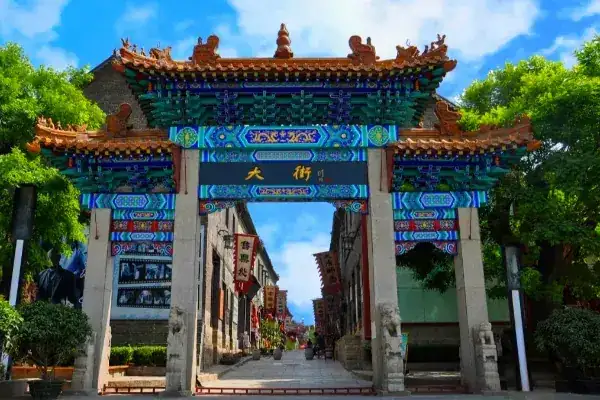
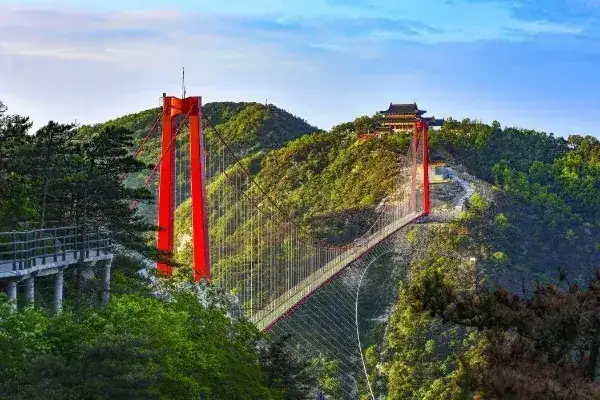
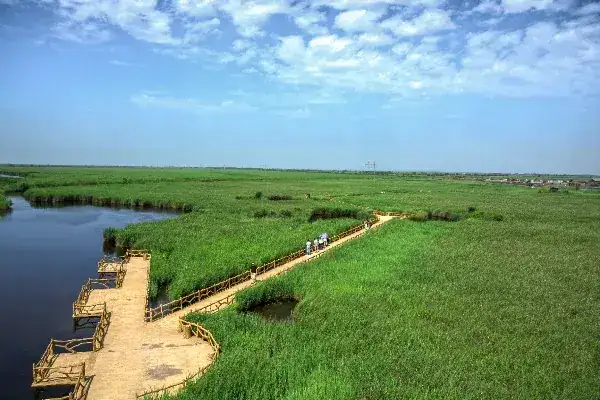
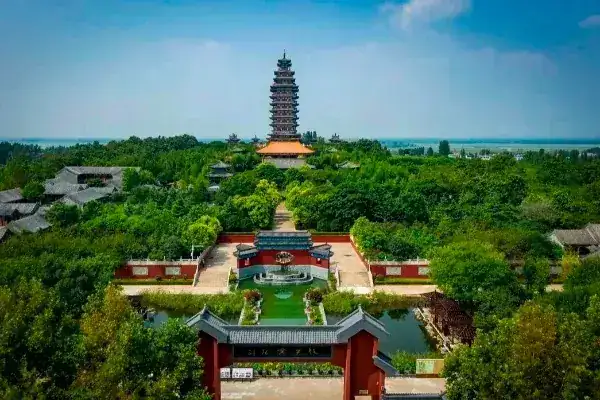
As of March 2024, the city had 6 4A-level scenic areas, 40 3A-level areas, and 13 2A-level areas.
Major Attractions
As of March 2023, Liaocheng had 10 nature reserves, all natural parks, totaling 4,254.04 hectares, including 3 national-level parks covering 1,596.25 hectares and 7 local-level parks covering 2,657.79 hectares.
Notable Figures
Throughout history, Liaocheng has produced numerous prominent figures across literature, politics, military, and other fields, contributing to the rich cultural heritage of the region.
Honorary Titles
Liaocheng has received numerous honors, including National Historical and Cultural City (1994), China Excellent Tourism City (2004), National Garden City (2012), National Forest City (2018), National Health City (2022), National Child-Friendly City (2024), National Double Support Model City (2025), and National Civilized City (2025).
External Relations
Liaocheng maintains trade relations with 205 countries and regions. In 2024, Belt and Road Initiative trade reached 42.52 billion RMB ($6.0 billion), accounting for 67.6% of total trade. The city has 132 operating foreign enterprises from 28 countries, with registered capital of $4.5 billion, and has established 2 overseas industrial parks with 36 operating overseas investment enterprises.
Travel information can change. Check current opening hours, reservations and entry requirements before you travel.
Traveller discussion
Start the conversation with a helpful tip or a question.