
Dezhou City
Dezhou CityDezhou City, abbreviated "De" and anciently known as Ande, is a prefecture-level city in Shandong Province. Located in northwestern Shandong on the alluvial plain of the lower Yellow River, it borders Cangzhou (Hebei) to the nort
Dezhou City
Dezhou City, abbreviated "De" and anciently known as Ande, is a prefecture-level city in Shandong Province. Located in northwestern Shandong on the alluvial plain of the lower Yellow River, it borders Cangzhou (Hebei) to the north, Jinan and Liaocheng to the south, Hengshui (Hebei) to the west, and Binzhou to the east. The terrain slopes from southwest high to northeast low, with a pronounced monsoon influence and four distinct seasons. Total area: 10,356 square kilometers. As of March 2025, the city administers 2 districts, 7 counties, the Dezhou Tianqu New District (Dezhou Economic Development Zone), and 2 county-level cities. As of end 2024, the permanent population was 5.4828 million. The name "De" derives from "Deshui," an ancient name for the Yellow River. In 583 AD (Sui Dynasty, Kaihuang era), Ande was renamed Dezhou. Dezhou is designated by the State Council as a transportation hub and economic center in the Hebei-Shandong border region, an important industrial and trade city in northwestern Shandong, and a new energy industry base for Shandong Province. In 2025, Dezhou's GDP reached 421.461 billion yuan (approximately $58.1 billion), up 5.3% at constant prices.
History
During the Xia and Shang dynasties, the area belonged to the Yougeshi (Ge State) and Youqiongshi as vassal states. The Qin Dynasty established Ge County under the commandery-county system, later abolished under the Northern Qi. The Han Dynasty established Ande County, followed by various administrative units through the Sui, Tang, Song, Yuan, Ming, and Qing dynasties and the Republic of China, including Guangchuan, Changhe, Jiangling, Lingzhou, Lingxian, and De County. Over 2,200 years since the Qin, Dezhou changed its administrative seat six times.
During the Xia and Shang periods, the area belonged to Yanzhou. In the Western Zhou and Spring and Autumn periods, it was part of the Qi State. During the Warring States period, it was divided between the Qi and Zhao states. Under the Qin, it was split among Qi, Julu, Qinghe, and Shanggu commanderies. The Han Dynasty divided it among Pingyuan and Jinan commanderies (Qingzhou), Qinghe Commandery (Jizhou), and Bohai Commandery (Youzhou). During the Three Kingdoms, it belonged to Wei. The Western Jin assigned it to Pingyuan, Qinghe, Leling, and Le'an states, and Jinan Commandery. The Northern and Southern Dynasties saw it split among Ande, Qinghe, Pingyuan, and Leling commanderies.
Under the Sui, the area was divided among Pingyuan and Bohai commanderies (Yanzhou), Qinghe Commandery (Jizhou), and Qi Commandery (Qingzhou). The Tang Dynasty placed it under Dezhou, Beizhou, Dizhou, and Qizhou in the Hebei Circuit. The Northern Song split it between Hebei East Circuit and Jingdong Circuit. Under the Jin, it belonged to Shandong West and East Circuits, Hebei East Circuit, and Daming Prefecture Route. The Yuan assigned it to Hejian and Jinan routes under the Zhongshu Province. The Ming placed it under Jinan and Dongchang prefectures (Shandong) and Hejian Prefecture (capital region). The Qing divided it among Jinan and Wuding prefectures (Shandong), and Tianjin and Hejian prefectures (Zhili).
In the early Republic of China, the area was split among Jinan, Donglin, and Wuding circuits under Shandong, and Jinhai Circuit under Zhili. In 1928, it came under direct Shandong and Hebei provincial jurisdiction. During the Anti-Japanese War, areas east of the Jinpu Railway were under CCP-led Ji-Lu Border Region jurisdictions, while western areas fell under Jinan and Yundong special districts. After the PRC was founded, the Dezhou Special District was established on May 9, 1950. It underwent multiple reorganizations through the 1950s-60s, including a temporary merger with the Liaocheng Special District (1956-1961). In 1967, it was renamed Dezhou Prefecture. On December 17, 1994, the State Council approved abolishing Dezhou Prefecture and establishing the prefecture-level Dezhou City, converting the former county-level Dezhou City into Decheng District. The Dezhou Economic Development Zone was established in 1998, the Dezhou Canal Economic Development Zone in 2006, and the Dezhou High-tech Industrial Development Zone in July 2014.
Administrative Divisions
In October 2014, the State Council approved abolishing Lingxian and establishing Lingcheng District. As of March 2025, Dezhou administers 2 districts, 7 counties, and 2 county-level cities: Decheng District, Lingcheng District, Yucheng City, Leling City, Linyi County, Pingyuan County, Xiajin County, Wucheng County, Qingyun County, Ningjin County, and Qihe County — totaling 29 subdistricts, 91 towns, and 14 townships. The municipal government is located at No. 1566 Dongfeng East Road, Changhe Subdistrict, Decheng District.
Geographical Environment
Location
Dezhou is located in northwestern Shandong, north of the lower Yellow River, between 115 degrees 45 minutes and 117 degrees 36 minutes east longitude, and 36 degrees 24 minutes 25 seconds and 38 degrees 0 minutes 32 seconds north latitude. It borders Cangzhou (Hebei) to the north across the Zhangwei New River, Hengshui (Hebei) to the west across the Wei Canal, Liaocheng to the southwest, Jinan to the south across the Yellow River, and Binzhou to the east. It is 320 kilometers from Beijing. The territory extends 200 km east-west and 175 km north-south, covering 10,356 square kilometers (7.55% of Shandong's total area).
Topography
Dezhou sits on a Yellow River alluvial plain. Two major Yellow River course changes and over a thousand historical breaches created the southwest-high, northeast-low terrain. Three landform types: highland (34.3%, formed by riverbed deposits), slope land (52.1%, formed by flood deposits), and lowland (13.6%).
Climate
Dezhou has a pronounced monsoon-influenced continental climate with four distinct seasons. Springs are dry and windy; summers hot and rainy; autumns cool and clear; winters cold and dry with little snow. Annual sunshine averages 2,592 hours (60% sunshine rate), with May-June peaking at 280 hours per month (9 hours daily). The frost-free period averages 208 days (March 29 to October 24), reaching 225 days in Wucheng County. Annual precipitation averages 547.5 mm, higher in the east and south. July receives the most (190 mm), January the least (3.5 mm). Seasonal distribution: spring 12.8%, summer 67.7%, autumn 16.9%, winter 2.6%.
Hydrology
Major trans-provincial rivers include the Yellow River, Wei Canal, and Zhangwei New River. Key cross-city drainage channels are the Tuhai River, Dehui New River, and Majia River — all except the Yellow River belong to the Hai River basin. Two tributaries exceed 1,000 square kilometers: the Xin Zhaoniu River (Tuhai basin) and the Liuwu River (Zhangwei New River basin). Twelve tributaries span 300 to 1,000 square kilometers, with 53 between 100 and 300 and 114 between 30 and 100 square kilometers, forming an integrated flood-control and drainage network.
Natural Resources
Water Resources
Dezhou has seven rivers. The Yellow River supplies an average of 1.5 billion cubic meters annually, while other rivers serve flood control and drainage functions. Pit storage capacity totals 88.77 million cubic meters (usable: 75.46 million), trunk stream storage 102.86 million, and tributary storage 92.24 million, yielding a maximum regulation capacity of 336.17 million cubic meters. The multi-year average usable water is 376.29 million cubic meters. Groundwater exhibits a three-layer structure (fresh-salt-fresh) in most areas.
Land Resources
Total land area: 1,035,767.48 hectares. Agricultural land: 814,927.59 ha (78.68%), including farmland 643,783.82 ha (62.16%), orchards 13,956.17 ha (1.35%), and forest 61,835.75 ha (5.97%). Construction land: 185,231.86 ha (17.88%). Other land: 35,608.03 ha (3.44%), including water bodies 15,047.25 ha and natural reserves 20,560.78 ha.
Mineral Resources
Dezhou has identified 11 mineral types: 4 energy, 4 non-metallic, and 3 water-gas types, with 436 occurrences (6 large, 30 medium, 62 small, 338 points). Oil and natural gas are concentrated in the Linyi area; coal occurs along the Yellow River belt in Qihe and Yucheng; geothermal resources are present in all counties. Oil and gas reserves total 17.032 million tons (resource reserves: 21.832 million tons). Coal reserves: 1.237 billion tons (base reserves: 808 million tons). Geothermal reserves: 29.0633 million cubic meters annually, with total geothermal resources equivalent to 678.7 million tons of standard coal.
Population
Population Size
The 2020 census recorded 5,611,194 permanent residents, up 42,959 (0.77%) from 5,568,235 in 2010, with an annual growth rate of 0.08%. There were 1,857,840 households averaging 2.77 persons each (down 0.49 from 2010's 3.26). As of end 2024, the permanent population was 5.4828 million, including 3.1411 million urban residents, with an urbanization rate of 57.3% (up 0.96 percentage points).
Ethnic Composition
Dezhou is home to 42 ethnic minority groups, predominantly the Hui people.
Politics
Current Leaders
Information to be supplemented.
Sister Cities
Information to be supplemented.
Economy
Overview
In 2024, Dezhou's GDP reached 404.773 billion yuan (approximately $55.8 billion), up 5.6%. By sector: primary industry 38.852 billion yuan (~$5.36 billion, +3.4%), secondary industry 175.435 billion yuan (~$24.2 billion, +6.2%), tertiary industry 190.486 billion yuan (~$26.3 billion, +5.4%). The industrial structure was 9.6:43.3:47.1. Fixed-asset investment grew 6.2% (primary +15.3%, secondary +11.0%, tertiary +2.8%). General public budget revenue was 26.336 billion yuan (~$3.63 billion, +5.1%), with tax revenue of 16.941 billion (-3.0%). Public budget expenditure was 64.399 billion yuan (~$8.88 billion, +3.4%), with livelihood spending of 51.238 billion yuan.
Primary Industry
In 2024, total agricultural, forestry, animal husbandry, and fishery output reached 84.256 billion yuan (~$11.6 billion, +4.0%). Grain was planted on 16.0812 million mu, producing 7.8778 million tons (489.88 kg/mu). Vegetables and edible mushrooms: 7.0724 million tons (+3.9%); garden fruit: 293,700 tons (+3.2%). Year-end livestock: 3.1356 million hogs, 310,900 cattle, 551,000 sheep, and 71.6473 million poultry. Meat output: 677,800 tons; eggs: 448,500 tons; milk: 538,500 tons.
Secondary Industry
In 2024, above-scale industrial added value grew 8.4%. By ownership: joint-stock enterprises +9%, foreign/HK/Macau/Taiwan enterprises +1.1%, private enterprises +5.3%. By sector: mining +31.5%, manufacturing +8.8%, utilities +0.1%. Of 33 industrial categories, 24 grew (72.7%). Above-scale industrial revenue was 374.197 billion yuan (~$51.6 billion, -1.8%); profits totaled 22.744 billion yuan (~$3.14 billion, -0.1%). The construction sector had 514 qualified enterprises, completing 46.081 billion yuan in output (+6.0%).
Tertiary Industry
In 2024, the services sector added value of 190.486 billion yuan (~$26.3 billion, +5.4%). Above-scale services revenue was 36.978 billion yuan (+0.9%). Total retail sales of consumer goods reached 148.309 billion yuan (~$20.5 billion, +5.8%): urban 119.626 billion, rural 28.683 billion. Total imports and exports were 73.45 billion yuan (~$10.1 billion, +5.1%), with exports of 62.04 billion (+7.6%). Financial institutions held deposits of 661.060 billion yuan (~$91.2 billion, +9.1%) and loans of 415.966 billion yuan (~$57.4 billion, +10.1%). Insurance premium income was 15.996 billion yuan (~$2.21 billion, +4.2%). In 2025, total goods trade reached 76.79 billion yuan (~$10.6 billion, +4.6%), with exports of 66.41 billion (+7.1%). Electromechanical products led exports at 31.81 billion yuan, with carbon electrodes (4.65 billion), integrated circuits (3.88 billion), and auto parts (2.36 billion) as key categories.
Social Affairs
Science and Technology
In 2024, Dezhou newly certified 350 national high-tech enterprises and added 1 provincial new R&D institution. Sixty-seven projects received provincial-level or higher science and technology funding. The city had 225 key laboratories (4 provincial, 221 municipal), 9 technology business incubators (6 national, 3 provincial), and 18 maker spaces (7 national, 11 provincial). Patent grants totaled 10,633 (+4.4%), including 2,136 invention patents (+70.6%), with 10.96 invention patents per 10,000 population.
Education
Dezhou has 6 regular universities (32,778 new admissions, 82,111 enrolled, 23,959 graduates, 4,491 faculty), 31 vocational secondary schools (45,826 enrolled), 36 general high schools (130,154 enrolled), 172 junior high schools (217,501 enrolled), 531 primary schools (453,087 enrolled), and 1,242 kindergartens (124,586 children). Fourteen special education schools served 3,448 students. Twelve new public kindergartens were built, adding 3,570 seats (58.02% public rate).
Culture
As of end 2024, Dezhou had 4 art performance troupes, 146 cultural centers, 3 art galleries, 12 public libraries (3.251 million volumes), and 25 museums. There were 31 urban cinemas serving 2.259 million viewers (box office: 93.944 million yuan). Eleven broadcasting stations operated 12 radio and 14 television program channels, achieving 100% population coverage. The "Opera in the Countryside" program staged 6,085 performances. The Dezhou Grand Theater is located at the southeast corner of the Dezhou Cultural and Sports Center.
Healthcare
Dezhou had 5,580 medical and health institutions (129 hospitals, 131 township health centers, 12 CDCs, 12 maternal and child health centers). Total beds: 33,609 (+7.2%). Health workers: 43,537 (+6.3%), including 18,605 licensed physicians and 17,897 registered nurses. The city had 172 municipal and 10 provincial clinical key specialties. All grassroots medical institutions met standardization requirements, with 66 reaching the recommended quality standard.
Sports
In 2024, Dezhou built 255 new community sports courts and 17 smart fitness trails. A 130-kilometer Yellow River-Grand Canal connecting fitness corridor was completed, linking 5 counties and 18 towns. The city held 4,849 mass fitness events with nearly 1 million participants, including Leling's "LeBA" basketball, Ningjin's "Village Ping-Pong," and Pingyuan's "Sports Carnival."
Social Security
As of end 2024, Dezhou had 1.3006 million employee pension, 934,100 employee medical, 629,100 unemployment, and 840,400 work injury insurance enrollees. Resident pension and medical insurance covered 3.0376 million and 4.3515 million people, respectively. The city had 142 social service institutions with 138 nursing homes (20,100 beds) and 54 institutions for destitute relief.
Transportation
Known historically as the "Thoroughfare of Nine Roads" and "Gateway to the Capital," Dezhou has been a major transportation hub since the Grand Canal era. Historically an important port on the Beijing-Hangzhou Grand Canal, it served as a key node for north-south cultural exchange. After the Ming Emperor Yongle established the capital in Beijing, until the mid-19th century, Dezhou was a vital grain transport route from nine southern provinces to Beijing. Dezhou is the junction of five railway lines: Beijing-Shanghai, Shijiazhuang-Dezhou, Beijing-Shanghai HSR, Shijiazhuang-Jinan Passenger Dedicated Line, and Delongyan Railway. Expressways include Beijing-Shanghai, Beijing-Taipei, Qingdao-Yinchuan, Dezhou-Hengshui, Dezhou-Binzhou, Jinan-Liaocheng, and Jinan-Leling. National highways G104, G105, G205, G308, and G309 pass through, along with the Grand Canal (140+ km within the city). In 2006, Dezhou was designated a national comprehensive transportation hub city. As of end 2024, total highway mileage was 4,990.57 km (expressway: 593.97 km). Highway passenger traffic was 2.5291 million (+2.2%) and freight 41.2427 million tons (+16.2%). The city operated 2,255 buses on 287 routes (61.25 million passengers) and 4,246 taxis (54.97 million passengers). In December 2023, four expressways began construction: Jinan-Ningjin, Qingyun-Zhangqiu, Jinan-Dong'e (Qihe-Dong'e section), and Jinan-Linqing (Qihe-Linqing section).
Scenic Spots
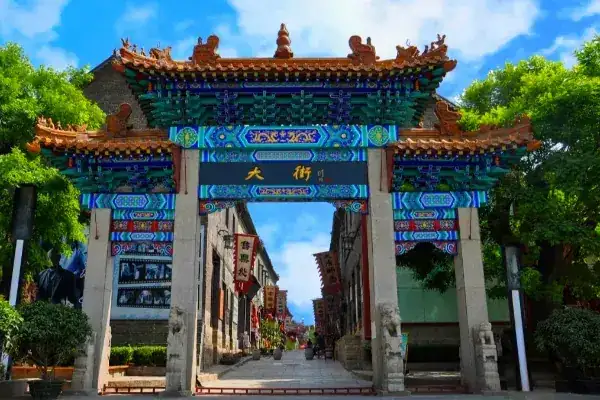
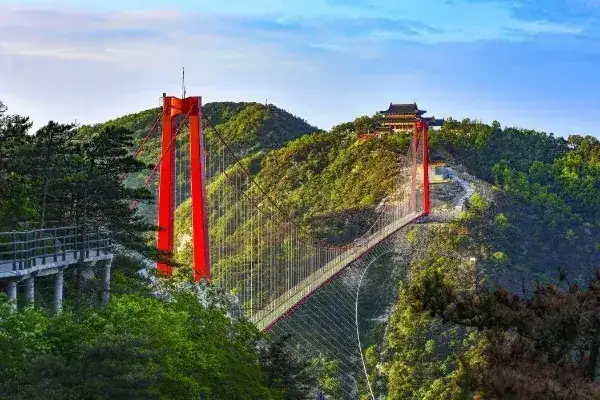
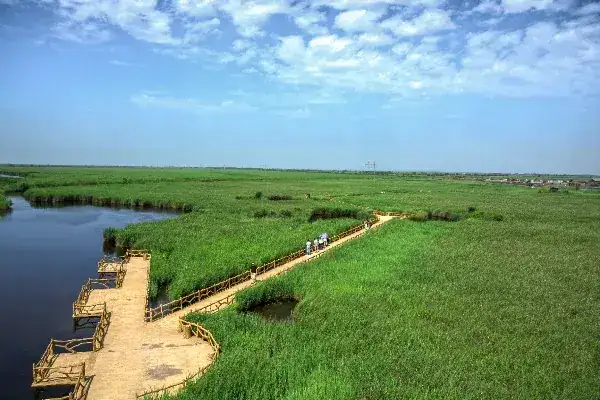
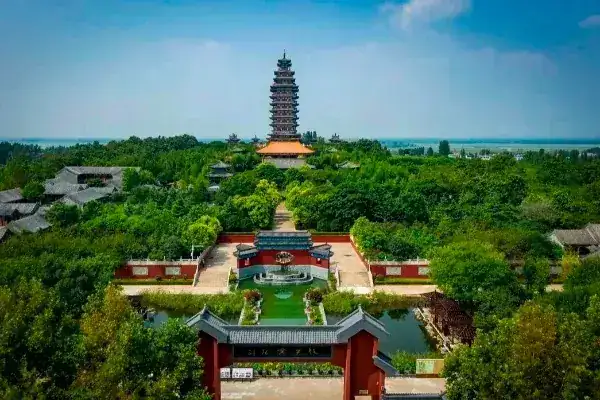
Dezhou's cultural and historical map features notable attractions across the region. Detailed scenic spot information to be supplemented.
Famous People
Information to be supplemented.
Honorary Titles
Dezhou was selected as one of China's "Top 100 Prefecture-level Cities for Livelihood Development" (September 2016), listed as a first-batch national new urbanization comprehensive pilot area, reconfirmed as a National Health City (2018), rated as a National Double Support Model City (October 2020), and classified as a Tier-3 city (2023).
Local Specialties
Information to be supplemented.
Travel information can change. Check current opening hours, reservations and entry requirements before you travel.
Traveller discussion
Start the conversation with a helpful tip or a question.