
Linyi City
Linyi CityLinyi, a prefecture-level city in Shandong Province, is located in southeastern Shandong. It spans latitudes 34 degrees 22 minutes to 36 degrees 13 minutes North and longitudes 117 degrees 24 minutes to 119 degrees 11 minutes East
Linyi City
Linyi, a prefecture-level city in Shandong Province, is located in southeastern Shandong. It spans latitudes 34 degrees 22 minutes to 36 degrees 13 minutes North and longitudes 117 degrees 24 minutes to 119 degrees 11 minutes East, with a temperate monsoon climate featuring four distinct seasons and synchronized rainfall and heat. Three major mountain ranges -- Yishan, Mengshan, and Nishan -- extend from north to south, controlling the flow of the Yishu River and its tributaries. The fan-shaped Lintancang Plain to the south is one of Shandong's three major plains. The total area is 17,191.2 square kilometers. As of the end of 2024, the resident population was 10.8484 million. As of March 2025, Linyi administers 3 districts and 9 counties. The municipal government is seated at No. 17 Beijing Road, Liuqing Subdistrict, Lanshan District. Named for its proximity to the Yi River, Linyi was known in antiquity as Langya and Yizhou, and is a core birthplace of Dongyi culture with over 3,000 years of urban history. During the Spring and Autumn Period, Qiyang City was built here; in the Han Dynasty, it served as the seat of Langya; and in the Qing Dynasty, Yizhou Prefecture was established. During the War of Resistance Against Japanese Aggression, Linyi was the capital of the Shandong Anti-Japanese Base Area led by the Chinese Communist Party and the birthplace of the East China Bureau, East China Military Region, East China Field Army, and Shandong Provincial Government. In 1994, it was designated as a prefecture-level city. Linyi is a modern industrial and commercial city with waterfront characteristics, a commerce and logistics center, a national comprehensive transportation hub, and one of 20 key cities in old revolutionary base areas. Notable attractions include the Yimeng Mountain World Geopark, the Yinqueshan Han Bamboo Slips Museum, and the Former Residence of Wang Xizhi. Historical figures include Sunzi, Zengzi, Zhuge Liang, Wang Xizhi, Yan Zhenqing, and Liu Hong. Linyi has been awarded National Civilized City, National Double Support Model City, and National Garden City honors, and designated as China's Market City, China's Logistics Capital, and China's Calligraphy City. In 2025, Linyi's GDP reached 686.22 billion RMB (approximately $95.3 billion), growing 5.4% year-on-year at constant prices.
History
Ancient Period
Linyi has a long history and is an important birthplace of Chinese civilization. As early as 200,000 years ago, human ancestors created ancient civilization on this land. Early Paleolithic cultural remains have been discovered at multiple sites. Nearly 100 microlithic cultural sites found along the Yi and Shu river basins were created by humans 10,000 to 20,000 years ago. By 5,000 years ago, people here had begun using written symbols, mastered brewing techniques, produced black pottery, and used stone needles for medical treatment.
Xia, Shang, and Zhou Dynasties
During the Shang Dynasty, the states of Tan, Ju, and Fei existed on this land. After the Zhou conquered the Shang, the Linyi area was incorporated into Qingzhou and divided between the states of Qi and Lu. States recorded in the Spring and Autumn Annals include Zhuanyu, Yu, Zeng, Zhun, Yang, Xiang, Tan, Genmou, and Yuyuqiu.
Spring and Autumn and Warring States Periods
During the Spring and Autumn Period, Ji Sun Si and Shu Sun Zhou Chou of the Lu state led the construction of Qiyang City as a southeastern barrier, which became the predecessor of today's old Linyi city. Seventeen major cities are recorded in the Spring and Autumn Annals within the area. During the Warring States Period, the vassal states were successively annexed by Qi and Chu, with the south belonging to Chu and the north to Qi by the late period.
Qin, Han, and Three Kingdoms Periods
After Qin unified China, the commandery-county system was implemented. The Linyi area belonged to Langya Commandery and Tan Commandery. During the Western Han, to avoid the naming taboo of Emperor Jing (Liu Qi), Qiyang City was renamed Kaiyang. Emperor Wu established the Thirteen Provinces, with Tan County serving as the seat of Xuzhou. During the Eastern Han, Langya Commandery was changed to Langya State, and its capital was moved to Kaiyang. During the Three Kingdoms Period, Kaiyang served as the capital of Langya State. The area belonged to the state of Wei, and the Langya Zhuge clan of Langya Yangdu had members serving across the Three Kingdoms.
Two Jin and Northern and Southern Dynasties
During the Western Jin, the area was divided among Langya State, Donghai Commandery, Lanling Commandery, and Dongguan Commandery in Xuzhou, and Taishan Commandery in Yanzhou. After the Jin court moved south, the area successively belonged to Later Zhao, Eastern Jin, Former Yan, Later Yan, Southern Yan, Former Qin, and Northern Wei.
Sui and Tang Dynasties
During the Sui Dynasty (605 CE), the three counties of Kaiyang, Linyi, and Jiqiu were merged into Linyi County. The area was divided among Yizhou, Sizhou, Mizhou, Haizhou, and Xuzhou. During the Tang Dynasty, it was divided among Yizhou (Langya Commandery), Mizhou (Gaomi Commandery), and Xuzhou (Pengcheng Commandery).
Song, Jin, Yuan, Ming, and Qing Dynasties
During the Song, the area belonged to Yizhou and Mizhou. During the Jin, it was divided among Yizhou, Juzhou, Pizhou, and Tai'an in Shandong East Circuit. During the Yuan, it belonged to Yanzhou and Qingzhou prefectures. In 1734 (Qing Dynasty, Yongzheng reign), Yizhou was elevated to Yizhou Prefecture, governing 6 counties and 1 department.
Republic of China Period
After the founding of the Republic of China, the prefecture system was abolished. In 1913, Yizhou Prefecture was dissolved and Juzhou became Juxian County. In 1914, Lanshan County was renamed Linyi County. In August 1945, the Shandong Provincial Government was established in Dadian. In July 1948, three administrative areas were merged into the Luzhongnan Administrative Area.
People's Republic of China Period
In 1950, Yishui and Linyi Special Areas were established. In 1953, Yishui Special Area was merged into Linyi Special Area. In 1967, it was renamed Linyi Prefecture. In 1989, Rizhao was separated and Yiyuan County was transferred to Zibo. In 1992, Juxian County was transferred to Rizhao. In December 1994, the State Council approved the establishment of prefecture-level Linyi City.
Administrative Divisions
Division History
In 1961, Linyi Special Area governed 13 counties. In 1989, Rizhao was elevated to a prefecture-level city and Yiyuan was transferred to Zibo. In 1992, Juxian was placed under Rizhao. In 1994, Linyi was reorganized into a prefecture-level city with 3 districts and 9 counties. In 2014, Cangshan County was renamed Lanling County.
Division Details
As of March 2025, Linyi administers 3 districts (Lanshan, Luozhuang, and Hedong) and 9 counties (Tancheng, Lanling, Junan, Yishui, Mengyin, Pingyi, Feixian, Yinan, and Linshu), plus 2 development zones, with 30 subdistricts, 120 towns, and 6 townships. The municipal government is seated at No. 17 Beijing Road, Liuqing Subdistrict, Lanshan District.
Geography
Location and Boundaries
Linyi is located in southeastern Shandong, near the Yellow Sea, at the junction of the Yangtze River Delta and Bohai Rim economic circles. It connects Rizhao to the east, Zaozhuang, Jining, and Tai'an to the west, Zibo and Weifang to the north, and Xuzhou and Lianyungang of Jiangsu to the south. It spans latitudes 34 degrees 22 minutes to 36 degrees 13 minutes North and longitudes 117 degrees 24 minutes to 119 degrees 11 minutes East, with a total area of 17,191.2 square kilometers.
Geology
Linyi's geological structure is complex, with strata from the Archean to the Cenozoic. The main feature is the Tanlu Fault Zone (known locally as the Yishu Fault Zone), which extends through Tancheng and runs through the entire city.
Topography
The terrain is high in the northwest and low in the southeast. Three mountain ranges -- Yishan, Mengshan, and Nishan -- extend northwest to southeast, controlling the flow of the Yishu River and its tributaries. Mountains surround the area on three sides, forming a fan-shaped alluvial plain to the south. Mountains, hills, and plains are distributed in a 2:4:4 ratio.
Climate
Linyi has a temperate monsoon climate with moderate temperatures, four distinct seasons, abundant sunlight, and plentiful rainfall. Spring warms quickly with little rain; summers are hot and humid; autumn sees sharp temperature drops with pleasant weather; winters are cold and dry.
Hydrology
Linyi's water system features four major systems: the Yi River, Shu River, Grand Canal, and coastal rivers, all in the Huai River Basin. The main rivers are the Yi River (570 km total, 287.5 km within Linyi) and the Shu River (197 km within Linyi), with over 1,035 tributaries and more than 300 rivers exceeding 10 km.
Soils
Linyi's soils are divided into five categories: brown earth (840,300 ha, 46.06%), cinnamon soil (605,700 ha, 33.21%), fluvo-aquic soil (244,800 ha, 13.42%), shajiang black soil (81,400 ha, 4.46%), and paddy soil (48,900 ha, 2.68%). Brown earth is found in the eastern hills and around Mengshan. Cinnamon soil is on limestone mountains west of the Yi and Shu river. Fluvo-aquic soil is along riverbanks and plains, ideal for wheat, corn, and cotton.
Natural Resources
Water Resources
Linyi has abundant water resources. The multi-year average surface water resource is 5.16 billion cubic meters, groundwater is 2.36 billion cubic meters, and total water resources are 5.96 billion cubic meters. Existing projects can supply 3.18 billion cubic meters in normal years.
Land Resources
Crop planting area is 1.0862 million hectares, forest area is 506,700 hectares, with 35% forest coverage. The alluvial plains are among Shandong's three major granaries, producing yellow tobacco, peanuts, sweet potatoes, and corn.
Biological Resources
Linyi has 151 families and 1,043 species of higher plants, including 830+ medicinal plants and 923 crop varieties. Fauna includes approximately 14 classes and 1,049 species, with 57 freshwater fish species, 171 bird species, and 25 mammal species. Notable products include honeysuckle, ginkgo, garlic, chestnuts, hawthorns, pears, apples, Sichuan pepper, and walnuts.
Mineral Resources
Linyi has 84 mineral types. Dolomite reserves rank first nationally; diamond, gypsum, and quartz sandstone rank second; serpentine, porcelain clay, and stone materials rank third. There are 15 natural mineral water sites and 2 geothermal sites: Tangtou Hot Spring in Hedong District and Xinwanggou Hot Spring in Yinan County.
Population
Population Size
According to the Seventh National Population Census (November 1, 2020), Linyi's resident population was 11.018 million. As of the end of 2024, the resident population was 10.8484 million.
Ethnic Composition
In addition to the Han majority, Linyi has 48 ethnic minorities including Hui, Mongolian, Miao, Yi, Zhuang, Manchu, Korean, Bai, Hani, Tibetan, Yao, Tujia, Uyghur, Lahu, and Bouyei.
Politics
The Linyi Municipal People's Government serves as the city's administrative organ, seated in Lanshan District. Key institutions include the Municipal CCP Committee, the Municipal People's Congress, and the Municipal CPPCC Committee.
Economy
Overview
In 2024, Linyi's GDP was 655.58 billion RMB (approximately $91.1 billion), up 5.7%. The primary, secondary, and tertiary industries added values of 54.32 billion RMB ($7.5 billion), 265.54 billion RMB ($36.9 billion), and 335.72 billion RMB ($46.6 billion), respectively. General public budget revenue was 46.85 billion RMB ($6.5 billion), up 5.1%. In 2025, GDP reached 686.22 billion RMB (approximately $95.3 billion), up 5.4%, with the three industries adding 55.54 billion RMB ($7.7 billion), 272.64 billion RMB ($37.9 billion), and 358.04 billion RMB ($49.7 billion).
Primary Industry
In 2024, the total output value of agriculture, forestry, animal husbandry, fishery, and services was 103.76 billion RMB ($14.4 billion), up 3.6%. Grain output was 4.313 million tons, and vegetable output was 9.139 million tons. In 2025, the total reached 106.2 billion RMB ($14.75 billion), up 4.6%, with vegetable output of 9.437 million tons.
Secondary Industry
In 2024, Linyi had 4,698 industrial enterprises above designated scale, with industrial added value up 8.6%. Eight traditional industries produced 751.42 billion RMB ($104.4 billion) in output. In 2025, enterprises grew to 4,976, with added value up 7.7%. Thirteen industrial chains produced 685.13 billion RMB ($95.2 billion). Construction output reached 137.55 billion RMB ($19.1 billion).
Tertiary Industry
In 2024, consumer market retail sales reached 343.38 billion RMB ($47.7 billion), up 6.4%. Online retail reached 82.54 billion RMB ($11.5 billion), up 11%. Total import and export volume was 169.19 billion RMB ($23.5 billion). Financial deposits reached 1,180.75 billion RMB ($164.0 billion), and loans reached 1,091.02 billion RMB ($151.5 billion). In 2025, retail sales reached 387.75 billion RMB ($53.9 billion), up 5.2%. Import and export totaled 177.58 billion RMB ($24.7 billion), up 4.9%.
Social Affairs
Science and Technology
In 2024, Linyi implemented 314 major research projects. It hosts 2 national engineering technology research centers, 47 provincial, 2 national key laboratories, 27 academician workstations, and 5 national Torch Program bases. Incubation area totals 2.55 million square meters.
Education
As of 2023, Linyi had 5,037 schools and kindergartens with 2.6733 million students and 184,000 faculty. This includes 3,258 kindergartens, 1,303 primary schools, 337 junior high schools, 71 senior high schools, 35 vocational schools, 12 technical schools, 16 special education schools, and 5 universities.
Culture
In 2024, the City Library held over 800,000 physical books and 1.87 million e-books. The City Museum and Cultural Center are both national first-grade facilities. All 156 townships have comprehensive cultural stations.
Healthcare
As of 2024, Linyi had 9,083 medical institutions including 265 hospitals, with 111,607 health workers and 84,634 beds. Total medical visits reached 84.28 million in 2024, with 2.7 million discharges.
Sports
In 2024, Linyi hosted over 50 national and provincial events and over 5,000 grassroots events with 1.3 million participants. The city won 3 gold, 10 silver, and 2 bronze medals nationally. In 2025, Linyi won the bid to host the 26th Provincial Games, and the sports industry reached 33.52 billion RMB ($4.7 billion).
Social Security
In 2024, urban employee pension, unemployment, and work injury insurance participants reached 2.413 million, 959,000, and 1.319 million respectively. Urban and rural resident pension insurance participants reached 5.542 million.
Transportation
Overview
Linyi is a national highway and railway hub city. Five expressways surround the urban area. As of 2024, railway mileage reached 693 km (165.3 km high-speed rail), highway mileage reached 32,600 km, and 48 air routes connect to 32 cities.
Railways
Three main stations serve Linyi: Linyi Station, Linyi North (high-speed rail), and Linyi East (freight). Multiple railways converge here. High-speed rail lines include the Lunan High-Speed Railway (350 km/h), Beijing-Shanghai Second Line, and the Wei-Su line (expected completion by 2028).
Airport
Linyi Qiyang Airport, built in 1958, is Shandong's earliest civil airport. It covers 263 hectares with a 3,200 m runway, operating 48 routes (including 9 international) to 32 cities through 39 airports with 21 airlines.
Highways
Highway mileage reaches 32,600 km with a density of 186.6 km per 100 sq km. Urban expressways include Mengshan Avenue and Shuangling elevated roads. The Sanhekou Tunnel -- Shandong's first river-bottom tunnel -- is 3.84 km with six lanes.
Public Transit
Linyi's BRT system opened in 2017 with Line 1 running 11.1 km. The bus system includes electric, gas, mini, and inter-county express buses at 2 RMB per ride. A public bicycle system launched in 2016 with 800 stations and 20,000 bicycles. A metro system with 3 backbone lines is planned.
History and Culture
Traditional Opera
Liuqin Opera, originating in the Linyi area during the Qing Dynasty, is also called "Soul-Pulling Melody." It was listed as national intangible cultural heritage in 2006. Other traditions include Longdeng Kangge folk dance and the Five Great Tunes of Southern Shandong.
Folk Customs
Linyi maintains traditions including the Longtaitou Festival (2nd day of the 2nd lunar month), Shangsi Festival (3rd day of the 3rd lunar month), Mid-Year Festival (6th day of the 6th lunar month), Kitchen God farewell, New Year greetings, and Lantern Festival viewing.
Intangible Cultural Heritage
Notable items include Cangshan clay sculpture, Tancheng woodblock New Year paintings, willow weaving, the Yimeng Mountain Folk Song, Lanling fine wine, wood-turning toys, and the local soup (Sa) making technique.
Festivals
Linyi hosts lantern fairs, temple fairs, and cultural tourism festivals celebrating revolutionary heritage and folk traditions throughout the year.
Urban Culture
Linyi is known as a "Water City" with distinctive waterfront features, integrating revolutionary culture, calligraphy traditions, and modern commerce.
Scenic Spots
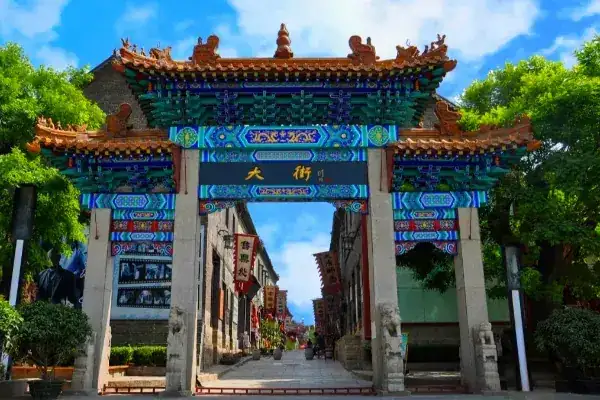
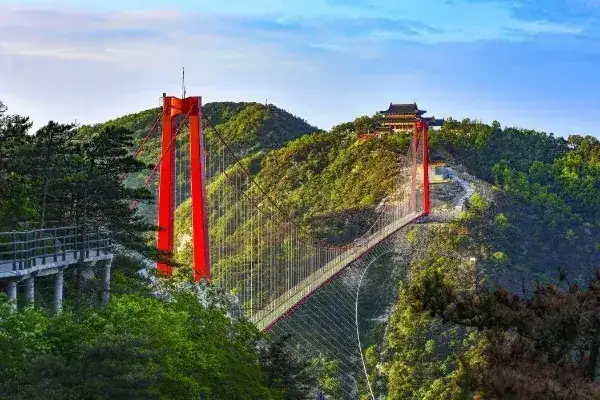
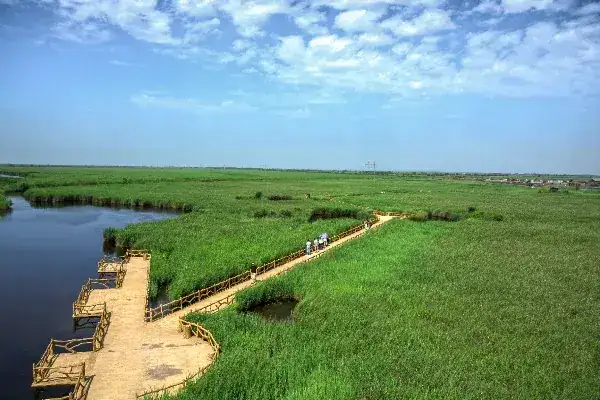
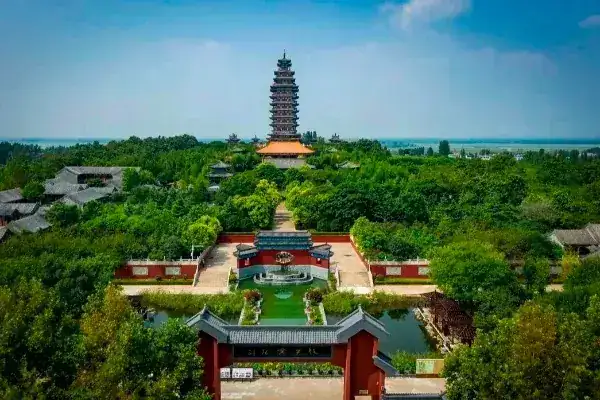
The Yimeng Mountain area, with Mengshan as its backbone, is a World Geopark. As of 2018, Linyi had 195 national A-level attractions, including 2 at 5A and 27 at 4A level. Tourism themes include natural scenery, Han-Jin historical culture, red tourism, hot springs, and water-city urban tours.
Local Specialties
Linyi Cuisine
Linyi is an important representative of Shandong cuisine, with techniques including steaming, boiling, roasting, and stir-frying. Famous dishes include Sa (peppery beef or mutton soup), Yimeng Bachelor Chicken, Linyi Jianbing (flatbread), Garlic Mud Fish, and Lanling Fine Wine.
National Geographic Indication Products
Linyi's national geographic indication products include Lanling Garlic, Pingyi Honeysuckle, Tancheng Ginkgo, and other distinctive agricultural products.
Notable Figures
Historical figures from Linyi include Sunzi (military strategist), Zengzi (philosopher), Zhuge Liang (statesman and strategist), Wang Xizhi (the "Sage of Calligraphy"), Yan Zhenqing (calligrapher and statesman), and Liu Hong (astronomer and mathematician).
Honorary Titles
Linyi has been awarded National Civilized City, National Double Support Model City, National Garden City, China's Market City, China's Logistics Capital, and China's Calligraphy City.
Sister Cities
Domestic
Lianyungang, Yan'an, Zunyi, Enshi, Anyang, Xinxiang, Lijiang, Fuyang, Yulin, Yingkou, and Lincang.
International
Bad Vilbel (Germany), Bintan (Indonesia), Nassau County (USA), Layton (USA), Haven (USA), Hattiesburg (USA), Feira de Santana (Brazil), Bucharest Sector 2 (Romania), Aragon (Spain), Gwadar (Pakistan), Rovaniemi (Finland), Himeji (Japan), Brazzaville (Congo), Jinhae (South Korea), Pyeongtaek (South Korea), Gunpo (South Korea), Eskilstuna (Sweden), Salisbury (Australia), Hanover (Germany), Rumst (Belgium), Nyborg (Denmark), Tifton (USA), Ondo State (Nigeria), Budapest District 15 (Hungary), and Padawan (Malaysia).
Travel information can change. Check current opening hours, reservations and entry requirements before you travel.
Traveller discussion
Start the conversation with a helpful tip or a question.