
Rizhao City
Rizhao CityRizhao is a prefecture-level city in Shandong Province, located on the coast of the Yellow Sea in southeastern Shandong. It faces Japan and South Korea across the Yellow Sea to the east, borders Linyi to the west, connects with Q
Rizhao City
Rizhao is a prefecture-level city in Shandong Province, located on the coast of the Yellow Sea in southeastern Shandong. It faces Japan and South Korea across the Yellow Sea to the east, borders Linyi to the west, connects with Qingdao and Weifang to the north, and adjoins Lianyungang (Jiangsu Province) to the south. The terrain is higher in the center and lower around the edges, tilting slightly toward the southeast. The city has a warm-temperate, semi-humid monsoon climate and a total area of 5,374.90 square kilometers. As of March 2025, Rizhao administers 2 districts and 2 counties. As of end-2024, the permanent population was 2.9288 million. The city is named for "where the first sunlight of dawn shines." During the Xia and Shang dynasties, the area belonged to the Dongyi people and is one of the birthplaces of Longshan Culture. The Song dynasty established Rizhao Town, marking the origin of the name. In June 1989, it became a prefecture-level city. Rizhao is a coastal, ecological, livable, tourism-oriented modern port city and port-industry base, and part of the Shandong Peninsula Urban Agglomeration, Shandong Peninsula Blue Economic Zone, and Jiaodong Economic Circle. It features two natural harbors -- Shijiu Bay and Foshou Bay -- and a port complex formed by Rizhao Port and Lanshan Port, earning the titles "Capital of Water Sports" and "City of the Eastern Sun." It received the UN Habitat Scroll of Honour Award for its excellent environment. Notable historical figures include Jiang Shang, Liu Xie, and Samuel C.C. Ting (Ding Zhaozhong). The city has been designated a National Civilized City, National Forest City, National Key Environmental Protection City, and National Ecological Demonstration Zone. In 2025, Rizhao's GDP reached 268.996 billion yuan (approximately $37.4 billion), up 6.0% year-on-year at constant prices.
History
From the Western Zhou to the early Warring States period, the area belonged to the State of Ju.
During the Qin dynasty, it was part of Langya Commandery.
During the Western Han, Haigu County was established. In the Eastern Han, it was renamed Xihai County.
During the Three Kingdoms period under Wei, it belonged to Chengyang Commandery and was merged into Ju County.
During the Northern Wei, Liangxiang County was established, with its former seat at present-day Liangcheng Town.
During the Sui dynasty, it returned to Ju County under Langya Commandery.
During the Tang and Song dynasties, it belonged to Mizhou. In the second year of Yuanyou (1087 CE), Rizhao Town was established under Ju County, marking the first use of the name "Rizhao."
In the 24th year of Dading in the Jin dynasty (1184 CE), Rizhao County was formally established under Yidu Prefecture's Juzhou.
During the Yuan dynasty, Rizhao County belonged to Yidu Circuit's Juzhou.
In the early Ming dynasty, it was under Qingzhou Prefecture's Juzhou.
During the Qing dynasty, it belonged to Yizhou Prefecture.
In 1913, the prefecture system was abolished and it came under Jiaodong Circuit. In 1928, it was placed directly under the Shandong provincial government. During the Anti-Japanese War, the KMT Rizhao county government was under the Third Administrative Inspectorate of Shandong. In March 1940, the Rizhao County Anti-Japanese Democratic Government was established.
In 1950, it was assigned to Yishui Special District.
In 1956, it was placed under Linyi Special District.
On March 22, 1985, with State Council approval, Rizhao County was converted to Rizhao City (county-level) under Linyi Prefecture.
On June 12, 1989, with State Council approval, Rizhao was elevated to a prefecture-level city.
On December 7, 1992, the State Council approved Rizhao's district-and-county structure: Donggang District was established from the original municipal area, with Juxian and Wulian County placed under its jurisdiction.
In September 2004, Lanshan District was established.
Administrative Divisions
As of March 2025, Rizhao administers 2 districts and 2 counties: Donggang District, Lanshan District, Juxian, and Wulian County, comprising 16 subdistricts, 35 towns, and 4 townships. The municipal government is seated at No. 198 Beijing Road, Qinlou Subdistrict, Donggang District.
Geography
Location
Rizhao is located between 118 degrees 25 minutes and 119 degrees 39 minutes east longitude, and 35 degrees 4 minutes and 36 degrees 4 minutes north latitude, on the central coast of mainland China and the southeastern Shandong Peninsula. It borders the Yellow Sea to the east, Linyi to the west, Lianyungang (Jiangsu) to the south, and Qingdao and Weifang to the north, facing Japan and South Korea across the sea. The city extends approximately 82 km north-south and 90 km east-west, with a total area of 5,374.90 square kilometers.
Topography
Rizhao lies in the Ludong hilly region. The terrain slopes from a higher center to lower surroundings, tilting slightly southeast. Mountains, hills, and plains are interspersed. The highest point is Ma'er Mountain in Wulian County at 706 meters; the lowest is Donghaiyu Village in Donggang District at 1 to 1.5 meters. Mountains account for 17.5% of the total area, hills 57.2%, and plains 25.3%. The city has 18 major rivers totaling 461.4 km in length, with a drainage area of 5,222.7 square kilometers. There are 4,358 peaks of various sizes, with 39 exceeding 500 meters in elevation.
Climate
Rizhao has a warm-temperate, semi-humid monsoon climate strongly influenced by the ocean. Compared with inland areas at the same latitude, it features mild seasons -- no extreme heat in summer or severe cold in winter. Springs are dry and windy; summers are warm with concentrated rainfall; autumns are cool with large temperature variations; winters are dry with little snow. In 2020, the average annual temperature was 14.1 degrees Celsius (57.4 degrees Fahrenheit), 1.1 degrees above the long-term average. The extreme minimum was -15.5 degrees Celsius (4.1 degrees Fahrenheit) in Juxian on December 31, and the extreme maximum was 37.8 degrees Celsius (100.0 degrees Fahrenheit) in Wulian County on June 4. Annual precipitation averaged 1,233.0 mm, and annual sunshine totaled 2,410.5 hours.
Hydrology
Rizhao's rivers belong to the Shuhe, Weihe, and Southeast Coastal water systems. Major rivers include the Shuhe -- the largest, flowing 83.29 km through Juxian; the Futan River, the largest independent river to the sea at 60.72 km; the Weihe at 47.5 km; the Xiuzhen, a provincial boundary river at 24.42 km; and the Chaobai, a boundary river with Qingdao at 41.83 km. The coastline extends 168.5 km from Tianshui River mouth to Xiuzhen River mouth, featuring Shijiu Bay and Foshou Bay as two major natural harbors forming the Rizhao Port complex. There are 595 reservoirs with a total capacity of 1.3 billion cubic meters.
Natural Resources
Biological Resources
Rizhao's forests belong to the warm-temperate deciduous broadleaf zone, with 82 families, 209 genera, and 739 species of woody plants. The city has 275 ancient and notable trees, with the ginkgo at Fulai Mountain in Juxian being over 3,500 years old -- the oldest, thickest, and largest of its kind. Thirteen species are under national protection.
Animal Resources
Rizhao has 357 species of terrestrial vertebrate wildlife, including 7 species under national first-class protection (Oriental White Stork, Chinese Merganser, Siberian Crane, Red-crowned Crane, Great Bustard, Relict Gull, and Chinese Crested Tern) and 30 species under second-class protection, with over 330 bird species.
Mineral Resources
Rizhao has identified 63 types of minerals, with 38 having proven reserves. These include 2 energy minerals (coal and geothermal), 7 metallic minerals (copper at 121,000 tonnes, ilmenite at 120 million tonnes, lead-zinc at 232,000 tonnes), and 27 non-metallic minerals (decorative granite at 80 million cubic meters, andalusite, pyrite, fluorite, serpentinite, and eclogite). Shandong's proven reserves of andalusite, kyanite, and eclogite are concentrated in Rizhao, with andalusite reserves ranking 5th nationally and granite reserves leading the province.
Population
According to the 7th National Census (November 1, 2020), Rizhao's permanent population was 2,968,365, an increase of 167,352 (5.97%) from 2010, with an average annual growth rate of 0.58%. As of end-2024, the registered population was 3.0692 million, with a permanent population of 2.9288 million and an urbanization rate of 64.62%.
Politics
The municipal government operates under the leadership of the Chinese Communist Party Rizhao Municipal Committee, with the Mayor as head of the city administration.
Economy
Overview
In 2024, Rizhao's GDP was 255.689 billion yuan (approximately $35.5 billion), up 5.4% at constant prices. The primary sector contributed 21.923 billion yuan ($3.0 billion, +4.4%), the secondary sector 110.004 billion yuan ($15.3 billion, +5.7%), and the tertiary sector 123.762 billion yuan ($17.2 billion, +5.2%). The industrial structure ratio was 8.6:43.0:48.4.
Fixed asset investment grew 4.2%. General public budget revenue was 20.416 billion yuan ($2.8 billion, +4.5%) and expenditure 31.845 billion yuan ($4.4 billion, -0.5%). Livelihood expenditures totaled 25.54 billion yuan ($3.5 billion), or 80.2% of public spending.
Primary Industry
In 2024, grain was planted on 2.0137 million mu (approximately 134,200 hectares), yielding 448.12 kg/mu for a total output of 902,400 tonnes (+0.7%). Agriculture, forestry, animal husbandry, and fishery value-added totaled 24.063 billion yuan ($3.3 billion, +4.6%).
Secondary Industry
In 2024, total industrial value-added was 84.821 billion yuan ($11.8 billion, +6.0%), with above-scale industrial value-added growing 7.4%. Above-scale industrial enterprises achieved revenue of 438.061 billion yuan ($60.8 billion) with profits of 5.977 billion yuan ($830 million). Qualified construction enterprises completed output of 57.645 billion yuan ($8.0 billion, +6.2%).
Tertiary Industry
In 2024, the service sector's value-added was 123.762 billion yuan ($17.2 billion, +5.2%), accounting for 48.4% of GDP. Above-scale service industry revenue was 58.400 billion yuan ($8.1 billion, +5.1%). High-tech service value-added reached 2.88 billion yuan ($400 million, +45.6%).
Total retail sales of consumer goods reached 75.425 billion yuan ($10.5 billion, +5.3%). Foreign trade totaled 127.9 billion yuan ($17.8 billion, -7.0%), with exports of 49.24 billion yuan ($6.8 billion) and imports of 78.66 billion yuan ($10.9 billion).
Year-end financial institution deposits reached 453.413 billion yuan ($62.9 billion, +10.2%) and loans 454.809 billion yuan ($63.1 billion, +9.4%). Premium income was 8.819 billion yuan ($1.2 billion, +3.0%).
Social Affairs
Science and Technology
In 2024, Rizhao had 1,718 technology-based SMEs and 1,058 high-tech enterprises. The city secured 71 provincial science and technology projects. Effective trademark registrations reached 56,196 (+8.2%), with 16 China Well-Known Trademarks and 3,908 valid invention patents (+13.0%).
Education
As of end-2024, Rizhao had 950 schools of all types with 630,300 students and 49,400 staff. Preschool education coverage reached 93.4%. Five high schools were rated provincial-level featured high schools. Rizhao Health Care Vocational College was approved for enrollment, and Rizhao Vocational and Technical College passed provincial inspection for upgrading to a bachelor's-degree-granting institution.
Culture
As of September 2024, Rizhao had 5 public libraries, 5 cultural centers, 5 museums, 1 art gallery, and 55 city study rooms -- all at national Grade I level. Over 60 major cultural and tourism events were held, including the China Wind Music Exhibition and beach music festivals. The city hosted the 10th National B&B Conference.
Healthcare
As of end-2024, Rizhao had 2,524 medical institutions with 19,669 beds and 25,088 health professionals, including 10,131 licensed (assistant) physicians and 10,942 registered nurses. There were 8 provincial-level key clinical specialties (Western medicine) and 12 provincial-level TCM key clinical specialties.
Sports
In 2024, Rizhao hosted over 140 provincial-level and above sporting events and 3,800+ fitness activities. Sports lottery sales reached 890 million yuan ($123 million). Wulian County was named one of China's Top 10 Sports Tourism Destinations.
Social Security
As of end-2024, pension, unemployment, and work injury insurance covered 2.2859 million, 347,200, and 548,200 people respectively. Urban employee basic medical insurance covered 660,300 people, and urban-rural resident basic medical insurance covered 2.1797 million. The city operated 63 eldercare institutions serving 4,851 people, with 4,375 beds in township eldercare homes. Urban minimum living standards were raised to 977 yuan/month (approximately $135) and rural standards to 812 yuan/month (approximately $113).
Transportation
Overview
In 2024, port cargo throughput was 623 million tonnes (+5.0%), with container throughput at 6.71 million TEU (+7.2%). Total highway mileage reached 10,415.77 km.
Ports
Rizhao Port has 74 production berths (64 of 10,000-tonne class or above) with annual capacity of 256 million tonnes. Port cargo throughput reached 438 million tonnes (+8.9%), ranking 7th among China's coastal ports. Six cargo categories exceeded 10 million tonnes, including metal ores (177.35 million tonnes), petroleum products (68.74 million tonnes), and coal (48.16 million tonnes).
Aviation
Rizhao Shanzihe Airport is located in Houcun Town, Donggang District, 19 km from the city center. The airport covers approximately 161 hectares, with a 22,000-square-meter terminal, 4C flight area rating, 2,600-meter runway, and 11 parking positions. It connects to major cities including Beijing, Shanghai, Guangzhou, and Shenzhen.
Railways
Rizhao West Station opened in 2018 with the Qing-Yan Railway. In 2019, the Lunan High-Speed Railway opened, bringing Rizhao into the "high-speed rail era." Railway passenger departures reached 1.613 million (+7.7%), and freight volume was 79.96 million tonnes (+3.6%). Rizhao Station, undergoing renovation since 2020, will serve as the originating and terminating station for the Xinhe-Yanri Railway, Qing-Yan Railway, and Ri-Lan High-Speed Railway.
Highways
Expressways within Rizhao include the Shen-Hai Expressway, Chang-Shen Expressway, Ri-Lan Expressway, Wei-Ri Expressway, Rizhao Shijiuh Port Area spur expressway, and Rizhao Airport Expressway.
History and Culture
Overview
The name "Rizhao" dates to the Yuanyou era. It is known as the place of "sunrise over the sea, first touched by dawn." Sweet osmanthus and ginkgo are the city's official flower and tree. According to Oxford University's World History Overview, Liangcheng in Rizhao was one of Asia's earliest cities (3500 to 2000 BCE). Rizhao is an important birthplace of Longshan Culture, with nearly 100 archaeological sites discovered, including the Liangcheng, Lingyanghe, Dantu, and Donghaiyu sites. Ju Culture, Qi Culture, and Lu Culture were collectively known as the Three Great Cultures of Shandong. Rizhao's black pottery has a 5,000-year history. In 1988, Rizhao was named one of China's first Modern Folk Painting Towns.
Intangible Cultural Heritage
As of September 2024, Rizhao has 1 UNESCO Intangible Cultural Heritage item, and 6, 28, and 165 items at the national, provincial, and municipal levels respectively, with 1, 14, and 125 designated inheritors.
Cultural Relics Protection
Rizhao has registered 1,236 immovable cultural relics and 35,000 movable artifacts. There are 420 protected cultural heritage sites at or above county level, including 7 national-level and 33 provincial-level sites.
Folk Culture
Rizhao is one of the world's five major sun culture origin sites, with ancient sun-worshipping traditions. According to the Classic of Mountains and Seas, the place where Xihe sacrificed to the sun -- Tanggu and the Ten-Sun Kingdom -- was in the Rizhao area. Mount Tiantai in Taoluo Town, Donggang District, retains relics related to sun worship, including the Sun God Stone and Sun God Tomb.
The Sun Festival is a local folk holiday. Each year on the 19th day of the 6th lunar month, farmers make sun-shaped cakes from newly harvested wheat to thank the sun for the harvest. These cakes are said to be the origin of the famous Shandong jianbing (pancakes).
Arts and Culture
Rizhao, along with Shanghai's Jinshan and Shaanxi's Huxian, is known as one of China's "Three Great Farmer Painting Towns." Rizhao farmer paintings evolved from traditional folk painting through the Ming-Qing incubation period, post-1949 formation, and post-reform innovation. In 1988, Rizhao was named a "China Modern Folk Painting Town" by the Ministry of Culture, with works exhibited abroad over a dozen times. The paintings feature vivid colors, bold lines, and full compositions, drawing from woodblock New Year paintings, folk embroidery, and paper-cutting traditions.
Donggang District's traditional craft embroidery has grown into a significant industry with over 10 enterprises and 10,000+ processing households, exporting to Japan, the United States, Germany, the United Kingdom, and Canada.
Scenic Spots
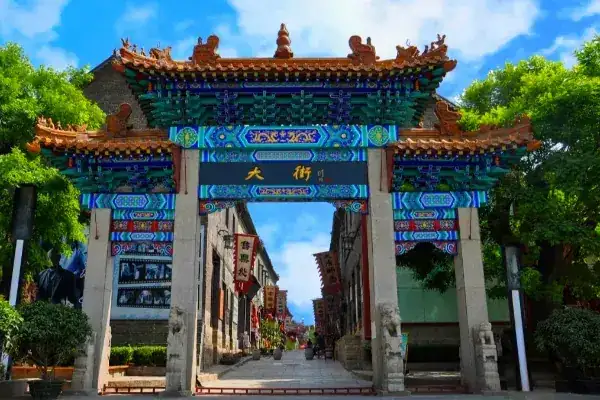
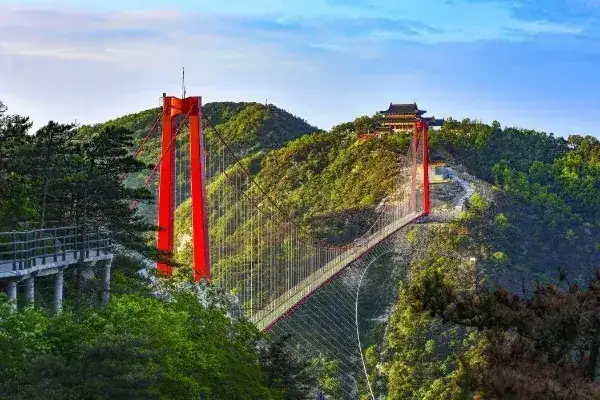
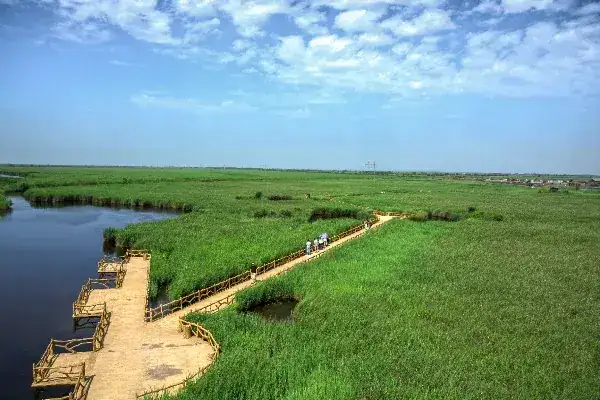
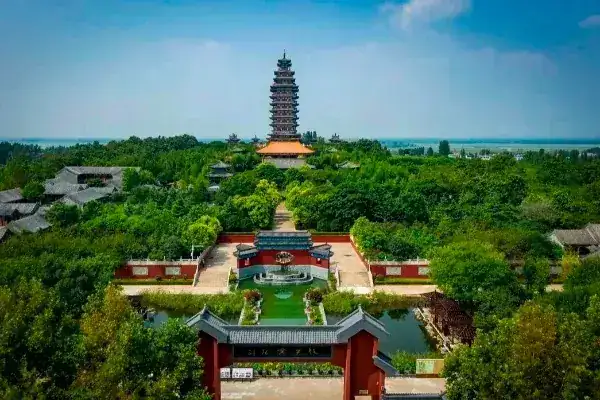
Rizhao is renowned for its "blue sky, emerald sea, and golden beaches." The 100-km coastline includes 64 km of premium sandy beach, praised by experts as "China's last unpolluted golden coast." Notable attractions include the Olympic Water Sports Park, Lunan National Coastal Forest Park, Wanpingkou Seaside Tourism Area, Wulian Mountain, Jiuxian Mountain, Zhudongtian, and Fulai Mountain in Juxian.
As of September 2024, Rizhao has 1 national-level tourism resort, 2 provincial-level resorts, 47 A-level tourist attractions (13 at 4A level, 29 at 3A level), 3 national rural tourism key villages, and 20 provincial-level key villages and towns.
Specialties
Rizhao is known for its black pottery, green tea (a national geographical indication product), seafood products, and farmer paintings.
Famous People
Notable figures from Rizhao include Jiang Shang (legendary strategist of the Zhou dynasty), Liu Xie (author of The Literary Mind and the Carving of Dragons), and Samuel C.C. Ting (Ding Zhaozhong, Nobel Prize laureate in Physics, 1976).
Honorary Titles
Rizhao has been designated a National Civilized City, National Forest City, National Key Environmental Protection City, National Ecological Demonstration Zone, UN Habitat Scroll of Honour recipient, and National Double Support Model City.
Travel information can change. Check current opening hours, reservations and entry requirements before you travel.
Traveller discussion
Start the conversation with a helpful tip or a question.