
Yantai City
Yantai CityYantai City, a prefecture-level city in Shandong Province, is located in the northeastern part of the Shandong Peninsula. It borders Weihai to the east, Weifang to the west, and Qingdao to the southwest, facing the Bohai Sea and
Yantai City
Yantai City, a prefecture-level city in Shandong Province, is located in the northeastern part of the Shandong Peninsula. It borders Weihai to the east, Weifang to the west, and Qingdao to the southwest, facing the Bohai Sea and Yellow Sea to the north across from the Liaodong Peninsula and the city of Dalian. The terrain is characterized by low mountains and hills, with a warm temperate continental monsoon climate. The total area is 13,930.1 square kilometers. As of June 2023, Yantai administers 5 municipal districts and 6 county-level cities. As of the end of 2024, the resident population was 7.0352 million. The Yantai dialect belongs to the Jiao-Liao Mandarin group. Historically the land of the Dongyi people, who established a state here during the Xia Dynasty, Yantai's urban origins trace to 1398 (the 31st year of Hongwu in the Ming Dynasty), when the imperial government established the Qishan Defense Garrison to strengthen coastal defenses. Beacon towers built on the northern hills — also known as "wolf-smoke platforms" (yantai) — gave the city its name. Yantai is a large city designated by the State Council as a central city of the Shandong Peninsula, an important port city in the Bohai Rim region, and a national famous historical and cultural city. It is one of China's first fourteen coastal open cities, an internationally renowned coastal city, a Tier-2 city, an International Wine City, a UN Habitat Scroll of Honour award-winning city, and one of three core cities in Shandong's new and old kinetic energy conversion initiative. Yantai is also a core city of the China (Shandong) Pilot Free Trade Zone, one of the first carbon peak pilot cities, and a "City of Olympic Champions." In October 2025, it was recognized as a National Demonstration City for Rule-of-Law Government. In 2025, Yantai's GDP reached 1,135.098 billion yuan (approximately $156.6 billion USD), up 6.1% year-on-year.
Name and Etymology
Yantai was anciently known as Zhifu. As early as the Late Pleistocene epoch (approximately 10,000 to 20,000 years ago), humans inhabited this area. Since the Xia and Shang dynasties, successive Chinese dynasties placed great importance on governing this region. The name "Yantai" literally refers to ancient beacon towers. In the early Hongwu reign of the Ming Dynasty, to defend against wokou (Japanese pirate) incursions, the Qishan Defense Garrison of a Thousand Households was established on the northern part of the Jiaodong Peninsula, with a castle built along the mountain ridges and beacon towers erected atop. With these wolf-smoke platforms in place, the wokou no longer dared to raid. Another account traces the name to Yantai Mountain. In 1398, local troops and civilians erected wolf-smoke beacon platforms on the coastal northern hills. Upon spotting enemy forces, they raised smoke by day and lit fires by night as warning signals — hence the abbreviated name "Yantai" (smoke platform). The mountain took the name Yantai Mountain, and the city was named after it.
History
During the Shang, Western Zhou, and Spring and Autumn periods, the area belonged to the State of Lai. During the Warring States period, it was part of the State of Qi. Under the Qin Dynasty, it fell under Qi Commandery; under the Han Dynasty, Donglai Commandery. During the Jin Dynasty, it belonged to the Donglai Kingdom. During the Northern and Southern Dynasties, it was under Donglai and Changguang commanderies. Under the Sui Dynasty, it was part of Laizhou; under the Tang, it belonged to Dengzhou and Laizhou, a pattern continued through the Song and Yuan dynasties. During the Ming and Qing dynasties, it was under Dengzhou and Laizhou prefectures.
In 1925, it belonged to the Donghai Circuit. In 1928, the circuit system was abolished. On January 19, 1938, the Jiaodong Military-Political Committee was established; on February 3, Japanese forces occupied Yantai. In February 1941, the Jiaodong Administrative Joint Office was formed. In July 1942, the Jiaodong District Administrative Office was established, governing four special districts: Donghai, Xihai, Nanhai, and Beihai. On August 24, 1945, the Eighth Route Army liberated Yantai, making it the earliest and largest coastal port city liberated by the Eighth Route Army.
In 1950, Wendeng and Laiyang special districts and Yantai City were established. In 1956, Wendeng and Laiyang special districts merged into Laiyang Special District. In 1958, Laiyang Special District and Yantai City merged to form Yantai Prefecture. On August 30, 1983, the State Council approved the abolition of Yantai Prefecture and the establishment of the prefecture-level Yantai City. On November 1, the CPC Yantai Municipal Committee and Yantai Municipal Government officially began operations. On June 15, 1987, Weihai was elevated to a prefecture-level city, and Rongcheng, Wendeng, and Rushan counties were transferred from Yantai to Weihai.
Administrative Divisions
Division History
On August 30, 1983, twelve counties from the former Yantai Prefecture were placed under Yantai City's jurisdiction. Weihai became a provincially-administered (county-level) city under Yantai's management, and Laixi County was transferred to Qingdao. The former Yantai City was redesignated as Zhifu District, and the former Fushan County as Fushan District.
In October 1984, the State Council approved the establishment of the Yantai Economic and Technological Development Zone, covering 10 square kilometers. In September 1986, Huangxian County was abolished and Longkou City established. In February 1987, Laiyang County became Laiyang City. In June 1987, Weihai was elevated to prefecture-level and the three counties of Rongcheng, Wendeng, and Rushan were transferred. In February 1988, Yexian County became Laizhou City. In November 1991, Penglai County became Penglai City. In December 1991, Zhaoyuan County became Zhaoyuan City. In July 1994, Muping County was abolished and Muping and Laishan districts were established. In November 1995, Qixia County became Qixia City. In April 1996, Haiyang County became Haiyang City. In 1998, Yantai had four districts (Zhifu, Fushan, Muping, Laishan), Changdao County, and seven county-level cities. On June 5, 2020, the State Council approved the merger of Penglai City and Changdao County into the new Penglai District.
Division Details
As of June 2023, Yantai administers 5 districts and 6 county-level cities, along with a national-level economic and technological development zone, a high-tech industrial development zone, and other special zones, comprising 82 towns, 6 townships, and 65 sub-districts, with 583 communities and 6,007 administrative villages. The municipal government is seated at No. 6 Furong Road, Laishan District.
Physical Geography
Location and Extent
Yantai is located in eastern China, on the northeastern part of the Shandong Peninsula, between 119 degrees 34 minutes and 121 degrees 57 minutes east longitude and 36 degrees 16 minutes and 38 degrees 23 minutes north latitude. It borders Weihai to the east, Weifang to the west, and Qingdao to the southwest, facing the Bohai Sea and Yellow Sea to the north across from the Liaodong Peninsula and Dalian, together forming a maritime gateway guarding the capital, Beijing. The maximum east-west span is 214 km and the maximum north-south span is 130 km, with a total area of 13,930.1 square kilometers, of which the urban area is 3,975.5 square kilometers and the built-up area is 474.29 square kilometers.
Topography
Yantai's terrain is characterized by low mountains and rolling hills. Mountains account for 36.62% of the total area, hills 39.7%, plains 20.78%, and lowlands 2.90%. The low mountain zone occupies the central part, composed mainly of granite peaks including Daze Mountain, Aishan, Luoshan, Yashan, Cishan, and Kunyu Mountain, with elevations above 500 meters. The highest peak is Kunyu Mountain at 922.8 meters. The hilly areas surround the low mountain zone at elevations of 100 to 300 meters, with gentle slopes and broad, shallow valleys.
Climate
Yantai has a warm temperate monsoon climate, characterized by moderate rainfall, moist air, and mild temperatures — with no severe cold in winter or extreme heat in summer. The average annual precipitation is 524.9 mm, the average annual temperature is 13.4 degrees Celsius, and the average annual sunshine reaches 2,488.9 hours. The four seasons are distinct, each with its own climatic character.
Hydrology
Yantai has numerous small and medium-sized rivers, with 121 rivers exceeding 5 km in length. Seven rivers have drainage basins exceeding 300 square kilometers: Wulong River, Dagu River, Dagu Jia River, Wang River, Jie River, Huangshui River, and Xin'an River. The main rivers are divided by the "Jiaodong Ridge" formed by Kunyu, Ya, Ai, Luo, and Daze mountains, flowing south and north into the sea respectively. The rivers are characterized by steep gradients, short courses, and rapid flow with dramatic seasonal fluctuations — typical of monsoon-fed rain-source rivers.
Natural Resources
Water Resources
The multi-year average precipitation is 681 mm, with an average water resource volume of 3.2 billion cubic meters, including 2.48 billion cubic meters of surface water and 1.27 billion cubic meters of groundwater. Per capita water resource availability is 487 cubic meters, less than one-fifth of the national average, making Yantai a resource-scarce water region. As of January 2024, Yantai has 1,061 registered reservoirs — the most of any city in Shandong Province. The Laolan Reservoir, with a total capacity of 158 million cubic meters, is the only large reservoir built in Yantai in over 60 years and a key node in Shandong's modern water network.
Plant Resources
Yantai's vegetation falls within the warm temperate deciduous broad-leaved forest zone. The area's favorable hydrothermal conditions support a richer variety of vegetation types compared to other parts of the warm temperate deciduous forest region. The city has 1,349 plant species, including 457 woody and vine species across 70 families and 742 herbaceous species across 120 families.
Animal Resources
Yantai has 524 species of wild vertebrates, including 30 mammals, 377 birds, 15 reptiles, and 8 amphibians. Of these, 102 species are under national or provincial key protection, including 9 species under national Class I protection and 42 under Class II.
Land Resources
As of 2022, Yantai has 353,130.94 hectares of cultivated land, 331,512.40 hectares of orchard land, and 287,809.40 hectares of forest land.
Mineral Resources
Yantai has discovered 68 types of minerals across 1,182 mineral occurrences. Reserves have been identified for 35 mineral types, including energy minerals (coal, oil shale, geothermal), metal minerals (iron, gold, silver, copper, lead, zinc, molybdenum), and non-metallic minerals (graphite, magnesite, fluorite, phosphorus, pyrite, marble, granite, talc, bentonite, perlite).
Politics
The city is governed by the CPC Yantai Municipal Committee and the Yantai Municipal People's Government, operating under the prefecture-level city administrative system with a people's congress.
Population
Population Size
According to the Seventh National Census (November 1, 2020), Yantai's resident population was 7,102,116, an increase of 133,914 persons (1.92%) from the 2010 census. As of the end of 2024, the resident population was 7.0352 million, with an urbanization rate of 70.11%, up 0.88 percentage points from the previous year.
Language
The Yantai dialect belongs to the Jiao-Liao Mandarin group. The dialects of the Liaodong Peninsula, particularly those of Dalian and Dandong, are heavily influenced by Yantai speech. The Yantai dialect has four initial consonants and seven finals not found in Standard Mandarin, and uses three tonal categories — one fewer than Standard Mandarin.
Ethnic Groups
Yantai is home to 48 ethnic groups, with 47 ethnic minorities alongside the Han majority, primarily concentrated in the more economically developed districts such as Zhifu, the Development Zone, and Laishan.
Religion
Five major religions are practiced in Yantai: Buddhism, Daoism, Islam, Catholicism, and Protestantism.
Economy
Overview
In 2024, Yantai achieved a GDP of 1,078.283 billion yuan (approximately $148.7 billion USD), growing 6.1% year-on-year at constant prices. By industry: the primary sector added 68.327 billion yuan (approximately $9.4 billion USD), up 3.8%; the secondary sector added 459.267 billion yuan (approximately $63.4 billion USD), up 6.9%; and the tertiary sector added 550.689 billion yuan (approximately $76.0 billion USD), up 5.7%. The industrial composition ratio was 6.3:42.6:51.1.
Fixed asset investment (excluding rural households) grew 3.2%, with manufacturing investment up 9.0% and private investment up 15.9%. General public budget revenue reached 69.88 billion yuan (approximately $9.6 billion USD), up 3.7%, with tax revenue accounting for 61.3%. General public budget expenditure was 100.5 billion yuan (approximately $13.9 billion USD), up 5.5%, with livelihood expenditure accounting for 77.8%.
In 2025, Yantai's GDP surpassed 1.1 trillion yuan (approximately $151.7 billion USD), growing 6.1% year-on-year.
Primary Industry
In 2024, the total output value of agriculture, forestry, animal husbandry, and fisheries was 131.953 billion yuan (approximately $18.2 billion USD), up 4.1%. Grain production reached 1.9126 million tons, up 1.0%, with a unit yield of 417.0 kg per mu. Apple output was 681,160 tons, up 3.4%. Meat production totaled 799,000 tons, up 2.0%, and aquatic product output was 1.9982 million tons, up 3.5%. In 2025, the total agricultural output value reached 136.72 billion yuan (approximately $18.9 billion USD), up 4.5%.
Secondary Industry
In 2024, total industrial value added was 395.804 billion yuan (approximately $54.6 billion USD), up 7.2%. Above-scale industrial value added grew 9.0%, with manufacturing up 9.7%. Above-scale industrial enterprise profits were 67.309 billion yuan (approximately $9.3 billion USD), down 6.7%. Total construction industry output value was 106.603 billion yuan (approximately $14.7 billion USD), up 7.3%. In 2025, above-scale industrial value added grew 13.5%, ranking first in the province, with total industrial output reaching 1.32 trillion yuan (approximately $182.1 billion USD).
Tertiary Industry
In 2024, the service sector achieved a value added of 550.689 billion yuan (approximately $76.0 billion USD), up 5.7%. Wholesale and retail grew 7.4%, accommodation and catering grew 11.9%, and finance grew 10.2%. Total retail sales of consumer goods reached 375.751 billion yuan (approximately $51.8 billion USD), up 6.0%. The aggregate financing increment was 176.16 billion yuan (approximately $24.3 billion USD). Year-end deposits at financial institutions reached 1,423.90 billion yuan (approximately $196.4 billion USD), up 6.7%, and loan balances reached 1,009.64 billion yuan (approximately $139.3 billion USD), up 10.7%. Securities and futures market transactions totaled 3.83 trillion yuan (approximately $528.3 billion USD), up 29.8%. The city had 63 listed companies and 40 New Third Board-listed companies. Original insurance premium income was 34.638 billion yuan (approximately $4.8 billion USD), up 2.8%.
Social Services
Education
In 2024, Yantai had 19 regular higher education institutions. Graduate enrollment was 3,845 (up 6.1%), with 11,146 graduate students enrolled. Undergraduate and junior college enrollment was 107,500 (up 7.8%), with 315,100 students enrolled. The city had 46 regular senior high schools, 231 junior high schools, 274 primary schools, and 873 kindergartens.
Healthcare
As of the end of 2024, Yantai had 6,424 medical and health institutions, including 211 hospitals and 6,142 primary healthcare facilities. The per capita basic public health service subsidy was raised to 94 yuan (approximately $13 USD).
Culture
Yantai's cultural system includes 10 professional performing arts troupes, 13 public libraries, 14 cultural centers, and 74 museums and memorial halls. The city has 10 county-level and above converged media centers and 12 broadcast transmission stations, achieving 100% comprehensive radio and television coverage. The city allocates 15 million yuan (approximately $2.1 million USD) annually in special funds to support the film industry.
Sports
Yantai is one of six national "Cities of Olympic Champions." At the 33rd Paris Olympics, 12 Yantai-born athletes competed in 9 major events and 15 sub-events, winning 1 gold, 1 silver, and 2 bronze medals. In 2024, the city held 3,500 mass sporting events with over 500,000 participants. The city has 8,830 fitness venues and 73,000 pieces of fitness equipment, with a coverage rate exceeding 95%.
Social Security
As of the end of 2024, 2.3087 million people participated in employee basic pension insurance (excluding retirees) and 3.095 million in resident basic pension insurance. The minimum basic pension for residents was raised from 168 yuan to 188 yuan (approximately $26 USD) per person per month, effective July 2024. A total of 6,723 urban residents and 57,400 rural residents received minimum living allowances. The city had 253 social welfare institutions with 44,000 beds, and 1,886 eldercare service facilities including community day-care centers and rural happiness homes. Welfare lottery sales reached 983 million yuan (approximately $135.6 million USD), and the municipal charity federation raised 39.8069 million yuan (approximately $5.5 million USD) in donations and goods. In 2024, Yantai constructed 2,109 affordable rental housing units and renovated 351 old residential communities, benefiting 97,000 households.
Transportation
Overview
Yantai is a transportation terminus for road and rail, and was the first city in Shandong to operate China-Europe (Central Asia) freight trains on all routes (European, Russian, Belarusian, Central Asian, and Southeast Asian lines). Domestically, it sits at the "T"-shaped intersection of China's coastal transport corridor and the Yellow River basin, connecting the Beijing-Tianjin-Hebei region with the Yangtze River Delta. Internationally, it occupies the junction of the New Eurasian Continental Bridge connecting Japan and South Korea to Europe, serving as an important gateway for China toward Japan and Korea, and a bridgehead connecting the Belt and Road Initiative.
Highways
In 2024, Yantai's total highway mileage reached 20,069.39 km, including 668.02 km of expressways. Freight transport volume was 265.0245 million tons (up 2.5%) and passenger transport volume was 40.207 million trips (up 3.6%).
Aviation
Yantai Penglai International Airport is a Class I aviation port. In 2011, Yantai became the first city in Shandong to receive fifth-freedom rights. The airport operates 170 routes with 37 airlines, connecting 78 domestic and 16 international destinations. In 2019, annual passenger throughput reached 10.055 million trips, making it the 39th airport in China to surpass the 10-million mark. A new 172,000-square-meter Terminal 2 was completed and opened in 2024.
Water Transport
Yantai Port is one of 15 key ports designated under the Belt and Road Initiative, serving as a Northeast Asian international shipping logistics hub and a strategic reserve and distribution center for energy and mineral resources in northern China. It ranks 8th nationally in throughput, is China's largest port for bauxite imports (accounting for three-quarters of the national total), and is the top port for China-Africa trade. As of 2022, the port's 8 operating areas were open as Class I ports, with direct shipping connections to over 100 ports in more than 70 countries and regions. In 2024, coastal port cargo throughput reached 501.9924 million tons (up 3.6%), with container throughput at 5.091 million TEU (up 10.0%).
Railways
Yantai's rail network includes the Lanyan Railway, the Qingdao-Yantai-Weihai-Rongcheng intercity railway, and the Longkou-Yantai Railway. The Dalian-Laizhou-Longkou Railway, spanning 7 districts, was upgraded in June 2022, raising annual freight capacity from 19 million to 30 million tons. The Weifang-Yantai high-speed railway, part of the national "eight vertical and eight horizontal" HSR network, serves as the main passenger corridor for the northern Shandong Peninsula with 8 stations in Yantai. The Laiyang-Rongcheng high-speed railway opened on December 8, 2023, with stations at Laiyang South and Haiyang in Yantai.
Public Transit
As of the end of 2024, Yantai operated 4,018 buses on 515 routes, with an annual ridership of 282.269 million trips. The city also had 5,414 taxis with an annual ridership of 66.6121 million trips.
Culture and Heritage
Overview
Yantai is one of the earliest regions of human habitation. In the southwestern part of Zhifu District, approximately 1.5 km from the present coastline, a small harbor existed 7,000 years ago where the Baishi people, combining maritime fishing with agriculture, created a brilliant prehistoric culture. After unifying China, Qin Shi Huang made three eastern inspection tours, leaving his mark in Yantai. He sought the elixir of immortality and worshipped at the Yangzhu Temple on Zhifu Island. Yantai's development zone commemorates this with the Qin Shi Huang Eastern Tour Palace.
Yantai also played a significant role in the ancient Maritime Silk Road. Over 2,000 years ago during the Spring and Autumn and Warring States periods, Zhifu Bay was an important anchorage on China's northern sea route. During the Tang Dynasty, Dengzhou (present-day Penglai) was one of China's four major trading ports alongside Guangzhou, Jiaozhou, and Yangzhou.
Yantai is also a birthplace of China's modern industry. In 1892, overseas Chinese businessman Zhang Bishi founded the Changyu Wine Company in Yantai, hiring an Austrian consul as winemaker. By 1915, Changyu wine won an international gold medal. The city also pioneered flour milling, electricity generation, canning, clock manufacturing, and beer brewing in Shandong Province. Yantai is additionally a birthplace of China's modern postal system — as early as 1868, the Yantai customs office began handling postal affairs.
Cuisine
Yantai's rich marine resources yield sea cucumber, prawns, abalone, and scallops. Yantai wine, Yantai apples, Yantai cherries, and Yantai sea cucumber are all protected national geographical indication products.
Customs
Jiaodong decorated steamed buns (hua bobo) are an art form created by Jiaodong women using flour as the primary material, symbolizing auspiciousness, health, prosperity, and abundant harvests. Yantai flour sculpture originated in ancient sacrificial activities and remains a beloved folk culture. The annual Fishermen's Lantern Festival, held on the 13th or 14th day of the first lunar month, features collective processions with firecrackers and offerings including pig heads sprinkled with pig blood to symbolize "bleeding fortune," along with the largest fish caught that year.
Historical Sites
Yantai preserves numerous historical and cultural sites, including ancient beacon towers, the Yangzhu Temple ruins on Zhifu Island, and the Changyu Wine Company heritage site.
Intangible Cultural Heritage
Yantai's intangible cultural heritage includes traditional Jiaodong flour sculpture, the Fishermen's Lantern Festival, and various folk crafts and performing arts, as of November 2023.
Scenic Attractions
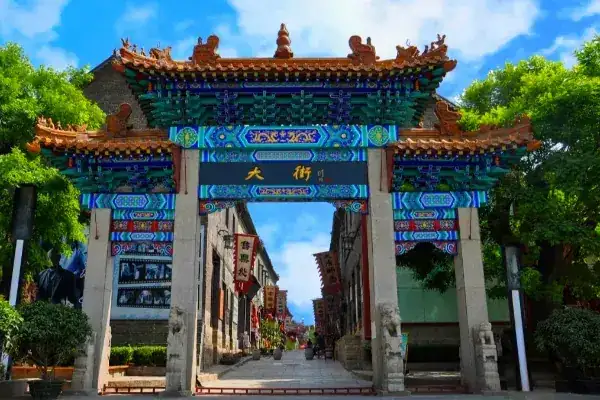
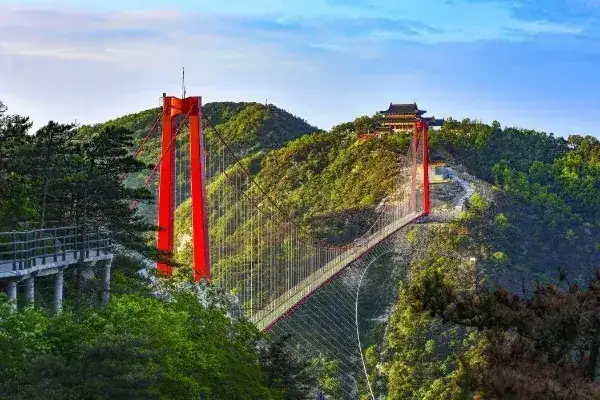
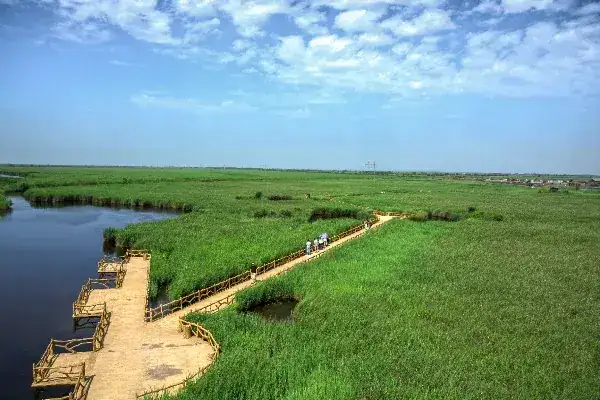
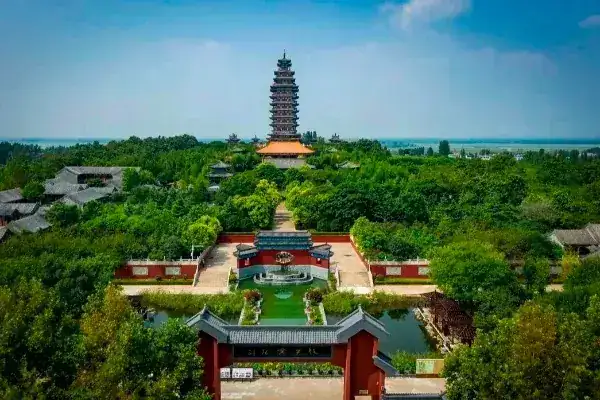
Yantai boasts stunning coastal scenery with golden beaches, islands, the famous Penglai Pavilion, and the ethereal mirages of the Bohai Sea. As of the end of 2024, the city had 3 national and 7 provincial-level tourism resorts, and 85 national A-level tourist attractions, including 2 at the 5A level and 21 at the 4A level.
External Relations
Yantai maintains sister-city relationships and international cooperation partnerships, leveraging its position as a core city of the China (Shandong) Pilot Free Trade Zone and its proximity to Japan and South Korea.
Notable Figures
Yantai has produced numerous notable historical and contemporary figures across politics, military, arts, and sciences, reflecting its rich cultural heritage.
Major Honors
Yantai has been recognized as a UN Habitat Scroll of Honour award-winning city, an International Wine City, a City of Olympic Champions, a National Demonstration City for Rule-of-Law Government, one of China's first coastal open cities, and one of the first carbon peak pilot cities, among numerous other distinctions.
Travel information can change. Check current opening hours, reservations and entry requirements before you travel.
Traveller discussion
Start the conversation with a helpful tip or a question.