
Dongying City
Dongying CityDongying, a prefecture-level city of Shandong Province, also known as the "Oil City," "Oriental Wetland City," and "Yellow River Water City," is located in northern Shandong. It faces the Bohai Sea to the east and north, border
Dongying City
Dongying, a prefecture-level city of Shandong Province, also known as the "Oil City," "Oriental Wetland City," and "Yellow River Water City," is located in northern Shandong. It faces the Bohai Sea to the east and north, borders Binzhou City to the west, and adjoins Zibo City and Weifang City to the south. The terrain slopes from southwest to northeast along the Yellow River, with a warm-temperate continental monsoon climate featuring cold winters, hot summers, and distinct seasons. The total area is 8,243 square kilometers. As of the end of 2023, Dongying administers 3 districts and 2 counties. As of the end of 2024, the permanent population was 2.2083 million. Archaeological evidence from a Houli culture site discovered in November 2013 indicates human habitation in the southern Guangrao County area as early as 8,000 years ago. The western Lijin County area formed during the Spring and Autumn and Warring States periods, while the northern and eastern areas were created by Yellow River sediment deposition in modern times. Counties were first established in 201 BCE. After several administrative reorganizations, Dongying City was officially established on October 15, 1983. Dongying is the central city of the Yellow River Delta, an important petroleum base, the hometown of Sun Wu (Sunzi), the birthplace of Lüju opera, and the site of the Shengli Oilfield. In 2025, Dongying's GDP reached 450.273 billion yuan (approximately $63.4 billion), up 5.5% year-on-year.
History
Pre-Qin Period
The pre-establishment history of Dongying is traced through Guangrao, Lijin, and Kenli counties. From the Xia Dynasty to the end of the Shang Dynasty, the area was inhabited by the Jize, Feng Boling, and Pugu peoples. From the Western Zhou Dynasty to the Warring States period, the land areas were part of the State of Qi.
Qin-Han to Northern and Southern Dynasties Period
During the Qin Dynasty, the area belonged to Qi Commandery. In the Western Han Dynasty, it was under Qiansheng and Qi commanderies. In 201 BCE, Emperor Gaozu of Han established Guangrao County. During the Eastern Han Dynasty, Qiansheng Commandery was renamed Le'an Kingdom. During the Three Kingdoms period, the area belonged to the Wei Kingdom. In the Western Jin Dynasty, Guangrao County was re-established. From the Eastern Jin to the Northern and Southern Dynasties, the area successively belonged to Later Zhao, Former Yan, Later Yan, Former Qin, and Northern Wei.
Sui-Tang to Song-Yuan Period
During the Sui Dynasty, Guangrao was renamed Qiansheng in 583 CE under Qingzhou. In the Tang Dynasty, the area was under Henan Circuit. In 1138, the Jin Dynasty renamed Qiansheng County to Le'an County. In 1193, Lijin County was formally established. Under the Yuan Dynasty, the area fell under the Shandong East-West Circuit.
Ming-Qing Period
In the Ming Dynasty, the southern area belonged to Qingzhou Prefecture and the western area to Jinan Prefecture. In the Qing Dynasty, a three-tier province-prefecture-county system was implemented. In 1734, the area was transferred to Wuding Prefecture.
Republic of China Period
In 1913, the prefecture system was abolished. In 1914, Le'an County was renamed Guangrao County. During the Second Sino-Japanese War from 1938, the area was largely occupied by Japanese forces with multiple competing administrations. Anti-Japanese democratic governments were established in the region. During the Civil War period, Lijin and Kenli counties were under the Bohai District's Fourth Administrative Office.
After the Founding of the PRC
After the founding of the People's Republic of China, Guangrao, Lijin, and Kenli were placed under the Huimin Administrative Office in 1950. Administrative boundaries were reorganized multiple times. In October 1983, Dongying City was formally established. In April 2025, Dongying established a sister-city relationship with Tyumen, Russia.
Administrative Divisions
At its establishment, the city was divided into 3 districts (Dongying, Niuzhuang, Hekou) and 3 counties (Guangrao, Lijin, Kenli). In 1987, Niuzhuang District merged with Dongying District. In August 2016, Kenli County was converted to a district. As of the end of 2023, Dongying administers 3 districts (Dongying, Hekou, Kenli) and 2 counties (Guangrao, Lijin), comprising 15 subdistricts, 247 communities, and 1,664 villages. The city government is seated at No. 77 Fuqian Avenue, Dongying District.
Natural Geography
Location and Territory
Dongying is located in the Yellow River Delta region of northern Shandong, where the Yellow River flows into the Bohai Sea. Its coordinates range from 36°55′–38°10′N and 118°07′–119°10′E. The maximum north-south distance is 123 km, and the maximum east-west distance is 74 km, with a total land area of 8,243 square kilometers.
Geology
Dongying is located at the eastern end of the Jiyang Depression in the North China Downwarp, with stratigraphy spanning Archean to Cenozoic formations. Key structural features include the Chengzikou Uplift, Chezhen Depression, Yihezhuang Uplift, Zhanhua Depression, Chenjiazhuang Uplift, Dongying Depression, and Guangrao Uplift.
Topography
The terrain slopes from southwest to northeast, with elevations ranging from 28 meters in the southwest to 1 meter in the northeast. The Yellow River forms an elevated "suspended river" with riverbank land 2–4 meters higher than surrounding areas. Five micro-geomorphological types exist: ancient riverbank highlands (4.15%), riverbank highlands (3.58%), gently sloping plains (54.54%), shallow depressions (10.68%), and beach land (27.05%).
Climate
Dongying has a warm-temperate continental monsoon climate with cold winters, hot summers, and distinct seasons. The average annual temperature is 12.8°C, with a frost-free period of 206 days. Annual precipitation averages 555.9 mm, with 65% concentrated in summer. Major meteorological hazards include frost, dry hot winds, hail, drought, flooding, and storm surges.
Hydrology
The Yellow River segment in Dongying spans 138 km, flowing from the Binzhou boundary to the Bohai Sea at Kenli District. South of the Yellow River, the area belongs to the Huai River basin with 20 rivers including the Xiaoqing River. North of the river, the area belongs to the Hai River basin with 10 rivers including the Chao River.
Soil
Dongying's soils fall into five categories: cinnamon soil (4%), shajiang black soil (0.6%), fluvo-aquic soil (59%), saline soil (36%), and paddy soil (0.2%). Fluvo-aquic soil is the primary agricultural soil, while saline soil is mainly used for aquaculture and grazing.
Marine Area
Dongying's coastline extends 412.67 km, approximately one-ninth of Shandong's total coastline. The intertidal zone covers 101,900 hectares, and shallow sea areas within the 10-meter isobath total 4,800 square kilometers. The seabed is relatively flat, with muddy silt comprising 77.8% and sandy silt 22.2%. Seawater transparency ranges from 32–55 cm. Coastal ice lasts about 2 months in winter. The area is a semi-enclosed sea with irregular semi-diurnal tides. Storm surges exceeding 3.5 meters have occurred 7 times in the past century.
Natural Resources
Water Resources
Dongying's average total water resources amount to 532 million cubic meters, including 447 million cubic meters of surface water and 85 million cubic meters of groundwater. The Yellow River is the primary external water source, with an average annual runoff of 35.8 billion cubic meters and an average annual diversion of approximately 1 billion cubic meters. Total water supply is 928.08 million cubic meters.
Land Resources
Dongying has a total land area of 11.8849 million mu (approximately 792,300 hectares), with 6.43 mu per capita—2.6 times the Shandong provincial average. Agricultural land comprises 47.47%, construction land 14.52%, and unused land 38.01%. Between 1855 and 1985, the Yellow River created 30,000–40,000 mu of new land annually; after 1985, the rate slowed.
Biological Resources
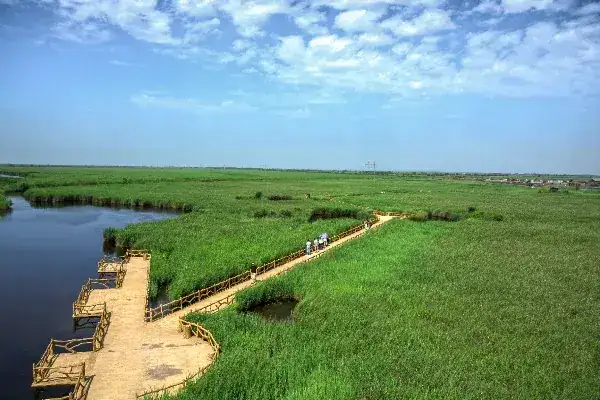
Dongying has 179 woody plant species across 44 families, 93 grassland species, and over 300 medicinal plant species. Wildlife includes 270 bird species (7 under Class I national protection, 33 under Class II) and 641 aquatic animal species. The Yellow River Delta National Nature Reserve, established in 1992, covers 153,000 hectares with 74% wetland. It hosts 374 bird species including red-crowned cranes and Oriental white storks, with populations in the millions. It is China's largest newly formed coastal wetland vegetation area, with 55.1% natural vegetation coverage.
Mineral Resources
Dongying's main mineral resources include petroleum, natural gas, geothermal energy, rock salt, gypsum, underground brine, oil shale, and coal. As the main production area of the Shengli Oilfield, 81 oil and gas fields have been discovered with cumulative proven geological reserves of 5.587 billion tons of petroleum. By the end of 2020, cumulative crude oil production reached 12.46 billion tons and natural gas production 59.402 billion cubic meters. Geothermal resources cover 5,655 square kilometers—the richest in Shandong. Rock salt resources are estimated at 109.679 billion tons, coal at 6.18 billion tons, and oil shale at 154.46 billion tons.
Population
Population Size
According to the Seventh National Census (November 2020), Dongying's permanent population was 2,193,518, an increase of 158,180 (7.77%) over ten years. As of the end of 2024, the permanent population was 2.2083 million, with an urbanization rate of 73.46%.
Ethnic Groups
The population is predominantly Han Chinese. In 2022, the city had 48 ethnic minority groups with 10,980 minority residents. The largest minority is Manchu, followed by Hui, Mongolian, and Miao.
Language
Dongying dialects are divided into five main types: Lijin, Guangrao, Zhanhua, Shouguang, and Luxi, with Lijin and Guangrao further subdivided into southern and northern variants.
Religious Beliefs
As of 2022, Dongying has five religions—Buddhism, Taoism, Islam, Catholicism, and Christianity—with 11 religious organizations, 75 registered religious activity venues, and 93 registered religious clergy.
Politics
Economy
Overview
In 2025, Dongying's GDP reached 450.273 billion yuan (approximately $63.4 billion), up 5.5% year-on-year. The primary industry value-added was 19.972 billion yuan (~$2.8 billion, +4.3%), secondary industry 265.78 billion yuan (~$37.4 billion, +5.5%), and tertiary industry 164.521 billion yuan (~$23.2 billion, +5.7%). In 2024, fixed asset investment grew 6.4%, general public budget revenue was 30.215 billion yuan (~$4.3 billion, +6.2%), and general public budget expenditure was 43.173 billion yuan (~$6.1 billion, +13.1%).
Primary Industry
In 2025, the total output value of agriculture, forestry, animal husbandry, and fisheries was 39.472 billion yuan (~$5.6 billion, +4.8%). Grain production remained stable at 1.5398 million tons. In 2024, grain output was 1.5396 million tons (+1.3%), total meat output was 314,000 tons (+2.4%), and aquatic product output was 566,700 tons (+3.5%).
Secondary Industry
In 2025, above-scale industrial value-added grew 7.4%, with equipment manufacturing up 12.6% and high-tech manufacturing up 9.6%. Key sectors included petroleum processing (+13.8%) and chemical manufacturing (+10.2%). In 2024, total industrial value-added was 254.326 billion yuan, with above-scale industrial revenue of 1,030.24 billion yuan. Construction output was 35.309 billion yuan (+5.7%).
Tertiary Industry
In 2025, total retail sales of consumer goods reached 97.092 billion yuan (~$13.7 billion, +6.4%). Upgraded consumer goods saw strong demand. In 2024, total import-export value was 267.052 billion yuan (~$37.6 billion, +6.7%), with exports of 61.936 billion yuan and imports of 205.116 billion yuan. Service trade totaled $510 million (+30.1%). Financial institution deposits reached 651.326 billion yuan, with loans of 466.163 billion yuan. Insurance premium revenue was 12.689 billion yuan (~$1.8 billion, +4.8%).
Economic Functional Zones
Dongying Economic and Technological Development Zone: Established in 1992 and upgraded to national-level in March 2010, it features a modern industrial system led by new materials, with 301 R&D platforms including 8 national-level and 67 provincial-level.
Dongying Port Economic Development Zone: Established in April 2006 as a provincial-level zone, it is the core park of the Dongying refining and chemical integration area, positioned as a national green circular energy and petrochemical industry base.
Yellow River Delta Agricultural High-Tech Industry Demonstration Zone: Evolved from the state-owned Guangbei Farm (established 1950), it was formally established in November 2016, with 9 major research platforms and collaborations with 36 universities and institutes.
Social Affairs
Science and Technology
In 2024, Dongying granted 2,004 invention patents (+10.8%), with 9,063 valid invention patents, reaching 41.03 per 10,000 people. The city had 43,396 valid registered trademarks (+6.8%), 35 well-known trademarks, and 1,484 Madrid international registrations.
Education
In 2024, the enrollment rate for school-age children was 100%. A total of 14,864 students sat for the summer college entrance examination and 6,526 for the spring examination. Over 40,000 candidates were registered for higher education self-study examinations.
Cultural Affairs
As of the end of 2024, Dongying had 4 state-owned performing arts troupes, 6 public libraries, 6 cultural centers, 14 museums, 3 art galleries, and 40 cultural stations. There were 30 cinemas with annual box office revenue of 56.9913 million yuan, and 79 rural film projection teams screening 41,268 films.
Healthcare
As of the end of 2024, Dongying had 2,004 medical institutions including 80 hospitals, 839 village clinics, and 92 community health service centers, with 15,672 beds. The full vaccination rate for school-age children reached 97.18%.
Sports
As of the end of 2024, Dongying had 9,595 sports venues covering 7.701 million square meters, with 3.49 square meters per capita. Nearly 9,500 fitness events were held, benefiting over 900,000 people. The Huanghekou (Dongying) Marathon attracted 35,095 participants from 12 countries and regions. Sports lottery sales reached 748 million yuan.
Social Security
As of the end of 2024, employees covered by basic pension, unemployment, and work-related injury insurance numbered 714,700, 396,100, and 768,700 respectively. Resident basic pension insurance covered 695,500 people, and basic medical insurance covered 1,222,400 people. The minimum monthly basic pension was 263 yuan (~$37). Urban minimum living allowance was 1,075 yuan/month (~$151) for 1,230 people, and rural minimum living allowance was 930 yuan/month (~$131) for 16,184 people.
Transportation
Overview
In 2024, highway passenger volume was 4.294 million (+13.8%), and highway freight volume was 62.5994 million tons (+3.4%). Port cargo throughput reached 91.1477 million tons (+26.4%). Shengli Airport handled 1.1632 million passengers (+9.1%). The total classified highway mileage was 9,403.98 km.
Highways
Dongying has 2,913.4 km of highways with a density of 39 km per 100 square kilometers. Ten major trunk roads, centered on the Dongying Yellow River Highway Bridge, connect southward to the Ji-Qing Expressway and northward to Beijing and Tianjin. The expressway network forms a "Y" pattern with G18, G25, and S7211. The planned regional trunk road network forms a "one ring, two express, five horizontal, four vertical" pattern.
Railways
The Circum-Bohai Intercity Railway passes through Hekou District and Kenli, connecting to the Jinan-Binzhou-Dongying intercity rail. New railways include the Huangda and Deda railways, with upgrades to the Zidong Railway. The planned urban transit system includes seven comprehensive transportation hubs integrating intercity rail, urban rail, long-distance bus, and public transit.
Aviation
Dongying Shengli Airport is a domestic 4D-level regional airport, serving as a regional aviation hub between the Beijing-Tianjin-Hebei region and the Jiaodong Peninsula. Flight routes connect to 9 cities including Beijing, Shanghai (Pudong), Chongqing, Dalian, Haikou, Ningbo, Guangzhou, Harbin, and Zhengzhou.
Culture and History
Literature and Art
Lüju Opera: Originating from Shijia Village in Dongying District around 1900, it was initially called "made-up yangqin." Known for its melodious singing style accompanied by the zhuiqin (a bowed string instrument), it later gained popularity in Jinan and other cities.
Chen'guan Short-Tassel Flower Drum: A folk dance from Chen'guan Township, Guangrao County, dating back over 300 years. Originally a means of survival for itinerant performers during famines, it evolved into a distinctive folk art form.
Tiger-Fight-Bull: Originating in the late Qing Dynasty from Dabeijie Village, Lijin County, this performance art uses bamboo and paper-crafted tiger and bull figures in simulated combat.
Regional Symbols
In 2019, Dongying designated the pagoda tree as the city tree, lotus as the city flower, and the Oriental white stork as the city bird.
Other Culture
As of November 2024, Dongying had 2 national-level, 35 provincial-level, 226 municipal-level, and 678 county-level intangible cultural heritage representative projects. Dongying Lüju Opera and Chen'guan Short-Tassel Flower Drum were selected for the second batch of national intangible cultural heritage projects.
Specialty Products
Scenic Spots
Food Specialties
Lijin Pan-Fried Buns: Originating in the Guangxu era of the Qing Dynasty, these buns are made with leavened dough and fillings of diced pork with chives or Chinese cabbage, cooked to golden perfection.
Shikou Roast Chicken: A specialty from Shikou Town in Dongying District, known for its attractive appearance, rich color, pure flavor, and satisfying texture.
Notable Figures
Notable historical figures from Dongying include: Sun Wu (Sunzi), the renowned "Military Sage" of the Spring and Autumn period from Le'an (modern Guangrao); Han Dynasty scholars Ouyang Sheng and Ni Kuan; Yuan Dynasty general Yan Gongzhi; Ming Dynasty scholar Li Shun and "Iron-faced Censor" Cheng Yong; Qing Dynasty scholar Li Huanzhang and painter Li Fangying; modern-era revolutionary figures Deng Tianyi, Li Yunsheng, and general Li Yutang; Lüju opera founder Shi Dianyuan; and contemporary figures including fiber expert Feng Yunhe and model worker Wang Weimin.
Major Honors
Dongying has received numerous honors, including: National Health City (2003), National Civilized City (2017), China Top 100 Cities (54th in 2017, 50th in 2019), National Ecological Garden City (2019), National Double Support Model City (2020, 2025), National Barrier-Free Environment Demonstration City (2021), National Anti-Drug Demonstration City (2021), and Peaceful China Construction Demonstration City (2021). In 2022, it was selected for the "Waste-Free City" construction list and ranked 69th on the China Dynamic Cities Top 100.
Travel information can change. Check current opening hours, reservations and entry requirements before you travel.
Traveller discussion
Start the conversation with a helpful tip or a question.