
Qingdao City
Qingdao CityQingdao City, a prefecture-level city in Shandong Province, is abbreviated "Qing" and also known as "Island City" or "Qindao." It is a sub-provincial city, a city with separate state planning, and the core city of the Qingdao me
Qingdao City
Qingdao City, a prefecture-level city in Shandong Province, is abbreviated "Qing" and also known as "Island City" or "Qindao." It is a sub-provincial city, a city with separate state planning, and the core city of the Qingdao metropolitan area. Located on the southern Shandong Peninsula, it borders the Yellow Sea to the east and south, Yantai to the northeast, Weifang to the west, and Rizhao to the southwest. The total area is 11,293 square kilometers. As of end 2025, the permanent population was 10.52 million. Qingdao has a temperate monsoon climate with significant maritime characteristics.
Qingdao is a national famous historical and cultural city. Jiaozhou Bay has been an important northern port since the Tang and Song dynasties. In 1891, the Qing government established military administration at Jiao'ao; in 1897, Germany leased the area and built the port and railway. In 1930, it was formally named Qingdao City. Qingdao is the birthplace of the May Fourth Movement, host city for the 2008 Beijing Olympics sailing competitions, and one of China's most concentrated cities for modern cultural figures' former residences. The State Council designates Qingdao as an important coastal center city, modern marine city, international comprehensive transportation hub, northern advanced manufacturing base, northern gateway for opening up, and international coastal tourism destination.
In 2025, Qingdao's GDP reached 1,756.07 billion RMB (approximately $245.7 billion), up 5.4% year-on-year. By sector: primary industry 51.62 billion RMB ($7.2 billion, +4.0%), secondary industry 587.38 billion RMB ($82.1 billion, +4.9%), tertiary industry 1,117.06 billion RMB ($156.2 billion, +5.6%).
History
Civilization in the Qingdao area dates to the Neolithic Age, belonging to the Dongyi tribes. During the prehistoric and Xia-Shang periods, the area was part of the Laiyi territory. Under the Western Zhou, it belonged to the Yi state, and during the Spring and Autumn period, it was divided among the states of Jie, Yi, and Lai. After Qi conquered Lai, the area came under Qi rule. During the Warring States period, most of the area was governed by Qi's Jimo county. Under the Qin Dynasty, the western part belonged to Langya Commandery and the north to Jiaodong Commandery. Through successive dynasties from Han through Qing, the area underwent numerous administrative changes.
In 1891, the Qing government established military defenses at Jiao'ao, marking Qingdao's founding. In 1897, Germany seized Jiao'ao under the pretext of the Juye Incident, investing heavily in port and railway construction and making it Shandong's largest commercial port. During WWI in 1914, Japan occupied the area. The May Fourth Movement of 1919 was triggered by the Qingdao sovereignty issue. China recovered Jiao'ao in 1922, and in 1930, it was renamed Qingdao City. After liberation in 1949, it became a provincial city of Shandong. In 1984, Qingdao was designated one of 14 coastal port cities for further opening up; in 1986, granted separate state planning status; and in 1994, listed among 15 sub-provincial cities.
Administrative Divisions
As of June 2023, Qingdao has 7 municipal districts and administers 3 county-level cities, plus 1 development zone. The municipal government is seated at 11 Xianggang Middle Road, Shinan District.
Geography
Location Located at 119 degrees 30 minutes to 121 degrees east longitude and 35 degrees 35 minutes to 37 degrees 9 minutes north latitude on the southern Shandong Peninsula. Total area: 11,293 square kilometers, with urban districts covering 5,226 square kilometers and three county-level cities covering 6,067 square kilometers.
Topography A coastal hilly city with mountains (15.5%), plains (37.7%), and lowlands (21.7%). Three mountain systems: Laoshan (highest peak 1,132.7 m), Dazeshan (736.7 m), and the Dazhushan range (724.9 m).
Climate Temperate monsoon climate with maritime characteristics. Annual average temperature 12.7 degrees Celsius; extreme high 38.9 degrees, extreme low minus 16.9 degrees. Annual precipitation averages 662.1 mm; annual relative humidity 73%.
Hydrology 224 rivers, all monsoon-fed. The Dagu River system is the largest (179.9 km main stream, 6,131.3 square kilometers basin). The city has 23 large and medium reservoirs.
Ocean Maritime area approximately 12,200 square kilometers; coastline 905.2 km. 120 islands, with Lingshan Island the largest. Semi-diurnal tides average 2.8 m. China's national elevation benchmark is based on the Qingdao tidal station.
Natural Disasters
Frequent weather disasters include tropical cyclones, storm surges, heavy rain, drought, fog, and floods. In 2019, disasters affected 117,600 people, with 20,700 emergency relocations and 16,363 hectares of crops damaged.
Natural Resources
Water Resources Annual average precipitation 687.5 mm. In 2023, total water resources: 1.407 billion cubic meters (20.5% below multi-year average).
Marine Resources Rich marine biodiversity including kelp, yellow croaker, abalone, and shrimp. Jiaozhou Bay's nutritious waters support shellfish and algae aquaculture.
Wind and Solar Energy Effective wind energy density 240.3 W per square meter with 6,485 annual hours. Annual solar radiation 500 kJ per square centimeter; annual sunshine 2,550.7 hours.
Flora and Fauna 1,237 plant species across 152 families, including four rare endemics: Qingdao geranium, Qingdao sedge, Jiaozhou euonymus, and Qingdao lily. 429 terrestrial vertebrate species; 398 bird species (28% of China's total, 91% of Shandong's).
Mineral Resources
Predominantly non-metallic: 66 mineral types discovered. Graphite, decorative granite, and marble rank first in Shandong. Gold: 2 tons proven, 7 tons prospective. Total reserve value approximately 27 billion RMB ($3.8 billion).
Population
As of end 2024, permanent population 10.44 million, urbanization rate 78.87%. Life expectancy rose from 81.5 to 82.2 years by 2025.
Politics
Qingdao operates as a sub-provincial city with independent state planning authority under a municipal party-government leadership system.
Social Affairs
Education In 2023, 80 schools and kindergartens built or expanded. 29 higher education institutions. Primary and junior secondary enrollment rates consistently exceed 99%.
Healthcare 8,991 medical institutions including 361 hospitals; 105,000 health professionals; 69,600 beds.
Science and Technology 7,920 high-tech enterprises (up 1,240). Technology contract transactions: 63.23 billion RMB ($8.8 billion, up 60%). Effective invention patents per 10,000 people: 71.83.
Culture 136 museums, 149 cultural centers, 11 public libraries, 100 theaters. Qingdao became China's first UNESCO City of Film in 2017.
Sports 11,000 fitness facilities; per capita sports venue area 3.3 square meters (above national average). National Key Football City (1979, 1992, 2022) with 3 professional clubs.
Environmental Protection PM2.5 and PM10 at 29 and 58 micrograms per cubic meter respectively, meeting national standards for four consecutive years. Nearshore water quality excellence rate: 99.3%.
Social Security
In 2025, 373,000 new urban jobs created. Pension and medical insurance enrollment: 8.68 million and 9.46 million respectively. 329 elderly care institutions with 46,000 beds.
Economy
Overview Historically a northern center for navigation and trade, modern industry emerged after the 1897 German occupation. In 2025, GDP exceeded 1.7 trillion RMB ($237.8 billion); general public budget revenue 134.07 billion RMB ($18.7 billion); per capita GDP over 160,000 RMB ($22,380).
In 2024, GDP was 1,671.95 billion RMB ($233.8 billion, +5.7%): primary 50.08 billion RMB ($7.0 billion, +4.0%), secondary 572.31 billion RMB ($80.0 billion, +7.1%), tertiary 1,049.55 billion RMB ($146.8 billion, +5.0%). Per capita disposable income: 59,922 RMB ($8,382, +5.2%). Retail sales: 658.45 billion RMB ($92.1 billion, +4.2%). Budget revenue: 133.93 billion RMB ($18.7 billion); expenditure: 172.04 billion RMB ($24.1 billion), with livelihood spending at 75.8%.
Primary Industry In 2025, total agricultural output first exceeded 100 billion RMB ($14.0 billion). In 2024, agriculture/forestry/livestock/fishery output: 97.38 billion RMB ($13.6 billion, +4.1%). Grain: 3.214 million tons (+0.9%). Meat, eggs, and milk: 1.187 million tons (+6.7%).
Secondary Industry Modern industry began during the German occupation (1899) with railway and port construction; by 1936, textiles ranked second nationally. In 2024, above-scale industrial value-added grew 9.4%; equipment manufacturing +11.0%, high-tech manufacturing +12.8%. New energy vehicles, integrated circuits, and industrial robots grew 140%, 52.6%, and 20.6% respectively.
Tertiary Industry In 2024, services grew 5.0%, accounting for 62.8% of GDP. Producer services: 592.1 billion RMB ($82.8 billion, +6.6%). Retail sales: 658.45 billion RMB ($92.1 billion, +4.2%). Foreign trade: 907.67 billion RMB ($126.9 billion, +3.6%); exports 527.82 billion RMB ($73.8 billion, +12.0%), imports 379.85 billion RMB ($53.1 billion, down 6.2%). Deposits: 2.87 trillion RMB ($401.4 billion); loans: 3.19 trillion RMB ($446.2 billion).
Transportation
International trade port and maritime hub trading with 450+ ports in 130+ countries. In 2023, total freight reached 440 million tons (+9.9%); passengers 56.92 million (+90.3%). Port throughput: 680 million tons (+4.0%); containers: 28.77 million TEU (+12.1%). Air passengers: 21.42 million (+120.4%).
Aviation Qingdao Jiaodong International Airport (opened August 2021): 243 passenger routes (20 international), 18 cargo routes.
Railway 12 lines totaling 666 km, including 228 km high-speed rail. Major stations: Qingdao, Qingdao North, Hongdao (primary), Qingdao West (auxiliary). China-Europe freight train connects to Dushanbe, Tajikistan.
Highways 15,366 km total, including 869.2 km of expressways in a "three-vertical, four-horizontal, five-connector" network.
Urban Transport 10,489 buses on 927 routes; 740 million annual passengers. National Public Transit Demonstration City.
Port International hub port with 122 productive berths (97 at 10,000-ton class). 210 container routes, highest in northern China. Sea-rail intermodal: 1.82 million TEU, leading nationally for 7 years.
Rail Transit
As of end 2024, Qingdao Metro operates 7 lines totaling 352 km with 172 stations; annual ridership 470 million. Long-term plan: 19 lines, 872 km. First line opened December 2015; Line 6 in April 2024.
Culture and Humanities
Qingdao's cultural character centers on folk customs and hospitality. The city tree is cedar; city flowers are camellia and Chinese rose. In the 1930s, modern literary figures including Lao She, Shen Congwen, and Wen Yiduo gathered in Qingdao, creating a literary peak. The annual International Beer Festival (since 1991) and UNESCO City of Film designation (2017, China's first) highlight cultural vibrancy. The Qingdao Oriental Movie Metropolis (5.4 million square meters, opened 2018) hosts major film productions. Notable intangible cultural heritage includes Jiaozhou yangge (folk dance) and Maoqiang (local opera). Distinctive architecture includes seaweed-roofed houses, a traditional ecological dwelling of the Jiaodong Peninsula.
Marine Culture
Marine culture dates to antiquity, with archaeological evidence from Beixin and Dawenkou cultures. During the Spring and Autumn period, ancestors pioneered navigation routes to the Korean Peninsula and Japan, forming the Eastern Maritime Silk Road. Mazu (sea goddess) worship spread along the coast during the Ming-Qing era, producing sea-festival customs.
Scenic Spots
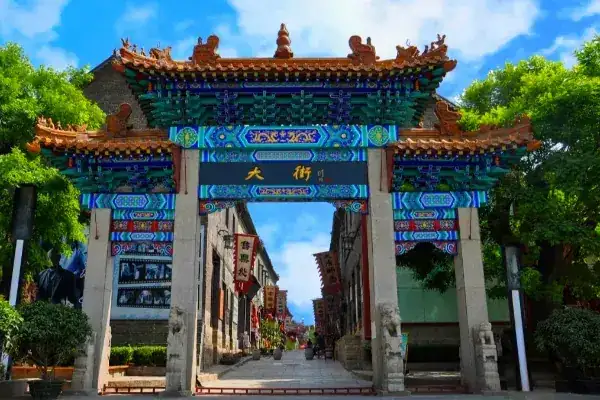
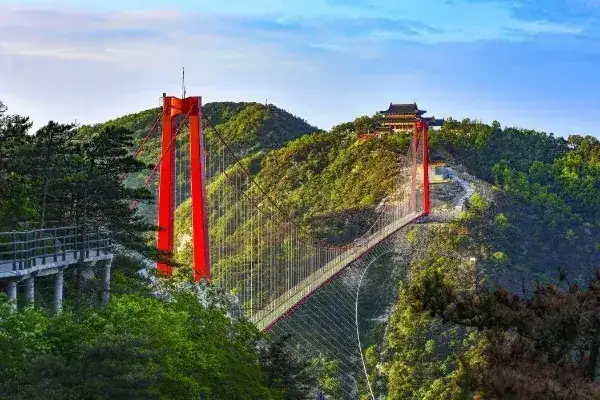
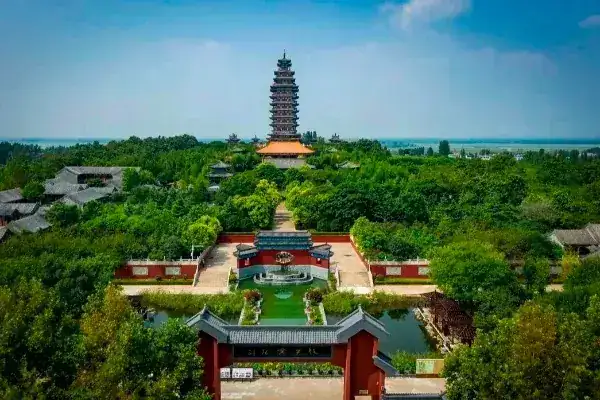
National famous historical and cultural city with 34 national-level protected heritage sites. Major attractions: Laoshan Scenic Area and Qingdao Coastal Scenic Area. 100 A-level tourist attractions (1 at 5A, 25 at 4A). Of Shandong's approximately 300 historic buildings, 131 are in Qingdao, with 85 notable former residences of cultural figures.
Local Specialties
Pantao Ginger (from Pingdu, national geographic indication product) and Majiagou Celery (a 1,000-year-old cultivar, national geographic indication product) are signature local specialties.
Foreign Exchange
Qingdao maintains extensive international exchange relationships and hosts consular institutions.
Sister Cities
Qingdao has established sister city partnerships with multiple cities worldwide.
Famous Figures
Qingdao has produced and attracted numerous notable cultural and historical figures throughout its history.
Honorary Titles
Host city for the 2008 Beijing Olympics and 13th Paralympics sailing competitions. Designated China's Sailing Capital, World Beer City, UNESCO City of Film, first-batch coastal open city, National Civilized City, and China's Brand Capital.
Travel information can change. Check current opening hours, reservations and entry requirements before you travel.
Traveller discussion
Start the conversation with a helpful tip or a question.