
Shangrao City
Shangrao CityShangrao, historically known as Xinzhou and Guangxin, is a prefecture-level city in Jiangxi Province, located in northeastern Jiangxi. It borders Zhejiang Province to the east, Fujian Province and Yingtan City to the south, Fuz
Shangrao City
Shangrao, historically known as Xinzhou and Guangxin, is a prefecture-level city in Jiangxi Province, located in northeastern Jiangxi. It borders Zhejiang Province to the east, Fujian Province and Yingtan City to the south, Fuzhou, Nanchang, and Jiujiang to the west, and Jingdezhen and Huangshan (Anhui) to the north. The terrain is predominantly hills, higher in the southeast and lower in the northwest, with Poyang Lake to the west. The climate is subtropical humid. Total area: 22,737 square kilometers. As of the end of 2025, the city administers 3 districts, 8 counties, and 1 county-level city. As of the end of 2025, the permanent resident population was 6,271,000. The name Shangrao is said to derive from "superior and abundant" (shang cheng fu rao). The city was established as a commandery in 210 CE. Shangrao is one of the birthplaces of Daoism, the hometown of Zhu Xi (the great Neo-Confucian philosopher), Zhan Tianyou (the "Father of China's Railway"), and Fang Zhimin (revolutionary leader). The poet Xin Qiji also lived here for an extended period. The city boasts 4 national 5A scenic areas (Sanqing Mountain, Guifeng, Jiangwan, and Huangling), 3 World Heritage Sites (Sanqing Mountain, China Danxia, and Wuyi Mountain), and is a national comprehensive transportation hub with the Beijing-Fuzhou and Shanghai-Kunming high-speed railways crossing through. In 2025, GDP was 393.59 billion yuan, up 5.6%.
History
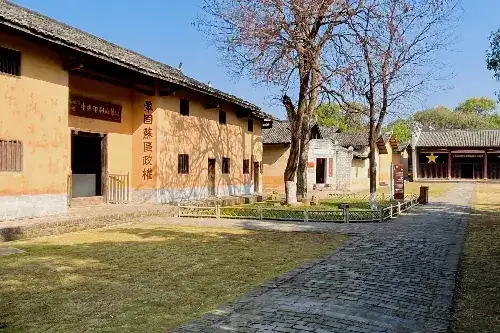
Human activity dates to the early Neolithic period, evidenced by the Xianrendong (Immortal Cave) site in Wannian County. The area anciently belonged to Yangzhou, first as the Panyi of the Chu State. In 504 BCE, Wu conquered it; in 473 BCE, Yue conquered Wu; in 333 BCE, Chu conquered Yue. In 221 BCE, the Qin Dynasty placed the area under Jiujiang Commandery. In 210 CE, the Eastern Han established Poyang Commandery. During the Three Kingdoms, it belonged to Wu. In 589, the Sui Dynasty (581–618) renamed it Raozhou. In 758, the Tang Dynasty (618–907) established Xinzhou. The Song, Yuan, Ming, and Qing dynasties maintained the area under Raozhou, Xinzhou/Guangxin, and Huizhou. In 1928, Fang Zhimin established the Gan-Dongbei (Northeastern Jiangxi) Revolutionary Base and the Red Army's 10th Corps. In 1949, Shangrao was liberated. In 2000, the prefecture was converted to a city.
Administrative Divisions
Divisional History
In 1950, Shangrao City was established from Shangrao County. In 1953, Jingdezhen was separated. In 1983, Yingtan was separated. In 2000, Shangrao Prefecture became Shangrao City. In 2015, Guangfeng County became Guangfeng District. In 2019, Shangrao County became Guangxin District.
Division Details
As of end 2025: 3 districts (Xinzhou, Guangfeng, Guangxin), 8 counties (Wannian, Yugan, Poyang, Yiyang, Hengfeng, Yanshan, Wuyuan, Dexing), 1 county-level city (Dexing). Government: No. 666 Guangxin Avenue, Xinzhou District.
Physical Geography
Location and Boundaries
Northeastern Jiangxi, between 27°48′–29°42′N and 116°13′–118°29′E. East-west: 210 km; north-south: 194 km. Borders Zhejiang, Anhui, Fujian, and 5 Jiangxi cities. Total area: 22,737 km².
Landforms
Predominantly hilly, surrounded by mountains on three sides (north, east, south) with Poyang Lake to the west. Three mountain ranges from north to south: Zhanggong Mountain, Huaiyu Mountain, and Wuyi Mountains, forming an inverted "mountain" character shape. The central Huaiyu range features Ling Mountain (1,496m). Mountains cover 10.27%, hills 63.34%, plains 26.39%.
Climate
Subtropical humid climate. Average annual temperature: 16.7–18.3°C. Average annual sunshine: 1,781–2,098 hours. Average frost-free period: 251–274 days. Main hazards: winter ice/snow, drought, lightning, and torrential rain.
Hydrology
The Xinjiang and Raohe rivers are the main rivers, flowing through the city into Poyang Lake and then to the Yangtze via Jiujiang's Hukou. Xinjiang basin: 16,890 km² (12,221.3 km² within the city, 72% of total). Raohe basin: 15,428 km², composed of the Le'an River (8,989 km²) and Changjiang (6,222 km²).
Natural Resources
Land Resources
11 soil types including mountain meadow, yellow-brown, red, purple, limestone, fluvo-aquic, and paddy soils.
Biological Resources
2,830 plant species (293 families, 1,127 genera): 248 ferns, 276 bryophytes, 28 gymnosperms, 2,278 angiosperms. Protected species include ginkgo, southern yew, dawn redwood, and incense tree. Wildlife: 260+ bird species, ~80 mammal species, ~30 amphibian/reptile species. 60+ national key protected species including blue-crowned laughing thrush, Chinese merganser, and Cabot's tragopan.
Mineral Resources
79 mineral types discovered, 48 with proven reserves. 20+ minerals with reserves exceeding 50% of provincial total: copper, molybdenum, gold, silver, nickel, niobium, chromium, fluorite. 1,000+ mineral occurrences, 382 proven deposits (43 large, 64 medium, 285 small). Key minerals: copper, gold, silver, coal, lead, zinc, fluorite, phosphorus, serpentinite, and bentonite.
Population
As of end 2025: 6,271,000 (down 80,000). Urban: 3,691,000 (58.86% urbanization rate, up 1.15 percentage points). Birth rate: 5.39‰; death rate: 8.17‰; natural growth rate: -2.78‰.
Politics
Economy
Overview
In 2025, GDP was 393.59 billion yuan (up 5.6%). Primary: 36.26 billion (up 3.8%); secondary: 151.48 billion (up 6.4%); tertiary: 205.84 billion (up 5.4%). Structure: 9.2:38.5:52.3. Per capita GDP: 62,366 yuan (up 6.6%). General public budget revenue: 28.92 billion (up 2.6%). Fixed asset investment grew 3.8%, with industrial investment up 20.2% and high-tech investment up 47.2%. Per capita disposable income: 37,143 yuan (up 5.2%); urban: 51,277 yuan; rural: 22,810 yuan.
Primary Industry
In 2025: agricultural output 58.75 billion yuan (up 4.2%). Grain sown area: 581,300 hectares; grain output: 3.344 million tonnes (up 1.6%). Vegetables: 2.135 million tonnes; fruits: 206,000 tonnes; tea: 27,000 tonnes. Meat: 294,000 tonnes; pig slaughter: 2.891 million; inventory: 1.539 million. Aquatic products: 13,300 tonnes.
Secondary Industry
In 2025: above-designated-size industry grew across 22 of 36 categories (61.1% growth breadth). Equipment manufacturing +6.9%; non-public industry +8.9%. Solar cells: 75.702 million kW (down 9.5%); automobiles: 40,965 units (up 18.7%). Revenue: 648.82 billion (up 2.5%); profits: 30.19 billion (up 1.7%). 8 enterprises with revenue exceeding 10 billion yuan. 13 industrial parks: 2,302 enterprises, revenue 637.98 billion (up 2.9%). Construction: 1,326 qualified enterprises, output 114.91 billion (up 2.9%).
Tertiary Industry
Shangrao has a long commercial history—since the Western Zhou Dynasty (1046–771 BCE), it was on the Luoyang-to-Guangzhou trade route. In 2025: service industry 205.84 billion (up 5.4%). Wholesale/retail: 35.72 billion (up 3.2%); financial: 22.04 billion (up 5.5%); accommodation/catering: 9.55 billion (up 8.2%). Above-designated-size service revenue: 89.15 billion (up 8.2%). Retail sales: 149.61 billion (up 5.7%). Import/export: 38.59 billion (down 14.1%); exports: 29.89 billion (down 18.9%). Belt and Road trade: 23.66 billion (61.3% of total). Actual foreign investment: 25.24 million USD (up 17.2%). Financial deposits: 702.75 billion (up 8.4%); loans: 669.21 billion (up 9.5%). Insurance premiums: 10.19 billion (up 6.1%). Express delivery: 480 million parcels (up 31.0%). 5G base stations: 20,000 (38.7% of total).
Social Undertakings
Science and Technology
As of end 2025: 52 provincial engineering/technology research centers, 4 provincial technology innovation centers, 2 provincial key laboratories. 946 patents authorized (up 26.6%). 3.9 valid invention patents per 10,000 people (up 30.4%). Technology contracts: 3,655, valued at 22.02 billion yuan. 143 provincial-certified inspection institutions.
Education
Shangrao has a long educational tradition since the Qin Dynasty. The famous Ehu Academy (Goose Lake Academy) in Yanshan County hosted the "Ehu Conference" in 1175—where Zhu Xi, Lu Zuqian, and the Lu brothers debated philosophy, a landmark event in Chinese intellectual history. As of end 2025: 7 higher education institutions, 98 general high schools, 11 secondary vocational, 381 junior high/nine-year, 1,037 primary schools, 1,657 kindergartens. Senior high gross enrollment: 93.6%; college entrance rate: 78.7%.
Culture
As of end 2025: 8 performing troupes, 13 cultural centers, 13 public libraries, 26 museums, 12 broadcast/TV institutions. 100% broadcast and TV coverage. National Class I libraries: Shangrao City Library, Xinzhou District Library, and Yiyang County Library.
Healthcare
As of end November 2025: 6,088 medical institutions, 18 Class III hospitals, 1 national and 7 provincial clinical key specialties. 11 counties built compact county medical communities covering 227 health centers and 1,274 village clinics.
Sports
As of end 2024: 11 fitness centers, 2 national youth sports clubs, 2 national sports traditional schools. In 2024: 1 Olympic gold medal, 1 world championship bronze, 7 national gold, 2 silver, 3 bronze.
Social Security
In 2025: 56,000 new urban jobs; 86,000 rural labor transfers. Employee pension: 1.715 million; resident pension: 3.093 million; medical insurance: 6.499 million; unemployment: 426,000. 32,426 urban and 243,305 rural minimum living allowance recipients. 174 elderly care institutions with 14,152 beds. Welfare lottery: 490 million yuan.
Transportation
Overview
Shangrao is a national comprehensive transportation hub at the junction of four provinces. The Shanghai-Kunming and Beijing-Fuzhou high-speed railways cross in a three-dimensional interchange, making Shangrao a hub connecting the Yangtze Delta and Fujian Delta regions.
Highways
"Three verticals, three horizontals" national highway network plus "ten verticals, three horizontals, sixteen links" provincial network. Expressways: G0321 Dezhou-Shangrao, G1514 Ningde-Shangrao, S33 Shangrao-Wannian, G56 Hangzhou-Ruili, G60 Shanghai-Kunming, G6021 Hangzhou-Changsha. As of end 2025: total highway mileage 27,165 km (799 km expressways). Highway freight: 205.91 million tonnes (up 4.5%).
Railways
Zhegan, Wangan, Qujiu, Lede, and Fengfu conventional railways, plus Hefu, Shanghai-Kunming, and Hangchang high-speed railways. In 2025: railway passengers 33.379 million (up 6.9%).
Shipping
Ports: Poyang, Yugan, Wannian, Yiyang, Yanshan, Shangrao, Xinzhou, Yushan, Hengfeng. In 2025: waterway freight 16.525 million tonnes (up 9.1%).
Aviation
Shangrao Sanqingshan Airport: 4C-level civil regional airport, 8 km from downtown. Opened May 28, 2017. Flights to Beijing, Kunming, Harbin, Jinan, Sanya, Shenzhen, Qingdao, Guangzhou, Chongqing, Xiamen, and other cities.
Public Transit
Shangrao Public Transport Group (established 1975). As of end 2020: 698 vehicles, 1,157 stops, 83 routes, 1,331.49 km single-direction mileage, 5 bus depots (88,400 m²), 242 charging guns (9,894 kW total capacity). Annual operating mileage: 19.6049 million km.
Historical Culture
Name Origin
Two theories: (1) named after the Shangrao River (now Xinjiang); (2) from "mountain treasures and abundant resources" (shan yu zhen qi, shang cheng fu rao). The latter is generally accepted.
Cultural Relics
As of June 2023: 1 World Cultural and Natural Heritage (Wuyi Mountain), 21 national key cultural heritage protection units, 91 provincial, 59 municipal, 568 county-level. 3,663 immovable cultural relics. 25,411 movable cultural artifacts (2,102 precious).
Folk Activities
Dragon boat racing during the Dragon Boat Festival (national intangible cultural heritage since 2011). Zipu Town is a renowned dragon boat construction center in northeastern Jiangxi, with centuries-old boat-building traditions.
Intangible Cultural Heritage
As of July 2021: 10 national-level items including Nuo dance (Wuyuan), Yiyang opera, Hui opera (Wuyuan), Huizhou three-dimensional carving (Wuyuan), Yanshan Liansizhi papermaking, She inkstone crafting, Poyang lacquerware, Wuyuan green tea processing, rice farming customs, and paper umbrella crafting.
Dialect
Multiple dialects: Wu Chinese (Guangxin, Xinzhou, Guangfeng, Yushan), Gan Chinese (Poyang, Yugan, Wannian, Yiyang, Hengfeng, Yanshan), and Hui Chinese (Dexing, Wuyuan).
Scenic Spots
Shangrao has 3 World Heritage Sites, 4 national 5A scenic areas, and 32 national 4A scenic areas—the most of any prefecture-level city in Jiangxi.
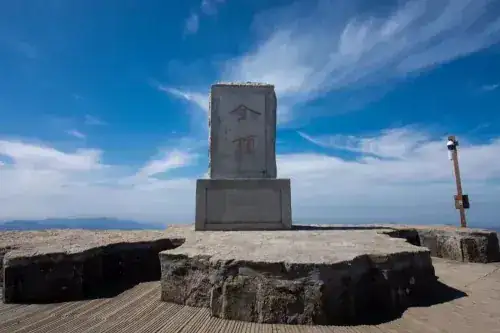
Sanqing Mountain: World Natural Heritage, World Geopark, national 5A scenic area. Named for three peaks resembling the Three Pure Ones of Daoism. Main peak Yujing at 1,819.9m. Features the world's densest and most diverse granite peak forest, 2,373 plant species, 1,728 animal species, and 1,600+ years of Daoist history with an ancient temple complex laid out in bagua (octagon) formation—called "an open-air museum of ancient Chinese Daoist architecture."
Guifeng (Turtle Peak): World Geopark, national 5A, World Natural Heritage (China Danxia component). Typical Danxia landform formed 135 million years ago. Nanyan Temple has 40+ stone niches carved into cliff walls—"the First Buddha Cave of China" and "Southern Dunhuang." The Sleeping Buddha is 416m long.
Jiangwan Scenic Area (Wuyuan): National 5A scenic area, a historic village with rich Huizhou cultural heritage and well-preserved Hui-style architecture.
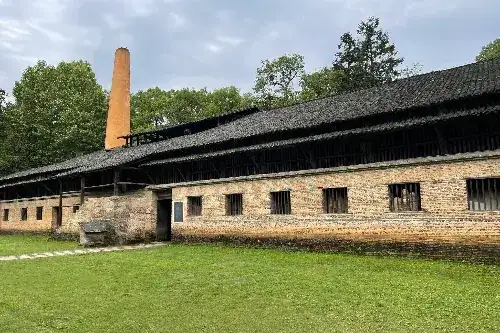
Shangrao Concentration Camp Site: National key cultural heritage site, national 4A scenic area. A Fascist concentration camp established by the Nationalist military intelligence in the 1940s. Includes revolutionary martyr cemetery, memorial buildings, and historical prison structures.
Specialty Foods
Specialties include Guifeng braised pork, Wannian tribute rice, Fanbuguo rice cakes, Geyuan tofu, Yanshan Dengzhan fruit, Yiyang rice cakes, meat-filled flatbread, fried dough with glutinous rice balls, Qingming fruit, glutinous rice cakes, rice noodles with pig liver, large pork noodles, mutton noodles, braised intestines noodles, braised goose, steamed red carp, steamed pork with rice flour, tofu soup, whole fish banquet, stir-fried Artemisia with cured meat, white jade beans, and Guifeng "National Highway Fish."
Famous Figures
Shangrao has produced 23 prime ministers, 2,097 jinshi graduates (1,515 named), 13 zhuangyuan (top scholars), 6 runners-up, and 5 third-place graduates. Notable figures include: Wu Rui (King of Changsha, Han Dynasty), Tao Kan (Jin Dynasty statesman-general), Zhu Xi (the great Neo-Confucian philosopher), Xin Qiji (Southern Song poet-general), Jiang Kui (Southern Song poet-musician), Zhan Tianyou (Father of China's Railway), Jin Yong (wuxia novelist), Fang Zhimin (revolutionary), Chen Zhen (zoologist, CAS academician), Huang Jiasi (medical scientist), and Yang Weiyi (entomologist, CAS academician). In 2002, Shangrao selected its "Ten Great Historical Cultural Figures."
Honorary Titles
Travel information can change. Check current opening hours, reservations and entry requirements before you travel.
Traveller discussion
Start the conversation with a helpful tip or a question.