
Fuzhou City
Fuzhou CityFuzhou is a prefecture-level city in Jiangxi Province, with mountains on three sides (east, south, west) and terrain descending from south to north. The climate is southern humid rainy monsoon. Total area: 18,800 square kilometer
Fuzhou City
Fuzhou is a prefecture-level city in Jiangxi Province, with mountains on three sides (east, south, west) and terrain descending from south to north. The climate is southern humid rainy monsoon. Total area: 18,800 square kilometers. As of April 2025, the city administers 2 districts and 9 counties. As of the end of 2025, the permanent resident population was 3,545,700. Fuzhou is located in the hinterland of the Yangtze River Delta, Pearl River Delta, and Minnan Delta. The Fuyin Expressway, Jiguang Expressway, Fuji Expressway, Ziguang Expressway, Xiangpu Railway, and Shanghai-Kunming HSR all pass through the city. Fuzhou is an important city in the Yangtze Middle Reaches urban cluster, the West Coast Economic Zone, the Poyang Lake Ecological Economic Zone, and the former Central Soviet Area. Historically, it produced many great scholars: Wang Anshi (Northern Song statesman-thinker), Zeng Gong (prose master), Yan Shu and Yan Jidao (ci poets), Lu Jiuyuan (philosopher known as "the great Confucian of a hundred generations"), and Tang Xianzu (Ming Dynasty dramatist). Fuzhou has over 2,200 years of administrative history since the Western Han Dynasty. The Linchuan culture created by the Jiangyou people of Fuzhou is a key pillar of Jiangyou culture. In 2025, GDP was 229.811 billion yuan, up 5.9%.
History
The area has been inhabited since the late Neolithic period, with stone tools and pottery found at multiple archaeological sites. During the Xia-Shang period, it belonged to Yangzhou. During the Spring and Autumn period (770–476 BCE), it was under the Wu State. In 473 BCE, Yue conquered Wu; in 306 BCE, Chu conquered Yue. In 223 BCE, Qin conquered Chu. In 221 BCE, the area was under Jiujiang Commandery.
In 203 BCE, the Western Han established Nancheng County under Yuzhang Commandery. In 96 CE, the Eastern Han established Linru County (named for the Lin and Ru rivers). In 257 CE, the Three Kingdoms Wu established Linchuan Commandery. In 589, the Sui Dynasty (581–618) established Fuzhou ("pacifying" meaning). In 622, the Tang Dynasty (618–907) restored Fuzhou. The Song, Yuan, Ming, and Qing dynasties maintained the area under Fuzhou Prefecture and Jianchang Prefecture.
In 1949, the area was liberated. In 2000, Fuzhou Prefecture was converted to the prefecture-level Fuzhou City, with Lichuan District established. In 2007, the municipal government moved to the new administrative center on Gandong Avenue.
Administrative Divisions
As of April 2025: 2 districts (Linchuan, Dongxiang), 9 counties (Nancheng, Lichuan, Nanfeng, Chongren, Le'an, Yihuang, Jinxi, Zixi, Guangchang). Plus Fuzhou National High-Tech Development Zone and Donglin New Area. Government: Gandong Avenue, Linchuan District.
Geographical Environment
Location and Boundaries
Eastern Jiangxi, between 115°35′–117°18′E and 26°29′–28°30′N. North-south: ~222 km; east-west: ~169 km. Total area: 18,800 km².
Landforms
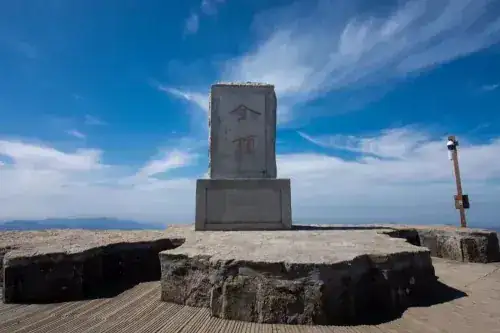
Mountains on three sides (east, south, west) with central hills and river valleys. Terrain descends from south to north toward the Poyang Lake Plain. Mountains (above 500m) cover 30%, hills (100–500m) 50%, plains (below 100m) 20%. The highest peak is Junfeng Mountain (1,761m). Two major ranges: the Wuyi Mountains (east, along the Jiangxi-Fujian border) and the Yushan Mountains (southwest).
Climate
Southern humid rainy monsoon climate: warm, abundant rainfall, sufficient light and heat, four distinct seasons, long growing season. Average annual temperature: 17.06–18.44°C (July 27.64–29.85°C, January 5.20–6.80°C). Extreme maximum: 42.2°C; extreme minimum: -13.2°C. Average annual precipitation: 1,740.7–2,003.3 mm (concentrated April–June, 50% of annual). Average annual sunshine: 1,585.5 hours. Main hazards: drought, flood, wind/hail, lightning, and low temperatures.
Hydrology
Three major river systems: the Fuhe, Xinjiang, and Ganjiang. 470 rivers of all sizes, all flowing north into Poyang Lake (except the Wujiang). The Fuhe River (348 km total, 271 km in Fuzhou) is Jiangxi's second-largest river after the Ganjiang, with a basin of 16,439 km². Main tributaries: Xujiang, Linshui, Litanhe, and Dongxiangshui.
Soil
Red soil, paddy soil, and other types. Rich variety suitable for diverse agricultural use.
Natural Resources
Water Resources
Total water resources: 24.923 billion m³. Surface water: 18.111 billion m³ (per capita ~6,300 m³). Groundwater (shallow): 5.186 billion m³.
Land Resources
Per the third national land survey: arable land 296,089.54 ha (4.4413 million mu, of which 4.101 million mu paddy); orchard 109,208.39 ha; forest 1,225,415.10 ha; grassland 8,517.03 ha; urban/mining 93,190.58 ha; transport 34,922.44 ha; wetland/water 101,817.10 ha.
Plant Resources
3,000+ higher plant species. 1,018 woody species (109 families, 322 genera). 20 national protected tree species including Bretschneidera sinensis, incense tree, dawn redwood, and southern yew. 45 provincial protected species. Timber, economic (oil, starch, fiber, fruit), ornamental, and medicinal (160+ species) plant categories.
Animal Resources
7 national Class I protected species: South China tiger, leopard, clouded leopard, sika deer, golden cat, Cabot's tragopan, white-necked long-tailed pheasant. 37 Class II protected species. 62 provincial protected species. Mammals: 27+ species. Birds: 206 species. Amphibians: 28 species. Reptiles: 42 species. Fish: 125 species (74 cyprinid).
Energy Resources
Hydropower: theoretical 702,460 kW (10.29% of provincial); developable 491,400 kW (19.66 billion kWh/year). Solar: average 1,585.5 sunshine hours/year. Wind: low average (1.1–3.0 m/s). Coal: 32 occurrences, proven reserves 8.27 million tonnes (0.7% of provincial).
Mineral Resources
20+ metallic and 30+ non-metallic mineral types. 265 proven deposits (3 large, 9 medium, 253 small). Key minerals: uranium (rare metal advantage), copper, porcelain clay, and building materials. Currently mined: copper, uranium, porcelain clay, gold, tungsten, coal, rare earths, fluorite, graphite, and building materials.
Population
As of end 2025: 3,545,700 (up 10,900—first population growth since 2010). Urban: 2,157,600 (60.85% urbanization rate, up 0.49 percentage points). Birth rate: 5.55‰; death rate: 7.66‰; natural growth rate: -2.10‰. Sex ratio: 106.08. 35 ethnic minorities with She being the largest (75% of minority population, ~12,987 people).
Politics
Economy
Overview
In 2025, GDP was 229.811 billion yuan (up 5.9%). Primary: 26.289 billion (up 3.8%); secondary: 89.943 billion (up 6.7%); tertiary: 113.579 billion (up 5.8%). Structure: 11.5:39.1:49.4. Per capita GDP: 64,914 yuan (~$9,093 USD). General public budget revenue: 15.067 billion (up 2.1%). Fixed asset investment grew 3.8%. Per capita disposable income: 35,321 yuan (up 5.2%); urban: 47,041 yuan; rural: 24,743 yuan.
Primary Industry
In 2025: agricultural output 46.02 billion yuan (up 4.0%). Grain sown area: 6.3142 million mu. Vegetables: 1.1959 million mu. Pork: 260,000 tonnes; beef: 12,000; mutton: 1,000; poultry: 121,000. Eggs: 110,000 tonnes. Pig inventory: 1.756 million; slaughter: 1.756 million. 115 provincial+ agricultural leading enterprises (9 national).
Secondary Industry
In 2025: industrial value added 67.446 billion (up 9.3%); above-designated-size industry grew 10.8%. Heavy industry +13.5%, light industry +3%. Manufacturing +11.6%. Revenue: 328.79 billion (up 12.5%); profits: 14.9 billion (down 8.9%). 1,637 industrial park enterprises, revenue 319.853 billion (up 12.6%). Construction: 607 qualified enterprises (74 first-grade+), output 78.769 billion (up 1.3%).
Tertiary Industry
In 2025: service industry 113.579 billion (up 5.8%). Wholesale/retail: 20.789 billion (up 6.1%); financial: 12.975 billion (up 4.3%); real estate: 13.059 billion (up 2.4%). Retail sales: 82.382 billion (up 5.0%). Import/export: 22.547 billion (up 21.6%); exports: 20.932 billion (up 23.7%). Actual foreign investment: 15.5 million USD. Express delivery: 255 million parcels (up 14.5%). 5G base stations: 11,300. Financial deposits: 444.155 billion (up 12.2%); loans: 400.48 billion (up 8.3%). Insurance premiums: 6.951 billion (up 5.6%). Tourism: domestic visitors +2.3%, spending +7.8%.
Social Undertakings
Education
As of end 2025: 7 higher education institutions, 23 secondary vocational, 44 general high schools, 201 junior high, 291 primary, 507 kindergartens, 11 special education. Nine-year compulsory education retention: 99.6%; high school gross enrollment: 95.0%.
Science and Technology
In 2025: 571 national high-tech enterprises, 1,536 national technology-based SMEs (up 19.1%). 2,452 patents authorized (304 invention). 7.06 valid invention patents per 10,000 people. 2024 R&D expenditure: 4.305 billion (1.98% of GDP).
Culture
As of end 2025: 12 cultural centers, 12 public libraries, 18 museums, 5 intangible cultural heritage halls. National Class I libraries: Fuzhou City Library, Jinxi County Library, Chongren County Library.
Healthcare
As of end 2025: 2,848 medical institutions (99 hospitals, including 1 Class III Grade A), 32,208 health workers (11,313 physicians), 22,674 beds (17,321 in hospitals).
Social Security
As of end 2025: employee pension 1.059 million; resident pension 1.686 million; employee medical 416,300; resident medical 3.2278 million; unemployment 280,200; work injury 404,000. Urban minimum living allowance: 19,500 recipients; rural: 136,200. 134 residential welfare institutions with 15,000 beds. Welfare lottery: 288 million yuan.
Transportation
Overview
As of end 2025: total highway mileage 19,239 km (803 km expressways, 11.2% of provincial). 541,900 civilian automobiles (482,400 private cars, 54,900 new energy vehicles).
Railways
Changfu Railway (Xiangpu): Class I national rapid railway, 632 km, 200 km/h design speed, connecting Nanchang-Fuzhou-Fujian. Stations: Fuzhou Station (Class II, built 2013), Nancheng, Nanfeng. Fuzhou East Station: on the Shanghai-Kunming HSR, 38 km from city center. Xiangle Railway: 117.4 km local industrial branch.
Highways
Fuyin Expressway (G70, Fuzhou-Yinchuan, 2,485 km national), Fuji Expressway (Fuzhou-Ji'an, 179.188 km), Fujin Expressway (Fuzhou-Jinxi, 39.288 km). Fuba Line (Fuzhou-Le'an, 120.1 km). Donglin First-Class Highway (40.985 km, connecting the Shanghai-Ruili and Beijing-Fuzhou expressways).
Historical Culture
Overview
Fuzhou is known as "the hometown of scholars and a cultural state." It produced 7 prime ministers, 13 deputy prime ministers, and 2,451 jinshi graduates. Over 300 scholars authored 481 works (5,580+ volumes), 65 of which (770+ volumes) are included in the Complete Library of the Four Treasuries. Of the "Eight Great Prose Masters of the Tang and Song," two—Wang Anshi and Zeng Gong—were from Fuzhou.
Linchuan Culture: Generated in the Qin-Han period, flourished in the Song Dynasty (960–1279), and continued through the Ming-Qing. It encompasses humanities, philosophy, education, literature, art, science, medicine, religion, folklore, and cuisine.
Distinctive Cultural Elements
Poetry and Scholarship: Fuzhou's ci poets included 42 of Jiangxi's 153 Song Dynasty ci poets. Yan Shu was called "the pioneer of Song ci" and his son Yan Jidao "pushed the ling form to its zenith."
Prose: Wang Anshi and Zeng Gong were two of the Eight Great Prose Masters. Wang Anshi was praised by Liang Qichao as "occupying the highest position in thousands of years of Chinese literary history."
Opera: Fuzhou is one of the earliest and most flourishing centers of southern Chinese opera. The "Erhuang" melody originated in Yihuang. Tang Xianzu's "Four Dreams of Linchuan" (The Peony Pavilion, The Purple Hairpin, The Nanke Record, The Handan Record) marked the peak of Ming Dynasty drama. Tang is called "the Shakespeare of the East."
Philosophy: Lu Jiuyuan (Lu Xiangshan) founded the "Mind Learning" (xin xue) school, which, together with Zhu Xi's Neo-Confucianism, formed the Song-Ming Neo-Confucian philosophical system. The "Lu-Wang School of Mind" profoundly influenced Yuan, Ming, and Qing intellectual culture.
Xujiang Medicine: One of ancient China's four major regional medical schools, with 2,016 physicians and 815 medical works from the Han to the Republic. 7 of Jiangxi's top 10 ancient physicians were from the Xujiang school.
Chan Buddhism: Fuzhou was called "the center of the Zen river under heaven." Mazu Daoyi established the Hongzhou School; Benji founded the Caodong Sect at Caoshan Temple; Wenyi created the Fayan Sect at Chongshou Zen Temple. Three of the five major Chan sects originated here.
Fuzhou Merchant Group: A branch of the Jiangyou merchants, active across southern China and Southeast Asia ("no Fuzhou person, no market"). During the Ming-Qing, they dominated Beijing's porcelain and paper markets, and the Jianchang medicine merchants controlled 40+ counties' medicine trade for nearly 300 years.
Folk Activities
Dragon boat racing during the Dragon Boat Festival, originating from commemorating Qu Yuan, flourishing in the Tang Dynasty, and evolving into a comprehensive folk celebration.
Cultural Relics
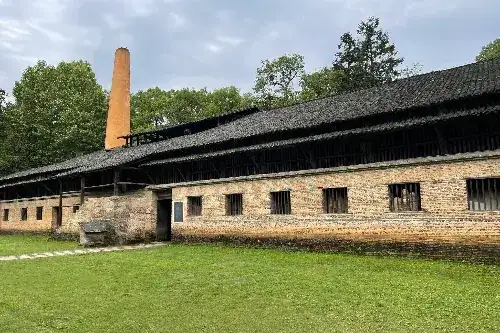
714 cultural heritage protection units at all levels: 16 national (including Fuzhou Yulong Wanshou Palace), 87 provincial, 83 municipal, 528 county-level. Notable ancient architecture: Liukeng Village ("the First Village of Millennia"), boat-shaped houses in Lichuan and Nancheng, ancient book-printing street in Jinxi's Huwan, Wenchang Bridge (Southern Song, 1202–1203), Wannian Bridge (Ming, 1634). Qianjin Weir listed as a World Irrigation Engineering Heritage site. Fuzhou has the most traditional villages in Jiangxi (96 national, 33 provincial), 10 national historical/cultural towns and villages, and was selected as one of 10 national demonstration cities for traditional village protection.
Intangible Cultural Heritage
Folk Customs
"Carrying Lord Kang" procession: commemorating Xie Lingyun (the landscape poet who served as prefect of Linchuan during the Southern Dynasties), evolved into the Kang Gong Temple Fair combining folk worship and commerce. Life milestones: boys' 15th birthday ("manhood"), 60th birthday celebrations with longevity noodles, house-building customs with "start-work," "beam-raising," and "completion" banquets.
Dialect
Fuzhou dialect belongs to the Gan Chinese, Fuzhou sub-group (also called Fuguang or Fuzhou-Nancheng sub-group), distributed along the Fuhe River basin and northwestern Fujian.
Scenic Spots
Overview
Fuzhou has 10 national historical/cultural towns and villages, 135 traditional villages (nearly 1/3 of Jiangxi's total, #1 among prefecture-level cities). 1 national tourism demonstration zone, 2 provincial, 1 national 5A, 24 national 4A scenic areas, 4 provincial 5A rural tourism sites. National 4A count ranks 2nd in Jiangxi. Named "2020 Most Beautiful China Cultural Tourism City."
Natural Scenery
Dajueshan (Great Awakening Mountain) in Zixi: 3.6 km canyon rafting, 180m drop—"Asia's #1 Rafting." Magu Mountain in Nancheng: named after Magu who attained immortality here. Yaoxi Lotus Fields in Guangchang: China's largest lotus pond. Liukeng Ancient Village in Le'an: "the First Village of Millennia," founded in the Five Dynasties period, with 260+ ancient buildings and 650+ couplets and plaques. Huwan Ancient Town in Jinxi: the largest book-printing distribution center during the Song-Ming.
Cultural Landmarks
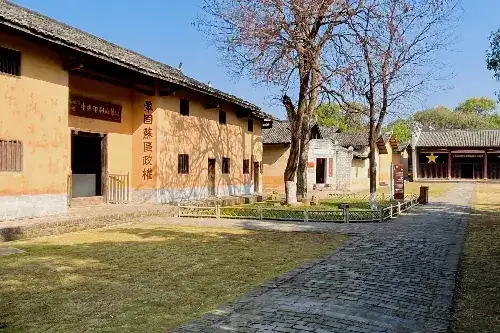
Wang Anshi Memorial Hall, Tang Xianzu Cultural Arts Center, Tang Xianzu Memorial Hall and Tomb, Zeng Gong Reading Cave, Tan Lun Tomb, Lu Xiangshan Tomb, Shu Tong Calligraphy Museum, and streets named after famous Fuzhou figures. Historical calligraphy and inscriptions left by visiting scholars including Yan Zhenqing, Wang Xizhi, Bai Juyi, Lu You, and Xie Lingyun. Revolutionary sites: 4th and 5th Anti-Encirclement campaign sites, Kangdu Conference site, and former residences of Mao Zedong, Zhou Enlai, Zhu De, and Deng Xiaoping.
Local Specialties
Agricultural Products
Nanfeng mandarin oranges, Guangchang white lotus seeds, Zixi white tea, Fuzhou watermelon, Chongren hemp chicken, Lichuan Torreya nuts, Le'an bamboo shoots, Linchuan tiger milk mushroom, Jinxi sweet pear, Hongmen bighead carp, Dongxiang green-shelled egg chicken, Le'an spotted pig, Lichuan tea tree mushroom, Wangqiao flower-fruit taro, Nancheng Chinese yam.
Crafts
Linchuan bamboo weaving, Nanfeng clay stoves, Nanfeng Nuo masks, Le'an egg carving, Fuzhou wooden relief carving, Nancheng Magu wine, Zixi bamboo pyrography, Linchuan paper cutting, Linchuan gold and silver engraving.
Ten Famous Dishes
Soft-shell turtle with rice noodles, braised beef tripe, Linchuan lotus root shreds, sunflower seed lotus, Rushu health flying chicken, scorched bamboo shoots, Nanfeng fish floss, Jianchang steamed pork, Chongxiang braised chicken, dragon beard tofu.
Local Snacks
Fuzhou rice noodles, Linchuan vegetable stems, Magu rice noodles, Huwan oil noodles, Zixi wine-braised chicken, filled candy, lotus root silk candy, frozen rice meatballs, red sister fermented bean curd. "Ten Famous Snacks": Lichuan taro cakes, Jinxi oil noodles, Linchuan beef offal, Tang Weng potstickers, moldy tofu cakes, salt-braised green eggs, Nanfeng rice noodles, Zixi bread, soup dumplings, Yan Shu cakes.
Famous Figures
Honorary Titles
National Garden City (2014), National Forest City (2014), China's Top 100 Livable Cities (2015), China's Top 10 Cultural Competitiveness Cities (2017–2019, three consecutive years), National Go Hometown (2018), National Tourism Best Destination (2019), National Health City (2021), China Poetry City (2021), National Historical and Cultural City (2022), National Double Support Model City (2025), and others.
Sister Cities
Whakatane (New Zealand), Livingstone (Zambia), Chusovoy (Russia), Stratford-upon-Avon (UK—Shakespeare's birthplace), Alcalá de Henares (Spain—Cervantes' birthplace).
Travel information can change. Check current opening hours, reservations and entry requirements before you travel.
Traveller discussion
Start the conversation with a helpful tip or a question.