
Jiujiang City
Jiujiang CityJiujiang, abbreviated as "Xun" and historically known as Xunyang, Chaisang, and Jiangzhou, is a prefecture-level city in Jiangxi Province, located in the northern part of the province at the junction of Jiangxi, Hubei, Hunan, a
Jiujiang City
Jiujiang, abbreviated as "Xun" and historically known as Xunyang, Chaisang, and Jiangzhou, is a prefecture-level city in Jiangxi Province, located in the northern part of the province at the junction of Jiangxi, Hubei, Hunan, and Anhui provinces. Between 113°56′–116°54′E and 28°41′–30°05′N, it has a subtropical monsoon climate with four distinct seasons. Total area: 19,084.61 square kilometers. As of 2026, the city administers 3 districts, 7 counties, and 3 county-level cities. As of the end of 2025, the permanent resident population was 4,484,200. Jiujiang is a Jiangyou people settlement area with over 2,200 years of history. It was historically one of China's three major tea markets and four major rice markets. Located at the intersection of the Yangtze River and the Beijing-Kowloon Railway economic development belts, it is a national comprehensive transportation hub, a National Civilized City, and a central port city in the middle reaches of the Yangtze. Known as the "North Gate of Jiangxi" and "the meeting point of three rivers and the thoroughfare of seven provinces," it is one of China's first five cities opened along the Yangtze River. The city boasts Lushan Mountain (UNESCO World Cultural Landscape Heritage), Poyang Lake (China's largest freshwater lake), Donglin Temple (birthplace of the Pure Land Buddhist sect), and Bailudong Academy (foremost of China's four great academies). In 2025, GDP was 424.651 billion yuan, up 5.2%.
History
During the Xia (c. 2070–1600 BCE) and Shang dynasties, the area belonged to Jingzhou and Yangzhou. During the Spring and Autumn period (770–476 BCE), it was known as "the head of Wu and the tail of Chu." In 221 BCE, the Qin Dynasty placed it under Jiujiang Commandery. In 201 BCE, the Western Han established Yuzhang Commandery with 5 counties in the Jiujiang area. In 210 CE, the Eastern Han established Poyang Commandery. The Three Kingdoms period (220–280) saw the area under the Wu State. During the Southern and Northern Dynasties, it was successively part of various commanderies. In 589, the Sui Dynasty (581–618) established Raozhou. In 758, the Tang Dynasty (618–907) established Xunzhou. The Song, Yuan, Ming, and Qing dynasties maintained the area under Raozhou, Xunzhou/Jiujiang Prefecture, and Nanjing Prefecture. In 1949, Jiujiang was liberated. On July 27, 1983, Jiujiang City and Jiujiang Prefecture merged.
Administrative Divisions
Divisional History
In 1989, Ruichang County became a county-level city. In 2010, Gongqingcheng was established as a county-level city. In 2016, Xingzi County was abolished and Lushan City was established; Lushan District was renamed Lianxi District. In 2017, Jiujiang County was abolished and Chaisang District was established.
Division Details
As of March 2026: 3 districts (Xunyang, Lianxi, Chaisang), 7 counties (Xiushui, Wuning, Yongxiu, De'an, Duchang, Hukou, Pengze), 3 county-level cities (Ruichang, Gongqingcheng, Lushan). Also: Jiangxi Lushan Scenic Area Administration (vice-departmental), Jiujiang Economic Development Zone, Lushan Xihai Scenic Area, Balihu New Area, and Poyang Lake Eco-Science City. Government: No. 166 Balihu Avenue, Balihu New Area.
Geographical Environment
Location and Boundaries
Northern Jiangxi, south bank of the middle-lower Yangtze River, at the junction of four provinces. Between 113°56′–116°54′E and 28°41′–30°05′N. East-west: 270 km; north-south: 140 km. Total area: 19,084.61 km² (11.3% of Jiangxi).
Landforms
Complex terrain: higher in the east and west, lower in the center, slightly higher in the south, sloping northward. Average elevation: 32m (urban: 20m). Mountains, hills, plains, and lakes are all present—mountains 16.4%, hills 44.5%, lakes 18% ("six parts mountain, two parts water, half part field, half part roads and estates"). The Jiuling range (main peak 1,786.9m, the city's highest) separates the Xiu and Jin river basins. The Mufu range (1,656m) forms the Jiangxi-Hubei border.
Climate
Subtropical monsoon climate with four distinct seasons, mild temperatures, abundant sunlight, rich heat, and plentiful rainfall. Average annual temperature: 16–17°C. Annual rainfall: 1,300–1,600 mm (40%+ in Q2). Frost-free period: 239–266 days. Average fog days: fewer than 16.
Soil
Red soil is the zonal type, with paddy soil, black limestone soil, yellow-brown soil, and fluvo-aquic soil also present.
Natural Resources
Land Resources
As of 2019: arable land 262,900 ha; orchard 29,100 ha; forest 1,123,400 ha; grassland 8,800 ha; urban/mining 121,400 ha; transport 33,700 ha; wetland/water 3,314,700 ha.
Mineral Resources
Located on the Yangtze middle-lower reaches non-ferrous/precious metal metallogenic belt. 53 mineral types with 266 occurrences: 31 large, 40 medium, and 195 small deposits. Advantageous minerals: copper, lead, zinc, tungsten, tin, antimony, cement limestone, flux limestone, decorative stone, and building stone.
Biological Resources
3,400+ plant species, 2,800+ higher plants, 86 nationally protected rare species. Wildlife: 115 resident bird species, 11 amphibians, 20+ mammals. Poyang Lake hosts 126 migratory bird species (100,000+ birds) in winter, including Siberian cranes (95%+ of global population), white-headed cranes, white storks, and black storks. 140+ fish species (81%+ of provincial total). Pengze's Taohongling has 600+ wild sika deer (40% of national total). In November 2023, the endangered Chinese quillwort (Isoetes sinensis) was discovered for the first time in Jiujiang.
Water Resources
In 2025: surface water resources 7.989 billion m³ (down 62.7%); average precipitation 1,208.2 mm (down 32.8%). 2 large reservoirs with 3.583 billion m³ year-end storage (down 971 million m³). The Zhaolin Reservoir has 79.2 billion m³ capacity. Poyang Lake (70% of its waters in Jiujiang, ~3 million mu) is the main channel for all Jiangxi rivers to the Yangtze.
Population and Ethnic Groups
Population Numbers
As of end 2025: 4,484,200 (down 14,800). Urban: 2,917,400 (65.06% urbanization rate, up 0.58 percentage points). Birth rate: 5.16‰; death rate: 7.61‰; natural growth rate: -2.45‰.
Ethnic Composition
47 of China's 56 ethnic groups are present. Han: 99.59%; minorities: 0.41%. 16 minorities with 100+ people: Hui (2,817), Miao (2,361), She (1,997), Tujia (1,790), Zhuang (1,411), and others.
Politics
Economy
Overview
In 2025, GDP was 424.651 billion yuan (up 5.2%). Primary: 28.335 billion (up 4.4%); secondary: 162.697 billion (up 5.9%); tertiary: 233.619 billion (up 4.8%). Structure: 6.7:38.3:55.0. Per capita GDP: 94,544 yuan (up 5.8%). General public budget revenue: 32.202 billion (down 1.2%). Fixed asset investment grew 4.3%. Urban per capita disposable income: 51,298 yuan (up 4.3%); rural: 24,171 yuan (up 5.8%).
Primary Industry
In 2025: grain sown area 274,200 ha; grain output 1.5073 million tonnes (up 1.8%). Oil crop output: 237,700 tonnes; cotton: 19,000 tonnes. Forestation: 2,540 ha; forest tending: 11,629 ha. Meat: 192,600 tonnes; pig slaughter: 1.8577 million; inventory: 964,600. Aquatic products: 552,000 tonnes (up 2.8%). 135 provincial+ agricultural leading enterprises (9 national), 9,125 farmer cooperatives, 8,394 family farms. 1,108 "Three Products and One Standard" certified products.
Secondary Industry
In 2025: above-designated-size industry grew 7.2%. Nine major industrial chains grew 7.9%. Power generation: 30.756 billion kWh (up 11.3%); yarn: 217,900 tonnes; garments: 65.533 million pieces; crude oil processing: 6.4109 million tonnes; cement: 13.7545 million tonnes; crude steel: 5.9727 million tonnes. 2,522 enterprises achieved profits of 25.557 billion yuan (up 5.5%). 2,010 industrial park enterprises with 201,000 employees, profits 21.152 billion (up 9.6%). Construction: output 78.97 billion (up 1.7%), value added 18.685 billion (down 1.0%).
Tertiary Industry
In 2025: retail sales 178.814 billion (up 4.6%). Import/export: 39.87 billion (down 1.0%); exports: 20.74 billion (down 0.4%). Actual foreign investment: 95.45 million USD (up 39.9%). Tourism: 90.902 million visitors (up 13.0%), revenue 81.726 billion (up 33.9%). Financial deposits: 619.733 billion (up 42.749 billion); loans: 595.794 billion (up 41.333 billion). Insurance premiums: 10.052 billion (up 4.4%).
Transportation
Overview
Jiujiang is at the intersection of the Yangtze River and Beijing-Kowloon Railway economic belts. Jiujiang Port is one of the Yangtze's top 10 ports (passenger and freight volumes ranking 2nd and 4th among Yangtze ports). Five railways converge: Beijing-Kowloon, Wuhan-Jiujiang, Hefei-Jiujiang, Tongling-Jiujiang, and Nanchang-Jiujiang intercity. In 2025: highway passengers 36.65 million; railway passengers 14.9612 million; waterway passengers 913,400; air passengers 382,500. Highway freight 144.94 million tonnes; waterway freight 39.065 million tonnes; railway freight 12.5538 million tonnes.
Railways
Jiujiang is a major railway hub with the Beijing-Kowloon, Wuhan-Jiujiang, Hefei-Jiujiang, Tongling-Jiujiang, Nanchang-Jiujiang Intercity, and Quzhou-Jiujiang railways. Jiujiang Station (Class I, 9 platforms 12 tracks) was built in 1916 and expanded in 1996. Lushan Station serves the Beijing-Kowjiang, Nanchang-Jiujiang Intercity, and Wuhan-Jiujiang HSR lines. Future HSR lines: He'an-Jiujiang (opened 2021), Nanchang-Jiujiang (started 2021), and planned Chizhou-Jiujiang and Fuyang-Jiujiang lines.
Highways
Total highway mileage: 3,753 km. Expressways: Jiujiang Ring, Nanchang-Jiujiang (Chang-Jiu), G70 Fuyin, G56 Hangrui, Jiujiang-Ruichang, G45 Daguang, Yongwu, Penghu, Xiuping, Dujiu, Pingyi, and Xianjiu. National highways: 105, 316, 351, 530, 531, 532. The Jiujiang Bus Terminal operates 117 routes to 14 provinces/cities.
Aviation
Jiujiang Lushan Airport (IATA: JIU, ICAO: ZSJJ): 4C-level military-civilian tourism airport, 8.5 km from Lushan Scenic Area, 31 km from city center. In summer 2022: 3 airlines operating 4 routes to 6 cities.
Shipping
Jiujiang Port has been a major commercial port since the Ming-Qing dynasties, historically one of China's four major rice markets and three major tea markets. In 1980, it became a national Class I foreign trade port. With 152 km of Yangtze shoreline, it is one of China's 28 major inland river ports and Jiangxi's only river-sea intermodal foreign trade port, handling 80%+ of provincial port throughput.
Public Transit
Jiujiang Public Transport Group operates 77 routes (including 2 tourism routes). 1,539 cruising taxis (1,374 using clean energy). 1,348 ride-hailing vehicles. Urban rail transit plan: 5 main lines (including 1 branch) totaling ~149 km with 89 stations, plus a 3-line Lushan tourism rail system (~85.4 km, 21 stations).
Social Undertakings
Science and Technology
In 2025: 23 county+ independent R&D institutions, 353 science projects (19 national, 114 provincial, 220 municipal). 4,498 patents authorized.
Education
As of 2025: 14 higher education institutions (208,300 students, 63,300 new enrollment), 26 secondary vocational schools (36,000 students), 297 general secondary schools (319,100 students), 368 primary schools (320,300 students). 100% enrollment for both primary and junior high. Notable: Jiujiang University, Jiangxi Vocational University of Technology, and multiple provincial colleges.
Culture
As of end 2025: 11 performing troupes, 15 cultural centers, 15 public libraries, 15 museums/memorials (26 state-owned). 12 broadcast/TV stations, 99.65% broadcast coverage, 99.95% TV coverage. National Class I libraries: Jiujiang City Library, Lushan Library, Xiushui County Library, Hukou County Library.
Sports
As of end 2025: 39 new-type sports schools, 4,717 fitness activity sites. 299 new rural sports fitness projects in 2025.
Healthcare
As of end 2025: 3,584 medical institutions (84 hospitals, 207 health centers, 18 disease prevention centers, 11 maternal/child centers), 30,104 beds, 41,618 health workers (9,949 physicians, 15,239 nurses).
Social Security
In 2025: 24,900 reemployed urban unemployed; 11,000 difficult-group employment. 6.565 billion yuan in entrepreneurship guarantee loans. Employee pension: 868,600 (up 22,500); institutional pension: 117,200; resident pension: 1,924,400; unemployment: 430,800; work injury: 539,000; basic medical: 4,584,700 (employee 737,500, resident 3,847,100); maternity: 449,900. 360 affordable rental units, 131 urban renovation units, 14 old community renovation projects.
Environmental Protection
In 2025: 115 excellent days, 215 good days, 30 light pollution, 5 moderate pollution. Air quality good rate: 90.4%. 27 national ecological towns and 1 ecological village.
Historical Culture
Name Origin
The name "Jiujiang" first appears in the Classic of History (Shangshu). Two theories: (1) "Nine" as the largest number in ancient Chinese numerology, meaning "the place where many waters converge"—"nine" is figurative; (2) nine rivers (Gan, Po, Yu, Xiu, Gan, Xu, Shu, Nan, Peng) flow into the Pengli Marsh—"nine" is literal.
Dialect
Complex dialect distribution: Gan Chinese (Xiushui, Wuning, Yongxiu, De'an, Lushan City, Gongqingcheng, Duchang, Hukou), Jiang-Huai Mandarin (Xunyang, Lianxi, Chaisang, Ruichang), and Hakka (mainly in Xiushui, also Wuning). Due to historical mass migrations, Hunan, Henan, Ji'an, and Tongcheng dialects are also spoken in pockets.
Cuisine
Jiujiang cuisine, a major component of Jiangxi cuisine, emphasizes spicy, tender, and crisp flavors. The city's location at the junction of four provinces brings together culinary traditions from across China.
Religion
Jiujiang has a deep religious heritage. The Donglin Temple on Lushan is the birthplace of the Pure Land Buddhist sect. Scholar Hu Shi noted that Lushan represents three major trends: Huiyuan's Donglin Temple (Buddhism's sinicization), Bailudong Academy (700 years of Neo-Confucianism), and Guling (Western cultural influence in China).
Traditional Opera
Ruichang Tea-Picking Opera: Evolved from Ming Dynasty lantern performances, known for its lyrical and gentle melodies—called "glutinous rice tea-picking" for its sweet richness.
Jiujiang Wenqu Opera: Popular in the Jiangxi-Hubei border region, with over 100 folk tunes across four melody systems.
Jiujiang Tanqiang: A Jiangxi opera genre, a Ganju (Jiangxi opera) branch, featuring Er-huang and Xipi melodies.
Qingyang Qiang (Hukou Gaoqiang): Originated in the Ming Dynasty when Jiangxi's Yiyang Qiang spread to Anhui's Chizhou, combining with local speech and folk songs. It once surpassed Kunqu in influence, affecting Huiju and Huangmei opera. National intangible cultural heritage since 2006.
Folk Customs
Dragon boat racing during the Dragon Boat Festival has a long tradition. In the late Qing Dynasty, Jiujiang's urban dragon boat races were citywide celebrations centered on Gantang and Nanmen lakes, with "red-grabbing" contests and victory laps.
Intangible Cultural Heritage
As of June 2023: 16 national, 52 provincial, 210 municipal, 295 county-level items across 7 categories.
City Spirit
City spirit: "Gathering Nine Rivers, Daring to Lead, Working Hard, Pursuing Excellence." City flower: lotus (designated by the 13th Municipal People's Congress), symbolizing purity—"rising from the mud unstained." City tree: camphor tree, symbolizing perseverance and auspiciousness.
Scenic Spots
Jiujiang has been a renowned tourist destination since ancient times—"the Nine Rivers of Xunyang Commandery, as beautiful as a painting." With 230+ scenic spots, it centers on Lushan Mountain and Poyang Lake, integrating ancient temples, academies, architecture, and political history.
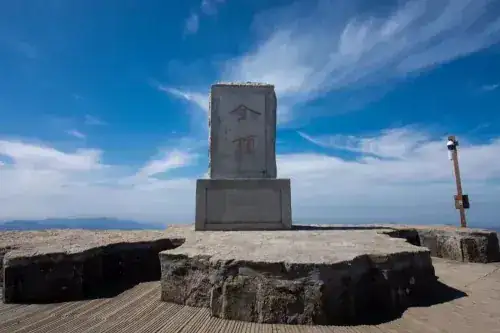
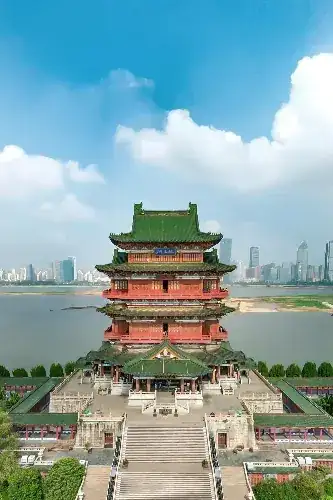
Key attractions: Lushan Mountain (UNESCO World Cultural Landscape Heritage, national 5A scenic area), Poyang Lake (China's largest freshwater lake, wintering ground for 100,000+ migratory birds including 95%+ of global Siberian cranes), Donglin Temple (birthplace of Pure Land Buddhism), Bailudong Academy (foremost of China's four great academies, where Zhu Xi lectured), Longgong Cave ("Underground Art Palace" in Pengze), Yunju Mountain Zhenru Temple (Zen Buddhist center), Shizhong Mountain (Stone Bell Mountain), Xunyang Tower, Pipa Pavilion, and the 1938 Flood Memorial Square.
Local Specialties
Lushan "Three Stones" (stone fish, stone chicken, stone ear), Wuning stick fish, Lushan fresh bamboo shoots, Lushan Cloud-and-Mist Tea (one of China's top 10 teas), Hukou fermented black beans, Pengze crucian carp, Jiujiang tea cakes, Xiushui steamed dumplings, Ruichang yam, Hukou pickled fish, and Huanglaomen ginger.
Famous Figures
Tao Yuanming (poet, known as the "father of pastoral poetry"), Huang Tingjian (Song Dynasty calligrapher-poet), Jiang Wanli (founder of Bailudong Academy), Lei Fada (architect). The Chen family produced four generations of scholars: Chen Baozhen, Chen Sanli, Chen Hengke, and Chen Yinque (historian). Li Liejun (1911 Revolution elder, who led the Hukou Uprising against imperial restoration). Also: Yuan Longping (Father of Hybrid Rice), Pan Jiluan (welding scientist, CAS academician), and others.
Sister Cities
Domestic: Beijing Dongcheng, Tianjin Nankai, Shanghai Huangpu, Sanmenxia, Nantong, Anqing, Jingzhou. International: 14 sister cities across 5 continents, 13 countries.
Honorary Titles
China Top 10 Livable Cities (2004), National Civilized City (2025), National Double Support Model City (2020, 2025), International Wetland City (2025), National Historical and Cultural City (2022), National Health City, China Top 100 Cities for Foreign Trade, China's first batch of "Gigabit Cities," and others.
Travel information can change. Check current opening hours, reservations and entry requirements before you travel.
Traveller discussion
Start the conversation with a helpful tip or a question.