
Zhangzhou City
Zhangzhou CityZhangzhou City is a prefecture-level city under Fujian Province, a city in the Xiamen-Zhangzhou-Quanzhou Metropolitan Circle. Located in southern Fujian, it borders Xiamen's Jimei District (east), Longyan (north), Guangdong's
Zhangzhou City
Zhangzhou City is a prefecture-level city under Fujian Province, a city in the Xiamen-Zhangzhou-Quanzhou Metropolitan Circle. Located in southern Fujian, it borders Xiamen's Jimei District (east), Longyan (north), Guangdong's Meizhou and Chaozhou (west), and faces Taiwan Province across the sea (southeast). Area: 12,607 square kilometers. South subtropical oceanic monsoon climate. As of end 2025: 5,084,000 permanent residents. As of 2024: 4 districts, 7 counties. Zhangzhou has 10,000+ years of human history. In 222 BC, it was incorporated into the Qin Dynasty. In 686, General Chen Yuanguang established Zhangzhou. In 1985, it became a coastal economic open zone. Known as "Hometown of Chinese Narcissus," National Historical and Cultural City, national Minnan Culture Ecological Protection Area, important ancestral homeland of Taiwan compatriots. It has 1 5A scenic area (Fujian Tulou Nanjing). In 2025, the gross regional product was 615.412 billion yuan.
Name Evolution
Zhangzhou is named after the Zhangjiang River ("Zhang water"). The "Yuanhe Commandery Gazetteer" records: "Zhangzhou is named after the Zhang water." The river's clear and turbid waters merge to form patterns ("zhang" = pattern), hence "Zhangjiang."
History
Pre-Qin Period
Human activity dating back ~10,000 years. Zhou Dynasty: Min territory. Warring States: Minyue tribal land after Chu conquered Yue.
Qin to Sui
In 222 BC, incorporated into Minzhong Commandery under Qin. Han: divided between Minyue Kingdom (north) and Nanhai Kingdom (south). Jin: Northern part under Jin'an Commandery, southern under various commanderies. In 507, Longxi and Lanshui counties established. In 592, Lanshui and Sui'an merged into Longxi, ending the north-south division.
Tang to Qing
In 686, Chen Yuanguang petitioned to establish Zhangzhou, with Zhouzhi at Xilin (on the Zhangjiang). Chen Yuanguang became the first prefect. In 716, seat moved to Zhangpu. In 741, Longxi County transferred from Quanzhou. In 786, seat moved to Longxi's Guilin Village (present-day Xiangcheng District). Southern Tang: renamed Nanzhou. Song: restored name Zhangzhou in 966. In 980, Changtai County transferred from Quanzhou. Yuan: Nan Sheng County established (1322), renamed Nanjing (1356). Ming: various counties established. By 1567, 10 counties. Qing: Longyan elevated to a directly administered department (1734).
Republic of China
1912: Zhangzhou Prefecture under Fujian West Road. 1916: Dongshan County established. 1928: Hua'an County established. 1934: 10 administrative inspectorates. 1935: 7 inspectorates.
September 19, 1949: Zhangzhou liberated. September 26: 6th Administrative Inspectorate established.
After the Founding of the People's Republic of China
1950: renamed Zhangzhou Administrative Inspection District, then Longxi District. 1951: Zhangzhou City (county-level) established from Longxi's urban districts. 1955: Longxi Special District. 1960: Longxi and Haicheng merged into Longhai County. 1968: Longxi Special District Revolutionary Committee. 1970: renamed Longxi Region. 1985: prefecture-level Zhangzhou City established, county-level Zhangzhou became Xiangcheng District. 1993: Longhai became county-level city. 1997: Longwen District established from parts of Xiangcheng and Longhai.
Administrative Divisions
As of September 2024: 4 districts (Xiangcheng, Longwen, Longhai, Changtai) and 7 counties (Zhangpu, Yunxiao, Zhao'an, Dongshan, Pinghe, Nanjing, Hua'an), plus 5 development zones (Zhangzhou Development, Changshan, Gulei, Taiwan Merchant Investment, Zhangzhou High-tech). 123 township-level units, 2,075 villages/communities. City Government at No. 118 Shengli West Road.
Natural Geography
Location
Southern Fujian, between 23°34'-25°15' N and 116°54'-118°08' E. Borders Xiamen (east), Longyan (north), Guangdong (west), Taiwan Strait (southeast). Spans 187 km north-south, 127 km east-west. Area: 12,607 km². Coastline: 715 km. 143 islands. Sea area: 18,600 km².
Geology
Complex structure influenced by Indosinian, Yanshanian, and Himalayan orogenies. Controlled by NE Cathaysian, NNE Neo-Cathaysian, and NNW Taiyishan structural trends. North: folds dominant. Central-south: faults dominant, compresso-torsional. Mountains: Mesozoic volcanic + Yanshanian granite, hard and erosion-resistant. Maritime geology: Binhai Fault Zone (NE-trending) separates continental extension (north) from South China Sea subplate (south).
Topography
NW high, SE low. Bopingling Mountains on NW border, Daiyun remnant in north. Coastal: Wushan and Liangshan ranges reach the coast. Longhai, Zhangpu, Yunxiao, and Zhao'an are coastal. Dongshan was an island, connected by causeway in the 1960s. Coastline: 631 km, highly indented. 12 major bays. 502 islands and reefs.
Climate
Subtropical monsoon humid climate. Mountains block cold currents to the north; ocean moderates to the south. Near the Tropic of Cancer: warm, abundant rain, no extreme winters or summers. Large inter-annual and seasonal precipitation variation. Droughts and floods alternate. Mountain areas receive more rain than coastal. Frequent summer typhoons. 2024: average precipitation 1,922.7 mm (+324.5 mm above normal); average temperature 22.4°C (+0.6°C). 2025: 22.3°C, humidity 76.8%, sunshine 2,184.2 hours, precipitation 1,745.7 mm.
Hydrology
Grid-like river network, flowing NW and NE, mostly perpendicular to mountain ranges. All rivers originate within the territory, mountain-stream type. Jiulongjiang (Nine Dragon River): Zhangzhou's largest, Fujian's 2nd largest. 3 branches: North Stream (274 km, main stream), West Stream, South Stream. Basin: 14,741 km² (7,566 km² in Zhangzhou). Dongxi (1066.9 km² basin, 93 km), Zhangjiang (1,038 km², 66.2 km), Luxi (643 km², 54 km), and Hanjiang tributaries (878.2 km²). 11 rivers with basins over 100 km².
3 large reservoirs, 515 medium/small reservoirs (total capacity 1.381 billion m³). 458 water gates (7 large, 47 medium). 24 large/medium irrigation districts (1.1498 million mu design area). Jiulongjiang Water Diversion Project: largest water project in Zhangzhou history (12.4 billion yuan, 124 km, 3 phases).
Soil
South subtropical to central subtropical transition. 8 major soil types, 23 subtypes, 66 genera, 90 species. From coast to inland: saline soil, aeolian sand, paddy soil, alluvial soil, latosolic red soil, red soil, yellow soil, purple soil.
Vegetation
200-500 m: subtropical rainforest. 400-1000 m: evergreen broadleaf forest.
Natural Disasters
Main hazards: typhoons, heavy rain, strong convection, drought, high temperature, frost. Geological disasters: landslides, collapses, debris flows. Post-1949 floods: West Stream 8 major floods (worst 1960 "6-9" flood, 6,140 m³/s, ~33-year flood). North Stream 2 major floods (worst 1960, 9,400 m³/s, ~50-year flood). 1959: Typhoon #3 (force 12+) destroyed most seawalls. 1962-63: 240+ day drought, rivers nearly dry, 120,000 without drinking water. 1918: M7.3 earthquake (intensity X), severe damage.
Natural Resources
Water Resources
2024: surface water 13.545 billion m³, groundwater 3.714 billion m³, total 13.6 billion m³. Transit water: 8.665 billion m³ in, 1.584 billion m³ out. Per capita: 2,679 m³. Sea discharge: 195.91 billion m³.
Land Resources
Cultivated: 1,131,700 mu. Orchard: 4,449,000 mu. Forest: 9,912,200 mu. Grassland: 115,800 mu. Wetland: 345,200 mu. Construction: 1,497,400 mu. Transportation: 440,200 mu. Water: 1,116,100 mu.
Forest Resources
2025: planting 155,500 mu (coastal shelterbelt 58,100 mu). Commercial timber: 1.7545 million m³ (+4.5%). 31 nature reserves (2 national, 2 provincial, 9,461.2 hectares total).
Mineral Resources
41 mineral types (36 with proven reserves). Advantageous: natural quartz sand, granite, Hua'an jade, silver, gold, copper, lead-zinc, kaolin, geothermal, mineral water.
Wetland Resources
Total: 251,333 hectares (19.9% of land). Artificial: 178,886 ha (71.2%). Natural: 72,447 ha (28.8%). 4 types: coastal (66.1%), riverine (19.3%), estuarine (11.3%), lacustrine (3.2%). Mangroves: 386 hectares (62.75% of Fujian's total), 10 species in 5 families. Mangrove afforestation land: 872.7 hectares.
Biological Diversity
25 mammal, 14 amphibian, 25 reptile, 158 bird, 2,000+ insect species. 73 nationally protected animals (13 Class I, 60 Class II).
47 fruit types, 330+ varieties. 35 vegetable types, 108 varieties. 1,200+ flower varieties. 200+ medicinal species. 1,000+ other herbaceous, woody, and vine plants. Nanjing Liudou Mountain subtropical rainforest: 20 hectares, 1,050+ species. Nanjing Dakeng: 2,666+ hectares of subtropical rainforest ("Tree Sea"), Fujian's largest. Rare plants: tree fern, Jian cypress, etc. 4,000+ marine species (400+ fish/shrimp/shellfish/algal).
15 nature reserves (2 national, 2 provincial, 11 county-level, 28,340 hectares total, 2.25% of territory).
Population
As of end 2025: 5,084,000 (up 8,000). Urban: 3,353,000 (65.95% urbanization). Birth rate: 6.96 per mille; death rate: 7.58 per mille; natural growth rate: -0.63 per mille. Registered: 5,234,400 (down 12,000). 53 ethnic groups (She: 66,600, #2 in Fujian; Gaoshan: 387 people in 124 households, most concentrated in mainland China).
Language
Zhangzhou Southern Min (Minnan), Hakka (Nanjing, Pinghe, Yunxiao, Zhao'an counties), and limited Chaoshan dialect. Southern Min originated from Central Plains Heluo dialect brought by Chen Yuanguang's troops in the Tang Dynasty, spreading to Xiamen, Quanzhou, Taiwan, and Southeast Asia.
Religious Beliefs
4 major religions: Buddhism, Taoism, Catholicism, Christianity. 5 municipal religious organizations, 29 county-level. 491 registered venues (232 Buddhist, 78 Taoist, 29 Catholic, 152 Christian). 991 clergy. ~442,000 believers (Buddhism ~250,000, Taoism ~130,000, Catholic 13,000, Protestant 49,000).
Politics
Economy
Overview
"4+4" industrial pattern: 4 pillars (petrochemicals, special steel, equipment manufacturing, food) + 4 strategic emerging (electronics, new materials, new energy, biopharmaceuticals). Building "3+4+X" system: 3 strategic pillars (new materials, high-end equipment, new energy) + 4 specialty (electronics, biopharmaceutical, marine high-tech, digital services) + future industries. In 2025, GDP: 615.412 billion yuan, up 3.0%. By industry: primary 60.874 billion (9.9%), secondary 269.666 billion (43.8%), tertiary 284.872 billion (46.3%). Per capita: 121,144 yuan. Urban disposable: 53,508 yuan. Rural: 31,487 yuan. In 2024: 606.371 billion yuan, up 6.1%.
Primary Industry
Specialty agriculture: Yunxiao loquat, Longhai bayberry, Pinghe pomelo, Nanjing banana, Hua'an Wogan citrus. County-level "business cards": narcissus, phalaenopsis, mushroom, banana, pomelo, loquat, plum, aquatic products, bamboo shoots, golden thread lotus. 2025: total agricultural output 115.685 billion yuan, up 2.9%. Grain area: 952,000 mu. Grain: 431,200 tons. Fruit: 4,887,100 tons. Tea: 78,700 tons. Aquaculture: 2,395,800 tons. Meat: 456,800 tons.
Secondary Industry
Key industries: food, equipment manufacturing, steel, petrochemicals, electronics, clocks/watches, paper, auto parts, biopharmaceuticals. Clock/watch industry: China's electronic quartz clock production/sales base, global mid-to-low watch production base. 444 above-scale equipment enterprises (2018 output: 100.2 billion yuan, 17.8% of total). 2025: industrial added value up 1.7%. Above-scale up 1.3% (15/34 industries growing). 3,015 above-scale enterprises (182 over 500M yuan, 10 over 5B, 8 over 10B). Revenue: 518.682 billion (down 8.5%). Profits: 23.746 billion (down 25.8%). Construction added value: 67.794 billion, up 3.0%.
Tertiary Industry
Food: Zhangzhou's advantage and pillar. Canned food: "China's Canned Food Capital," ~1/10 of national output, #1 exports for 35 consecutive years. East Mountain Bay aquatic processing: China's largest, 26+ billion USD exports (~1/7 national). Leisure food: Longhai "China's Leisure Food City." 2025: wholesale/retail 74.284 billion (+5.7%), transportation 21.693 billion (+5.2%), accommodation/catering 10.88 billion (+1.7%), finance 18.089 billion (+0.4%), real estate 28.995 billion (-2.1%). Total retail sales: 243.204 billion (+3.1%). Foreign trade: 109.6 billion yuan (-14.2%). Total deposits: 546.788 billion (+6.0%). Total loans: 647.489 billion (+9.3%). Insurance: 11.507 billion (+4.6%). Tourist arrivals: 97.3177 million domestic (+12.1%), 311,900 inbound (+18.8%). Tourism revenue: 114.386 billion yuan (+11.9%).
Economic Development Zones
21 industrial parks: 4 national (Dongshan ETDZ, Zhangzhou Merchants ETDZ, Taiwan Merchant Investment Zone, Zhangzhou High-tech), 8 provincial (Jinfeng, Lantian, Changtai, Gulei, Changshan, Hua'an, Zhao'an, Pinghe), 9 county-level.
Social Affairs
Education
86 new/renovated schools, 1,495 new teachers, 460,000 m² new school building. 7 universities, 16 vocational, 81 high schools, 132 junior high, 784 primary. University enrollment: 109,419 (32,530 new). Graduate: 2,263 (915 new). Vocational: 31,173. High school: 111,558. Junior high: 202,195. Primary: 442,664. Kindergarten: 122,704.
Healthcare
4,079 health institutions: 94 hospitals, 106 health centers. 31,846 beds (29,614 in hospitals). 37,649 health workers (14,099 physicians, 16,857 nurses).
Science and Technology
12 provincial enterprise key labs, 25 provincial engineering centers, 6 provincial incubators. 922 high-tech enterprises. 42,783 valid patents (5,043 invention patents, +11.7%). 187 seismic monitoring stations.
Culture
9 art troupes, 11 public libraries (7.8621 million volumes), 14 cultural centers, 14+1 museums. 9 broadcasting/TV stations. Radio coverage: 99.78%, TV coverage: 99.8%.
Sports
390 events (244,700 participants, +32.0%). 18 national-level medals (2 gold, 5 silver, 11 bronze). Zhangzhou Sports Training Base: China Women's Volleyball training base since 1976, where the national team was reformed and achieved "Five Consecutive World Championships."
Social Security
Employee pension: 1,254,500 (down 91,100). Unemployment: 627,300 (up 7,700). Work injury: 960,500 (up 7,500). Medical: 923,900 (up 31,400). Maternity: 617,900 (up 39,800). 104,000 minimum living. 11,200 rural special hardship. 37,100 new urban jobs. 2,800 elderly care institutions (10,700 beds). Lottery: 460 million yuan.
Environmental Protection
Jiulongjiang (Zhangzhou section): 100% Class I-III water quality. Drinking water: 100% compliance. Air quality: 353 days excellent (96.7%), 165 Class I + 188 Class II days.
Transportation
Overview
856,800 motor vehicles (765,400 private, 466,800 sedans). 3 national highways (324, 319, G357), 3 expressways (Xiazhang, Zhangzhao, Zhanglong), Yingxia Railway, Xiashen and Longxia HSR. Zhangzhou Port connects to Southeast Asia. 58.9 km to Xiamen International Airport. 2025: total highway 13,900 km (717 km expressway).
Highways
3 expressways, 3 national highways, 6 provincial highways, 9 county roads, 872 township roads. Total: 13,900 km (+200 km).
Railways
Zhangshan HSR: 176.007 km total (127.177 km Fujian section, 48.83 km Guangdong), 350 km/h design, 4.5 year construction, 39.23 billion yuan total. 4 stations: Zhangzhou (renovated), Zhangpu (renovated), Dongshan Island (new), Zhao'an South (new). 8 HSR stations under Zhangzhou Railway Bureau.
Water Transport
Coastline: 715 km. Zhangzhou Port: 7 port areas (Shima, Zhaoyin, Houshi, Dongshan, Gulei, Yunxiao, Zhao'an), 6 open to foreign ships. 5 Taiwan small-trade points, 6 Taiwan vessel mooring points. Planned: 250 berths (138 deep-water), 288.35 million ton capacity. Zhaoyin: 4.2 km deep-water shoreline, 300,000-ton vessel capacity, ~100 million ton annual throughput. Gulei: one of China's 8 deep-water ports, 35 berths (10,000-250,000 ton). 3 "name cards": first batch Taiwan direct-sail port (1996), approved for Kinmen/Mazu/Penghu direct freight (2001), national Class I open port (2002).
Public Transportation
655 buses (481 new energy, 174 clean energy), 63 routes, 6.3 million km daily, ~3,245 daily departures, ~106,000 daily passengers. 100% new energy vehicles in operation.
Culture
Overview
1,000+ years of history, "Coastal Zou-Lu." Fused Central Plains, maritime, Hakka cultures, inherited Zhu Xi and Red cultures. Major birthplace of Minnan culture. Important Taiwan compatriot ancestral homeland (shared cultural roots). 1986: National Historical and Cultural City. Notable figures: Lu Xie (Ming), Huang Daozhou (early Qing), Xu Dishan, Yang Sao, Lin Yutang (modern).
Food
Braised noodles (1,300+ years): brought by Chen Yuanguang's troops from Gushi, Henan. Fa-guo (steamed rice cake): fermented, cracked surface symbolizing prosperity. He-he bao (lotus box bun): shaped like a lotus leaf, filled with sweet filling, symbolizing harmony.
Customs
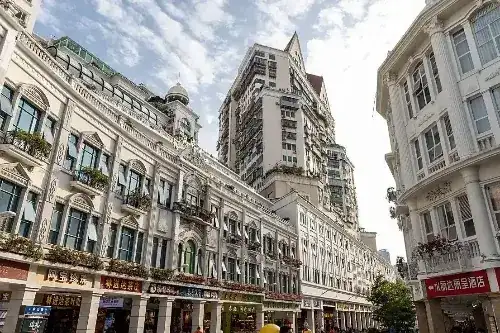
Dan (boat people) customs: maritime culture, 9-river basin, "Wangchuan" ceremony (UNESCO 2020, one of 14 representative transmission points). Five-foot-distance (qilou/arcade): 19th century Nanyang colonial architecture combined with Zhangzhou traditional bamboo-pole house, first batch of Minnan arcade buildings.
Arts
Puppet show (1,000+ years): "palm drama," 3 schools (Fuchun, Fuxing, Mudanting), 8 generations, national heritage (2006). Xiang Opera (Gezai Opera): originated in Zhangzhou, formed in Taiwan Yilan, ~100 years old, Fujian's 5 major local operas, national heritage (2006). Sungjiang Nine-Continent Bagua Formation: martial arts formation with 3 scales (24/48/108 persons), 10 attack-defense formations, 36 empty-hand routines, won gold medals internationally.
City Symbol
City tree: Acacia and Camphor (2015). City flower: Narcissus (1984).
Tulou Culture
Tulou (earth buildings): traditional residential architecture, evolved from military fortresses to civilian dwellings. Formed in Tang, transformed in late Yuan, peaked in Ming-Qing, built until late 20th century. 2,000+ surviving tulou of various types. Notable: Hua'an Eryilou (first national protected tulou), Nanjing Tianluokeng cluster (beautiful layout), Yuchanglou (late Yuan round), Zhangpu Yidelou (Ming square), Pinghe Zhuangshangcheng (super-large variant square), Nanjing Heguilou (built on marshland), Pinghe Shengwulou (exquisitely carved). 2008: UNESCO World Cultural Heritage (including Nanjing Tianluokeng, Hekeng clusters, Hua'an Dadi cluster, and Nanjing Huaiyuanlou, Heguilou).
Scenic Spots
Overview
53 A-level scenic areas: 1 5A, 14 4A, 18 3A, 20 2A. Also: national nighttime culture-tourism cluster, national tourism leisure street, provincial tourism leisure streets, national rural tourism key villages.
Main Scenic Spots
Fujian Tulou (Nanjing Scenic Area): World Cultural Heritage, "mythical mountain architecture," unique large-scale rammed-earth residential buildings, Song Dynasty origins.
Yundongyan Scenic Area: 4A, 280 m main peak, 12.6 km², 50+ attractions including Three-Month Gorge, Thousand-Person Cave, One-Line Sky.
Famous People
Sister Cities
Honorary Titles
National Historical and Cultural City, National Civilized City, China Excellent Tourist City, National Double Support Model City, World Canned Mushroom Capital, China Hot Spring City, China Clock and Watch City, National Agricultural Sustainable Development Pilot Zone, National Hygienic City.
Travel information can change. Check current opening hours, reservations and entry requirements before you travel.
Traveller discussion
Start the conversation with a helpful tip or a question.