
Xiamen City
Xiamen CityXiamen City, abbreviated as "Xia" or "Lu," is a prefecture-level city, sub-provincial city, separately planned city under Fujian Province. Located on the southeastern Fujian coast, it consists of mainland areas along Xiamen Bay,
Xiamen City
Xiamen City, abbreviated as "Xia" or "Lu," is a prefecture-level city, sub-provincial city, separately planned city under Fujian Province. Located on the southeastern Fujian coast, it consists of mainland areas along Xiamen Bay, Xiamen Island, Gulangyu Island, and surrounding waters. Subtropical oceanic monsoon climate, mild and rainy. Land area: 1,700.61 square kilometers. As of end 2025: 6 districts, 5,365,000 permanent residents. Xiamen was originally a habitat for white egrets, hence "Egret Island" (Ludao). Tong'an County was established in 282. The city wall was built in 1394. In 1935, Xiamen City was established. In 1980, the Xiamen Special Economic Zone was established. In 1988, it became a separately planned city. In 1994, it was elevated to sub-provincial status. Xiamen is a China Special Economic Zone, an important southeastern coastal center city, modern marine city, scenic tourism city, international comprehensive transportation hub, and national Minnan culture ecological protection area. Famous attractions: Gulangyu, Botanical Garden, Horticulture Expo, Hulishan Fortress, Tianzhushan Forest Park. In 2025, the gross regional product was 898.037 billion yuan, up 5.7%.
History
In ancient times, Xiamen Island was a habitat for white egrets, hence "Egret Island." Before the Qin Dynasty, it was Baiyue territory. In 282, Tong'an County was established. In 803, Datong Field was carved from Nan'an. In 933, Tong'an County was re-established. In 1394, the Ming Dynasty built Xiamen City. In 1655, Zheng Chenggong (Koxinga) renamed it Siming Prefecture. In 1680, Qing forces captured it. In 1684, the Fujian Naval Commander moved to Xiamen. In 1842, Xiamen became one of five treaty ports under the Treaty of Nanjing. In 1902, Gulangyu became an international settlement. In 1935, Xiamen City was established. In 1938, occupied by Japan. In 1945, liberated. In 1949, the PLA liberated Xiamen on October 17. In 1980, the Xiamen Special Economic Zone was established (2.5 km² in Huli). In 1984, the SEZ expanded to the entire island. In 1988, became a separately planned city. In 1994, elevated to sub-provincial. In 2003, Gulangyu and Kaiyuan districts merged into Siming; Xinglin renamed Haicang; Xiang'an established. In 2010, SEZ expanded to entire city. In 2014, China (Fujian) Pilot Free Trade Zone Xiamen Area established (43.78 km²).
Administrative Divisions
As of end 2025: 6 districts (Siming, Huli, Jimei, Haicang, Tong'an, Xiang'an), plus informal economic management zones. 37 subdistricts, 8 towns, 379 communities, 147 villages. The City Government is at No. 61 Hubin North Road, Siming District.
Geographical Environment
Location
Between 24°23'–24°54' north latitude and 117°53'–118°26' east longitude, on China's southeastern coast, southern Fujian. Borders Quanzhou (north), Zhangzhou (south), faces Kinmen islands (east). Land area: 1,700.61 km². Sea area: ~390 km². Xiamen Island: 157.76 km² (4th largest in Fujian), coastline 234 km.
Topography
Coastal plains, terraces, and hills. NW-SE slope. Yunding Mountain at 1,175.2 m (highest in city). Yunding Rock: highest on Xiamen Island. Sunlight Rock: highest on Gulangyu. Geological structure on the eastern Fujian volcanic fault depression edge, southeastern coastal metamorphic belt. Seismic zone, building standard 7.5 magnitude. Xiamen Port: natural harbor with 234 km coastline, 43 km deep-water shoreline (>12m), 27 km suitable for port construction. Strait-type natural harbor, ice-free year-round.
Climate
Subtropical oceanic monsoon climate, mild and rainy. Annual average: ~21°C. No extreme winter or summer. Annual precipitation: ~1,200 mm (peak May–August). Prevailing wind: NE, force 3–4. Average 4–5 typhoons per year (July–September).
Natural Resources
Water Resources
Freshwater-scarce island city. 80% of daily water from Jiulongjiang River. Average annual water resources: 1.247 billion m³. Per capita: only 513 m³. 14 hot springs/geothermal anomalies (50–90°C, total allowable extraction 33,002 m³/day).
Land Resources
Total: 1,700.61 km². Low hills and terraces: 62.5%. Plains: 14%. Mudflats: 7.7%. 6 soil types, 11 subtypes, 21 genera, 42 species. Red soil and paddy soil: 78%+. 60%+ are low-to-medium yield fields.
Mineral Resources
Limited metallic minerals: thorium, iron, manganese, copper, tungsten, lead, titanium, molybdenum, zinc. Main non-metallic: granite (wide distribution, large reserves, high economic value, also a tourism resource). Kaolin, refractory clay, brick clay (mainly in Tong'an and Xiang'an).
Biological Resources
Rich marine life: ~2,000 species. 157 economically valuable fish, 89 mollusks, 127 crustaceans, 139 algae. Lancelet and Chinese white dolphin: national Class I protected. Horseshoe crab: provincial key protected.
Population
As of end 2025: 5,365,000 (91.31% urbanization rate). Birth rate: 5.60 per mille; death rate: 3.92 per mille; natural growth rate: 1.68 per mille. Registered: 3,159,600. Han majority. 49 ethnic minorities (She and Hui largest). 20,000+ resident minorities, 10,000+ temporary. 2 ethnic communities: Zhongzhai She (Huli) and Chentang Hui (Xiang'an).
Politics
Current Leadership
Former Leaders
Economy
Overview
Xiamen pioneered "standard land" reform (2022) and software industry incentives. SEZ, southeastern coastal gateway, regional innovation highland, international coastal tourism destination, and cross-strait exchange hub. In 2025, the gross regional product was 898.037 billion yuan, up 5.7%. By industry: primary 2.424 billion (0.3%), secondary 339.474 billion (37.8%), tertiary 556.139 billion (61.9%). General public budget revenue: 163.835 billion, up 3.4%. Local revenue: 96.108 billion, up 3.0%. Tax revenue: 67.552 billion, up 3.3%. Expenditure: 107.656 billion, up 1.6%. Fixed-asset investment down 9.0% (infrastructure up 11.2%, industrial up 3.0%, social up 24.2%).
Primary Industry
Total agricultural output: 5.313 billion yuan, up 2.9%. Crop area: 307,500 mu (up 1.4%). Grain area: 64,500 mu (up 3.2%). Grain output: 27,300 tons (up 3.6%). Vegetables: 534,200 tons (up 3.4%). Fruit: 67,700 tons (up 9.0%). Meat: 19,000 tons (down 2.2%). Aquaculture: 52,500 tons (up 0.2%). Pigs: 130,400 inventory (up 4.9%), 212,100 sold (up 2.2%).
Secondary Industry
Industrial added value: 258.2 billion yuan, up 8.7%. Above-scale industrial added value up 10.2% (joint-stock up 14.1%; foreign/HMT up 3.7%; state-controlled up 19.3%; private up 11.8%; light industry up 8.1%; heavy up 11.5%). Sales rate: 97.01%. 3,110 above-scale enterprises (987 over 100M yuan, 87.7% of total). Electronics and machinery: 1,612 enterprises (51.8% of total, 61.6% of output). Electronics: 28.0%; Machinery: 33.6%. Profits up 12.4%. Construction added value: 85.25 billion, up 1.1%.
Tertiary Industry
Wholesale/retail: 104.64 billion, up 5.0%. Transportation: 41.985 billion, up 1.9%. Accommodation/catering: 13.065 billion, up 5.3%. Finance: 66.23 billion, up 4.3%. Real estate: 47.238 billion, down 6.7%. Total retail sales: 344.86 billion, up 3.6%. Online retail (above-quota): up 10.8%. Total deposits: 194.9896 billion, up 9.2%. Total loans: 197.0159 billion, up 2.8%. 38 insurance companies (premiums: 35.216 billion, up 9.9%; claims: 11.696 billion, up 11.1%). 2 securities companies, 101 securities branches. Securities trading: 150.5 trillion yuan (up 58.1%). Futures trading: 161.7 trillion yuan (up 27.7%).
Social Affairs
Education
1,200 full-time schools. 17 universities (237,700 students, 73,900 new). 158 secondary schools (344,400). 275 primary (437,400). 742 kindergartens (147,700). 7 special education (1,455). 72,500 full-time teachers. Notable: Xiamen No. 1 Middle School, Xiamen Double Ten School, Xiamen Foreign Language School, Xiamen University-affiliated Science Middle School.
Science and Technology
59 technology-advanced service enterprises. 47 municipal incubators (10 national). 7 national key laboratories (3 lead, 4 co-build). 3 provincial innovation labs, 66 provincial key labs, 159 municipal key labs. 340 enterprise technology centers. 46 national postdoctoral workstations. 35 national makerspaces. 29,886 domestic patent authorizations (7,829 inventions). 654 PCT international patent applications. 317 new S&T achievements registered. 79 Fujian Provincial S&T Awards.
Culture
China Golden Rooster Awards (since 2019, long-term resident). 7 public cultural centers, 13 museums, 10 public libraries. 6 newspapers, 25 journals. 6 radio programs, 7 TV programs. 69 cinemas, 466 screens, 382 million yuan box office. 51 national/provincial honors for professional arts. "Gulang Sounds" musical selected for National Arts Fund. Nanyin "Lumen Qingfeng Song" and group dance "Red Tide Green Wave" selected for national performances. 455 cultural benefit performances (200,000+ audience).
Healthcare
2,786 health institutions: 70 hospitals, 33 community centers, 8 health centers, 592 outpatient departments, 7 maternal/child centers, 7 CDCs. 49,195 health workers (19,303 physicians, 1,339 assistant physicians, 21,553 nurses). 25,220 beds (23,873 hospitals, 458 community, 889 public health).
Sports
803 new/renovated sports facilities (330,000 m²). 187 schools opened sports facilities. 14 national sports parks, 50 smart gyms. 95.21% community sports facility coverage (15-min walk). First provincial "sports promotes health" center. 1.2 million "Xiamen i Fitness" registrants, 13 million cumulative visits. 10,000+ mass sports events (1 million+ participants). 295 sports organizations. 27 gold medals. 25 athletes selected for national/provincial teams. 4 gold, 6 silver, 1 bronze at Greater Bay Area National Games.
Social Security
Pension: 6,221,100 (up 7.7%). Work injury: 2,895,200 (down 0.6%). Unemployment: 2,648,300 (up 0.2%). Migrant worker pension: 3,956,700 (up 11.0%). 3 insurance funds: revenue 26.032 billion, expenditure 25.67 billion. 30 work injury medical institutions. 544,500 retirees under social management (100%). Medical insurance: 4,872,700 (up 0.9%). Maternity: 2,622,700. Fund revenue: 22.246 billion, expenditure: 15.352 billion. 782 designated medical institutions, 1,389 designated pharmacies. Minimum living: 115,300 household-times, 172,300 person-times, 201 million yuan. 44 elderly care institutions (12,661 beds: 2,774 public, 9,887 private).
Transportation
Overview
"13th Five-Year" period: regional aviation hub, Haixi railway hub, "internal-external, bay-radiating" road network formed. 2025: 121 million passengers (up 2.1%), 455 million tons freight (up 0.5%). Xiamen Port: 192 berths (82 over 10,000 tons), 211 million tons throughput (up 0.3%), 12.5077 million TEU containers (up 2.1%).
Highways
3 expressways, 4 national highways, 4 provincial highways, 64 county roads. "Five bridges, two tunnels, one causeway" island access. Total: 2,119.47 km (110.37 km expressway, 515.2 km Class I, 249.48 km Class II).
Railways
"Four trunk, two branch" network: Xiashen, Longxia, Fuxia, Yingxia railways + Haicang and Dongdu port lines. 146 km operating. China-Europe (Xiamen) freight train and Central Asia train.
Water Transport
Xiamen Port: major coastal port, container trunk port, SE regional hub, Taiwan Strait main port. 9 port areas (Dongdu, Haicang, Xiang'an in Xiamen; Zhaoyin, Houshi, Shima, Gulei, Dongshan, Zhao'an in Zhangzhou). 190 container routes (149 foreign, 41 domestic) connecting 54 countries and 151 ports. 2024: 210.7 million tons, 12.2547 million TEU, 3.5963 million passengers.
Aviation
Xiamen Gaoqi International Airport: major SE China aviation hub.
Public Transportation
408 bus routes (384 conventional, 8 BRT, 16 custom), 7,036.7 km total. 4,314 buses, 1.4652 million daily riders. Fare: 1 yuan within district, 1-2 yuan cross-district. 5,680 taxis (9 companies, 17,000 drivers). 28,800 ride-hailing vehicles (11 companies, 79,000 drivers). Metro: opened December 31, 2017. 3 lines (98.4 km, 87 stations, 75 operating), 6 segments under construction (118.2 km). BRT: opened August 31, 2008, China's first elevated BRT. 8 lines, 45 stations.
History and Culture
City Symbol
Language
Xiamen dialect of Southern Min (Minnan). Southern Min is one of China's eight major dialects, used in southern Fujian, eastern Guangdong (Chaoshan), parts of Taiwan, Hainan, and overseas Chinese communities in Southeast Asia.
Folk Culture
Mid-Autumn Mooncake Gambling (Bobing): unique Minnan game using 6 dice, traditionally predicting luck for the year. New Year's Day 3rd taboo (no visits, mourning day commemorating 16th-century anti-pirate battle). Dan (boat people) customs: maritime culture with unique wedding, hair, and fishing traditions. "Chest-Slapping Dance" (Paixiong Wu): ancient Minyue dance with rope headband resembling a snake head (snake totem worship).
Religion
Buddhism (main), Christianity, Catholicism, Islam. Nanputuo Temple and Minnan Buddhist College. New Street Church ("China's First Sanctuary"). Catholic diocese on Gulangyu.
Cultural Relics
251 protected immovable cultural relics (305 points): 7 national (50 points), 57 provincial (65 points), 92 municipal (95 points), 95 county (95 points). 89 Taiwan-related sites.
Intangible Cultural Heritage
110 municipal+ items (15 national, 62 provincial, 110 municipal). 251 inheritors (18 national, 80 provincial, 251 municipal). National items: Nanyin, Gaojia Opera, Gezai Opera, Dazhuigu, lacquer thread sculpture, Minnan nursery rhymes, storytelling, Baosheng Dadi belief, Mid-Autumn Bobing, Wangchuan ceremony (UNESCO 2020, jointly with Malaysia), centipede pavilion, Minnan traditional house building.
Other Culture
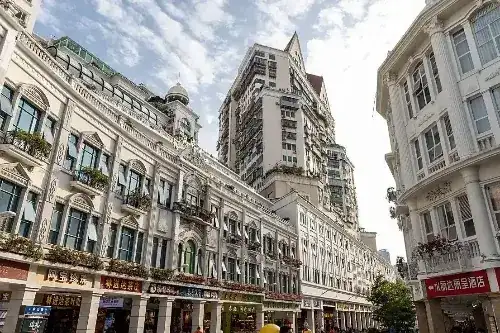
Qilou (arcade buildings): introduced from Southeast Asia by returned overseas Chinese. Kaiyuan Road: Xiamen's first road with arcade buildings, later spreading to Zhongshan Road and Dashengli. Xiamen became a "City of Arcades" within 10+ years. Overseas Chinese culture: Xiamen Port was the departure and return port for Minnan people going to Nanyang (Southeast Asia). Since the Ming Dynasty, 10+ overseas trade routes were established. Xiamen culture blends Minnan traditional, Western, Nanyang, overseas Chinese, and other external cultures.
Scenic Spots
Local Specialties
Abundant seafood: lobster, abalone, crab, shrimp, shellfish. Famous snacks: noodles paste (mianxian hu), satay noodles (shacha mian), tusundong (gelatinous sand worm), oyster omelet, five-spice fried rolls, peanut soup, meat dumplings (zongzi).
External Exchange
Taiwan Exchange
Xiamen SEZ was established "for Taiwan" and developed "because of Taiwan." Leading mainland city in cross-strait exchange. 30+ years of Taiwan work including: festival exchanges (Spring Festival, Lantern, Mid-Autumn), Minnan performing arts tours to Taiwan/Kinmen, folk belief exchanges (Baosheng Dadi, Zheng Chenggong, Fude), cross-strait art festivals, Bobing, coming-of-age ceremonies, Chinese character festivals, youth recitation, and surname origin competitions.
Consular Institutions
Sister Cities
Famous People
Honorary Titles
Credit index: #2 among 36 provincial/sub-provincial cities (2018). Business environment: #1 among sub-provincial cities. Foreign trade competitiveness: #5 nationally. Container throughput: #14 globally. Six consecutive "National Civilized City" awards (since 2005). National Hygienic City (2018). National Ecological Garden City (2020). National Double Support Model City (2020). First batch National Law-based Government Construction Demonstration. National Comprehensive Reform Pilot Zone, National Logistics Hub, Southeast International Shipping Center, China (Fujian) FTZ component, National Marine Economy Development Demonstration Zone, Cross-strait Emerging Industry and Modern Service Cooperation Demonstration Zone, Cross-strait Regional Financial Service Center, Cross-strait Trade Center. UN Habitat Scroll of Honour Award.
Travel information can change. Check current opening hours, reservations and entry requirements before you travel.
Traveller discussion
Start the conversation with a helpful tip or a question.