
Wuhu City
Wuhu CityWuhu City, a prefecture-level city in Anhui Province, was historically known as "Jiuzi" and also called "Jiangcheng" (River City). Located in southeastern Anhui along the lower Yangtze, between 117°40'-118°44'E and 30°19'-31°34'N,
Wuhu City
Wuhu City, a prefecture-level city in Anhui Province, was historically known as "Jiuzi" and also called "Jiangcheng" (River City). Located in southeastern Anhui along the lower Yangtze, between 117°40'-118°44'E and 30°19'-31°34'N, it covers 6,009.02 square kilometers with a population of 3.797 million (2024) and an urbanization rate of 75.22%. The urban area uses the Wuhu dialect (Jianghuai Mandarin), while some areas speak Wu Chinese. As of March 2026, Wuhu administers five districts, one county, and one county-level city. With over 2,500 years of recorded history, it was named "Jiuzi" in the Spring and Autumn Period for its gathering doves, and renamed Wuhu in 109 BCE after the shallow waters that grew duckweed. It opened as a treaty port in 1876, the first in Anhui, and was one of China's four great rice markets. Today, Wuhu is a sub-center of Anhui, a major Yangtze port, and a national advanced manufacturing base, focusing on new energy vehicles, intelligent connected vehicles, aerospace, and the low-altitude economy. In 2024, GDP reached 512.05 billion yuan (approximately $71.1 billion), up 6.4%; in 2025, GDP reached 540.27 billion yuan (approximately $75 billion), up 6.3%.
Name and Etymology
During the Spring and Autumn Period, Wuhu belonged to the State of Wu. Moisture-loving plants grew after the rainy season, attracting flocks of doves, hence the name "Jiuzi." In 109 BCE, Emperor Wu established it as a county and renamed it Wuhu after the surrounding marshes "held shallow water and grew duckweed."
Historical Evolution
Pre-Qin Period
Originally called Jiuzi, on the south bank of the Shuiyang River about 20 kilometers southeast of the present city. The name first appeared in the "Zuo Zhuan" (570 BCE). The "Battle of Jiuzi" recorded there is China's earliest documented naval battle. In 473 BCE, Yue conquered Wu; around 306 BCE, Chu conquered Yue, and Jiuzi came under Chu.
Qin, Han, and Southern-Northern Dynasties
In 221 BCE, Qin conquered Chu, and Jiuzi belonged to Zhang Commandery. In 109 BCE, Zhang was renamed Danyang Commandery, including Wuhu County. In 223 CE, Sun Quan moved the county seat to the north bank of the Qingyi River, forming Wuhu's oldest urban core. The area underwent many administrative reorganizations through the Southern and Northern Dynasties.
Sui, Tang, Song, and Yuan Dynasties
In 589 CE, Sui reduced Wuhu to a town under Dangtu County. The Southern Tang restored Wuhu County (937-942 CE). During the Song and Yuan, Wuhu belonged to Taiping Prefecture and its successor circuit.
Ming and Qing Dynasties
In 1368, the Ming placed Wuhu under Taiping Prefecture. In 1645, the Qing assigned it to Jiangnan Province. In 1667, Anhui Province was formally established, with Wuhu under Taiping Prefecture. During the Guangxu era, quality rice and transport links made Wuhu the foremost of the "Four Great Rice Markets."
Republic of China Period
In 1912, Wuhu County came directly under Anhui Province. Wuhu Circuit (1914-1928) governed 23 southern Anhui counties. On April 24, 1949, the People's Liberation Army liberated Wuhu; on May 10, the municipal government was established, separating city from county.
After the Founding of the People's Republic of China
In 1952, Wuhu became a provincial municipality. In 1973, it was upgraded to a provincial-level city. In 2011, Wuwei County joined Wuhu. In 2019, Wuwei became a county-level city under Wuhu. In 2020, Sanshan and Yijiang districts merged, Wuhu County became Wanzhi District, and Fanchang County became Fanchang District. As of 2024, the city administers five districts (Jinghu, Jiujiang, Yijiang, Wanzhi, Fanchang), one county (Nanling), and one county-level city (Wuwei).
Administrative Divisions
Wuhu administers Jinghu, Jiujiang, Yijiang, Wanzhi, and Fanchang districts, Nanling County, and Wuwei City. The municipal government is at No. 66 Zhengtong Road.
Physical Geography
Location and Territory
Wuhu borders Hefei and Ma'anshan to the north, Xuancheng and Chizhou to the south, and Tongling to the west, covering 6,009.02 square kilometers.
Climate
Northern subtropical humid monsoon climate: annual average temperature 16.7 degrees Celsius, precipitation 1,184.8 millimeters (60% from May to September), 245 frost-free days, and 1,921.7 sunshine hours annually. Prevailing easterly winds average 2.3 meters per second.
Geology
Strata include Triassic, Jurassic, Cretaceous, and Quaternary deposits. The area sits on the southern margin of the Ningwu Depression in the Lower Yangtze Paraplatform, with anticlines and faults including the Qingyi River fault.
Topography and Landforms
Part of the lower Yangtze plain, primarily terraces and floodplains with scattered low hills. Plains lie under 20 meters elevation; Siheshan is the highest point at 132 meters.
Hydrology and Water Resources
The Yangtze flows 71 kilometers through the city. Major rivers include the Qingyi, Zhang, Shuiyang, and Yuxi. Notable lakes include Kui Lake (approximately 7 square kilometers, the largest), Longwo Lake, and Fengming Lake. The city has 106 small reservoirs.
Soil
Six main types: paddy soils (83%), alluvial soils (13.42%), marsh soils, yellow-brown soils, lithic soils, and limestone soils.
Natural Disasters
Major hazards include floods, droughts, and storms. In 2008, a rare snowstorm caused over 900 million yuan (approximately $125 million) in losses, affecting 280,000 people. In 2024, flood risk inspections found 26 minor issues with no major concerns.
Natural Resources
Annual surface water averages 3.177 billion cubic meters; groundwater 847 million. The city has 22,850 hectares of arable land and 123,400 hectares of forest. Forty-eight mineral types have been discovered, of which 19 are exploited, including iron, copper, lead, zinc, and gold.
Biodiversity
Wuhu lies in the transitional zone between northern and central subtropical broadleaf forests. Forest coverage reached 32.98% (2020), with 1,163 vascular plant species and 43 mammal species. Nationally protected Class I species include the Chinese pangolin, small Indian civet, finless porpoise, and Chinese alligator. Fourteen nature reserves and parks cover 24,310.84 hectares.
Politics
The municipal government is led by the Mayor under the CPC Wuhu Municipal Committee, with the People's Congress, Government, and CPPCC committee.
Population
Population Size
The seventh census recorded 3,644,420 residents (51.28% male, 48.72% female), with 20.30% aged 60 and above. Population grew 2.80% since the sixth census. As of 2024, the resident population was 3.797 million with 75.22% urbanization.
Ethnic Groups
Predominantly Han Chinese, with Hui, Manchu, Miao, Mongolian, Zhuang, Uyghur, Korean, and other minorities. The Hui population is "widely dispersed, locally concentrated."
Language
The Wuhu dialect (Jianghuai Mandarin) features merged retroflex and non-retroflex initials. Generational differences are diminishing due to Mandarin influence and population mobility.
Religion
All five major religions are present: Buddhism and Daoism (over 1,000 years; the Chenghuang Temple founded 239 CE is China's earliest), Islam (over 600 years), Catholicism and Protestantism (post-treaty-port). The city has 160 registered Buddhist and 8 Daoist venues, with approximately 100,000 believers.
Economy
Overview
Wuhu is a key Yangtze River Delta city, core of the Wanjiang Industrial Transfer Zone, and member of the Hefei metropolitan circle and G60 Innovation Corridor. A pioneer in the low-altitude economy since 2013, locally produced general aviation aircraft deliveries exceeded 100 units by 2024, ranking first nationally for six consecutive years.
In 2024, GDP reached 512.05 billion yuan (approximately $71.1 billion), up 6.4%. Primary industry: 18.86 billion yuan ($2.6 billion); secondary: 229.58 billion yuan ($31.9 billion); tertiary: 263.61 billion yuan ($36.6 billion). Per capita GDP: 135,588 yuan (approximately $18,800). Public budget revenue: 42.68 billion yuan ($5.9 billion); expenditure: 63.19 billion yuan ($8.8 billion). In 2025, GDP reached 540.27 billion yuan (approximately $75 billion), up 6.3%.
Primary Industry
One of China's "Four Great Rice Markets," "Wuhu Rice" was recognized as a national geographical indication product in 2018. In 2024, agricultural output totaled 33.86 billion yuan (approximately $4.7 billion). Grain output was 1.428 million tons; vegetables 1.905 million tons; aquatic products 198,800 tons.
Secondary Industry
The automobile industry is Wuhu's flagship. In 2022, production exceeded one million vehicles (63.6% of Anhui's total). In 2024, above-scale industrial added value grew 9.9%; auto manufacturing grew 20.0% (45% of growth contribution). Industrial revenue exceeded 900 billion yuan (approximately $125 billion), with profits of 42.67 billion yuan ($5.9 billion).
Tertiary Industry
In 2024, the service sector grew 5.3%. Above-scale service revenue reached 120.20 billion yuan (approximately $16.7 billion). Retail sales totaled 216.90 billion yuan ($30.1 billion). Import and export value was 147.17 billion yuan ($20.4 billion), with electric vehicles, lithium batteries, and photovoltaics growing 112%. Bank deposits reached 778.51 billion yuan ($108.1 billion); loans 683.96 billion yuan ($95 billion). In 2025, retail sales reached 212.06 billion yuan ($29.5 billion); import and export 194.75 billion yuan ($27 billion); automobile exports 975,000 vehicles valued at 100.17 billion yuan ($13.9 billion).
Economic Development Zones
Wuhu has multiple zones, including the national-level High-Tech Industrial Development Zone (four pillars: intelligent connected and new energy vehicles, microelectronics and semiconductors, big data and IT, and high-end equipment manufacturing). The Jiangbei New Area (established 2020, 220 square kilometers) sits at the G60 corridor node within the Hefei-Nanjing one-hour economic circle.
Social Services
Education
As of 2023: 10 higher education institutions, 46 senior high schools, 164 junior high schools, and 224 primary schools. Enrollment included 12,100 graduate students and 156,900 undergraduates. Primary and junior high enrollment rates were 100%.
Healthcare
1,813 health institutions with 27,345 beds and 30,127 professionals. Notable hospitals include the Second Affiliated Hospital of Wannan Medical University (founded 1949) and Wuhu First People's Hospital (founded 1939, 1,500 beds).
Media
The Wuhu Media Center operates digital and social platforms. The "Wuhu Daily," founded July 1, 1949, is the CPC municipal committee's official newspaper.
Science and Technology
Forty engineering technology research centers, 26 key laboratories, and 2,006 high-tech enterprises. The Wuhu Data Center Cluster is a national "East Data West Computing" hub, with investment nearing 300 billion yuan (approximately $41.7 billion) from Huawei, ByteDance, Alibaba, and Baidu.
Cultural Services
Nine cultural centers, 10 public libraries, 8 archives, 13 national-level and 32 provincial-level protected heritage sites.
Sports
Athletes won 307 medals (100 gold) in 2021. The city has 11,939 sports venues with 2.90 square meters per capita. Notable strengths in fencing and shooting.
Environmental Protection
In 2023: 304 good air quality days (83.3%), PM2.5 at 34 micrograms per cubic meter. All 10 national water monitoring sections met standards. Traffic noise averaged 66.9 decibels, below national limits.
Social Security
Urban employee pension covered 1.5497 million people; basic medical insurance 3.6785 million; unemployment insurance 648,600. The city has 154 welfare institutions with 16,400 beds. Lottery sales reached 507 million yuan (approximately $70.4 million), raising 55.93 million yuan ($7.8 million) in welfare funds.
Transportation
Overview
National comprehensive transportation hub with the 100-million-ton Wuhu Port, high-speed railways, three Yangtze bridges, Wuxuan Airport, and light rail forming a multimodal system. Plans target a "1235 travel circle" reaching Yangtze Delta cities in 1 hour and national mega-regions in 5 hours.
Highways
11,317 kilometers of roads including 328 kilometers of expressways. Eight expressways serve the city. All 642 administrative villages have hard-surfaced roads.
Railways
442.9 kilometers of rail including 227.9 kilometers of high-speed rail. Three HSR lines form a cross network reaching 27 major cities. The Shanghai-Suzhou-Huzhou railway will cut Wuhu-to-Shanghai travel to 1.5 hours.
Aviation
4C-level Xuanzhou Airport with a 2,800-meter runway and 25,000-square-meter terminal. Twenty-nine routes serve 24 cities. The first international cargo route (Wuhu-Hanoi) opened in 2024. The city developed China's first independently-IP general aviation engine.
Water Transport
Twenty-nine navigable rivers totaling 728.9 kilometers. Wuhu Port, Anhui's first 100-million-ton port, is one of China's 28 major inland ports. In 2021, cargo throughput reached 135 million tons with 1.15 million TEU containers.
Public Transit
Light rail Lines 1 and 2 opened in 2021 (China's first driverless straddle monorail), spanning 46.2 kilometers with 35 stations. The city operates 1,585 buses on 156 routes (97% green vehicles). In 2024, autonomous micro-bus testing began.
Culture
Overview
With over 2,500 years of history, Wuhu Ancient City is among the best-preserved on the Yangtze's south bank, with over 180 historical sites including the Fanchang Kiln and Guangji Temple.
Cuisine
Rice-centered diet with traditional "tangfan" (reheated porridge) breakfasts. The city is a gateway to southern Anhui's tea culture. Signature dishes: fried stinky tofu, steamed rice with pork crumbs, shrimp-roe noodles, crab-roe soup dumplings (renowned since the 1920s), and Yijiang mutton.
Customs
The "zhuazhou" ceremony at a baby's first birthday places objects symbolizing future aspirations. The Guangji Temple Fair (7th lunar month 30th) honors Ksitigarbha Bodhisattva. Aili Village's "Sending Off the Kitchen God" festival features folk performances.
Arts
Wuhu Lihuang Opera (230+ years) evolved from local language and folk music. Nanling Mulian Opera, based on the Buddhist story "Mulian Saves His Mother," is a major recognized school.
Civic Symbols
The jiuzi bird symbol appears in a 33-meter bronze statue and the "Jiuzi Returns to Nest" sculpture. City flowers: chrysanthemum and Chinese rose. City trees: camphor and weeping willow.
Historical Sites
Thirteen national-level and 32 provincial-level protected cultural heritage sites.
Intangible Cultural Heritage
Three national-level and 30 provincial-level items, including Wuhu Lihuang Opera and Nanling Mulian Opera.
Scenic Attractions
Overview
Mountains (Zheshan, Shenshan, Tamen Mountain) and waterways (Qingyi River, Jing Lakes) define the landscape. In 2023, the city received 71.90 million tourists with revenue of 89.98 billion yuan (approximately $12.5 billion). Thirty-five A-level sites include one 5A and ten 4A attractions.
Key Attractions
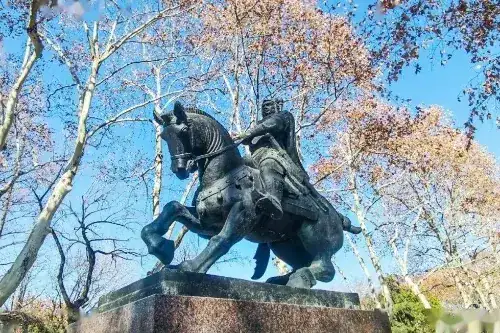
Wang Jiaxiang Memorial Park (4A, 2006) covers 1.24 hectares. Wuhu Fantawild Resort (5A, 2016) has 7 themed parks and 300+ attractions. Wuhu Zheshan Park (4A, 2016) covers 37 hectares with 140+ plant and 50+ animal species.
External Relations
Friendship Cities
Wuhu maintains international friendships fostering cooperation in trade, culture, and technology.
Friendship Exchange Events
Recent visits include the Ethiopian Consul General (2021), Thai Consul General (2022), Governor of Ulyanovsk Oblast, Russia (2023), Turkey's Minister of Industry and Technology (2023), and a Japan Value Engineering Association delegation (2024) for automotive and industrial cooperation.
Notable Figures
Wuhu has produced many notable figures across politics, military, arts, and sciences throughout its rich history.
Major Honors
Wuhu holds numerous national honors, including recognition as a national civilized city and a national demonstration city for advanced manufacturing.
Travel information can change. Check current opening hours, reservations and entry requirements before you travel.
Traveller discussion
Start the conversation with a helpful tip or a question.