
Zhenjiang City
Zhenjiang CityZhenjiang City is a prefecture-level city under Jiangsu Province, China, located in the southwestern part of the province on the south bank of the lower Yangtze River. As of end-2024, the resident population was 3.228 million.
Zhenjiang City
Zhenjiang City is a prefecture-level city under Jiangsu Province, China, located in the southwestern part of the province on the south bank of the lower Yangtze River. As of end-2024, the resident population was 3.228 million. The city administers 3 county-level cities and 3 districts, with a total area of 3,840 square kilometers. The terrain descends from west to east and south to north, characterized by low mountains and hills, with a forest coverage rate of 25.6%. Known as the "City of Mountains and Forests," it has a northern subtropical monsoon climate with an average annual temperature of 15.4 degrees Celsius. With over 3,000 years of history, Zhenjiang was known as Zhufang during the Spring and Autumn period, Jingkou during the Three Kingdoms, Nanxuzhou under the Liu Song dynasty, and Runzhou after the Sui unification. The name "Zhenjiang" dates from the Northern Song dynasty. During the Republic of China era, it served as the capital of Jiangsu Province. Located at the intersection of the Yangtze River and the Beijing-Hangzhou Grand Canal -- the "Golden Cross Waterway" -- Zhenjiang is an important advanced manufacturing base and regional center city in the Yangtze River Delta. In 2025, the city's GDP reached 573.678 billion yuan (approximately USD 79.1 billion), up 5.4% year-on-year. Zhenjiang Port's cargo throughput exceeded 300 million tons for the first time. The city has produced notable historical figures including Liu Yu, Shen Kuo, Mi Fu, and Mao Yisheng, and gave birth to cultural treasures such as The Literary Mind and the Carving of Dragons, Dream Pool Essays, and Selections of Refined Literature. It is a national historical and cultural city, and an important port, tourism, and livable city.
History
The earliest name for Zhenjiang was "Yi," a fief granted by King Kang of Zhou 3,000 years ago. During the Spring and Autumn period, it was called Zhufang, later going by Guyang, Dantu, Jingkou, and Runzhou. In 1113 CE, Zhenjiang Prefecture was established, marking the first use of the name "Zhenjiang," which persisted through the Song, Yuan, Ming, and Qing dynasties.
After the 1911 Xinhai Revolution, it was renamed Dantu County. In 1928, it became Zhenjiang County. During the Anti-Japanese War, the Chinese Communist Party established the Sunan Anti-Japanese Base. Zhenjiang served as the capital of Jiangsu Province until February 1949. On April 23, 1949, the People's Liberation Army liberated Zhenjiang during the Crossing-the-Yangtze Campaign.
After 1949, Zhenjiang underwent multiple administrative reorganizations involving the transfer of various counties between Zhenjiang, Suzhou, Yangzhou, and Nanjing jurisdictions. In 1983, Zhenjiang became a city under direct provincial administration, with Dantu, Danyang, Yangzhong, and Jurong counties placed under its jurisdiction.
Administrative Divisions
Division History
In 1984, the Urban District was renamed Jingkou District and the Suburban District was renamed Runzhou District. Danyang, Yangzhong, and Jurong counties were successively upgraded to county-level cities between 1987 and 1995. In 2002, Dantu County was reconstituted as Dantu District. In 2022, 55 industrial parks were consolidated into 10.
Division Details
As of end-2024, Zhenjiang has 3 districts and administers 3 county-level cities, comprising 25 sub-districts and 31 towns. The municipal government is seated at No. 68 Nanxu Avenue, Runzhou District.
Geography
Location
Zhenjiang is located between 31 degrees 37 minutes and 32 degrees 19 minutes north latitude, and 118 degrees 58 minutes and 119 degrees 58 minutes east longitude, bordering Changzhou to the southeast, Nanjing to the west, and facing Yangzhou and Taizhou across the Yangtze to the north. The total area is 3,840 square kilometers (3.7% of the province). The urban area covers 1,082 square kilometers, Danyang 1,047, Jurong 1,387, and Yangzhong 331.
Topography
The terrain features the Ningzhen-Maoshan low mountain and hill region. The Ningzhen range runs east-west with 114 peaks (Dahuashan 437m, Baohuashan 396.4m). The Maoshan range runs north-south, forming the watershed between the Qinhuai River and Taihu Lake systems. Urban hills below 100m -- Jinshan, Jiaoshan, Beigushan -- create a unique landscape of "one river flowing through, hills on three sides."
Climate
Northern subtropical monsoon climate. The 30-year average (1981-2010) temperature is 16.3 degrees Celsius, with 1,101.4mm precipitation and 1,946.1 sunshine hours. In 2020, the average temperature was 16.9 degrees Celsius, 1.2 degrees above normal. Seasons are distinct with rainfall concentrated in warm months.
Hydrology
The Yangtze River and the Grand Canal intersect here. The Yangtze flows 103.7 km through the city; the Grand Canal segment is 42.74 km. The city has 32 rivers with catchment areas of 50 square kilometers or more, 141 reservoirs, and 39,700 ponds.
Natural Resources
Biological Resources
Nationally protected animals include the baiji (Yangtze River dolphin), Chinese paddlefish, red-crowned crane, and Chinese sturgeon. The city has 394 woody plant species across 74 families, with protected plants including dove tree, yew, golden larch, ginkgo, and cycad.
Mineral Resources
Metallic minerals include iron, copper, lead, zinc, molybdenum, tungsten, gold, and silver (47 deposits). Non-metallic minerals include dolomite, limestone, marble, and bentonite. Geothermal resources are also abundant.
Population
The Seventh National Census (2020) recorded 3,210,418 residents. As of end-2024, the resident population was 3.228 million, with an urbanization rate of 81.1% and 28.2% aged 60 or above. The registered population was 2.6401 million. Zhenjiang has 52 ethnic minorities totaling 29,118 people (0.91%), with Hui, Miao, Tujia, Yi, and Mongolian being the largest.
Politics
Zhenjiang is a prefecture-level city under the jurisdiction of Jiangsu Province, governed by the municipal people's congress and administrative system under China's political framework.
Economy
Overview
In 2025, Zhenjiang's GDP reached 573.678 billion yuan (approximately USD 79.1 billion), up 5.4%. The primary, secondary, and tertiary sectors contributed 17.469 billion yuan (3.0%), 258.102 billion yuan (45.0%), and 298.107 billion yuan (52.0%) respectively. In 2024, general public budget revenue was 32.911 billion yuan (approximately USD 4.54 billion), up 2.6%; general public budget expenditure was 56.613 billion yuan (approximately USD 7.81 billion), up 6.1%.
Primary Industry
In 2024, grain output was 980,100 tons. Oil crops reached 47,700 tons (up 4.1%), vegetables 1.0801 million tons (up 3.5%), and fruit 183,600 tons (up 5.1%). Meat production was 104,200 tons (up 15.6%), and aquatic products 105,700 tons (up 2.8%).
Secondary Industry
Above-scale industrial value-added grew 6.6% in 2024. The city had 73 national-level "Little Giant" specialized enterprises and 497 provincial-level ones. Construction output reached 79.301 billion yuan (approximately USD 10.9 billion), up 7.8%.
Tertiary Industry
In 2024, total retail sales of consumer goods reached 156.147 billion yuan (approximately USD 21.5 billion), up 5.4%. Foreign trade totaled USD 14.575 billion (up 3.8%), with exports of USD 11.214 billion (up 6.3%). Exports to the EU reached USD 2.480 billion, to ASEAN USD 1.829 billion, and to Belt and Road countries USD 4.707 billion. RMB deposits totaled 842.862 billion yuan and loans 995.328 billion yuan. The city had 24 domestic listed companies with a market capitalization of 182.133 billion yuan (approximately USD 25.1 billion). Insurance premium income was 17.929 billion yuan (approximately USD 2.47 billion), up 5.2%.
Social Services
Education
As of end-2024, the city had 9 universities with 161,000 students, 108 secondary schools, 115 primary schools, and 273 kindergartens. Nine-year compulsory education retention and high school gross enrollment both reached 100%.
Science and Technology
High-tech industry accounted for 54.7% of above-scale industrial output. The city had 1,617 valid high-tech enterprises and 25,725 valid invention patents (79.8 per 10,000 people). Patent grants totaled 15,818 including 4,551 inventions.
Culture
The city had 8 cultural centers, 9 public libraries, 14 museums, and 4 art galleries, with 468,500 cable TV households.
Sports
In 2024, the city installed 386 fitness trails and held 328 fitness events. Sports lottery sales reached 1.266 billion yuan (approximately USD 175 million), up 7.6%.
Healthcare
The city had 1,306 health institutions with 20,000 beds and 26,100 health professionals. Per capita life expectancy reached 80.6 years.
Social Security
In 2024, livelihood expenditure totaled 43.464 billion yuan (approximately USD 6.0 billion), 76.8% of budget expenditure. The minimum monthly wage was 2,490 yuan (approximately USD 343). Enterprise pension insurance covered 732,100 people.
Transportation
Overview
Zhenjiang is a national waterway hub and provincial highway hub. Three Yangtze River bridges provide cross-river connections. In 2024, port cargo throughput was 295 million tons (up 10.5%), and container throughput was 432,100 TEU (up 8.1%).
Railways
The Shanghai-Nanjing railway opened in 1906. The Shanghai-Nanjing Intercity Railway (2010) and Beijing-Shanghai High-Speed Railway (2011) serve Zhenjiang, enabling travel to Beijing in under 4 hours and Shanghai in 58 minutes. The Lianyungang-Zhenjiang line (2020) and Shanghai-Nanjing Riverside line (2023) added further connections.
Aviation
Zhenjiang Dalu General Airport, with a 30m by 800m runway, became Jiangsu's first A1-class general airport in 2017. Changzhou Benniu International Airport is partially within Danyang.
Water Transport
Zhenjiang Port is a national main hub and first-class open port with 270 km of Yangtze shoreline (87 km deep-water). The Sunan Canal Zhenjiang section was China's first national-level model waterway.
Public Transit
Zhenjiang has over 100 bus routes with a base fare of 1 yuan. GPS-based intelligent dispatch was completed by 2012, and full mobile payment coverage (including UnionPay and Alipay) was achieved by 2019.
History and Culture
Cultural Relics
The city has 296 protected cultural heritage sites, including 13 national-level sites such as Jiaoshan Stele Forest, Southern Dynasties mausoleum stone carvings, the former British Consulate, Zhaoguan Stone Pagoda, the Grand Canal heritage points, and the Tiewengcheng (Three Kingdoms) site.
Intangible Cultural Heritage
Nine national-level projects include the Legend of the White Snake, Hengshun aromatic vinegar brewing, guqin art (Mei'an school), Yangzhou opera, and Mao Mountain Taoist music.
Customs
Dragon boat racing during the Dragon Boat Festival has been documented since the Sui dynasty. The Southern Tang government encouraged the sport, awarding silver bowls and conscripting participants into a naval "Lingbo Army."
Dialect
Ancient Zhenjiang spoke Wu Chinese, but the modern dialect is Jianghuai Mandarin, similar to Yangzhou dialect. The shift resulted from political and transportation factors. Eastern areas toward Danyang gradually transition to Wu Chinese.
Religious Beliefs
All five major religions -- Buddhism, Taoism, Islam, Catholicism, and Protestantism -- are present. As of 2015, there were 154 approved venues: 62 Buddhist, 15 Taoist, 4 Islamic, 1 Catholic, and 72 Protestant. Four nationally key temples include Jinshan Jiangtian Chan Temple, Jiaoshan Dinghui Temple, Baohuashan Longchang Temple, and Maoshan Daoist Temple. Buddhism arrived around 194 CE; Islam was introduced as early as 628 CE, making Zhenjiang one of the earliest Chinese cities to receive Islam.
Scenic Spots
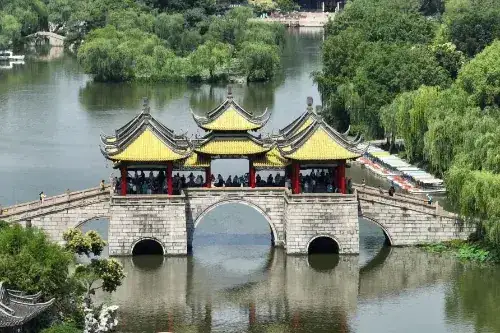
The city has 30 A-level attractions (2 at 5A, 7 at 4A). The three mountains -- Jinshan, Jiaoshan, Beigushan -- form a national 5A scenic area. Other highlights include Nanshan (Southern Mountain), Xijindu Ancient Street (1,000m of preserved history from Six Dynasties to Qing), and Chuishan with its "First Pagoda of the Yangtze." Jurong has Longchang Temple and Baohuashan National Forest Park; Maoshan combines scenic, Taoist, and revolutionary heritage.
Local Specialties
Special Cuisine
Zhenjiang's "Three Mountains" (Jinshan, Jiaoshan, Beigushan) are matched by its "Three Quirks": aromatic vinegar that never spoils, jellied meat (yaorou) served as a main dish rather than a side, and noodles cooked with a wooden pot cover floating in the broth -- a unique local technique.
Notable Figures
Notable historical figures from Zhenjiang include Emperor Liu Yu (founder of the Liu Song dynasty), the polymath scholar Shen Kuo (author of Dream Pool Essays), the calligrapher Mi Fu, and the bridge engineer Mao Yisheng.
Honorary Titles
Zhenjiang is recognized as a National Historical and Cultural City, a National Civilized City, and an Excellent Tourism City of China.
Travel information can change. Check current opening hours, reservations and entry requirements before you travel.
Traveller discussion
Start the conversation with a helpful tip or a question.